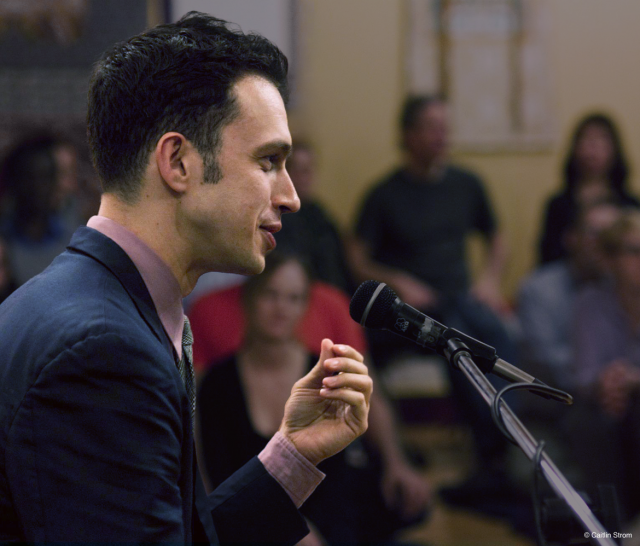
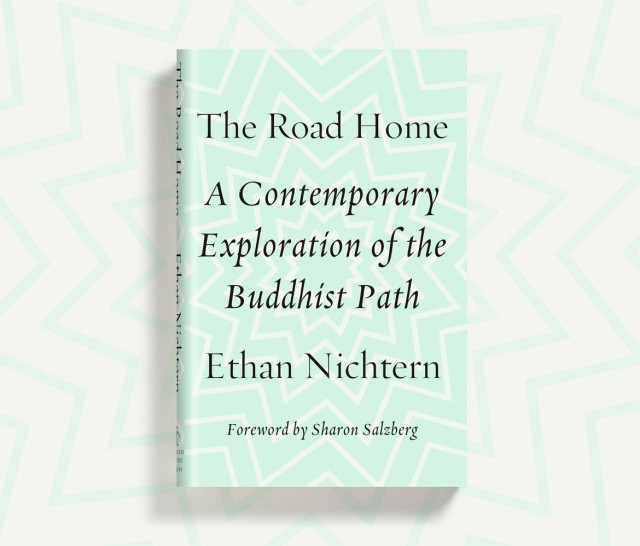
Shastri Ethan Nichtern will be celebrating the release of THE ROAD HOME with special events on April 21 & 28
ABC Carpet & Home, 888 Broadway at 19th St., 212-473-3000
Tuesday, April 21, $30 (includes copy of book), 7:00
Shambhala Meditation Center of New York, 118 West 22nd St., 212-675-6544
Tuesday, April 28, $5-$10 suggested donation, 7:00
www.ethannichtern.com
us.macmillan.com
I first met Ethan Nichtern about ten years ago, when my wife started studying at the Interdependence Project (IDP), a nonprofit organization dedicated to secular Buddhist meditation practice and community activism; its motto is “Change your mind to change the world.” Nichtern, a Brown grad and the son of Buddhist teacher and songwriter David Nichtern, was not at all what I expected; he was wise beyond his twentysomething years, a big sports and indie rock fan, a beer lover, and a pop-culture junkie with a playful sense of humor. The IDP has grown significantly since its humble beginnings in 2006, with a popular podcast, satellite meditation groups around the country, and such online and in-person classes as “Mindfulness-Based Stress Reduction,” “Tools for Living: Practical Buddhism for Work and Relationships,” and “Core Texts of Buddhism: Essential Writings from the Pali Canon to Today” (as well as a recently completed six-week course that Nichtern taught with my wife, a longtime student of his, a former IDP board member, and a recent graduate of the IDP Immersion Teacher Training program).
This week, Nichtern will publish his third book, The Road Home: A Contemporary Exploration of the Buddhist Path (North Point Press, April 21, $25), in which he takes readers on a journey into self-awareness and redefining the nature of home. “Where is your home? Is your address your home? Is your body your home? Do you feel at home in your own mind? Where, oh, where is home?” he asks in the introduction. “In many ways, these have been the central questions of my life. The quest to answer these questions — or at least to feel more capable of understanding them — is the primary reason I have chosen the path of Buddhism and the primary reason I practice and teach the path to others.”
In celebration of the release of the book, the follow-up to One City: A Declaration of Interdependence and Your Emoticons Won’t Save You, Nichtern will be at ABC Carpet & Home on April 21 and the Weekly Dharma Gathering at Shambhala on April 28; in addition, he will be leading the eight-week online series “The Road Home” on Thursday nights at 7:00 from April 23 to June 11, examining “The Path of Awakening in Four Stages.” While preparing for all of these events, Shastri Ethan Nichtern answered some questions about Buddhism, Radiohead, the Mets, and meditation.
twi-ny: The Road Home is your third book. What is the writing process like for you? Are you like the rest of us, panicking as deadlines loom, or are you able to incorporate your meditation practice to create a more calm environment?
Ethan Nichtern: I mean, meditation definitely helps, but it doesn’t cure any of the anxiety of having to complete a project. My writing process is fairly nonlinear. In a way, The Road Home is the first book I’ve written, because the ideas in the book cover the thirteen years that I have been teaching Buddhism in the contemporary world. It definitely feels like the most complete thing that I’ve written. Even though I’ve only really been putting it together the last few years. So I think mindfulness is about being in the process and letting the words and chapters emerge when they need to.
When a deadline looms it feels similar to having an object of mindfulness, a date by which you have to finish which helps to anchor you, just the same way the breath can anchor you in mindfulness meditation. However, if you expect your meditation practice to stop anxiety, you’ll probably be disappointed. Meditation is calming, yes, but primarily because it helps you deal with difficult emotions like anxiety, not stop them.
twi-ny: You’ve become a kind of Buddhist meditation rock star, and now you’ll be going out on the road, on a twenty-four-city tour in which people will be lining up to hear you talk, take pictures with you, and have you sign their books. Meanwhile, in the book itself, Sharon Salzberg writes in the foreword, “Ethan is the future of Buddhism.” How do you control your ego under such circumstances and high praise?
EN: Well, being well known for Buddhism is probably about the same level of popularity as being a roadie for a real rock star! Much of the time when I lead a retreat or workshop it’s just a small group of people who really want to come to terms with their own minds and also benefit others. So it’s very human and very humbling to share tools and discuss with people these very helpful humanistic processes that Buddhism offers. No glow sticks, no stage. It’s definitely true that when I give a talk more people come in then used to, and it’s amazing to think that I have something to offer them that is both very, very modern and very ancient, but the whole thing is so simple and down to earth that there’s really not a ton of room to let your “ego” run wild.
twi-ny: In the new book, you explore the nature of karma. What is the most misunderstood part of karma by the general population?
EN: I’m really happy that I went into karma in depth in The Road Home because it is so important and so misunderstood. I think the biggest misunderstanding, which has actually come up throughout history, but might be more pronounced by our consumer capitalist culture, is that karma is some kind of cosmic bank account. So the thinking is if I do something good, it’s like money goes into my hidden bank account in the cosmos, and then the universe owes me one. This leads to all sorts of weird and manipulative moral positions, and it leads us to resent the very real fact that most of the time we can’t get what we want. It’s a complicated conversation, but it’s much better to think of karma as the study of our habitual conditioning and acquired mental filters that cause us to perceive and react to our experience in certain ways. It’s not a commodity; it’s a study of habit.
twi-ny: In 2009, you led the IDP in a twenty-four-hour sit in the display windows of ABC Carpet, with you making it through the entire period. What was that experience like? I remember seeing you at one point on a break, looking kind of wobbly as you took in some fresh air.
EN: It was super tiring, because twenty-four hours was really a day and a half of waking time, which I didn’t think about beforehand, but it was amazing to be right there on Broadway with all the crowds passing by, being present with the city, and all the living people passing, especially the kids! It was so cool! The way I was sitting for most of the time was with my eyes open but slightly downward cast, which is often the way it is done in my tradition, the Shambhala tradition, but the window box I was sitting in was a little elevated from the street so I was at perfect eye level to make eye contact with children as they passed. It was a powerful experience for all the meditators involved. I hope we get to do it again soon.
twi-ny: You’ll be back at ABC Home for the April 21 launch of The Road Home. What can we expect from the gathering?
EN: A fun evening and a great conversation. I love how beautifully designed the hardcover version of the book turned out, and am very thankful to the folks at FSG for being so good at what they do. I’m sad the launch sold out so quickly, but I’ll be doing another event April 28 at the Shambhala Center. At ABC Carpet on April 21, which is a really cool spot, I will be joined by Sharon Salzberg, one of the best meditation teachers anywhere, who is a dear friend and mentor, and Dan Harris, the ABC news anchor who is an awesome guy and really down to earth, and has really stepped onto the path of Buddhist meditation wholeheartedly, and creates a great voice for skeptics about the whole practice. I’m looking forward to seeing everyone.
twi-ny: You love sprinkling your writing and talks with pop-culture references, from Radiohead to Star Wars. Are you looking forward to Star Wars: Episode VII?
EN: I am looking forward to the new Star Wars. I feel like J. J. Abrams is really good at sci-fi. He proved it with the new Star Trek movies, so I doubt there will be any Jar Jar Binks type of screenplay mistakes made. I do wish that the Jedi practices were more developed in their meditative and emotional dimensions. I love the early movies, but the spiritual dimension of them always strikes me as a little superficial, like a fortune-cookie version of Eastern thought, and I wish the Jedi practices were unveiled in a more contemplative way. But despite Star Wars feeling a bit superficial as a spiritual text, it’s always a ton of fun! So who really cares at the end of the day if it’s only quasiprofound?
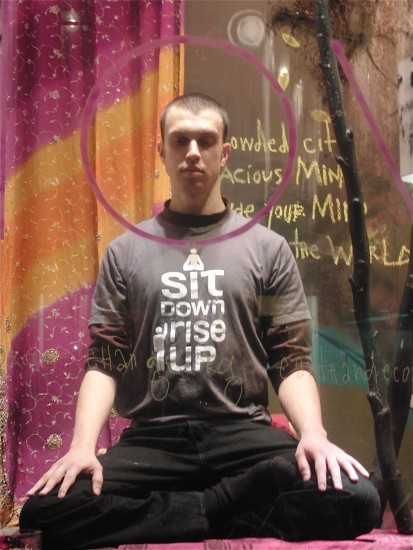
Ethan Nichtern leads a twenty-four-hour sit at ABC Carpet & Home in 2009 (photo by twi-ny/mdr)
twi-ny: What’s your favorite Radiohead album?
EN: It would be really hard to not call OK Computer the best Radiohead album, because it is now a classic of the 1990s, maybe the best complete album of the last twenty years. I like all of their albums, but I would say that my other favorite is Kid A. One of the chapter titles in The Road Home is “Where I End and You Begin,” which is so related to the Mahayana teachings, which is also one of my favorite songs from Hail to the Thief, which I think is an underrated album. I like them all.
twi-ny: If I’m not mistaken, you are, like me, a Mets fan. How can we use Buddhist meditation to help us through such annual disappointment come September?
EN: I mean, if we even make it to September before disappointment sets in, it means they are having a relatively good season. 🙂 It’s amazing how quickly we can identify personally with sports, but then when the season ends we have to let it go either way. And it’s that process of intense identification and hopefulness mixed with the annual need to just let go that I think makes being a sports fan in general a really good practice, especially when your team is perennially mediocre. Identify, hope, then let go! Then do it again next year. It’s beautiful.
twi-ny: Both you and my wife have tried to get me to meditate, but I’ve failed miserably. On a very general level, what is the most important first step for someone like me, who could probably benefit greatly from a more relaxed approach to life?
EN: I just think you have to keep it simple and short, like five minutes to start of just settling in with the breath. Everyone seems to be supportive of meditation now, but most people think it’s too hard for them to do personally. They usually have crazy expectations from a more idealistic spiritual standpoint about what is supposed to happen for them, like no more thoughts! And then they just confront their normal busy neurotic mind. So I would just let go of any expectations. You aren’t going to stop thinking! Classes on a regular basis can provide support and accountability, and you also realize that everyone is struggling in their own version the same way that you are, and I think the group environment can help overcome strange ideas about practice, of which there are so many. If I were you, I would just do it a little bit and not worry about how your thoughts feel while you aren’t doing it but instead focus on how you feel throughout the day after doing it for five minutes in the morning.
 (T)error is a great name for a horror movie, but even though it turns out that Lyric R. Cabral and David Felix Sutcliffe’s debut is not part of that genre, there still is plenty scary about it. Winner of the U.S. Documentary Special Jury Award for Break Out First Feature at Sundance, (T)error is a surprising look inside one aspect of the FBI’s counterterrorism program. Shortly after Saeed “Shariff” Torres, a friend and neighbor of filmmaker and photojournalist Cabral’s, suddenly disappeared, he contacted her, eventually letting her inside his secret career as a longtime FBI informant. A Muslim and former Black Panther revolutionary, the sixty-three-year-old school kitchen employee and father of a young son goes on camera as he takes on what he claims will be his final assignment, cozying up to a Pittsburgh man named Khalifa Ali Al-Akili, previously known as James Marvin Thomas Jr., who the FBI thinks might be involved in terrorist plots. It’s not exactly the most thrilling game of cat and mouse; Cabral and codirector Sutcliffe (Adama) follow Shariff as he goes about a lot of mundane business, arguing over how much money the FBI gave him, text-messaging back and forth with agents and his prey, examining Facebook pages, and Skyping with his son, whose face is blurred for protection. And Sharrif is not quite the kind of well-trained operative you read about in books or see in action-packed movies, making one wonder just what the FBI is thinking — and how it’s spending our money — especially after a major twist occurs about halfway through the film, turning everything around and inside out, providing a new vantage point that makes the whole sting operation even more bizarre and surreal. But it’s all too real, and rather frightening in its own very strange way. (T)error is screening April 21, 23, and 24 at the Tribeca Film Festival, with the filmmakers participating in Q&As after all three shows.
 “There’s not many people like her. She’s unique,” photographer David Bailey says about his former boss, Diana Vreeland, in the DVD extras of the wonderful documentary Diana Vreeland: The Eye Has to Travel. “You could easily put her in a list of people like Cocteau and, in a funny sort of way, Proust. She was very Proustian in a way. She loved the detail of things, the memory of things,” he adds. The 2011 film, directed and produced by Lisa Immordino Vreeland, who is married to Diana Vreeland’s grandson Alexander, and codirected and edited by Bent-Jorgen Perlmutt (Havana Motor Club) and Frédéric Tcheng (