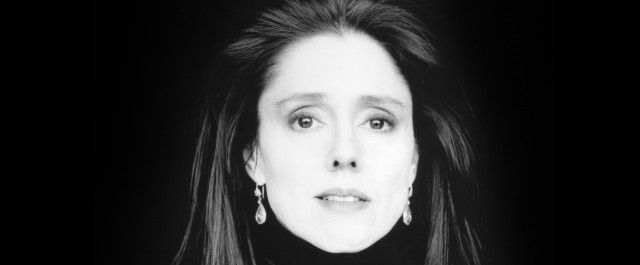
Julie Taymor will talk masks at the Rubin with Morgan Stebbins on July 9 (photo by Brigitte Lacombe, 2010)
TALK WITH JUNGIAN ANALYST MORGAN STEBBINS
Rubin Museum of Art
150 West 17th St. at Seventh Ave.
Thursday, July 9, $30, 7:00
212-620-5000
www.rmanyc.org
The Rubin Museum exhibition “Becoming Another: The Power of Masks” is a splendid collection of religious, cultural, and theatrical faces that people throughout the centuries have worn, from Japan, India, Bhutan, Alaska, British Columbia, Russia, Nepal, and other locales. Not part of the collection are the classic Greek comedy and tragedy masks, so essential to Western drama, depicting Thalia and Melpomene, but on July 9, they will all come together for “Julie Taymor: Removing the Mask,” when award-winning theater veteran Julie Taymor sits down with Jungian Analyst and archetypal symbols specialist Morgan Stebbins for an illustrated talk. Taymor has directed many a Shakespeare adaptation for stage and screen in addition to The Lion King on Broadway and the films Frida and Across the Universe; the New York-based Stebbins has previously been at the Rubin for talks with Meredith Monk and Billy Corgan. Also in conjunction with the exhibition, the Rubin’s Cabaret Cinema series “Movie Masks” will screen such films as The Princess Bride, Phantom of the Paradise, The Face of Another, and Witness for the Prosecution on Friday nights, with an all-day art workshop and tour on July 11.
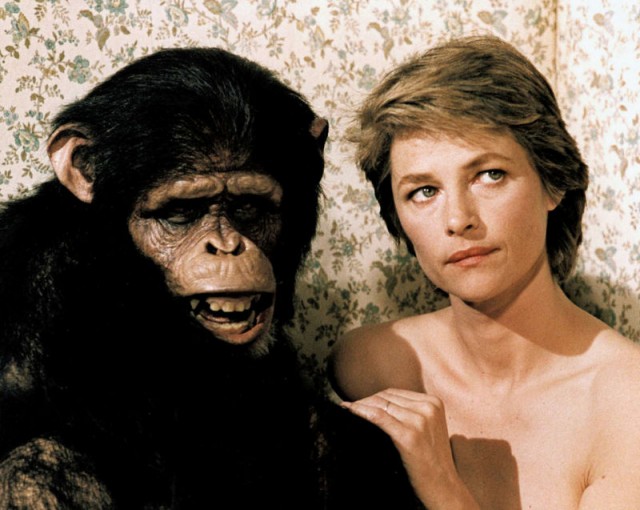
 It’s rather hard to tell how much Japanese auteur Nagisa Ôshima is monkeying around with his very strange 1986 movie, Max, Mon Amour, a love story between an intelligent, beautiful woman and a chimpanzee. The director of such powerful films as Cruel Story of Youth; Merry Christmas, Mr. Lawrence; Taboo; and In the Realm of the Senses seems to have lost his own senses with this surprisingly straightforward, tame tale of bestiality, a collaboration with master cinematographer Raoul Coutard, who shot seminal works by Truffaut and Godard; screenwriter Jean-Claude Carrière, who has written or cowritten nearly ninety films by such directors as Pierre Étaix (who plays the detective in Max), Luis Buñuel, Volker Schlöndorff, Philippe Garrel, and Miloš Forman; and special effects and makeup artist extraordinaire Rick Baker, the mastermind behind the 1976 King Kong, the Michael Jackson video Thriller, Ratboy, Hellboy, and An American Werewolf in London, among many others. Evoking Bedtime for Bonzo and Ed more than Planet of the Apes and Gorillas in the Mist, Max, Mon Amour is about a well-to-do English family living in Paris whose lives undergo a rather radical change when husband Peter Jones (Anthony Higgins) catches his elegant wife, Margaret (Charlotte Rampling), in bed with a chimp. Margaret insists that she and the chimp, Max, are madly in love and somehow convinces Peter to let her bring the sensitive yet dangerous beast home, which confuses their son, Nelson (Christopher Hovik), and causes their maid, Maria (Victoria Abril), to break out in ugly rashes. Peter, a diplomat, works for the queen of England, so as he prepares for a royal visit to Paris, he also has to deal with this new addition to his ever-more-dysfunctional family.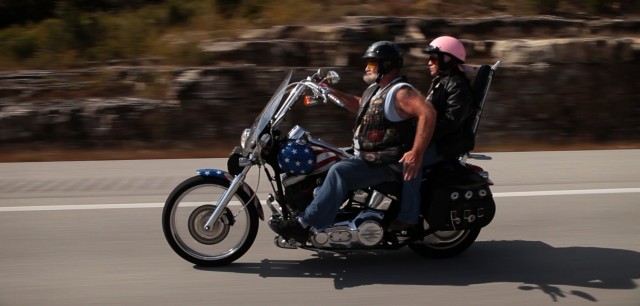
 Shortly after meeting Ron “Stray Dog” Hall at the Biker Church in Branson, Missouri, writer-director Debra Granik (Down to the Bone) cast the Vietnam vet as Thump Milton in her second feature, the Oscar-nominated Winter’s Bone. Upon learning more about him, she soon decided that he would be a great subject for a documentary, so she took to the road, following him across the country in the engaging and revealing Stray Dog. Nearly always dressed in black, including his treasured leather jacket covered in medals and patches — when he puts it in a suitcase for a trip, it’s a ritual like he’s folding the American flag — Hall is a wonderfully grizzled old man with a fluffy white beard. At home, he is learning Spanish online so he can communicate better with his new wife, Alicia, a Mexican immigrant, and her two sons (who still live across the border). He visits with his teenage granddaughter, who is making some questionable decisions about her future. In Missouri, he owns and operates the At Ease RV Park, where he gives breaks to fellow vets who can’t always afford to pay the rent. And when he goes on the road, participating in the Run for the Wall, joining up with thousands of other bikers heading for the annual service at the Vietnam Veterans Memorial in Washington, DC, he stops along the way at other ceremonies honoring soldiers who have gone missing, are POWs, or were killed in action in Vietnam, Iraq, Afghanistan, and other wars.

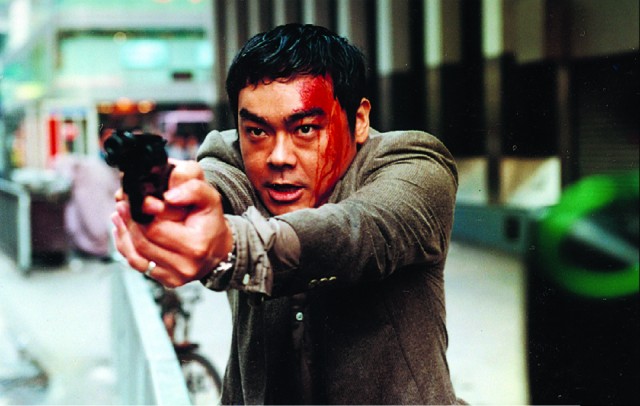
 The fourteenth annual New York Asian Film Festival is saluting legendary Hong Kong director Ringo Lam, presenting him with the Lifetime Achievement Award. Lam, who turns sixty this year, will be at Lincoln Center for screenings of two of his works, City on Fire on June 27 and Full Alert on June 28. In the latter, Lam’s follow-up to his disappointing Hollywood debut, the Jean-Claude Van Damme vehicle Maximum Risk, Lau Ching-wan stars as Officer Pao, a member of Hong Kong’s Special Crime Bureau who becomes involved in a case that turns deeply personal. After arresting explosives expert Mak Kwan (Francis Ng) for the brutal murder of an architect, Pao is determined to find the rest of Mak’s Taiwanese crew, which is led by mainland boss Jie (Jack Gao), and prevent the robbery of a mysterious vault. Pao and his team track Mak’s girlfriend, Chung Lai Hung (Amanda Lee), who knows more than she’s letting on, while Pao and Mak become immersed in a tense, psychological game of cat and mouse, exploring what it feels like to kill someone. There are numerous incredulous plot twists and a rather lame car chase, but the guerrilla filmmaking style of Lam and cinematographer Ardy Lam, ranging through the streets of a Hong Kong about to be handed over from the British to the Chinese, is supremely effective, as are the lead performances by Lau and Ng, evoking the relationships portrayed earlier by Robert De Niro and Al Pacino in Michael Mann’s Heat and later by Andy Lau and Tony Leung in Andrew Lau and Alan Mak’s Infernal Affairs. The use of mobile phones and surveillance technology feels much older than 1997, displaying how far we have come so fast. Lam saves the heavy violence for the spectacular finale, letting the emotions build before exploding. Nominated for five Hong Kong Film Awards, including Best Film, Best Director, and Best Actor (Lau), Full Alert is screening at the Walter Reade Theater on June 28 at 2:00, with Lam on hand to introduce it. The New York Asian Film Festival continues at Lincoln Center through July 6 with more than three dozen new and old films from China, Korea, Japan, the Philippines, Cambodia, and other Southeast Asian countries, including Sabu’s Chasuke’s Journey, Kinji Fukasuku’s Battles without Honor and Humanity, Im Sang-soo’s The President’s Last Bang, Wang Xiaoshuai’s Red Amnesia, Im Kwon-taek’s Revivre, and Sion Sono’s Tokyo Tribe.