Masashi (Takuto Sueoka) and cuddly cute Kurage-bo have to save their strange Japanese town in Takashi Murakami’s JELLYFISH EYES
JELLYFISH EYES (Takashi Murakami, 2015)
IFC Center
323 Sixth Ave. at West Third St.
Opens Wednesday, July 15
212-924-7771
www.jellyfisheyesthemovie.com
www.ifccenter.com
 Japanese artist and brand name Takashi Murakami — his 2008 exhibition at the Brooklyn Museum was unironically titled “© Murakami” — brings his unique take on his country’s culture and history to the big screen in his feature debut, Jellyfish Eyes. In his catalog essay “Flat Boy vs. Skinny: Takashi Murakami and the Battle for ‘Japan,’” Dick Hebdige wrote, “Combining shock and awe in equal measure with a destruction/solicitation strategy aimed at winning over jaded hearts and minds, Superflat functions like the ancient Trojan horse to penetrate the art and fashion world’s defenses and to neutralize whatever vestiges remain in the age of the corporate-sponsored art opening of the hermeneutics of suspicion.” That shock and awe is at the center of Murakami’s film, a battle for Japan as seen through the eyes of children, the only ones left with any semblance of humanity in a post-Hiroshima, post-Fukushima world. Sixth grader Masashi Kusakabe (Takuto Sueoka) has just moved to a strange suburban town with his recently widowed mother, Yasuko (Shizuko Amamiya). Masashi instantly makes a new friend, Kurage-bo, a ridiculously adorable jellyfish-like flying creature who goes with him everywhere. Once at school, Masashi discovers that all of the kids have a F.R.I.E.N.D. (the acronym comes from “life-Form, Resonance, Inner Energy, Negative emotion, Disaster prevention”), a kind of avatar/yōkai reminiscent of the daemons in Philip Pullman’s His Dark Materials trilogy. Some of the boys engage their cute or scary buddies in fights akin to bullying, controlling them with electronic devices that evoke the global obsession with smartphones and video games. Masashi makes a real friend in Saki Amamiya (Himeka Asami), a fellow student who abhors fighting and protects herself with her hairy oversize companion, Luxor. As the adults get caught up in strict rules, religious cults, and an unhealthy obsession with safety, a quartet of kids known as the Black Cloaked Four — Blue Dragon (Masataka Kubota), White Tiger (Shota Sometani), Black Tortoise (Hidemasa Shiozawa), and Vermilion Bird (Ami Ikenaga) — is working with Masashi’s uncle, Naoto (Takumi Saito), to capture enough negative energy to destroy and rebuild Japan. Oh, did we mention that this is a kids movie?
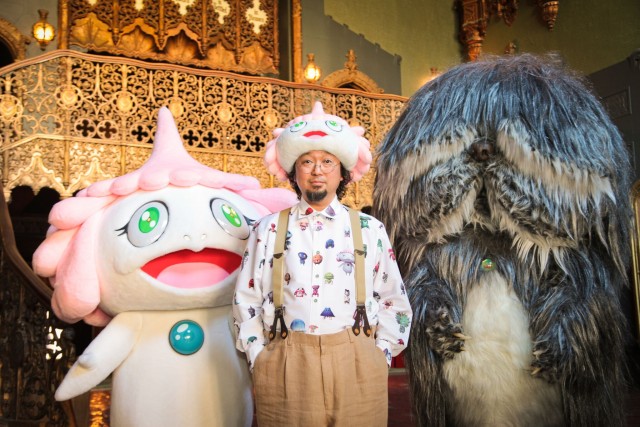
JELLYFISH EYES director Takashi Murakami playfully poses with some F.R.I.E.N.D.s (photo by Chika Okazumi)
It comes as no surprise that Jellyfish Eyes is a bright, colorful film set in a magical otaku/kawaii-crazed society (designed by art director Nori Fukuda), like Murakami’s paintings and sculptures come to life, with dazzling hues jumping off the screen; only the symbol of the Black Cloaked Four, the yin and yang sign, is in cold black-and-white. The F.R.I.E.N.D.s, from Masashi’s Kurage-bo and Saki’s Luxor to Tatsuya’s evil Yupi and Juran’s violent Shimon, as well as Koh’s Ko2, a large-scale, round-eyed anime girl, are tailor made for merchandising, and they are indeed available for purchase. Murakami has always had a dark side, perhaps never so clear as in his most recent exhibition, “In the Land of the Dead, Stepping on the Tail of a Rainbow,” a reaction to the devastation of the 2011 earthquake and tsunami, and it’s at the center of Jellyfish Eyes, the first of a proposed trilogy. But it’s also part of the problem, creating a murkiness and confusion in a narrative that doesn’t always make sense. The soundtrack, by KZ (livetune) and Yoshihiro Ike, is treacly sweet to a fault, and Murakami overdoes the CGI fight scenes. He’s also not shy about declaring this a message picture; “In the wake of 3/11, the damage sustained by Japan runs deep. We must all do our best to emerge from that shadow,” he has stated in reference to the film, as well as “In a sense, one of the few places in which the darkness still lurks in our time is inside mobile phones. Their screens are pitch black.” Murakami and screenwriter Jun Tsugita liberally borrow from such familiar tales as Godzilla, Where the Wild Things Are, Pokémon, and E.T. the Extra-Terrestrial, and the overload of cultural references threaten to pull Jellyfish Eyes down. But Sueoka’s charming innocence and Kurage-bo’s angelic delightfulness eventually triumph over the film’s various shortcomings. Jellfyish Eyes opens July 15 at the IFC Center, with Murakami on hand for a Q&A at the 7:00 show on Wednesday night.

 Shingo Wakagi’s Asleep is a quiet gem of a film, a poignant drama about three women’s relationship with beds and sleep. Sakura Ando stars as Terako, a young woman who is sleeping most of her life away. The only time she wakes up and gets out of bed is when her married lover, the somewhat older Mr. Iwanaga (Arata Iura), calls her to make a date. Terako’s best friend and former roommate, Shiori (Mitsuki Tanimura), recently committed suicide shortly after complaining about the difficulties of her job as a soineya, providing companionship — but not sex — by lying in bed with strangers who do not want to sleep alone. And Terako soon discovers that Iwanaga’s wife is languishing in a hospital bed in a deep coma. As Terako cares more and more for Iwanaga, she finds it harder and harder to get out from under the covers, trying to hide from a life surrounded by loneliness and death.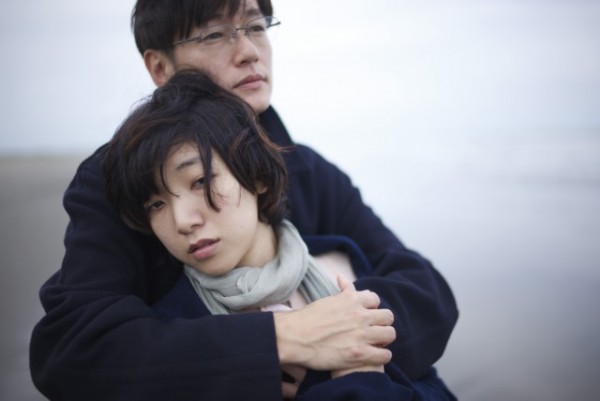
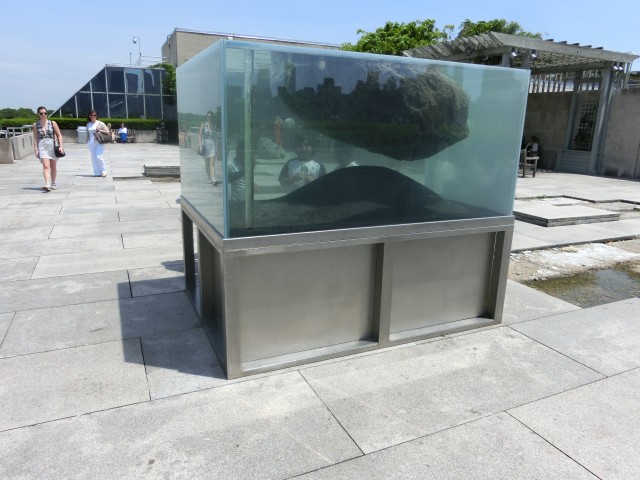
![Pierre Huyghe. Untilled (Liegender Frauenakt) [Reclining female nude]. 2012. Concrete with beehive structure, wax, and live bee colony; figure: 29 1/2 x 57 1/16 x 17 11/16" (75 x 145 x 45 cm), base: 11 13/16 x 57 1/16 x 21 5/8" (30 x 145 x 55 cm), beehive dimensions variable. The Museum of Modern Art, New York. Purchase. © 2015 Pierre Huyghe](https://twi-ny.com/wp-content/uploads/2015/07/pierre-huyghe-untilled-e1436760945406.jpg)

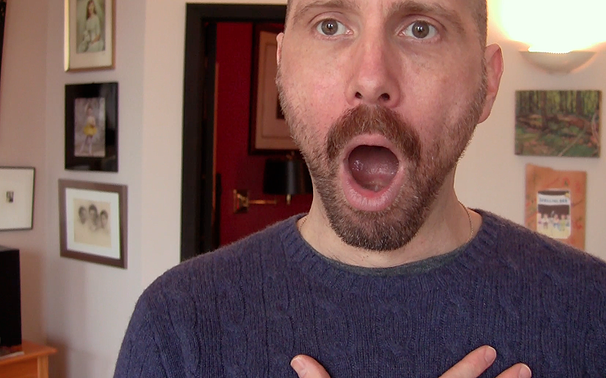
 About ten minutes into journalist David Thorpe’s absolutely charming yet emotionally bittersweet Do I Sound Gay?, he is at dinner with his best friends, Alberto and Sam, and the three are discussing the title question. It’s a fascinating conversation that is worth detailing extensively here. “I have the impression that you think it sounds bad,” Alberto says about David’s voice. “I interpret David’s feelings about this, and the feelings around this whole project, as bad. He has negative feelings about his voice, about the perception that it creates.” “And you don’t feel that at all yourself?” Sam asks. Alberto responds, “I have sort of a generic self-loathing that is created around my gayness. . . . . But I don’t think I can say it’s the only thing, or the main thing.” Finally, David chimes in, explaining, “I think I feel out of sync with my voice, and, at least it seems to me, that it’s anxiety about sounding too gay, so, okay, let’s see what it’s like to not sound gay, and maybe I’ll feel more in sync and maybe I’ll have some idea what my voice should sound like.” Alberto then gets to the heart of the matter, inquiring, “But you could also argue, why don’t you just accept how you sound?” And Alberto sums it all up: “We have never talked about this idea until you brought it up. I don’t know anybody else that I’ve talked to about it either. So I think there is this thing, obviously, that we all are aware of that hasn’t been spoken of. Maybe this is the elephant in the room.” David spends the rest of the film exploring the elephant in the room, meeting with speech therapists who examine his voice and teach him how to change it; talking to such out-of-the-closet gay icons as Dan Savage, Tim Gunn, Margaret Cho, David Sedaris, Don Lemon, and George Takei, who delve into their own gayness and how their voice is part of that; introducing us to a boy who was beaten up at school at a very young age because of his voice; and interviewing gay people on the street, who share their thoughts on whether they, or he, do or don’t sound gay, and whether that matters. Sedaris, whose short story “Go Carolina” served as inspiration for Thorpe, tells him, “I’m embarrassed to say this, but sometimes somebody will say, ‘I didn’t know you were gay.’ It’s like, Why does that make me feel good. I hate myself for thinking that. It’s very disturbing. I thought I was beyond that. What’s the problem if somebody assumes that I’m gay when I open my mouth? Why do I have a problem with that?”