AMC Empire 25
234 West 42nd St. between Seventh & Eighth Aves.
October 22-25, $49-$125
thefoodfilmfestival.com
Food and film go together like, well, dinner and a movie. The annual Food Film Fest takes it to the next level, showing films about food, accompanied by special talks and tastings. The 2015 event features more than two dozen short works, including several New York City, U.S., and world premieres. Among the tasty morsels are Nina Ha’s rap music parody Baby Got Kale, Barbara Zonzin’s Choco Thriller, Barbara Tranter’s Happy Goats Happy Cheese, Derek Klingenberg’s Serenading the Cattle with My Trombone, and Natasha Subramaniam and Alisa Lapidus’s animated fridge fight, Zergut. The festival takes place at the AMC Empire in Times Square, beginning October 22 ($89 / VIP $114) with “Tender: Stories of Love and Meat, which pairs four films with Texas BBQ from Kreuz Market, Kent Black of Black’s Barbecue, and Scott Morales of Taylor Café, pork tacos by Tortilleria Nixtamal, sliders from Schnipper’s, and potent potables from Iron Station, Black Rooster, and NY Distilling Co. October 23 ($99 / VIP $124) is the ever-popular “Food Porn Party,” with nine films, an appearance by Larry Caldwell, a VIP party by Public, ramen by Yosuke Sumida with Keizo Shimamoto, a vegetarian treat from Dirt Candy’s Amanda Cohen, and sweets from Archichef and Top Pot Donuts. On October 24 at noon (kids $23, adults $32, family packages $100-$125), “Eat Your Movies!” is a family event with six children’s films, food by Night Kitchen inspired by the films, treats from Fishing Creak Creamery and Robicelli’s, and kid-friendly food activities. On Saturday night ($99 / VIP $129), “Edible Adventure #13: Hungry for Love” consists of five films, a VIP party by David Burke Kitchen, food from Uncle Boons, Manna’s, chef Karl Palma, and Liddabit Sweets, and a matcha tea tasting. The culinary festivities conclude on October 25 at noon ($49) with “Restaurant Revival: Jodie’s Diner (1985-2014),” a screening of James Boo’s Nothing with Something: The Death of a Diner, with brunch prepared by Jodie Royston of Jodie’s Restaurant, the Albany, California, favorite that closed last year but is looking for a new home. Part of the proceeds from the festival benefit the Billion Oyster Project.


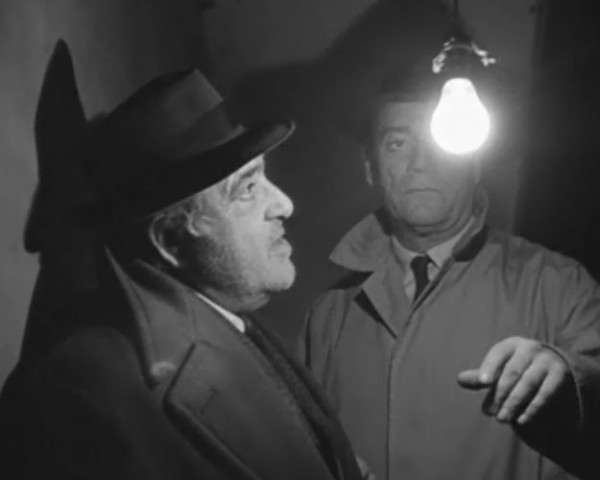
 “Sometimes, reality is too complex for oral communication. But legend embodies it in a form which enables it to spread all over the world,” a growly, disembodied, mechanical-like voice says at the beginning of Jean-Luc Godard’s futuristic sci-fi noir thriller, Alphaville: Une étrange aventure de Lemmy Caution. Godard’s 1965 black-and-white masterpiece takes place in an unidentified time period in a dark, unadorned, special-effects-free Paris. A tough-as-nails man in hat and trench coat named Lemmy Caution (Eddie Constantine) has arrived in Alphaville from the Outlands, claiming to be journalist Ivan Johnson, on assignment from the Figaro-Pravda newspaper. But his real mission is to first find fellow agent Henry Dickson (Akim Tamiroff), then capture or kill Alphaville leader and death-ray inventor Professor Vonbraun (Howard Vernon), the former Leonard Nosferatu. A Guadalcanal veteran who drives a Ford Galaxie, Caution — a character Constantine played in a series of films based on the novels of Peter Cheyney, including This Man Is Dangerous, Dames Get Along, and Your Turn, Darling — is a no-nonsense guy who takes nothing for granted. “All things weird are normal in this whore of cities,” he tells a blond seductress third class, who apparently comes with his hotel room. Documenting everything he sees with an Instamatic flash camera, Caution (perhaps a stand-in for Godard himself?) is soon visited by Natasha Vonbraun (Anna Karina), the professor’s daughter, setting off on an Orwellian journey through a grim city where poetry and emotion, and such words as “love,” “why,” and “conscience,” are banned in favor of “because” and “Silence. Logic. Security. Prudence,” where the hotel Bible is actually an ever-changing dictionary and enemies of the state are killed in swimming pools and pulled out by clones of Esther Williams, all overseen by a computer known as Alpha 60 (whose text, based on writings by Jorge Luis Borges, is eerily spoken by a man without a larynx, using a mechanized voice box).