this week in lectures, signings, panel discussions, workshops, and Q&As

PUBLIC ART FUND TALKS AT THE NEW SCHOOL: JEPPE HEIN

Jeppe Hein will be at the New School on September 29 to discuss his interactive Brooklyn Bridge Park installation (photo by twi-ny/mdr)

Jeppe Hein will be at the New School on September 29 to discuss his three-part interactive Brooklyn Bridge Park installation (photo by twi-ny/mdr)

PUBLIC CONTEXT, PRIVATE MEANING
The New School, Tishman Auditorium
63 Fifth Ave. between 13th & 14th Sts.
Tuesday, September 29, $10, 6:30
www.publicartfund.org

Jeppe Hein invites people to experience his work in tactile ways in “Please Touch the Art,” a three-part installation spread across Brooklyn Bridge Park. For the Public Art Fund project, the Danish artist, who lives and works in Berlin and Copenhagen, has created “Appearing Rooms,” a dancing water sculpture that visitors are encouraged to walk through and play in; “Modified Social Benches,” sixteen brightly colored red and orange uniquely shaped benches that people can sit on and climb; and “Mirror Labyrinth NY,” a circular maze of mirror-polished stainless-steel vertical planks that offers fun and fascinating reflections as you make your way in and around it, including mimicking the downtown Manhattan skyline across the river. (“Appearing Rooms” is on view until October 4, while the other two will remain in the park through April 17 of next year.) “People can use it; they don’t need to know it’s art or not,” Hein explains in a promotional video. “It’s just something twisting everyday life.” On September 29, Hein will give a participatory talk at the New School as part of the Public Art Fund series “Public Context, Private Meaning,” combining performance, audience interactivity, and interview. The Fall 2015 Public Art Fund Talks at the New School continue October 21 with Hank Willis Thomas and November 18 with Fiona Banner.

DORIS SALCEDO SYMPOSIUM AND EXHIBITION

(photo by David Heald/Solomon R Guggenheim Foundation)

“Plegaria Muda” evokes mass graves in Doris Salcedo exhibition at the Guggenheim (photo by David Heald/Solomon R. Guggenheim Foundation)

Solomon R. Guggenheim Museum
1071 Fifth Ave. at 89th St.
Exhibition: Friday – Wednesday through October 12, $25
Symposium: Friday, October 2, $15, 11:00 am – 6:30 pm
212-423-3587
www.guggenheim.org

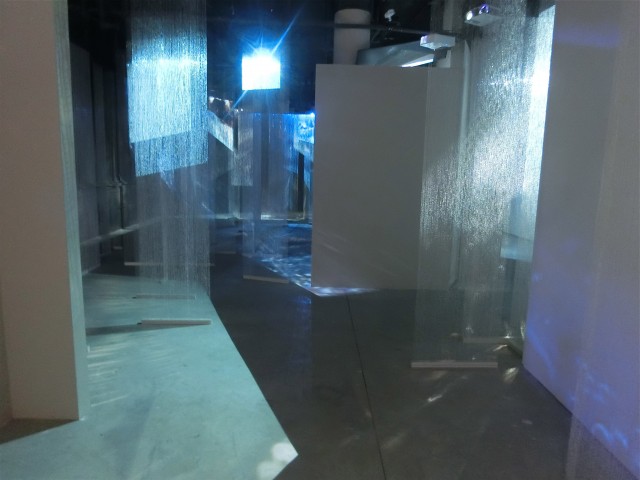
Colombian artist Doris Salcedo encapsulated her powerful, emotional oeuvre beautifully and succinctly in a recent interview with Marguerite Feitlowitz: “My work is based on the testimonies of victims of violence, on experiences that are alien to me,” she explained. “I am not a direct witness; I am witness to the witness, a secondary witness. I search for an intimate proximity with the victims of violence that will permit me to stand in for them as I actually make the work, but in such a way that their experience takes precedence over my own.” For three decades, the Bogotá native has been creating installations that examine the social injustice and violence experienced in Colombia and other parts of the world. She uses common domestic objects that each visitor can relate to, building on their evocation of memory and loss. Her current retrospective at the Guggenheim is installed on all four tower levels, allowing museumgoers plenty of time as they go from one section to another to process what they have just seen in one gallery before entering the next. “Plegaria Muda,” roughly translated as “silent prayer,” memorializes both mass gang killings in South Central Los Angeles and murders committed by the Colombian army between 2003 and 2009. The piece is a maze made of pairs of handcrafted tables inverted upon each other, with earth sandwiched between them. Blades of grass rise through the earth, life emerging from dozens of anonymous graves.

“La Casa Viuda”  is part of haunting retrospective at the Guggenheim (photo by David Heald/Solomon R Guggenheim Foundation)

“La Casa Viuda” is part of haunting retrospective at the Guggenheim (photo by David Heald/Solomon R. Guggenheim Foundation)

For “Atrabilarios,” Salcedo takes shoes left behind by los desaparecidos (individuals “disappeared” by security forces) and places them in wall niches, covering them with rectangles of semitranslucent animal fiber that is hand-stitched into the wall with medical sutures, the shoes fading away like slowly forgotten memories or barely healed scars. “A Flor de Piel” is a large floor piece composed of stitched-together, chemically treated rose petals, forming a kind of burial shroud for a Colombian nurse who was kidnapped, tortured, and killed. Salcedo uses silk thread and nearly twelve thousand burned needles to make “Disremembered,” a collection of barely there tuniclike hair shirts that combine beauty and pain. “Untitled” brings together hospital cots wrapped in animal fiber with stacks of crisply folded white shirts impaled by steel rebar, associating loss and violence with a place meant for healing. And “La Casa Viuda” is a room containing doors, dressers, tables, chairs, and other furniture connected, filled in, or closed off with concrete, a house devoid of people, no longer fit for human occupancy. Individually, the pieces demand silent contemplation and introspection, but as a whole, the exhibition will also make you angry about what is still happening all over the globe, brutal murders and disappearances that seemingly cannot be stopped. The moving exhibition, which also includes a video screening of Salcedo’s public projects, continues at the Guggenheim through October 12; on October 2, the artist will participate in an all-day symposium along with Elizabeth Adan, Carlos Basualdo, Katherine Brinson, Leslie Jamison, Roderick Mengham, Jean-Luc Nancy, and Alexander Nemerov.

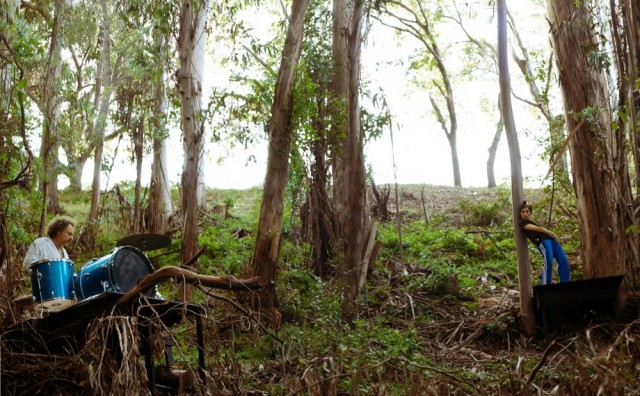
NYFF53 MAIN SLATE: THE FORBIDDEN ROOM

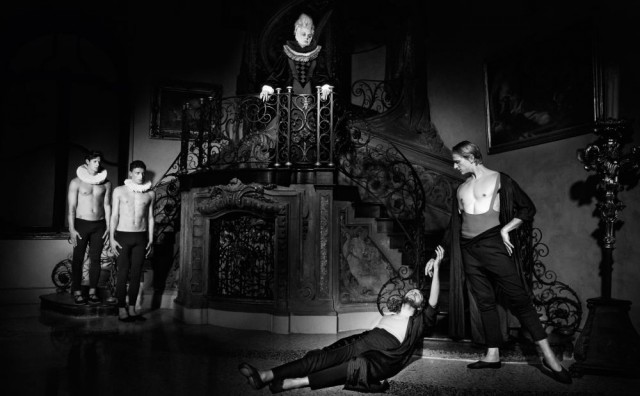
Roy Dupuis plays a heroic woodsman in Guy Maddin and Evan Johnsons unpredictably strange and wonderful homage to early cinema, THE FORBIDDEN ROOM

Roy Dupuis plays a heroic woodsman in Guy Maddin and Evan Johnson’s unpredictably strange and wonderful homage to lost early cinema, THE FORBIDDEN ROOM

THE FORBIDDEN ROOM (Guy Maddin & Evan Johnson, 2015)
Film Society of Lincoln Center, Walter Reade Theater
165 West 65th St. between Eighth Ave. & Broadway
Monday, September 28, 9:00, and Tuesday, September 29, 8:30
Festival runs through October 11
212-875-5050
www.filmlinc.org
theforbiddenroom-film.com

Guy Maddin and Evan Johnson’s The Forbidden Room is a deliriously mesmerizing epic tone poem, a crafty, complex avant-garde ode to cinema as memory, and memory as cinema. An homage to the lost films of the silent era, it is the illegitimate child of Bill Morrison and David Lynch, of Jack Smith and Kenneth Anger, of D. W. Griffith and Josef von Sternberg. The impossible-to-describe narrative jumps from genre to genre, from submarine thriller to Western adventure to murder yarn, from romantic melodrama and crime story to war movie and horror tale, complete with cannibals, vampires, poisoned leotards, “valcano” eruptions, caged lunatics, butt obsession, squid theft, explosive jelly, a fantastical mustache, and skeletal insurance defrauders. Intertitles that often fade away too soon to decipher help propel the plot, contain lines from John Ashbery and the Bible, and blast out such words as “Deliverer of Doom,” “Diablesa!” and “Trapped!” Text in intricate fonts announces each new character and actor, including Maddin regular Louis Negin as the Sacrifice Organizer, Slimane Dazi as shed-sleeper and pillow-hugger Baron Pappenheim, Lewis Furey as the Skull-Faced Man, and Roy Dupuis as a “mysterious woodsman” determined to rescue captured amnesiac Margot (Clara Furey) from the evil clutches of the Red Wolves. Also involved in the bizarre festivities are Udo Kier, Geraldine Chaplin, Mathieu Amalric, Charlotte Rampling, and Maria de Medeiros.

Although shot digitally, the film explores photographic emulsion and time-ravaged nitrate while treating celluloid as an art object unto itself, looking like Maddin (Tales from the Gimli Hospital, My Winnipeg) and Johnson stomped on, burned, tore up, and put back together the nonexistent physical filmstrip. Thus, major kudos are also due Maddin’s longtime editor, John Gurdebeke, and music composers Galen Johnson, Jason Staczek, and Maddin himself for keeping it all moving forward so beautifully. The film was photographed by Benjamin Kasulke and Stéphanie Anne Weber Biron in alternating scenes of black-and-white, lurid, muted color, and sepia tones that offer constant surprises. The Forbidden Room might be about the magic of the movies, but it is also about myth and ritual, dreams and fantasy as it explores storytelling as psychodrama. Oh, and it’s also about taking baths, as Marv (Negin) so eagerly explains throughout the film. But most of all, The Forbidden Room is great fun, a truly unpredictable and original work of art that is a treat for cinephiles and moviegoers everywhere. The Forbidden Room is screening at the New York Film Festival on September 28 at 9:00 and September 29 at 8:30, with Maddin and Johnson in person at the Walter Reade Theater. In addition, their thirty-one-minute documentary short, Bring Me the Head of Tim Horton, a behind-the-scenes account of the making of Paul Gross’s Afghanistan war movie, Hyena Road, is being shown both days (12 noon – 6:00; 8:30 – 11:00) for free at the Elinor Bunin Munroe Amphitheater across the street.

THEATER & CINEMA: VA SAVOIR

Jeanne Balibar is extraordinary in Jacques Rivette masterpiece

Jeanne Balibar is extraordinary in Jacques Rivette masterpiece

CINÉSALON: VA SAVOIR (WHO KNOWS?) (Jacques Rivette, 2001)
French Institute Alliance Française, Florence Gould Hall
55 East 59th St. between Madison & Park Aves.
Tuesday, September 29, $14, 4:00 & 7:30 (later screening introduced by Mathieu Bauer)
Series continues through October 27
212-355-6100
www.fiaf.org

Jacques Rivette’s Va Savoir is a long, talky French movie about very beautiful, very complicated, sex-crazed men and women — and it just might be the master filmmaker’s crowning glory, a magnificent masterpiece that deserved its slot as the New York Film Festival’s opening night selection back in 2001. This erotically charged, very funny drama is set around a traveling theater company’s return to Paris to put on Pirandello’s As You Desire Me in the original Italian. Ugo (Sergio Castellitto), the director and costar of the play, is romantically involved with Camille (Jeanne Balibar), the lead actress, who visits her former lover Pierre (Jacques Bonnaffé), a philosopher with a thing for Heidegger, who is now living with Sonia (Marianne Basler), a dance instructor who is being chased by Arthur (Bruno Todeschini), a ne’er-do-well whose half sister, Do (Hélène de Fougerolles), has taken a liking to Ugo and offers to help him find an unpublished ghost play by Carlo Goldini, which her mother (Catherine Rouvel) just might have. Every minute of this film is pure magic, and at the center of it all is the fantastique Camille, an instinctual, graceful actress whom everyone — men and women — fall in love with, played by the fantastique, instinctual, graceful Balibar, whom audiences will fall in love with as well. French film enthusiasts should watch for Claude Berri in a small role. Lovingly photographed by William Lubtchansky and edited by his wife, Nicole Lubtchansky, Va Savoir is screening at 4:00 and 7:30 on September 29 in FIAF’s CinéSalon series “Theater & Cinema”; the later show will be introduced by Mathieu Bauer. (FIAF is screening the 154-minute version, not the 220-minute director’s cut.) The Tuesday festival continues through October 27 with such other stage-related dramas as Olivier Assayas’s Clouds of Sils Maria, Arnaud Desplechin’s Esther Kahn, Abdellatif Kechiche’s Games of Love and Chance, and François Truffaut’s The Last Metro.

NEW YORKER FESTIVAL

(photo by Brigitte Sire)

The recently reunited Sleater-Kinney will sit down with Dana Goodyear at 2015 New Yorker Festival (photo by Brigitte Sire)

Multiple venues
October 2-4, $40-$45
festival.newyorker.com

Sure, programs with Lin-Manuel Miranda, Sigourney Weaver, Jim Gaffigan, Patti Smith, Billy Joel, Toni Morrison, Larry Wilmore, Trey Anastasio, Junot Díaz, Jonathan Safran Foer, Ta-Nehisi Coates, and Malcolm Gladwell are already sold out, but that doesn’t mean there aren’t still some pretty cool events you can check out at this year’s New Yorker Festival. Taking place October 2-4 at such locations as the Directors Guild Theatre, SIR Stage37, the Gramercy Theatre, One World Trade Center, and the SVA Theatre, the three-day series of discussions, interviews, preview film screenings, theatrical sneak peeks, and special presentations examines contemporary culture as only the New Yorker can. Talk isn’t necessarily cheap; it will cost you $40-$45 to see chats with Andrew Jarecki, Don DeLillo, HAIM, Ellie Kemper, Jason Segel, Jeffrey Tambor, Jesse Eisenberg, Marc Maron, Reggie Watts, Sleater-Kinney, Adam Driver, Julianna Margulies, and Zaha Hadid in addition to the below highlights.

Friday, October 2
Very Semi-Serious: A Partially Thorough Portrait of New Yorker Cartoonists, with Liana Finck, Emily Flake, Mort Gerberg, and Robert Mankoff, moderated by Roz Chast, Directors Guild Theatre, $45, 9:30

Ilana Glazer and Abbi Jacobson Talk with Emily Nussbaum, SVA Theatre 1, $45, 10:00

The New R&B, with Azekel Adesuyi, Bilal, James Fauntleroy, and Kelela, moderated by Andrew Marantz, Gramercy Theatre, $45, 10:00

Saturday, October 3
Larry Kramer talks with Calvin Trillin, SVA Theatre 2, $40, 10:00 am

Justice Delayed, with Shawn Armbrust, Tyrone Hood, Patrick Quinn, and Ken Thompson, moderated by Nicholas Schmidle, Directors Guild Theatre, $40, 10:00 am

Creating Complicated Characters, with Joshua Ferris, Yiyun Li, and Lionel Shriver, moderated by Willing Davidson, Gramercy Theatre, $40, 1:00

Sneak Preview: The Lady in the Van, starring Maggie Smith and Jim Broadbent, followed by a conversation between Judith Thurman and director Nicholas Hytner, Directors Guild Theatre, $45, 6:30

Sunday, October 4
Cleo: A reading of Lawrence Wright’s new play, directed by Bob Balaban, with Damian Lewis as Richard Burton, Directors Guild Theatre, $40, 11:00 am

Congressman John Lewis talks with David Remnick, Directors Guild Theatre, $40, 2:00

JR talks with Françoise Mouly, Gramercy Theatre, $40, 2:30

WORLD MAKER FAIRE NEW YORK

Sixth annual World Maker Faire New York zooms into Queens this weekend (photo by twi-ny/mdr)

Sixth annual World Maker Faire New York zooms into Queens this weekend (photo by twi-ny/mdr)

New York Hall of Science
47-01 111th St., Flushing Meadows Corona Park
September 26-27, $25-$35 per day, weekend pass $35-$80, 10:00 am – 6:00 pm
718-699-0005
www.makerfaire.com
2014 world maker faire slideshow

Let your inner — or outer — nerd shine at the sixth annual World Maker Faire New York, a two-day celebration of the playful side of creators on the cutting edge of technological innovation. Held at the New York Hall of Science in Flushing Meadows Corona Park, the festivities includes lectures, demonstrations, games, workshops, and lots of other activities that support World Maker Faire’s declaration of being the “Greatest Show & Tell on Earth.” In addition to the below select events, there are aerial drone battles, go-cart power racing, circus acrobatics, power tool drag racing, a live performance by DJ QBert and the Thud Rumble Crew, tons of cool booths, and lots of food trucks as well as the much-loved paella stand. And you can get a head start on everything by attending MakerCon — the Conference for Makers by Makers on September 24 ($395) and the NYC Media Lab Annual Summit at the NYU Skirball Center on September 25 ($145) as part of Maker Faire Week.

Saturday, September 26

Making Is Medicine, with Alton Barron, MD, and Carrie Barron, MD, Center Stage, NYSCI Auditorium, 11:00 am

Occupy Mars, with Steve Gaddis, Make: Live, 11:30 am

Divide and Conquer: Staring MergeSort, a Feminist Hackerspace in NYC, with Anne DeCusatis, Make: Live, 12:15

Makers of the Machine Age, with Genevieve Bell, Center Stage, NYSCI Auditorium, 12:30

You Can Make the Impossible, with Julie Taraska, Anoul Wipprecht, and Francis Bitonti, Center Stage, NYSCI Auditorium, 1:30

What Can You Do with a Drone? with Mike Senese and Brendan Schulman, Center Stage, NYSCI Auditorium, 2:30

Energy Scooter, with Shakeena Julio and Allieberry Pitter, Make: Electronics, 3:30

I Am CEO, with ten-year-old Zachary Wong, Make: Live, 3:45

Hubble Lives! with David Gaynes and Michael Soluri, Make: Live, 4:00

Decoding the Biological via Digital Media Art, with Laura Splan, Center Stage, NYSCI Auditorium, 4:30

Saturday, September 26, and Sunday, September 27

Life-Size Mousetrap, 11:30, 12:30, 2:30, 3:30, and 5:30

Coke Zero & Mentos Fountain, 6:00

Sunday, September 27

The Art of Rube Goldberg, with Jennifer George, Rube’s granddaughter, Center Stage, NYSCI Auditorium, 11:00 am

The Maker Ethos in Disaster Recovery, with Sam Bloch, Make: Live, 11:30 am

HONK NYC! with Sara Valentine, Make: Live, 1:00

Let’s Make Robots, with Rick Winscot and Andrew Terranova, Make: Workshop, 2:00

Jazz Is Better with Fire, with Jared Ficklin, Center Stage, NYSCI Auditorium, 2:30

Making the Modern Food Magazine with Lucky Peach, with Amanda Parkes, Center Stage, NYSCI Auditorium, 3:45

Building a Nation of Makers: Celebrating the Creativity, Ingenuity, and Diversity of the Maker Community, with
Dorothy Jones-Davis, Amy Hurst, Shawn Jordan, Kipp Bradford, and Jerry Valadez, Make: Live, 4:30

FIGMENT — Co-creating Reality: Building Creative Platforms for Social and Personal Transformation, with
David Koren, Center Stage, NYSCI Auditorium, 4:45

QUEER/ART/FILM: HUSH . . . HUSH, SWEET CHARLOTTE

Bette Davis is a scream in cult classic HUSH . . .  HUSH, SWEET CHARLOTTE

Bette Davis is a scream in cult classic HUSH . . . HUSH, SWEET CHARLOTTE

HUSH . . . HUSH, SWEET CHARLOTTE (Robert Aldrich, 1964)
IFC Center
323 Sixth Ave. at Third St.
Monday, September 21, 8:00
212-924-7771
www.ifccenter.com

Hot on the heels of their success with What Ever Happened to Baby Jane?, director Robert Aldrich and star Bette Davis sought to make a kind of thematic sequel again with Joan Crawford, another campy psychological thriller about jealousy, family, and the wounds of time. Crawford pulled out of the production, but she was replaced by one of Davis’s good friends, Olivia de Havilland, which added a terrific edge to what became another hit, Hush . . . Hush, Sweet Charlotte. The film is screening September 21 at 8:00 as part of the monthly IFC Center series “Queer/Art/Film,” curated by Adam Baran and Ira Sachs, consisting of influential works selected by gay artists. Hush . . . Hush, Sweet Charlotte was chosen by self-described “actor, playwright, novelist, screenwriter, director, and drag legend” Charles Busch (The Tale of the Allergist’s Wife, Die Mommie Die!), who will be on hand for a postfilm discussion. “I had my father take me to the opening day,” Busch says on the IFC Center website. “The stars were there, promoting the film. I was transfixed, studying how a legendary actress behaves.” The film is set on a Louisiana plantation where Charlotte Hollis (Davis) lives as a recluse with her devoted housekeeper, the batty Velma Cruther (Agnes Moorehead). It is 1964, thirty-seven years after Charlotte’s lover, the married John Mayhew (Bruce Dern), was brutally behanded and beheaded at a party thrown by Charlotte’s father, the controlling Big Sam (Victor Buono, who also appeared in Baby Jane). The Hollis mansion must be torn down to make way for a bridge, but Charlotte refuses to leave, causing major headaches for the sheriff (Wesley Addy) and the construction foreman (George Kennedy). Charlotte’s poor cousin, Miriam Deering (de Havilland), arrives to help the deeply tortured Charlotte, but Miriam and family doctor Drew Bayliss (Joseph Cotten) seem to have other plans. Meanwhile, kindly old reporter Harry Willis (Cecil Kellaway) starts poking around, trying to get to the truth behind all the mystery and madness.

Hush . . . Hush, Sweet Charlotte is a grisly southern gothic centered on the relationship between the crazed Charlotte and the calm, collected Miriam, allowing Davis and de Havilland to play off each other beautifully, the former chewing up huge swaths of scenery, the latter cleaning it all up neatly with a spritz of cold menace. The supporting cast, which features numerous Twilight Zone veterans and a cameo by Mary Astor in her final role, provides able support as Aldrich (The Dirty Dozen, Kiss Me Deadly) wishes a fond farewell to the Old South in striking black-and-white, courtesy of cinematographer Joseph F. Biroc, who also worked with Aldrich on such diverse films as The Flight of the Phoenix, The Killing of Sister George, and The Longest Yard. Composer Frank De Vol is responsible for the chilling soundtrack. It’s all great fun, with legitimate scares, helping it earn seven Oscar nominations, including for Moorehead, Biroc, and De Vol (as well as for art direction, costume design, editing, and song). It should be quite a blast getting Busch’s take on this cult classic. “Queer/Art/Film” continues October 9 with Agnès Varda’s Vagabond (with K8 Hardy) and November 23 with Alan Parker’s Fame (with Kia LaBeija).