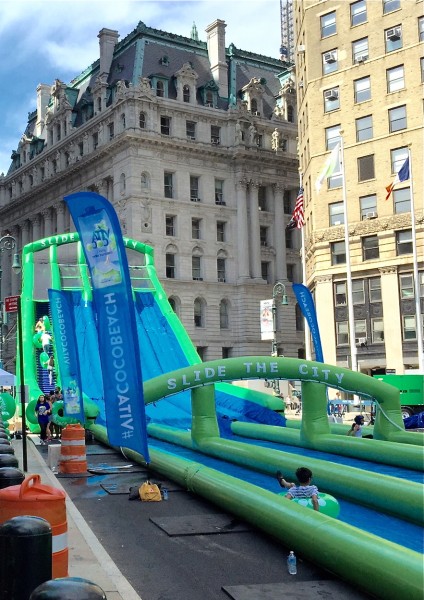
Giant slide is a highlight of Summer Streets program on first three Saturday mornings in August (photo by twi-ny/ees)
Park Ave. & 72nd St. to Foley Square
Saturday, August 6, 13, 20, free, 7:00 am – 1:00 pm
www.nyc.gov
Now in its seventh year, Summer Streets takes place the next three Saturday mornings, as Park Ave. will be closed to vehicular traffic from 72nd St. to Foley Square and the Brooklyn Bridge from 7:00 am to 1:00 pm, encouraging people to walk, run, jog, blade, skate, slide, and bike down the famous thoroughfare, getting exercise and enjoying the great outdoors without car exhaust, speeding taxis, and slow-moving buses. There are five rest stops along the route (Uptown at 52nd St., Midtown at 25th, Astor Pl. at Lafayette St., SoHo at Spring & Lafayette, and Foley Square at Duane & Centre), where people can stop for some food and drink, live performances, fitness classes, site-specific art installations, dog walks, bicycle workshops, and other activities, all of which are free. Below are some of the highlights.
Foley Square Rest Stop
Beachside Slide (advance preregistration required,) Adaptive Obstacle Challenge, “On Display / CitiSummerStreets” living sculpture by Heidi Latsky, “M2B, Beijing-New York” mobile bike sculpture by Niko de la Fey, historical reenactors, Department of Design and Construction: The Art and Construction of NYC’s Water Supply, Bronx Museum of the Arts workshop (August 20)
SoHo Rest Stop
Fitness classes, free bike repair and rentals, parkour fitness demonstrations, Museum of Chinese in America “Dragon Boat Crown Making” (August 6 & 20), Storefront for Art and Architecture “Manhattanisms” (August 13)
Astor Place Rest Stop
“Make It Here” interactive programs (athletics, social media vending machines, fashion showcases, Paws and Play Dog Park, “Los Trompos (Spinning Tops)” by Hector Esrawe and Ignacio Cadena
Midtown Rest Stop
A Taste of Summer Sampling Zone, Kid Bike Park, pop-up yoga, hand-cycle demonstration, helmet fittings, free bike rentals and repair, “GrowNYC Zero Waste Programs,” live dance, theater, and musical performances
August 6
Connor Larkin, Kelly Wright, the Other Brothers, Moondrunk
August 13
JHEVERE, Phone Home, Music with a Message, Evolfo
August 20
Orin Kurtz, Backtrack Vocals, Darrah Carr Dance, Drew and Joanne
Uptown Rest Stop
DOT Safety Zone, Zipline, “Unlimited NYC” athletics, Hallmark “Sounds of Shore” installation, “Make It Here” interactive programs (live performances, food tastings, sharing love stories), bike art party, Municipal Art Society tours, tai chi, Museum of the City of New York’s “Pushing Buttons: NYC Activism”
August 6
American Folk Art Museum’s “Families & Folk Art,” Publicolor’s “Color and Creativity, Sirens of Gotham, Receta Secreta, the Afro-Latineers, Robert Anderson Band, Stiletta, Washington Square Winds, Society of Illustrators’ “Draw and Groove Party,” Materials for the Arts’ “Found Object Flowers”
August 13
Risa Puno’s interactive “Win or Lose” game, ArchForKids’ “The Big Build,” Design Trust for Public Space’s “Under the Elevated,” National Museum of the American Indian’s “Inspired by Native/Indigenous Design,” Taliah Lempert’s “Street Smart Bike Art,” BumbleBee Jamboree, DreamStreet Theatre Company, Niall O’Leary School of Irish Dance, City Stompers, dancing classrooms
August 20
National Museum of the American Indian’s “Inspired by Native/Indigenous Design,” Taliah Lempert’s “Street Smart Bike Art,” “Poets House Imagination Station,” Art Gowanus workshop, Groundswell’s “Visualize Your Artist Skills,” New York Violinist Susan Keser, Opera Collective, Art of Stepping, Exit 12 Dance Group


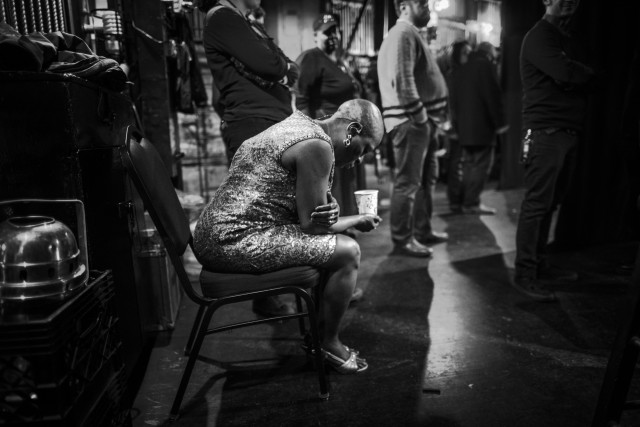
 “I feel my day is coming, it’s my time,” soul singer extraordinaire Sharon Jones is shown saying at the beginning of Barbara Kopple’s touching and intimate documentary, Miss Sharon Jones! But that was before the former wedding singer and Rikers Island corrections officer, who was born in 1958 in North Augusta, South Carolina, raised in Brooklyn, and later lived in Queens, was diagnosed in June 2013 with stage two pancreatic cancer. Jones, who has been called the female James Brown — she tells a story in the film about the time she met the Godfather of Soul — allows the Oscar-winning Kopple (Shut Up & Sing, Harlan County, USA) remarkable access as she cuts off her trademark locks and chooses a wig, undergoes painful chemotherapy, is cared for by her close friend and holistic nutritionist Megan Holken, and visits her old stomping grounds in Augusta, Georgia. Jones shares her thoughts about her future, feeling responsible for the financial well-being of her longtime band, the Dap-Kings. “First and foremost, we’re a family,” Daptone Records cofounder and saxophonist Neal Sugarman says. In fact, “family” is a word that pops up often in the film when people describe their relationship with Jones, who has never married and has no children. Among those who talk about Jones, her amazing talent, and her fight with cancer are her oncologist, Dr. James Leonardo; her manager, Alex Kadvan, who is with her every step of the way; her assistant manager Austen Holman, who tries not to break down on camera; Daptone Records cofounder and bassist Gabe Roth; guitarist Binky Griptite, who is up front about his financial troubles while the band is on hiatus; drummer Homer Steinweiss; and Dapettes Starr Duncan Lowe and Saundra Williams.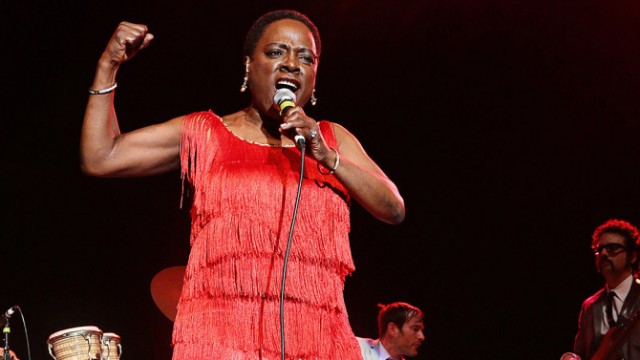
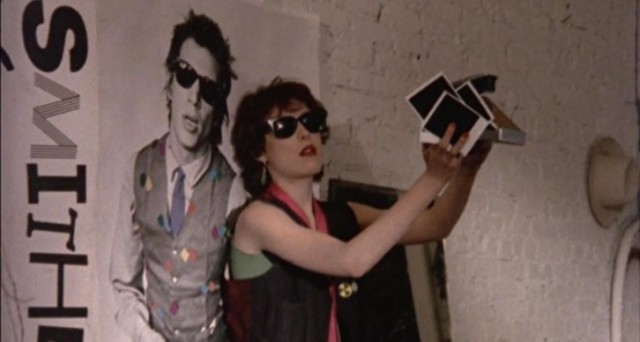
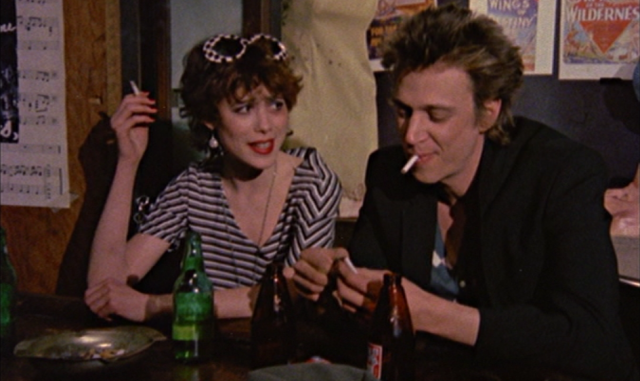
 I’m a little worried about Metrograph’s weeklong presentation of Susan Seidelman’s underground cult classic, the one and only Smithereens. The Lower East Side art house is proclaiming that it is showing a new 35mm print, but a lot of the charm of the low-budget wonder is its gritty, less-than-polished attitude. I’m afraid it could be like when you hear a crystal-clear old album on CD that sends you back to the vinyl LP so you can hear every beloved scratch and pop. Regardless, Smithereens, the first American indie to be shown in competition at Cannes, is a fab tale set in the East Village punk / new wave scene of the late 1970s, as a tough-talking young woman from the New Jersey suburbs seeks to find her place in the burgeoning city subculture. Susan Berman, who was discovered in the audience at an off-Broadway play, makes her film debut as Wren, an annoying, unlikable wannabe desperate to become part of the music business. Wearing ever-more-fashionable punky get-ups, she wanders the streets seeking fame, plastering Xeroxes of her face all over and claiming to be on the guest list at the Peppermint Lounge. The innocent Paul (Brad Rijn), recently arrived from Colorado and living in his cool van in a postapocalyptic abandoned lot, immediately falls for Wren, but she has her eyes set on Eric (Richard Hell), the leader of a band who has plans to make it big in California. Wren is an unapologetic user, taking advantage of Paul, Eric, her landlady, her family, and her few friends, but Berman imbues her with just enough sublimated tender charm to keep you glued to her trainwreck of a life.