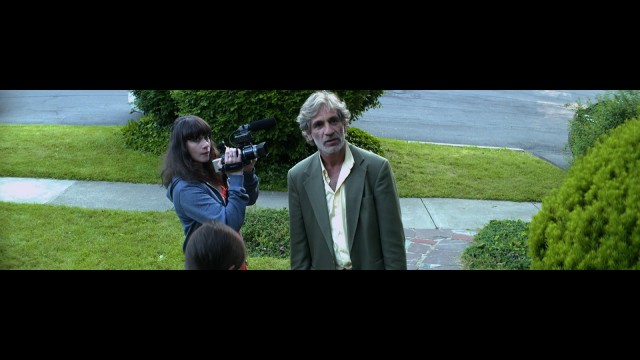
Myla (Naruna Kaplan de Macedo) and Ronnie (Alon Aboutboul) go on a road trip exploring regret and the past in IS THAT YOU?
IS THAT YOU? (Dani Menkin, 2014)
Cinema Village
22 East 12th St. between University Pl. & Fifth Ave.
Opens Friday, August 26
212-529-6799
www.cinemavillage.com
heyjudeproductions.com
 In Dani Menkin’s Is That You?, young film student Myla (Naruna Kaplan de Macedo) is making a documentary, asking strangers what they regret. If she asked me, I might just have told her that I regret having watched Is That You? Nominated for an Israeli Academy Award for Best Picture and winner of Best Indie Film, Dani Menkin’s Is That You? is a convoluted road-trip movie that manipulates its paper-thin plot until almost none of it makes sense. Israeli film, television, and stage favorite Alon Aboutboul (London Has Fallen, The Dark Knight Rises) stars as Ronnie, an outdated analog man in an ever-more-digital world. After losing his job as a projectionist in an Israeli art house, Ronnie heads to the States, determined to find his lost love, Rachel, who he has not seen in nearly forty years. He picks up an old used car (no fancy new styles for him) from his brother, Jacob (Rani Bleier), and sets out on his mission. The lemon soon breaks down, and Ronnie is offered help by Myla, whose film is called The Road Not Taken. Moved by Ronnie’s story, Myla joins him on his journey, taking her brother’s SUV, without permission. As Ronnie and Myla try to track down Rachel, who can’t seem to settle down in one place for very long, they stop along the way so Myla can interview people on the street and in their homes, getting them to share what they would change in their lives if they could. But the hardest person to get to open up is Ronnie himself.
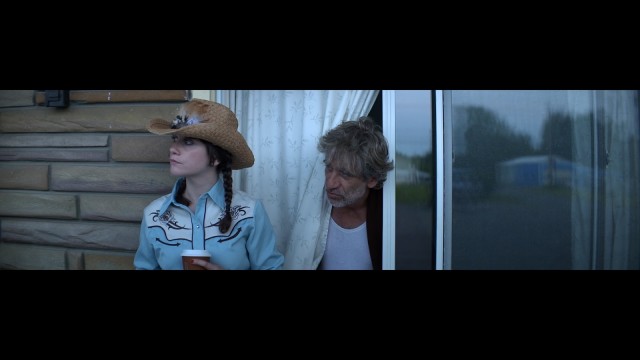
Myla (Naruna Kaplan de Macedo) and Ronnie (Alon Aboutboul) reach another fork in the road in IS THAT YOU?
Is That You? is a narrative mess from the start, as Menkin (39 Pounds of Love, Dolphin Boy) keeps trying to force square pegs into round holes; if a plot development doesn’t quite work, he forges ahead anyway, leaving viewers scratching their head in disbelief. Aboutboul (Out of the Blue, One of Us) is a wonderful actor, but Ronnie is just too dour and withdrawn, too uncommunicative, while Kaplan de Macedo, a real-life documentary filmmaker in her acting debut and a dead ringer for Zooey Deschanel, is fun to watch, although her character is overly quirky. Even the opening credits are a disappointment; Menkin uses the font associated with Woody Allen films, but there’s nothing in Is That You? that shares any of the wit and intelligence in even the Woodman’s lesser works. There are some interesting ideas in the film, but it probably would have worked better as a short instead of an eighty-three-minute feature. Is That You? opens August 26 at Cinema Village, with Menkin, Aboutboul, and other members of the cast and crew participating in several Q&As over the weekend.


 New York City has seen a dramatic rise in the closing of long-beloved institutions in the twenty-first century as gentrification and rent hikes soar. When filmmaker Kurt Vincent heard rumors that the Chinatown Fair arcade game haven was on the way out, he brought his camera to the Mott St. spot to document what it meant to him and the community that has been built around it since it opened back in 1944. “After all these years, the path to the arcade was ingrained, even in dreams,” he narrates at the beginning of The Lost Arcade, describing a dream he had. “As I stood in front of the doors, I could smell the arcade. The smell was a primordial memory hidden deep in my mind, somewhere beyond time and space, and somehow, in my dream, I connected with this distant and abstract memory.” Director-producer-editor Vincent and producer-writer Irene Chin, who previously collaborated on the experimental short The Bachelorette Party, have created a love letter to Chinatown Fair, affectionately known as CF, which has seen its ups and downs over the years, including a boom during the golden age of arcades in the 1980s and a problematic drop in the 2000s as kids stayed home to play video games on their computers and televisions. Vincent speaks with Anthony Cali Jr., who practically grew up in CF; former CF employees Henry Cen, Norman Burgess, Derek Rudder, and Akuma Hokura and their boss, Sam Palmer, who bought the place after visualizing it in a dream; and Lonnie Sobel, who attempted to resurrect it after its initial closure.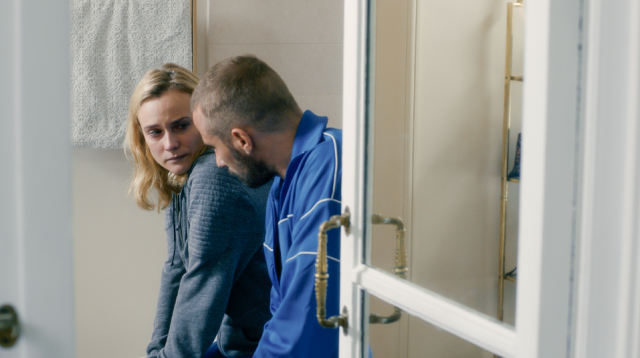
 French director Alice Winocour follows up her 2012 Cannes hit, Augustine, with the pulse-pounding, heart-racing paranoid thriller Disorder. Matthias Schoenaerts is sensational as Vincent, a role Winocour wrote specifically for him. A veteran of special forces in Afghanistan, Vincent has been sidelined back in France, diagnosed with PTSD and awaiting medical clearance for a return to the field. He is distraught and frustrated, as his identity as a soldier is his life. While waiting to hear from the doctors, he is hired by his team leader, Denis (Paul Hamy), to join a security force for a party at a French Riviera estate, known as Maryland, owned by powerful Lebanese businessman Imad Whalid (Percy Kemp). During the party, Vincent witnesses an altercation involving Whalid, cabinet minister Pierre Duroy (Philippe Haddad), and some mysterious figures. Later, when Whalid suddenly has to leave on a business trip, Vincent comes back to the estate as a one-person security force protecting Whalid’s trophy wife, Jessie (Diane Kruger), and her young son, Ali (Zaïd Errougui-Demonsant). Vincent is instantly suspicious of everything and everyone, constantly looking over his shoulder and scanning for threats ahead, which disturbs Jessie — until it appears that Vincent just may be right.