
Documentarian Petra Epperlein investigates her father’s mysterious suicide in KARL MARX CITY
KARL MARX CITY (Petra Epperlein & Michael Tucker, 2016)
Film Society of Lincoln Center
West 65th St. between Broadway & Amsterdam Aves.
Friday, October 14, Walter Reade Theater, $15, 8:30
Saturday, October 15, Francesca Beale Theater, $15, 12:30
Festival runs September 30 – October 16
212-875-5050
www.filmlinc.org
karlmarxcity.com
 In 1999, filmmaker Petra Epperlein’s fifty-seven-year-old father, Wolfgang, thoroughly washed his company car, burned all of his personal papers and photographs, and then hanged himself from a tree in the family garden in their home in Chemnitz, which was known as Karl Marx City in what was formerly communist East Germany from shortly after the end of WWII to the fall of the Berlin Wall. “Much like Karl Marx City, her father set out to erase himself,” narrator Matilda Tucker, Epperlein’s daughter, says near the beginning of the intricately plotted and gripping documentary Karl Marx City. “All that he left behind were questions.” Fifteen years later, Epperlein, who has made such sociopolitical films with her husband, Michael Tucker, as Gunner Palace, The Prisoner Or: How I Planned to Kill Tony Blair, and Bulletproof Salesman — the duo call themselves Pepper & Bones — returned to Chemnitz to try to answer some of those questions and find out whether her father had killed himself because, as was rumored, he had collaborated with the Stasi, the much-feared East German secret police. Between 1950 and 1990, the German Democratic Republic employed 92,000 officers and 200,000 informants to spy on their own friends, neighbors, and family, using audio and video to track their every move in order to identify supposed enemies of the state. Written, directed, edited, and produced by Epperlein and Tucker — Petra also did the audio recording and Michael served as cinematographer and sound designer — Karl Marx City features declassified surveillance tapes, broadcast intercepts, and propaganda films from the Ministry for State Security (the Stasi, or Staatssicherheit) along with striking new black-and-white footage of Epperlein’s quest as she poignantly retraces her father’s steps. She meets with such current and former employees of the Stasi Archive as Lothar Raschker, Dr. Juliane Schütterle, and Dagmar Hovestadt, Cold War and GDR expert Dr. Douglas Selvage, and Berlin-Hohenschönhausen Memorial director Dr. Hubertus Knabe to examine the history of the Stasi and detail the effects it had on the psyche of the German people.
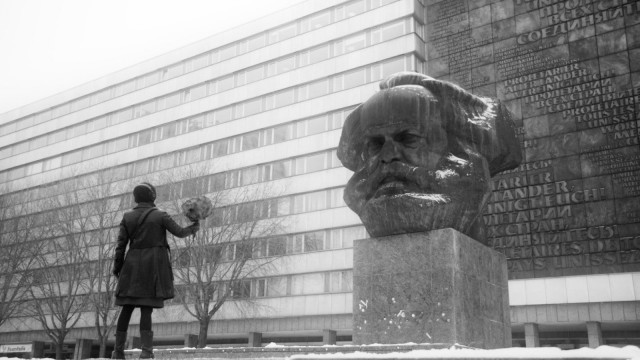
Poignant documentary looks into Stasi control of Karl Marx City during the Cold War era
Epperlein also speaks with former classmate Jana X and her parents, Stasi collaborators R. and S., and historian and suicide-letter expert Dr. Udo Grashoff, who examines a note and postcard that Wolfgang sent Petra just before he killed himself. “The main question of the Stasi was, Who is the enemy, and how can we prove that he is an enemy or she is an enemy?” Dr. Grashoff points out. “But you and I, we have different questions. And we find in the files empirical material that allows us to answer our different questions, and this is the value of the Stasi files for me. I’m not interested in the questions of the Stasi. You can find your own truth.” Petra’s twin brothers, Uwe and Volker, and their mother, Christa, also talk about their father, with Christa sometimes hesitant and emotional. Visiting sites from her family’s past, Epperlein travels everywhere wearing headphones and carrying a large fur-covered microphone, emphasizing how her, and our, world is still under constant surveillance. “No aspect of society escaped their gaze,” Tucker narrates early on, referring to the Stasi. “Everyone a suspect. The enemy is everyone.” Epperlein occasionally addresses the camera directly, creating boundary-shattering moments between filmmaker and audience while evoking the ability of the camera and microphone to make us all subjects, particularly in this surveillance-heavy age. In addition, Karl Marx City offers a vocabulary lesson, defining such words as Die Wende (“the change”), Ostalgie (“the feeling for home”), Erinnerungskutlur (“the culture of remembrance”), and Vergangenheitsbewältigung (“the process of coming to terms with the past”), the letters shown onscreen in torn red-and-white strips as if ripped from tabloid headlines or ransom notes. Karl Marx City is an eye-opening look at a frightening past as well as a potent reminder of what can always happen again — if it isn’t already. The film is screening October 14 & 15 in the Spotlight on Documentary section of the New York Film Festival, with both shows followed by a Q&A with Pepper & Bones.




 For the last four decades, Baldwin-born writer-director Jonathan Demme has alternated between fiction films and documentaries, releasing such features as Something Wild, The Silence of the Lambs, and Philadelphia as well as such real-life tales as Haiti: Dreams of Democracy, Cousin Bobby, and Neil Young Trunk Show. IFC Center is dedicating its complete fall Stranger Than Fiction season to the latter, screening six Demme documentaries on successive Tuesday nights, each followed by a Q&A with the Oscar-winning director. The series began with Stop Making Sense, Swimming to Cambodia, and The Agronomist; on October 18, STF will present one of Demme’s very best, Neil Young: Heart of Gold. In March 2005, less than a week before a scheduled operation for a brain aneurysm, Canadian country-folk-rock legend Neil Young headed to Nashville, assembled friends and family, and in four days recorded one of the best — and most personal — albums of his storied career, Prairie Wind. On August 18, he had recovered enough to put on a poignant show at the Ryman Auditorium in Nashville, captured on film by Jonathan Demme (whose previous music-related works included Talking Heads in Stop Making Sense, Robyn Hitchcock in Storefront Hitchcock, and videos by the Pretenders and Bruce Springsteen).