this week in lectures, signings, panel discussions, workshops, and Q&As

MoCCA ARTS FESTIVAL 2017

mocca fest 2017

Metropolitan West, West 46th St. between 11th & 12th Aves.
Ink48, 653 11th Ave. at West 48th St.
Saturday, April 1, and Sunday, April 2, $5
www.societyillustrators.org

The 2017 MoCCA Arts Festival takes place this weekend at Metropolitan West, where more than four hundred artists will be displaying comics, cartoons, and animated works. Presented by the Society of Illustrators, the show will include the “Awards of Excellence” exhibit, selections from Drew Friedman’s “Heroes of the Comics,” and guests of honor Blutch, Cliff Chiang, Becky Cloonan, David Lloyd, Gene Luen Yang, and Friedman. Below are the special programs, being held at the nearby Ink48 Hotel.

Saturday, April 1
“Reading without Walls: Diversity in Comics,” with Gene Luen Yang, Damian Duffy, Hazel Newlevant, and Whit Taylor, moderated by Jonathan W. Gray, Garamond Room, 12:30

“Drew Friedman: Heroes of the Comics,” with Drew Friedman, Gary Groth, Al Jaffee, and Karen Green, Helvetica Room, 12:30

“Covering Trump: Steve Brodner and Edel Rodriguez in Conversation,” moderated by Steven Heller, Helvetica Room, 2:00

“Blutch in Conversation with David Mazzuchelli,” moderated by Bill Kartalopoulos, Garamond Room, 2:00

“Cliff Chiang Q+A,” moderated by Paul Levitz, Helvetica Room, 3:30

“Fit to Print: French Artists in the New York Times, with Lucie Larousse, Mayumi Otero, Eugène Riousse, Simon Roussin, and Raphael Urwiller, moderated by Alexandra Zsigmond, Garamond Room, 3:30

Sunday, April 2
“David Lloyd in the Spotlight,” with David Lloyd, moderated by Kent Worcester, Garamond Room, 12:30

“Teaching Comics Internationally,” with Jessica Abel, Guillaume Dégé, Ben Katchor, and Merav Solomon, moderated by Bill Kartalopoulos, Helvetica Room, 12:30

“Rutu Modan and David Polonsky in Conversation,” moderated by Tahneer Oksman, Garamond Room, 2:00

“RESIST!,” with Françoise Mouly and Nadja Spiegelman, Helvetica Room, 2:00

“Becky Cloonan Q+A,” moderated by Nathan Fox, Helvetica Room, 3:30

“Anthologies as Art: Kramers Ergot and Lagon,” with Sammy Harkham and Alexis Beauclair, moderated by Bill Kartalopoulos, Garamond Room, 3:30

MARTIN SCORSESE — GREAT RESTORATIONS: THE RED SHOES WITH THELMA SCHOONMAKER

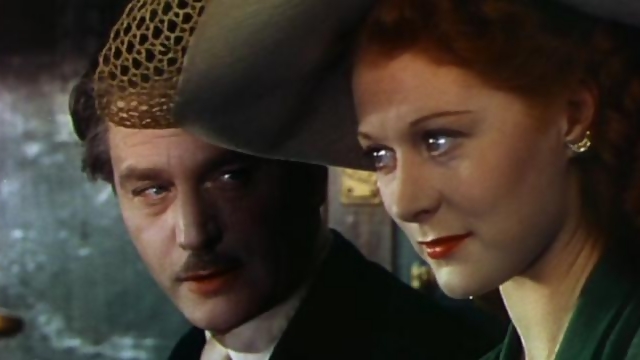
Boris Lermontov (Anton Walbrook) and Victoria Page (Moira Shearer) contemplate their future in Michael Powell and Emeric Pressburger’s THE RED SHOES

Boris Lermontov (Anton Walbrook) and Victoria Page (Moira Shearer) contemplate their future in Michael Powell and Emeric Pressburger’s THE RED SHOES

MARTIN SCORSESE RETROSPECTIVE: THE RED SHOES (Michael Powell & Emeric Pressburger, 1948)
Museum of the Moving Image
35th Ave. at 36th St., Astoria
Sunday, April 2, $15, 7:00 (with Schoonmaker introduction)
Sunday, April 9, $15, 4:00
Series runs through October 23
718-777-6800
www.movingimage.us

Michael Powell and Emeric Pressburger’s The Red Shoes is a lush, gorgeous examination of the creative process and living — and dying — for one’s art. Sadler’s Wells dancer Moira Shearer stars as Victoria Page, a young socialite who dreams of becoming a successful ballerina. She is brought to the attention of ballet master Boris Lermontov (Anton Walbrook) and soon is a member of his famed company. Meanwhile, composer Julian Craster (Marius Goring), whose music was stolen by his professor and used in a Lermontov ballet, also joins the company, as chorus master. As Vicky and Julian’s roles grow, so does their affection for each other, with a jealous Lermontov seething in between. Inspired by Sergei Diaghilev and the Ballets Russes, The Red Shoes is a masterful behind-the-scenes depiction of the world of dance, highlighted by the dazzlingly surreal title ballet, which mimics the narrative of the central plot. Based on the Hans Christian Andersen fairy tale, the fifteen-minute ballet takes viewers into a completely different fantasy realm, using such cinematic devices as jump cuts and superimposition as the drama unfolds well beyond the limits of the stage. To increase the believability of the story and make sure the dance scenes were effective, Powell and Pressburger enlisted players from the international dance community; the film’s cast includes Russian choreographer and dancer Léonide Massine as Lermontov choreographer Grischa Ljubov, French prima ballerina Ludmilla Tchérina as Lermontov star Irina Boronskaja, and Australian dancer Robert Helpmann as Ivan Boleslawsky; Helpmann also served as the film’s choreographer.
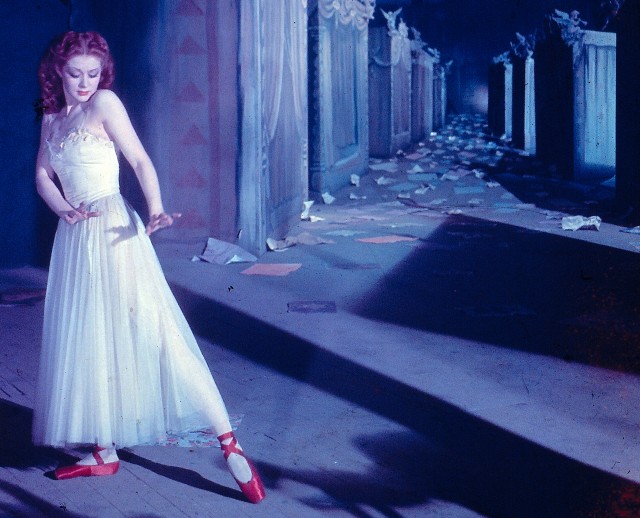


Victoria Page (Moira Shearer) gets immersed in a surreal ballet in classic dance drama THE RED SHOES

Victoria Page (Moira Shearer) gets immersed in a surreal ballet in classic dance drama THE RED SHOES

Brian Easdale won an Oscar for his score, which ranges from sweet and lovely to dark and ominous, with an Academy Award also going to Hein Heckroth’s stunning art direction and Arthur Lawson’s fabulous set design. The film was photographed in glorious Technicolor by Jack Cardiff. Upon meeting Vicky, Lermontov asks, “Why do you want to dance?” to which she instantly responds, “Why do you want to live?” No mere ballet film, The Red Shoes is about so much more. A newly restored 35mm print of The Red Shoes is screening April 2 at 7:00 in the Museum of the Moving Image series “Martin Scorsese: Great Restorations” and “Martin Scorsese Retrospective” and will be introduced by three-time Oscar-winning editor Thelma Schoonmaker, who has worked on all of Scorsese’s films since Raging Bull and was married to Michael Powell from 1984 to 1990. (The film is also being shown April 9 at 4:00 without the introduction.) The series are being held in conjunction with the “Martin Scorsese” exhibition; upcoming screenings include Stuart Heisler’s Journey into Light, Akira Kurosawa’s Dreams, and Sergei Parajanov’s The Color of Pomegranates.

THE ORCHID SHOW: THAILAND

(photo by twi-ny/mdr)

The fifteenth annual Orchid Show at the New York Botanical Garden transports visitors to Thailand (photo by twi-ny/mdr)

The New York Botanical Garden
Enid A. Haupt Conservatory
2900 Southern Blvd., Bronx
Tuesday – Sunday through April 9, $8-$10 children two to twelve, $20-$25 adults, 10:00 am – 6:00 pm
718-817-8700
www.nybg.org
twi-ny orchid slideshow

For its fifteenth annual Orchid Show, the New York Botanical Garden takes visitors to Thailand, a country with a rich orchid history and one of the world’s leading exporters of native and hybrid varieties. The Orchid Society of Thailand was formed in 1957; today Thailand produces more than $80 million worth of orchids every year, and its industry is on the cutting edge of micropropagation and cloning. On view through April 9, “The Orchid Show: Thailand,” inspired by the Nong Nooch Tropical Botanical Garden in Chonburi Province, designed by Christian Primeau, and curated by Marc Hachadourian, features more than a thousand plants in a rainbow of colors that reveal Thailand’s natural diversity, with focuses on dendrobium, vandas, paphiopedilum, and miniatures.

(photo by twi-ny/mdr)

Exhibition features more than a thousand varieties of orchids and other plants native to Thailand (photo by twi-ny/mdr)

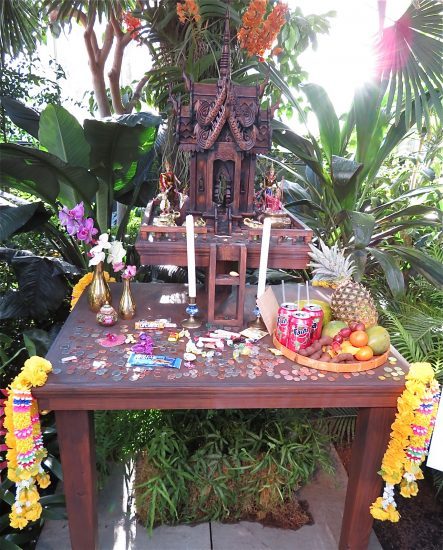
The pond display at the entrance boasts an elephant topiary; elephants are Thailand’s national symbol. (Thai topiaries, known as mai dat, date back to the thirteenth century and are generally abstract.) Sky lanterns (khom loi) hang from above, disposing of bad luck and bringing good fortune. A pair of spirit houses, hand-carved by Pirot Gitikoon, are shrines for protective spirits, with flower offerings, incense, candles, dancers, protective dragon spirits (naga), unseen guardian spirits (phra phum), elephants representing transportation, and strawberry soda. The centerpiece of the exhibition is a sala Thai, a place of rest and contemplation; hundreds of orchids grow in the pavilion, which was designed by artist and architect Mom Luang Tridosyuth Devakul (Mom Tri). In addition to orchids, there are other examples of Thai horticulture, including bouganvillea, bamboo, mangoes, bananas, and palms.

Offerings are made at spirit houses for protection (photo by twi-ny/mdr)

Offerings are made at spirit houses for protection (photo by twi-ny/mdr)

Orchid Evenings take place March 31 (LGBTQ Night) and April 1, 7, and 8 from 6:30 to 9:30, with music and dancing, a cash bar, and no one under twenty-one. (Try the Dancing Lady, created for the show by Edible Bronx mixologist Bruce “Blue” Rivera, consisting of silver tequila, tamarind purée, triple sec, grapefruit juice, and lime juice.) On April 2 and 9 in Ross Hall, “Magical Thailand — A Journey with the Somapa Thai Dance Co.” celebrates Thai art and culture. There are also orchid care demonstrations in the Conservatory GreenSchool on Saturdays and Sundays at 2:30 and 3:30 and orchid experts on call for advice in the NYBG shop Saturdays and Sundays from 1:30 to 4:30.

BROOKLYN MUSEUM FIRST SATURDAY: BEYOND THE BLUES

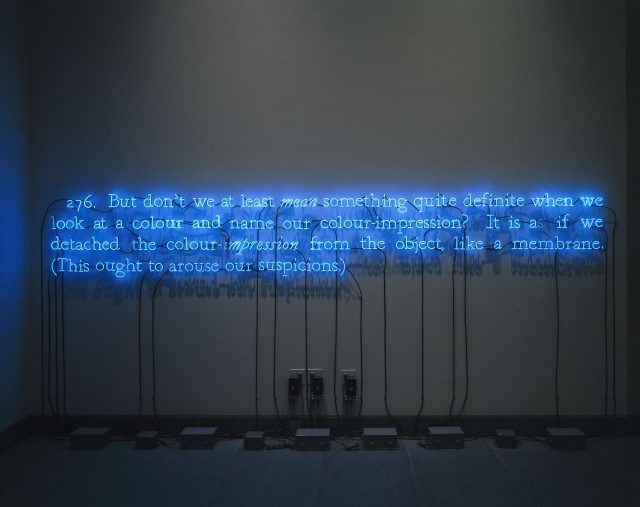
Joseph Kosuth, “276 (On Color Blue),” neon tubing, transformer, and electrical wires, 1993 (© 2016 Joseph Kosuth / Artists Rights Society, New York. Photo: Brooklyn Museum)

Joseph Kosuth, “276 (On Color Blue),” neon tubing, transformer, and electrical wires, 1993 (© 2016 Joseph Kosuth / Artists Rights Society, New York. Photo: Brooklyn Museum)

Brooklyn Museum
200 Eastern Parkway at Washington St.
Saturday, April 1, free, 5:00 – 11:00
212-864-5400
www.brooklynmuseum.org

The Brooklyn Museum focuses on numerous aspects of the word “blue” in its April First Saturday program, “Beyond the Blues.” There will be live music and dance by the Martha Redbone Roots Project, Geko Jones and Chiquita Brujita with Fogo Azul and Aina Luz, the Brooklyn Dance Festival (with a workshop), and Queen GodIs with special guests; the pop-up poetry event “An Address of the Times” with Pamela Sneed, Heather Johnson, t’ai freedom ford, and Timothy Du White; a screening of Marcie Begleiter’s Eva Hesse, followed by a discussion with Helen Charash (Hesse’s sister) and producer Karen Shapiro; a hands-on art workshop in which participants can make marbled paper using the Japanese suminagashi (“floating ink”) technique; an Emerging Leaders of New York Arts booth where participants can write postcards in support of the arts, take part in a public art project, and take a #SaveTheNEA selfie; the lecture performance #sky #nofilter by Chloë Bass exploring racial trauma; and a “New York City Participatory Budgeting” program where people can propose and vote on projects in their community. In addition, you can check out such exhibits as “Iggy Pop Life Class by Jeremy Deller,” Marilyn Minter: Pretty/Dirty,” “Infinite Blue,” “A Woman’s Afterlife: Gender Transformation in Ancient Egypt,” and, at a discounted admission price of $12, “Georgia O’Keefe: Living Modern.”

KARL MARX CITY

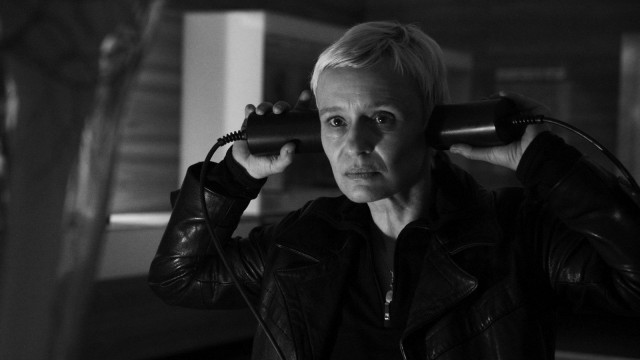
Documentarian Petra Epperlein investigates her fathers mysterious past in KARL MARX CITY

Documentarian Petra Epperlein investigates her father’s mysterious suicide in KARL MARX CITY

KARL MARX CITY (Petra Epperlein & Michael Tucker, 2016)
Film Forum
209 West Houston St.
March 29 – April 11
212-727-8110
filmforum.org
karlmarxcity.com

In 1999, filmmaker Petra Epperlein’s fifty-seven-year-old father, Wolfgang, thoroughly washed his company car, burned all of his personal papers and photographs, and then hanged himself from a tree in the family garden in their home in Chemnitz, which was known as Karl Marx City in what was formerly communist East Germany from shortly after the end of WWII to the fall of the Berlin Wall. “Much like Karl Marx City, her father set out to erase himself,” narrator Matilda Tucker, Epperlein’s daughter, says near the beginning of the intricately plotted and gripping documentary Karl Marx City. “All that he left behind were questions.” Fifteen years later, Epperlein, who has made such sociopolitical films with her husband, Michael Tucker, as Gunner Palace, The Prisoner Or: How I Planned to Kill Tony Blair, and Bulletproof Salesman — the duo call themselves Pepper & Bones — returned to Chemnitz to try to answer some of those questions and find out whether her father had killed himself because, as was rumored, he had collaborated with the Stasi, the much-feared East German secret police. Between 1950 and 1990, the German Democratic Republic employed 92,000 officers and 200,000 informants to spy on their own friends, neighbors, and family, using audio and video to track their every move in order to identify supposed enemies of the state. Written, directed, edited, and produced by Epperlein and Tucker — Petra also did the audio recording and Michael served as cinematographer and sound designer — Karl Marx City features declassified surveillance tapes, broadcast intercepts, and propaganda films from the Ministry for State Security (the Stasi, or Staatssicherheit) along with striking new black-and-white footage of Epperlein’s quest as she poignantly retraces her father’s steps. She meets with such current and former employees of the Stasi Archive as Lothar Raschker, Dr. Juliane Schütterle, and Dagmar Hovestadt, Cold War and GDR expert Dr. Douglas Selvage, and Berlin-Hohenschönhausen Memorial director Dr. Hubertus Knabe to examine the history of the Stasi and detail the effects it had on the psyche of the German people.
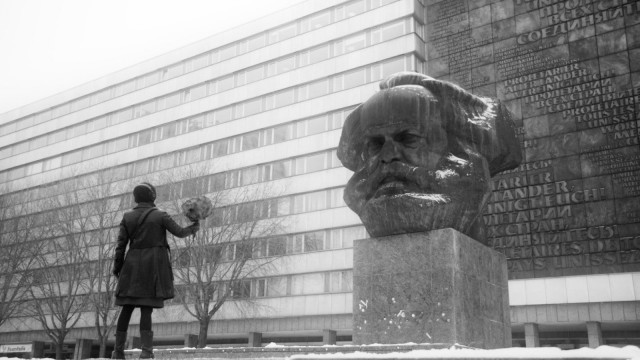
Documentary looks into Stasi control of Karl Marx City

Poignant documentary looks into Stasi control of Karl Marx City during the Cold War era

Epperlein also speaks with former classmate Jana X and her parents, Stasi collaborators R. and S., and historian and suicide-letter expert Dr. Udo Grashoff, who examines a note and postcard that Wolfgang sent Petra just before he killed himself. “The main question of the Stasi was, Who is the enemy, and how can we prove that he is an enemy or she is an enemy?” Dr. Grashoff points out. “But you and I, we have different questions. And we find in the files empirical material that allows us to answer our different questions, and this is the value of the Stasi files for me. I’m not interested in the questions of the Stasi. You can find your own truth.” Petra’s twin brothers, Uwe and Volker, and their mother, Christa, also talk about their father, with Christa sometimes hesitant and emotional. Visiting sites from her family’s past, Epperlein travels everywhere wearing headphones and carrying a large fur-covered microphone, emphasizing how her, and our, world is still under constant surveillance. “No aspect of society escaped their gaze,” Tucker narrates early on, referring to the Stasi. “Everyone a suspect. The enemy is everyone.” Epperlein occasionally addresses the camera directly, creating boundary-shattering moments between filmmaker and audience while evoking the ability of the camera and microphone to make us all subjects, particularly in this surveillance-heavy age. In addition, Karl Marx City offers a vocabulary lesson, defining such words as Die Wende (“the change”), Ostalgie (“the feeling for home”), Erinnerungskutlur (“the culture of remembrance”), and Vergangenheitsbewältigung (“the process of coming to terms with the past”), the letters shown onscreen in torn red-and-white strips as if ripped from tabloid headlines or ransom notes. Karl Marx City is an eye-opening look at a frightening past as well as a potent reminder of what can always happen again — if it isn’t already. The film opens March 29 at Film Forum and will be preceded by Alexander Lahl and Volker Schlecht’s seven-minute animated short, Broken — The Women’s Prison at Hoheneck; Epperlein and Tucker will participate in Q&As following the 7:00 shows on March 29 and 31 and the 4:40 show on April 1.

PERCEPTION: KNIFE IN THE WATER

KNIFE IN THE WATER

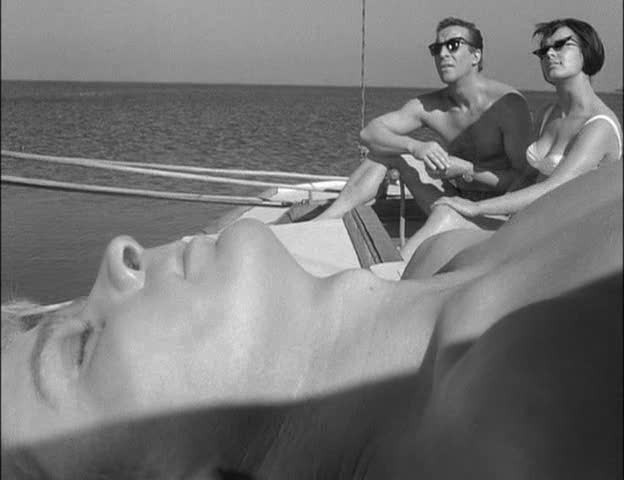
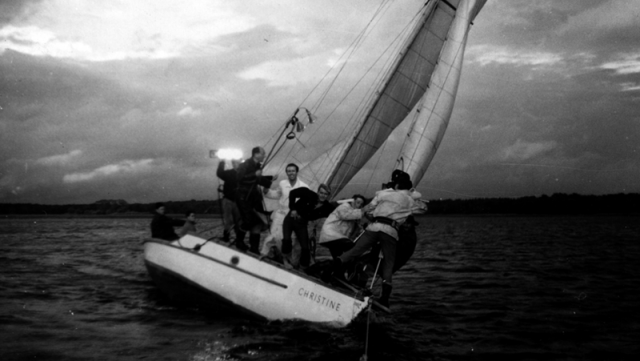
A young hitchhiker (Zygmunt Malanowicz) throws a kink in a couple’s sailing plans in Roman Polanski’s KNIFE IN THE WATER

CABARET CINEMA: KNIFE IN THE WATER (NÓŻ W WODZIE) (Roman Polanski, 1962)
Rubin Museum of Art
150 West 17th St. at Seventh Ave.
Friday, March 17, 9:30
212-620-5000
rubinmuseum.org

“Even discounting wind, weather, and the natural hazards of filming afloat, Knife in the Water was a devilishly difficult picture to make,” immensely talented and even more controversial Roman Polanski wrote in his 1984 autobiography, Roman by Polanski. That is likely to have been a blessing in disguise, upping the ante in the Polish filmmaker’s debut feature film, a tense three-character thriller set primarily on a sailboat, filmed on location. Upper-middle-class couple Andrzej (theater veteran Leon Niemczyk) and Krystyna (nonprofessional actor Jolanta Umecka) are on their way to their sailboat at the marina when a young hitchhiker (drama school grad Zygmunt Malanowicz) forces them to pull over on an otherwise empty road. Andrzej and the unnamed man almost immediately get involved in a physical and psychological pissing contest, with Andrzej soon inviting him to join them on their sojourn, practically daring the hitchhiker to make a move on his wife. Once on the boat, the two men continue their battle of wills, which becomes more dangerous once the young man reveals his rather threatening knife, which he handles like a pro. Lodz Film School graduate Polanski, who collaborated on the final screenplay with Jerzy Skolimowski (The Shout, Moonlighting) after initially working with Jakub Goldberg, envelops the black-and-white Knife in the Water in a highly volatile, claustrophobic energy, creating gorgeous scenes intimately photographed by cinematographer Jerzy Lipman, from Andrzej and Krystyna in their small car to all three trying to find space on the boat amid the vast sea and a changing wind. Many of the shots are highlighted by deep focus in which one character is shown in close-up in the foreground with the others in the background, alerting the viewer to various potential conflicts — sexual, economic, class- and gender-based — all underscored by Krzysztof T. Komeda’s intoxicating jazz score featuring saxophonist Bernt Rosengren.

Things got kind of crowded while making KNIFE IN THE WATER

Things got kind of crowded while making KNIFE IN THE WATER

The first Polish film to be nominated for a Best Foreign Language Film Oscar and winner of the Critics’ FIPRESCI Prize at the 1962 Venice Film Festival, Knife in the Water is screening March 31 in the Rubin Museum Cabaret Cinema series “Perception,” part of the institution’s latest Brainwave programming, and will be introduced by professor of psychology and neural science Dr. Clayton Curtis. “Perception” continues Friday nights through April 28 with such other mind-bending films as The Iron Giant, The Matrix, and Ghost in the Shell; meanwhile, Brainwave takes on such topics as “Keeping Your Eye on the Ball” with Patrick Vieira and John Krakauer on April 17, “Can we trust how our brain tells time?” with Ted Chiang and Dean Buonomano on April 21, and “What Makes a True Work of Art?” with Tobias Meyer and Frank Moore on April 26.

THE HAIRY APE: CONVERSATION SERIES

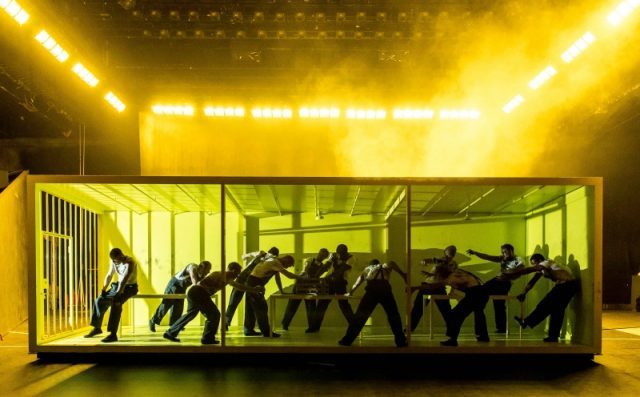
A pair of special discussions accompany presentation of THE HAIRY APE at the Park Ave. Armory (photo by Manuel Harlan)

A pair of special discussions accompany presentation of THE HAIRY APE at the Park Ave. Armory (photo by Manuel Harlan)

Park Ave. Armory, Veterans Room
643 Park Ave. at 67th St.
Friday, March 31, and Friday, April 14, $15, 6:00
Play continues through April 22, $60-$195
212-933-5812
www.armoryonpark.org

The Old Vic production of Eugene O’Neill’s 1922 play, The Hairy Ape, which was also made into a 1944 film starring William Bendix, Susan Hayward, Dorothy Comingore, and John Loder, has begun previews in the Park Ave. Armory’s Wade Thompson Drill Hall, prior to a March 30 opening; the show, starring Bobby Cannavale (in a role previously played onstage by such actors as Louis Wolheim, Paul Robeson, and Willem Dafoe) and directed by Richard Jones (Into the Woods, Too Clever by Half), runs through April 22. In conjunction with the play, the armory will be hosting two special events as part of its ongoing Conversation Series. On March 31 at 6:00 in the Veterans Room, the artist talk “A Hairy Ape for the 21st Century” will feature Jones, Cannavale, and O’Neill scholar and English professor Robert M. Dowling discussing the impact of the play nearly one hundred years after its debut. Two weeks later, on April 14 at 6:00, Catherine Combs (who plays Mildred), New-York Historical Society chief historian Valerie Paley, and theater arts and gender studies associate professor Erika Rundle will delve into “The Hairy Ape & New York City: Class vs. Identity.” O’Neill fans will also want to check out The Emperor Jones, continuing through April 23 at the Irish Rep, and Target Margin Theater’s six-hour revival of Mourning Becomes Electra, running April 26 to May 20.