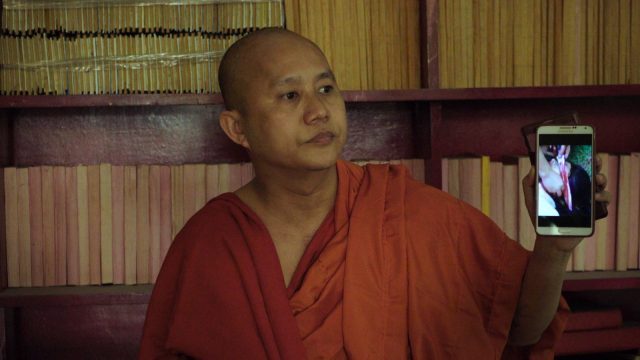
Megalomaniacal monk spouts his extremist views in Barbet Schroeder’s The Venerable W.
THE VENERABLE W. (Barbet Schroeder, 2017)
New York Film Festival, Film Society of Lincoln Center
Friday, October 13, Walter Reade Theater, $25, 6:00
Saturday, October 14, Francesca Beale Theater, $25, 1:00
Festival runs September 28 – October 15
212-875-5601
www.filmlinc.org
www.filmsdulosange.fr/en
 According to long-standing traditions and beliefs, Buddhists have empathy and compassion for all sentient beings. For example, in the recently released documentary The Last Dalai Lama?, His Holiness expressed such feelings even for the Chinese military and government that have waged war on the Tibetan people for more than fifty years and have decided that they will select the next Dalai Lama. So when Iranian-born Swiss-French director Barbet Schroeder heard about Ashin Wirathu, a Buddhist monk in Myanmar advocating violence against a Muslim minority known as the Rohingyas, he headed to the country, formerly known as Burma, where he was so shocked and disturbed by what he saw that he can still barely say the monk’s name in interviews. Nor could he bring himself to use it in the title of his film about the controversial figure, The Venerable W., which is screening at the New York Film Festival on October 13 and 14, followed by Q&As with the director. With the documentary, Schroeder, who is best known for such works as Barfly, Reversal of Fortune, and Single White Female, concludes his Trilogy of Evil, which began with General Idi Amin Dada: A Self Portrait in 1974, about the Ugandan dictator, and continued in 2007 with Terror’s Advocate, about lawyer Jacques Vergès, who has defended such clients as a former Nazi, a Khmer Rouge leader, and a Holocaust denier. The Venerable W. consists of archival footage and new interviews with Wirathu, as Schroeder essentially lets the leader speak his mind, in sermons to his rabid followers, at public events, and in his monastery, where he espouses his beliefs to the filmmaker. “The main features of the African catfish are that: They grow very fast. They breed very fast too. And they’re violent. They eat their own species and destroy their natural resources. The Muslims are exactly like these fish,” Wirathu, who was born in Kyaukse near Mandalay in 1968, says with a sly smile. He regularly boasts of his accomplishments in subduing the Rohingyas, whom he often refers to using a slur that is the equivalent of the N-word in America.
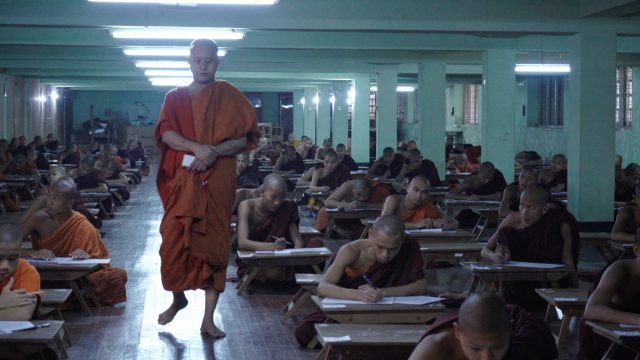
The Venerable Wirathu walks among his faithful minions in shocking documentary
A megalomaniacal nationalist with extremist positions on patriotism, protectionism, and border crossings and a clever manipulator of social media, Wirathu, inspired by the 1997 book In Fear of Our Race Disappearing, also makes extravagant, debunked claims using false statistics, from declaring that he started the 2007 Saffron Revolution to arguing that the Rohingyas are burning down their own villages so they can blame the Buddhists. Much of what he is saying sounds eerily familiar, evoking racist, nationalist sentiments that are gaining ground around the world, particularly in France, England, and America. “In the USA, if the people want to maintain peace and security, they have to choose Donald Trump,” Wirathu says. Schroeder also speaks with seven men who share their views about Wirathu: W.’s master, U. Zanitar; investigative magazine editor Kyaw Zayar Htun; Saffron Revolution monk U. Kaylar Sa; Fortify Rights creator Matthew Smith; Muslim political candidate Abdul Rasheed; Spanish journalist Carlos Sardiña Galache; and highly revered monk U. Galonni. Together they paint a portrait of a dangerous fanatic who is fomenting bitter hatred that has led to extensive episodes of rape, violence, and murder while the military and the government, headed by Aung San Suu Kyi, either support what Wirathu’s doing or merely look the other way. In numerous voiceovers, Portuguese actress Maria de Medeiros recites quotations from Buddhist texts, including the Metta Sutta, and states various sociopolitical facts. “The Buddha is often above good and evil, but his words should help us limit the mechanics of evil,” she narrates. Meanwhile, Wirathu, who was declared “the Face of Buddhist Terror” in a June 2013 Time magazine cover story, insists he is doing the right thing for his country. “I help people who have been persecuted by Muslims,” he says. “The threat against Buddhism has reached alert level.” It’s a brutal film to watch, infuriating and frightening, as Schroeder and editor Nelly Quettier clearly and concisely present the facts, without judgment, including scenes of people on fire and being viciously beaten; the director might not make any grand statements against what Wirathu and his flock are doing — he lets the monk take care of that by himself — but the film is a clarion call for us all to be aware of what is happening around the world, as well as in our own backyard. Both screenings of The Venerable W. will be preceded by the short film What Are You Up to, Barbet Schroeder?, which goes behind the scenes of his decision to tell Wirathu’s story.
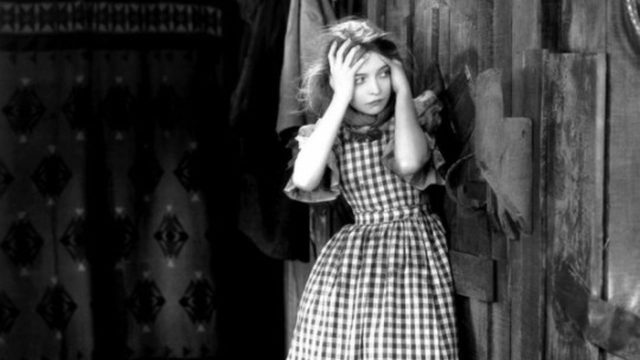
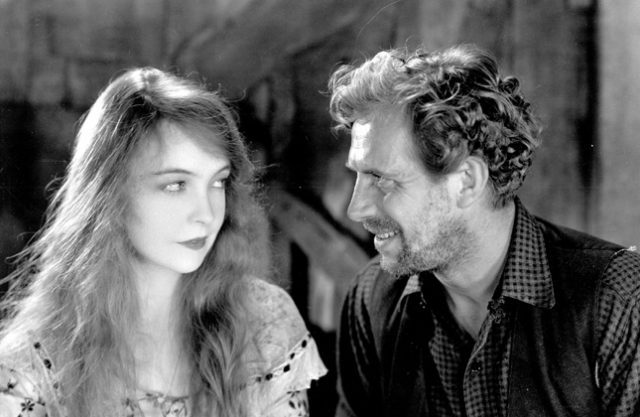
 Author Brian Selznick’s 2007 book The Invention of Hugo Cabret proved to be movie magic; it was turned into the film Hugo by Martin Scorsese, which garnered eleven Oscar nominations and won four. In conjunction with the theatrical release of the latest movie based on a Selznick book, Todd Haynes’s adaptation of Selznick’s 2011Wonderstruck, the Museum of the Moving Image is hosting the series “Inspiring Wonderstruck,” consisting of nine films that influenced and inspired the author. One of the most direct influences was Victor Sjöström’s 1928 now-classic silent film The Wind, starring Lillian Gish as Letty Mason, a young woman traveling from Virginia to Texas to live with her cousin Beverly (Edward Earle). Traveling from the cultured, civilized East to what was still the wild West, the uncertain Letty must confront the fierceness of nature head-on — both human nature and the harsh natural environment. On the train, she is wooed by cattleman Wirt Roddy (Montagu Love), but her fears grow as she first sees the vicious wind howling outside the train window the closer she gets to her destination. Once in Sweetwater, she is picked up by her cousin’s neighbors, the handsome Lige Hightower (Lars Hanson) and his goofy sidekick, Sourdough (William Orlamond). Both men take a quick liking to Letty, who seems most attracted to Wirt. Soon Beverly’s wife, Cora (Dorothy Cumming, in her next-to-last film before retiring), becomes jealous of Letty’s closeness with her husband and kids and kicks her out, leaving a desperate Letty to make choices she might not be ready for as the wind outside becomes fiercer and ever-more dangerous. The Wind is a tour de force for Gish in her last silent movie, not only because of her emotionally gripping portrayal of Letty but because she put the entire production together, obtaining the rights to the novel by Dorothy Scarborough, hiring the Swedish director and star Hanson, and arguing over the ending with the producers and Irving Thalberg. (Unfortunately, she lost on that account, just about the only thing that did not go the way she wanted.)