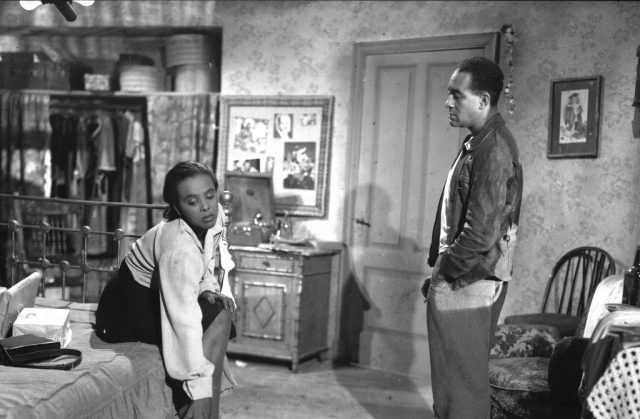
Pierre Chenal’s Native Son, starring Richard Wright as Bigger Thomas, is part of Frantz Fanon festival at BAM
BAMcinématek, BAM Rose Cinemas
30 Lafayette Ave. between Ashland Pl. & St. Felix St.
October 18-26
718-636-4100
www.bam.org
“I ascribe a basic importance to the phenomenon of language. That is why I find it necessary to begin with this subject, which should provide us with one of the elements in the colored man’s comprehension of the dimension of the other,” Martinique-born philosopher, psychoanalyst, and writer Frantz Fanon explains in the first chapter of his 1952 book, White Skin, Black Masks. The revolutionary continues, “For it is implicit that to speak is to exist absolutely for the other. The black man has two dimensions. One with his fellows, the other with the white man. A Negro behaves differently with a white man and with another Negro. That this self-division is a direct result of colonialist subjugation is beyond question. . . . No one would dream of doubting that its major artery is fed from the heart of those various theories that have tried to prove that the Negro is a stage in the slow evolution of monkey into man. Here is objective evidence that expresses reality. But when one has taken cognizance of this situation, when one has understood it, one considers the job completed. How can one then be deaf to that voice rolling down the stages of history: ‘What matters is not to know the world but to change it.’ This matters appallingly in our lifetime.”
The theories espoused by Fanon, who also wrote the seminal treatise The Wretched of the Earth, about the effects of colonization on the human psyche — and published the year he died, 1961, at the age of thirty-six — have made their way, directly and indirectly, into many films, and BAMcinématek honors that legacy in the series “Black Skin, White Masks: Cinema Inspired by Frantz Fanon,” which runs October 18-26 at BAM Rose Cinemas, featuring such powerful, wide-ranging films as Bill Duke’s Deep Cover, Ousmane Sembène’s Black Girl, Octavio Getino and Fernando E. Solanas’s The Hour of the Furnaces, and Claire Denis’s No Fear, No Die. The opening-night film, Isaac Julien’s Black Skin, White Masks, will be followed by a roundtable discussion with writer and activist Kazembe Balagun, artist Alexandra Bell, and cultural critic Tobi Haslett, moderated by series programmer Ashley Clark. In an era in which “the other” has taken center stage again as refugees search for new homes around the world, hatred, racism, and bigotry are spreading in such countries as the United States, France, and England, and walls are being put up to keep people out, many of Fanon’s philosophies are, sadly, still all-too relevant.
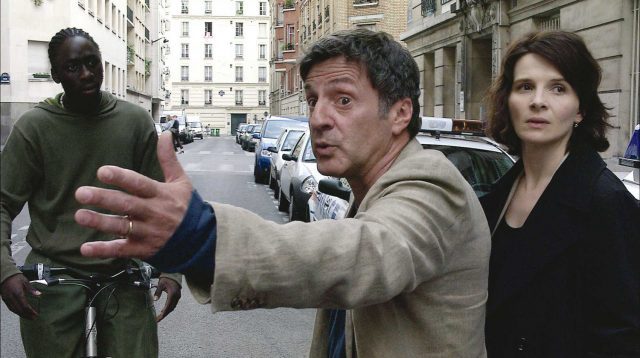
Daniel Autieul and Juliette Binoche star in Michael Haneke’s Caché
CACHÉ (HIDDEN) (Michael Haneke, 2005)
Saturday, October 21, 2:00 & 7:30
www.sonyclassics.com/cache
 Writer-director Michael Haneke (The Piano Teacher, The White Ribbon) was named Best Director at Cannes for this slow-moving yet gripping psychological drama about a seemingly happy French family whose lives are about to be torn apart. Caché stars Daniel Auteil as Georges, the host of a literary public television talk show, and Juliette Binoche as his wife, Anne, a book editor. One day a mysterious videotape is left for them, showing a continuous shot of their house. More tapes follow, wrapped in childish drawings of a boy with blood coming out of his mouth. Fearing for the safety of their son, Pierrot (Lester Makedonsky), they go to the police, who say they cannot do anything until an actual crime has been committed. As the tapes reveal more information and invite more danger, Georges’s secrets and lies threaten the future of his marriage. Caché is a tense, involving thriller that is both uncomfortable and captivating to watch. Haneke zooms in closely on the relationship between Georges and Anne, keeping all other characters in the background; in fact, there is no musical score or even any incidental music to enhance the searing emotions coming from Auteil and Binoche. Winner of numerous year-end critics awards for Best Foreign Language Film, Caché is screening October 21 at 2:00 and 7:30 at BAM. Oh, and be sure to pay close attention to the long final shot for just one more crucial twist that many people in the audience will miss.
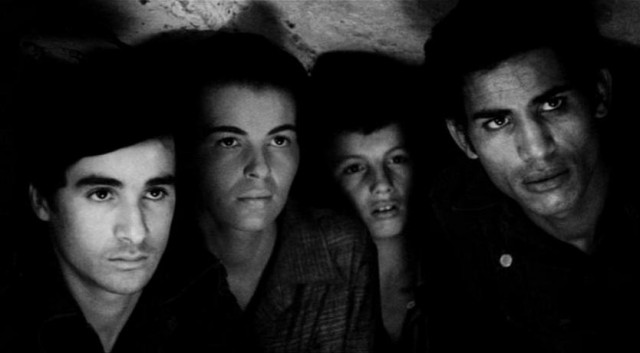
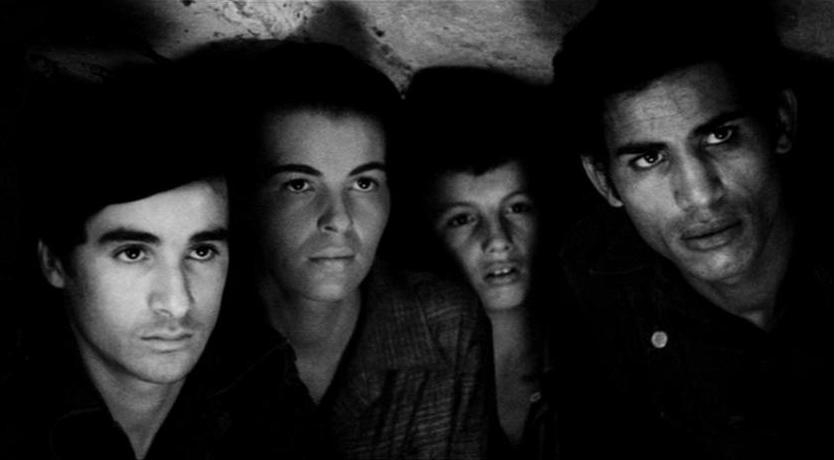
Members of the FLN hide from French paratroops in Gillo Pontecorvo’s neo-Realist classic The Battle of Algiers
THE BATTLE OF ALGIERS (Gillo Pontecorvo, 1966)
Saturday, October 21, 4:45
www.bam.org
 In Italian director Gillo Pontecorvo’s gripping neo-Realist war thriller The Battle of Algiers, a reporter asks French paratroop commander Lt. Col. Mathieu (Jean Martin), who has been sent to the Casbah to derail the Algerian insurgency, about an article Jean-Paul Sartre had just written for a Paris paper. “Why are the Sartres always born on the other side?” Mathieu says. “Then you like Sartre?” the reporter responds. “No, but I like him even less as a foe,” Mathieu coolly answers. In 1961, French existentialist Sartre wrote in the preface to Frantz Fanon’s Wretched of the Earth, the seminal tome on colonialism and decolonialism, “In Algeria and Angola, Europeans are massacred at sight. It is the moment of the boomerang; it is the third phase of violence; it comes back on us, it strikes us, and we do not realize any more than we did the other times that it’s we that have launched it,” referring to European colonization. “There are those among [the oppressed creatures] who assert themselves by throwing themselves barehanded against the guns; these are their heroes. Others make men of themselves by murdering Europeans, and these are shot down; brigands or martyrs, their agony exalts the terrified masses. Yes, terrified; at this fresh stage, colonial aggression turns inward in a current of terror among the natives. By this I do not only mean the fear that they experience when faced with our inexhaustible means of repression but also that which their own fury produces in them. They are cornered between our guns pointed at them and those terrifying compulsions, those desires for murder which spring from the depth of their spirits and which they do not always recognize; for at first it is not their violence, it is ours, which turns back on itself and rends them; and the first action of these oppressed creatures is to bury deep down that hidden anger which their and our moralities condemn and which is however only the last refuge of their humanity. Read Fanon: you will learn how, in the period of their helplessness, their mad impulse to murder is the expression of the natives’ collective unconscious.” Sartre’s brutally honest depiction of colonialism serves as a perfect introduction to Pontecorvo’s film, made five years later and then, unsurprisingly, banned in France. (In 1953, the Martinique-born Fanon, who fought for France in WWII, moved to Algeria, where he became a member of the National Liberation Front; French authorities expelled him from the country in 1957, but he kept working for the FLN and Algeria up to his death in 1961.)
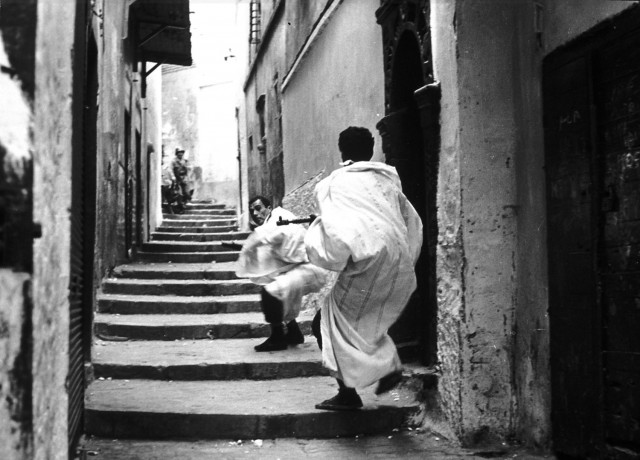
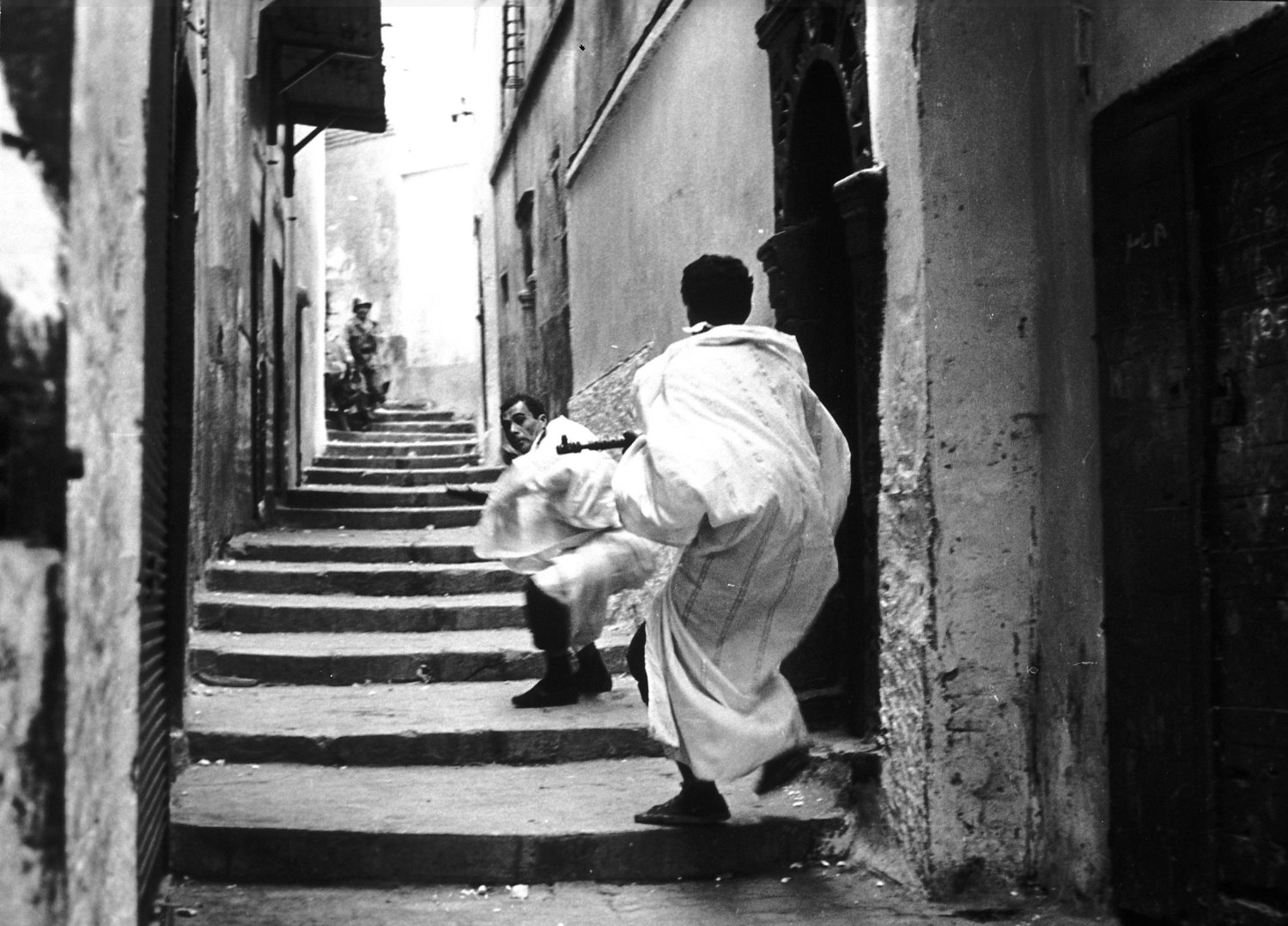
Terrorism and counterinsurgency take to the streets in Oscar-nominated The Battle of Algiers
In The Battle of Algiers, Pontecorvo (Kapò, Burn!) and screenwriter Franco Solinas follow a small group of FLN rebels, focusing on the young, unpredictable Ali la Pointe (Brahim Haggiag) and the more calm and experienced commander, El-hadi Jafar (Saadi Yacef, playing a character based on himself; the story was also inspired by his book Souvenirs de la Bataille d’Alger). Told in flashback, the film takes viewers from 1954 to 1957 as Mathieu hunts down the FLN leaders while the revolutionaries stage strikes, bomb public places, and assassinate French police. Shot in a black-and-white cinema-vérité style on location by Marcello Gatti — Pontecorvo primarily was a documentarian — The Battle of Algiers is a tense, powerful work that plays out like a thrilling procedural, touching on themes that are still relevant nearly fifty years later, including torture, cultural racism, media manipulation, terrorism, and counterterrorism. It seems so much like a documentary — the only professional actor in the cast is Martin — that it’s hardly shocking that the film has been used as a primer for the IRA, the Black Panthers, the Pentagon, and military and paramilitary organizations on both sides of the colonialism issue, although Pontecorvo is clearly on the side of the Algerian rebels. However, it does come as a surprise that the original conception was a melodrama starring Paul Newman as a Western journalist. All these years later, The Battle of Algiers, which earned three Oscar nominations (for Best Foreign Language Film in 1967 and Best Director and Best Original Screenplay in 1969), still has a torn-from-the-headlines urgency that makes it as potent as ever. The Battle of Algiers is screening on October 21 at 4:45 at BAM.
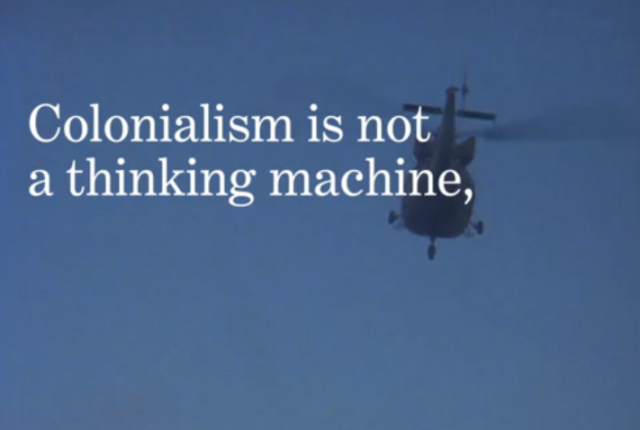
Documentary uses Swedish archival footage and the words of Frantz Fanon to tell story of colonization and decolonization
CONCERNING VIOLENCE (Göran Hugo Olsson, 2014)
Wednesday, October 25, 7:00
www.bam.org
www.facebook.com/concerningviolence
Swedish filmmaker Göran Hugo Olsson brings physician and psychiatrist Frantz Fanon’s seminal 1961 book, The Wretched of the Earth, to bold, vivid life in the empowering documentary Concerning Violence: Nine Scenes from the Anti-Imperialistic Self-Defense. “Every one of us must think for himself — always provided that he thinks at all; for in Europe today, stunned as she is by the blows received by France, Belgium, or England, even to allow your mind to be diverted, however slightly, is as good as being the accomplice in the crime of colonialism,” French philosopher Jean-Paul Sartre wrote in the lengthy preface to the book. For Concerning Violence, Olsson called on Columbia University professor Gayatri Chakravorty Spivak to provide a heavily academic introduction, setting the stage for nine examples of the relationship between settlers and natives, Europeans and Africans, in the 1960s, ’70s, and ’80s. As he did with his previous film, The Black Power Mixtape 1967-1975, Olsson uses amazing footage taken by Swedish journalists, including interviews with Christian missionaries, Zimbabwe president Robert Mugabe, reporter Gaetano Pagano, Burkina Faso president Thomas Sankara, black revolutionaries, and privileged white men, combining those stunning images with strong statements from Fanon’s treatise, read by Ms. Lauryn Hill and blasted across the screen in big letters. “Colonialism is not a thinking machine, nor a body endowed with reasoning faculties. It is violence in its natural state, and it will only yield when confronted with greater violence,” Hill states in a steady voice. “Decolonization is always a violent phenomenon. Decolonization is a historical process. It cannot be understood, it cannot become clear to itself except by the movements which give it historical form and content. Decolonization, which sets out to change the order of the world, is, obviously, a program of complete disorder.”
The nine “chapters” take viewers to Angola, Rhodesia, Liberia, Tanzania, Mozambique, Guinea-Bissau, and other current or former African nations, examining institutional racism, wealth and poverty, illegal imprisonment, guerrilla revolutions, the IMF, and the lurking “monster” that is the United States. It draws a brutal, powerful picture that pulls no punches, with expert use of archival footage never seen outside of Sweden. “There is no native who does not dream at least once a day of setting himself up in the settler’s place,” Ms. Hill reads, the words still ringing true today as riots and protests spread throughout the United States and civil wars continue in Africa and other continents. More than fifty years after its publication, The Wretched of the Earth is still a call to action, albeit one steeped in violence, as one can debate how much things have really changed. “The films in the Swedish Archive might have been part of a patronizing perspective at the time, but thirty years later, we think they reveal something important about this time to Europeans, Americans, and Africans — as well as others across the world who have been on either side of colonization, or are experiencing it now,” Olsson points out in his director’s statement. Concerning Violence is screening October 25 at 7:00 at BAM.
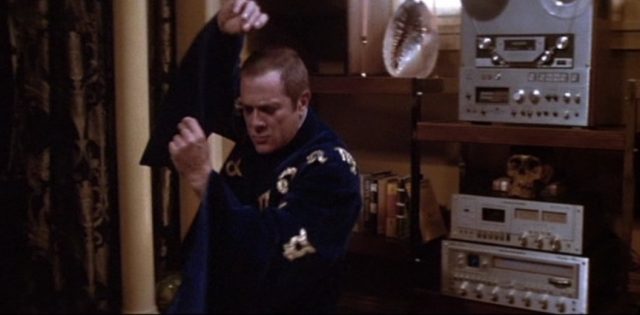
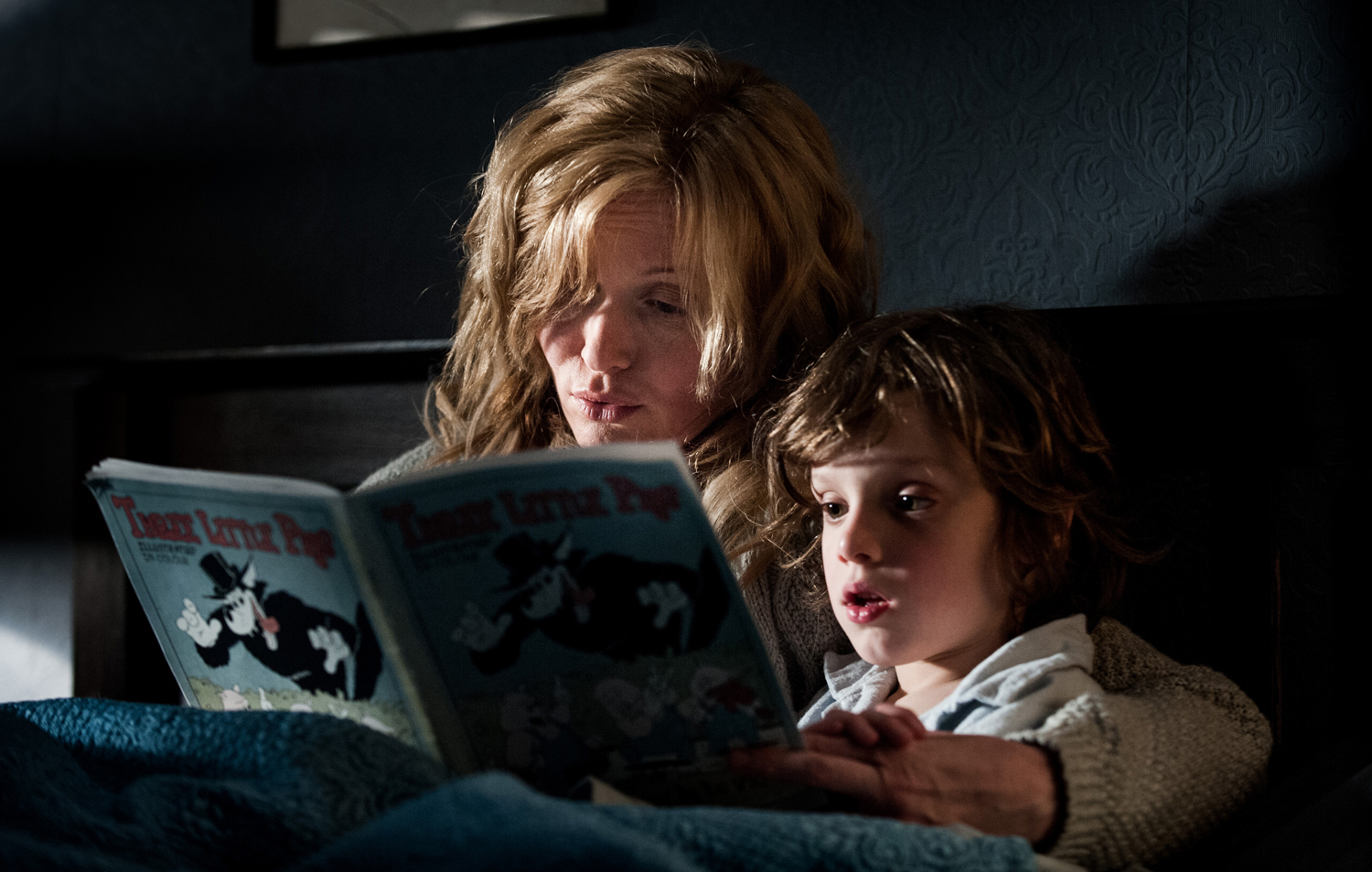
 A sleeper hit at Sundance that was named Best First Film of 2014 by the New York Film Critics Circle, The Babadook is a frightening tale of a mother and her young son — and a suspicious, scary character called the Babadook — trapped in a terrifying situation. Expanded from her 2005 ten-minute short, Monster, writer-director Jennifer Kent’s debut feature focuses on the relationship between single mom Amelia (Essie Davis), who works as a nursing home aide, and her seemingly uncontrollable six-year-old son, Samuel (Noah Wiseman), who is constantly getting into trouble because he’s more than just a little strange. Sam was born the same day his father, Oskar (Ben Winspear), died, killed in a car accident while rushing Amelia to the hospital to give birth, resulting in Amelia harboring a deep resentment toward the boy, one that she is afraid to acknowledge. Meanwhile, Sam walks around with home-made weapons to protect his mother from a presence he says haunts them. One night Amelia reads Sam a book that suddenly appeared on the shelf, an odd pop-up book called Mister Babadook that threatens her. She tries to throw it away, but as Sam and the book keep reminding her, “You can’t get rid of the Babadook.” Soon the Babadook appears to take physical form, and Amelia must face her deepest, darkest fears if she wants she and Sam to survive.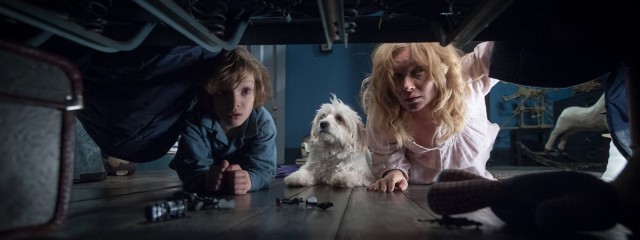


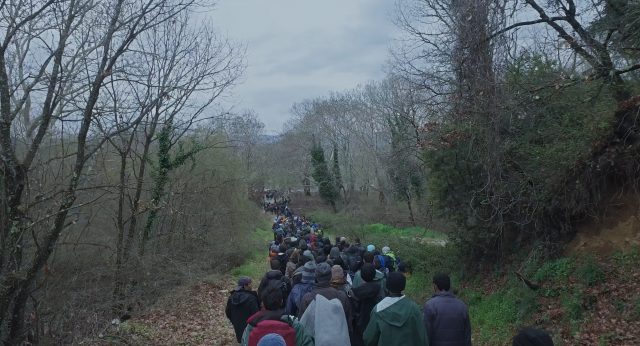
 This past fall, Chinese dissident artist Ai Weiwei had several concurrent exhibitions in New York City that dealt with the international refugee crisis. At Deitch Projects in SoHo,