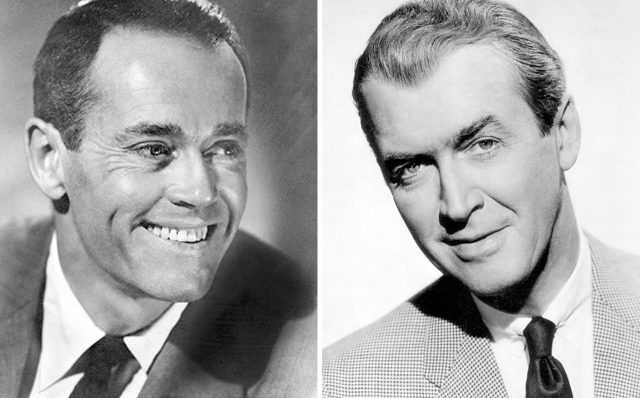
The long friendship Henry Fonda and Jimmy Stewart is the focus of terrific three-week series at Film Forum
Film Forum
209 West Houston St.
October 27 – November 16
212-727-8110
filmforum.org
If only America were more like the long relationship between Nebraska-born Oscar winner Henry Jaynes Fonda and Pennsylvania-born Oscar winner James Maitland Stewart. Fonda, who served in the Navy during WWII and passed away in 1982 at the age of seventy-seven, was a liberal Democrat who was married five times; Stewart, who served in the Army during WWII and passed away in 1997 at the age of eighty-nine, was married to the same woman for forty-four years. Not only did Hank and Jim disagree on politics, which they early on decided never to talk about in each other’s company, but they also went head-to-head for the Best Actor Oscar in 1941, when Stewart (The Philadelphia Story) beat Fonda (The Grapes of Wrath). Still, they remained best buddies, which is documented in Scott Eyman’s new book, Hank and Jim: the Fifty-Year Friendship of Henry Fonda and James Stewart (October 24, Simon & Schuster, $29), a tome that serves as the inspiration behind the fab Film Forum series “Hank and Jim,” running October 27 through November 16, consisting of more than three dozen movies made by the two actors, who both experienced success on Broadway as well as in Hollywood. (The onetime roommates met while trying to establish their careers in New York City.) Eyman will be at Film Forum to introduce several screenings and sign copies of his book.
The series begins October 27 with an Alfred Hitchcock double feature, The Wrong Man, starring Fonda as a jazz musician accused of murder, and Rope, in which Stewart plays a professor invited to a dinner party with an unexpected guest. That is followed October 28 with Sidney Lumet’s 12 Angry Men and Frank Capra’s Mr. Smith Goes to Washington, in which Fonda and Stewart both portray men with consciences who care about fairness and the truth. Other double features with films made by each man include The Ox-Bow Incident and Broken Arrow, Call Northside 777 and The Boston Strangler, The Moon’s Our Home and Next Time We Love, and Destry Rides Again and Daisy Kenyon, in addition to double features with just one of them and individual screenings of some of their greatest solo films. Fonda and Stewart made only three movies in which they appeared together, On Our Merry Way, Vincent McEveety’s Firecreek, and Gene Kelly’s The Cheyenne Social Club, but, oddly, none of them is part of this festival, nor is How the West Was Won, which stars both of them but they are never in the same scene.
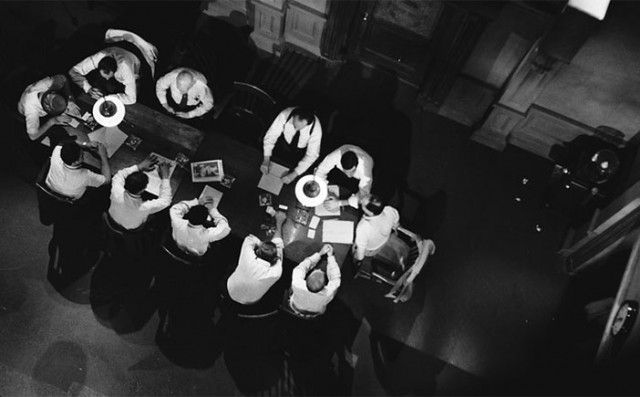
Sidney Lumet’s 12 Angry Men explores the consciences and more of a dozen jurors deciding a murder case
12 ANGRY MEN (Sidney Lumet, 1957)
Film Forum
Saturday, October 28, 3:00, 7:30
www.filmforum.org
 The fate of an eighteen-year-old boy charged with the murder of his father is at stake in Sidney Lumet’s first film, the gripping, genre-defining 12 Angry Men. After a series of establishing shots, a judge sends a dozen New Yorkers into the jurors room, where they need to come to a unanimous verdict that could lead to the execution of the teen. Over the course of about ninety minutes, an all-star cast examines and reexamines the case — and their own personal biases — as the heat increases, both literally and figuratively. At first, the nameless dozen men make small talk, trying to be friendly, but it’s not long before some of them are at others’ throats, primarily the gruff Lee J. Cobb, who has it in for the calm and thoughtful Henry Fonda, who is ready to stand alone if necessary for what he believes in. The other uniformly excellent actors playing a very specific cross-section of white, male America are John Fiedler, Martin Balsam, Robert Webber, E. G. Marshall, Jack Klugman, Edward Binns, Jack Warden, Ed Begley, Joseph Sweeney, and George Voskovec. “I tell you, we were lucky to get a murder case,” Webber tells Fonda, but he won’t feel the same as the tension reaches near-violent proportions. 12 Angry Men is a searing examination of the criminal justice system as well as basic human instincts, behavior, and common decency. The Philadelphia-born Lumet, whose parents were both in the Yiddish theater, is able to tell the story in cinematic ways despite its taking place mostly in one small, sweaty room, letting the intense acting drive the narrative; the director, who was nominated for an Oscar for the film, would go on to make such other classic New York City dramas as The Pawnbroker, The Anderson Tapes, Serpico, Dog Day Afternoon, and Prince of the City. Nominated for a Best Picture Oscar and winner of the Golden Bear at Berlin, 12 Angry Men, based on an original teleplay by Reginald Rose, is screening October 28 as part of a double feature with Frank Capra’s Mr. Smith Goes to Washington in the Film Forum series “Hank and Jim”; the 7:30 show will be introduced by Scott Eyman, author of Hank and Jim: the Fifty-Year Friendship of Henry Fonda and James Stewart, and followed by a book signing.
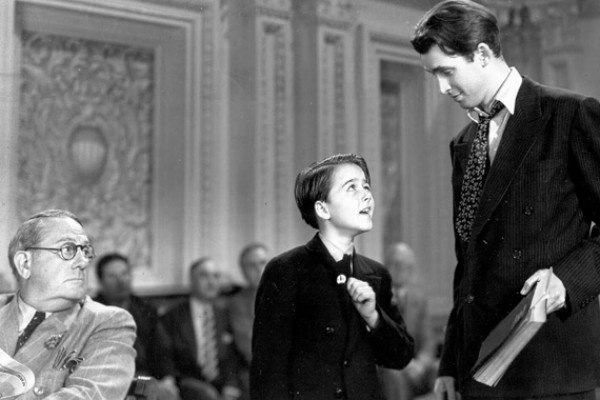
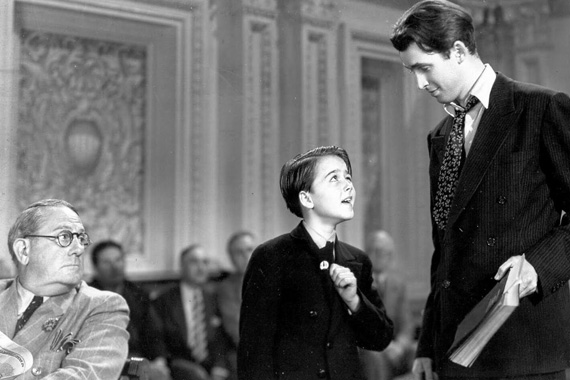
Jimmy Stewart takes filibustering to a whole new level in Mr. Smith Goes to Washington
MR. SMITH GOES TO WASHINGTON (Frank Capra, 1939)
Film Forum
Saturday, October 28, 12:30, 4:55
www.filmforum.org
 We love Jimmy Stewart; we really do. Who doesn’t? But a few years ago we had the audacity to claim that Jim Parsons’s performance as Elwood P. Dowd in the 2012 Broadway revival of Harvey outshined that of Stewart in the treacly 1950 film, and now we’re here to tell you that another of his iconic films is nowhere near as great as you might remember, although it still has its place in the Hollywood canon. Nominated for eleven Academy Awards, Frank Capra’s Mr. Smith Goes to Washington caused quite a scandal in America’s capital when it was released in 1939, depicting a corrupt democracy that just might be saved by a filibustering junior senator from a small state whose most relevant experience is being head of the Boy Rangers. (The Boy Scouts would not allow their name to be used in the film.) Stewart plays the aptly named Jefferson Smith, a dreamer who believes in truth, justice, and the American way. “I wouldn’t give you two cents for all your fancy rules,” Smith says of the Senate, “if, behind them, they didn’t have a little bit of plain, ordinary, everyday kindness and a little looking out for the other fella, too.” He’s shocked — shocked! — to discover that his mentor, the immensely respected Sen. Joseph Harrison Paine (played by Claude Rains, who was similarly shocked that there was gambling at Rick’s in Casablanca), is not nearly as squeaky clean as he thought, involved in high-level corruption, manipulation, and pay-offs that nearly drains Smith of his dreams. Having recently celebrated its seventy-fifth anniversary, Mr. Smith Goes to Washington is still, unfortunately, rather relevant, as things haven’t changed all that much, but Capra’s dependence on over-the-top melodrama has worn thin. It’s a good film, but it’s no longer a great one. Just in time for election day, Mr. Smith Goes to Washington is screening October 28 as part of a double feature with Sidney Lumet’s 12 Angry Men in the Film Forum series “Hank and Jim”; the 4:55 show will be introduced by Scott Eyman, author of Hank and Jim: the Fifty-Year Friendship of Henry Fonda and James Stewart, and followed by a book signing.
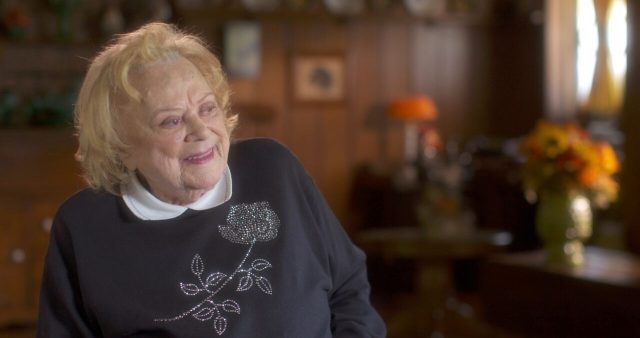
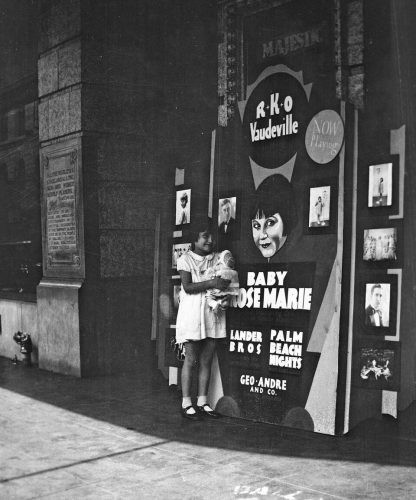
 To follow up his two Somm documentaries and Uncorked reality series, director Jason Wise decided his next film would be about how entertainment has changed over the last hundred years. But then he found “the kindest, toughest, hardest working, and most inspiring person I’ve ever met in my life” and was able to tell that same story from the point of view of one extraordinary figure. Wait for Your Laugh is the captivating, bittersweet tale of Rose Marie, who began her career at the age of three in 1926 and is still as feisty as ever at ninety-four. “Believe me when I tell you, she’s the history of show business,” longtime friend Peter Marshall, who is ninety-one himself, says of the actress, comedian, and singer, who was born Rose Marie Mazetta in New York City in 1923. She started out as Baby Rose Marie, having with her own radio show at the age of four; she went into vaudeville and performed on the cabaret circuit, appeared on Broadway, and was the first woman to host a TV game show. She fell in love with Bobby Guy, a trumpeter for Kay Kyser and Bing Crosby; was beloved and supported by Al Capone and Bugsy Siegel; opened the Flamingo in Vegas with Jimmy Durante; costarred in such television series as The Dick Van Dyke Show and The Doris Day Show and was a long-running favorite on The Hollywood Squares; and developed the successful touring show 4 Girls 4 with Margaret Whiting, Helen O’Connell, and Rosemary Clooney. All along the way, she fought fiercely for her independence, constantly expanding her repertoire, determined to always be working, preferably her way.