The Prince and the Dybbuk makes its U.S. premiere at the New York Jewish Film Festival
THE PRINCE AND THE DYBBUK (Piotr Rosolowski & Elwira Niewiera, 2017)
Film Society of Lincoln Center, Walter Reade Theater
165 West 65th St. at Amsterdam Ave.
Wednesday, January 10, 2:45, and Thursday, January 11, 9:00
Festival runs January 10-23
212-875-5601 www.filmlinc.org prince-dybbuk.com
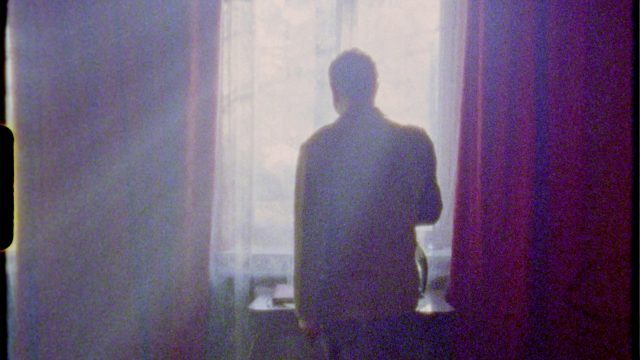
The New York Jewish Film Festival gets under way January 10 with an intriguing look at enigmatic filmmaker Michał Waszyński, the director of one of the most important Yiddish movies of all time, the 1937 supernatural tale The Dybbuk. In The Prince and the Dybbuk, directors Piotr Rosolowski and Elwira Niewiera find that discovering who Waszyński was is like chasing a ghost, as he continually reinvented himself while being haunted by a past he tried to erase. Like the characters in many of the films he produced and directed, he was constantly searching for his true identity as he journeyed from Poland and Germany to Italy and Spain. “He was in his world, so mysterious and exciting. Nobody really knows what he’s really like,” one of his assistant directors, Enrico Bergier, says. Throughout the eighty-minute documentary, friends, relatives, colleagues, and others describe Waszyński, who produced and/or directed nearly 150 films, as a gentleman, Jewish, Catholic, noble-minded, lonely, elegant and refined, an exceptional boss, generous, isolated, very smart, a larger-than-life character, an aristocrat, a bit strange, and a mythomaniac. He married a countess, dubbing himself the Polish Prince, and took one of his actors, Albin Ossowski, to gay restaurants. “He was longing for his youth,” Ossowski says. He hobnobbed with Orson Welles, Sophia Loren, Audrey Hepburn, and Claudia Cardinale. He appeared in Joseph L. Mankiewicz’s 1954 film, The Barefoot Contessa. He was singled out by Josef Goebbels as an enemy. He was involved with such 1960s blockbusters as El Cid and The Fall of the Roman Empire as well as smaller Eastern European films, most famously The Dybbuk, about a young bride possessed by a spirit. Rosolowski and Niewiera, who previously collaborated on the award-winning Domino Effect, include newsreel footage, family photos, home movies, a behind-the-scenes promotional piece narrated by James Mason about the making of Anthony Mann’s budget-busting The Fall of the Roman Empire, spoken excerpts from Waszyński’s diaries, and clips from such Waszyński films as His Excellency the Shop Assistant, Unknown Man of San Marino, Dvanáct kresel, Gehenna, Wielka Droga, Zabawka, and Znachor, many of which feature lost characters.
Enigmatic filmmaker Michał Waszyński (in red shirt) plays cards in Joseph L. Mankiewicz’s The Barefoot Contessa
Waszyński was born Moshe Waks in the village of Kovel in Poland (what is now Ukraine) in 1904 and later changed his name to Michał Waszyński and converted to Catholicism. Even when facts are revealed about him, there is no evidence about why he did the things he did in his personal life. “To me he was a great magician. He lived in a dream world, because cinema is a dream,” explains Maurizio Dickmann, a member of the Italian family that took him in. Later, in an Under the Flag of Love radio broadcast, Waszyński explains, “I do what I love. Cinema is my passion and it stimulates my intellect. . . . To me, film is like a second reality, subject to completely different rules. In a split second, a king can become a shepherd or a beggar a rich man.” His diaries divulge a dark side about his search for who he is and who he was as he transformed himself from shepherd to king. “My city vanishes from my mind, as if the place of my youth had never existed,” he writes. “But I can never rid myself of you. You were the one who abandoned us. Although, even now, in my dreams and when awake, you return to me every night, like a stab to the heart. You drive deep inside me. Like an evil spirit, you circle around me.” Waszyński was chased by spirits his entire life — he passed away suddenly in 1965 — and turned to the movies for answers, which only led to more questions. Named Best Documentary on Cinema at the Venice Film Festival, The Prince and the Dybbuk is making its U.S. premiere at the New York Jewish Film Festival, screening at the Walter Reade Theater on January 10 at 2:45 and January 11 at 9:00, preceded by Daria Martin’s short film A Hunger Artist, based on the Franz Kafka story. The January 11 screening will be followed by a Q&A with Rosolowski, Niewiera, and Martin. A copresentation of the Jewish Museum and the Film Society of Lincoln Center, the festival, which runs January 10-23, is also showing the world premiere of a brand-new restoration of The Dybbuk on January 14 and 17.
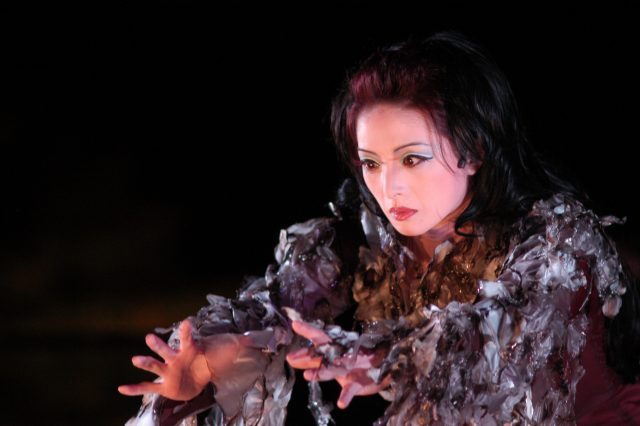
Desdemona tells her dark tale in Satoshi Miyagi’s Mugen Noh Othello (photo by Takuma Uchida)
Japan Society
333 East 47th St. at First Ave.
January 11-14, $35
Under the Radar continues through January 15
212-715-1258 www.japansociety.org www.publictheater.org
In September 2011, general artistic director Satoshi Miyagi and the Shizuoka Performing Arts Center sold out Japan Society with their international success, Medea, a unique reinterpretation of Euripedes’s classic tragedy. They now return with a retelling of Shakespeare’s Othello, being presented as part of the Public Theater’s Under the Radar festival and concluding Japan Society’s “NOH-NOW” series, which previously featured Luca Veggetti’s Left-Right-Left, Hiroshi Sugimoto’s Rikyu-Enoura, and Siti Company’s Hanjo. The Tokyo-born Miyagi, who has also directed versions of Hamlet and A Midsummer Night’s Dream for SPAC as well as Ibsen’s Peer Gynt and many Japanese dramas, including Mishima’s The Black Lizard, transforms the Bard’s tale of jealousy and pride into a mugen noh, a story told by a spirit, in this case Desdemona, the wife of Othello, a successful general deceived by his ensign, Iago, who seeks revenge on Othello for promoting Iago’s rival, the soldier Cassio. The ninety-minute show, performed in Japanese with English surtitles, is dark and ominous, with a script by Sukehiro Hirakawa, chanting, live music composed by Hiroko Tanakawa, beguiling costumes and masked figures designed by Kayo Takahashi, and lighting by Koji Osako. The company consists of Kazunori Abe, Yuya Daidomumon, Asuka Fuse, Maki Honda, Sachiko Kataoka, Yukio Kato, Kotoko Kiuchi, Micari, Keita Mishima, Fuyuko Moriyama, Yoneji Ouchi, Yu Sakurauchi, Junko Sekine, Haruyo Suzuki, Ayako Terauchi, and Soichiro Yoshiue. Also part of Japan Society’s 110th anniversary, Mugen Noh Othello is scheduled for only four performances, January 11-13 at 7:30 and January 14 at 4:00; opening night will be followed by a reception with the artists, while the January 12 show will be followed by a Q&A. In addition, SPAC will be teaching a Theater Technique workshop on January 13 at 1:30 ($45), focusing on body exercises required for its unique voice production.
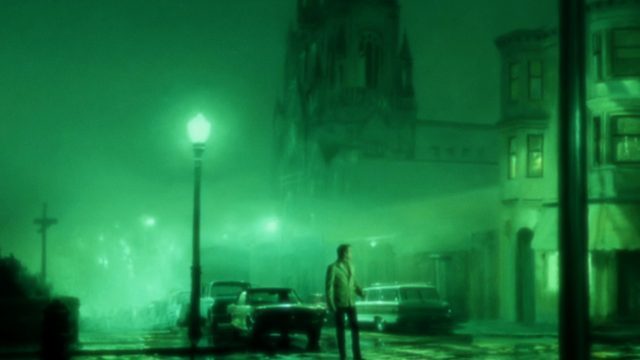
Guy Maddin, Evan Johnson, and Galen Johnson reimagine Alfred Hitchcock’s Vertigo with clips from old films in The Green Fog
THE GREEN FOG (Guy Maddin, Evan Johnson, and Galen Johnson, 2017)
IFC Center
323 Sixth Ave. at West Third St.
Opens Friday, January 5
212-924-7771 www.ifccenter.com guy-maddin.com
Winnipeg-based filmmakers Guy Maddin, Evan Johnson, and Galen Johnson ingeniously reimagine Alfred Hitchcock’s psychosexual masterpiece, Vertigo, using clips from dozens of movies and television shows in the mesmerizing pastiche The Green Fog. When Maddin, who has made such previous films as Careful, The Saddest Music in the World, and My Winnipeg, which use early-cinema conventions and look like rediscovered, decayed old works, was commissioned by the San Francisco International Film Festival to make a film for its sixtieth anniversary, Maddin turned to the Johnson brothers, his collaborators on The Forbidden Room and Bring Me the Head of Tim Horton, and began poring over movies and TV shows set in the City by the Bay. Along the way they were continually reminded of Vertigo as they recognized locations from the classic thriller about an agoraphobic detective obsessed with a woman who resembles his former love. So the trio decided to re-create Vertigo with found footage, not shot-by-shot like Gus Van Sant did with Psycho but by employing themes, places, pacing, mood, and tension similar to Hitchcock’s, and in about half the time. (The Green Fog runs sixty-three minutes, Vertigo slightly more than two hours.)
The Green Fog incorporates clips from such genre movies as Sudden Fear, starring Joan Crawford
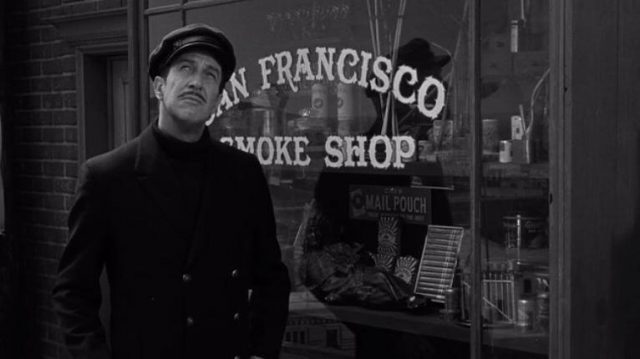
In sections with such titles as “Prologue,” “Weekend at Ernie’s,” and “Catatonia,” Maddin and the Johnsons follow the general story line of Vertigo,, with the Jimmy Stewart role “played” primarily by Rock Hudson from McMillan & Wife, Vincent Price from Confessions of an Opium Eater, and Chuck Norris from Slaughter in San Francisco and An Eye for an Eye. There’s a rooftop chase, a visit to a flower shop, scenes in restaurants and with paintings in museums, and a trip up a tower. Occasionally a green fog threatens ominously. In the vast majority of the clips, the dialogue has been cut out, so the characters are seen in choppy edits looking at each other in offbeat ways, allowing viewers to infer their own Vertigo-esque narrative. Because viewers are likely not to be familiar with many of the scenes from the movies and thus don’t know the relationships between the characters, issues of sexuality, homoeroticism, and even incest arise as Maddin and the Johnsons redefine the male gaze — so prevalent in Hitchcock films — while passing the Bechdel test. Snippets of conversation occasionally come through, usually involving people watching surveillance footage on film or monitors or listening to tape recordings, commenting with inside jokes and references to the making of The Green Fog. “What are we looking for, sir?” Sgt. Enright (John Schuck) asks Commissioner McMillan (Hudson), who responds, “I don’t know, but at this point I’ll take anything.” McMillan also says, “That’s the trouble with that old film,” and later sets fire to filmstrips, leading to a series of disasters of epic proportions. And Michael Douglas as Det. Steve Keller from The Streets of San Francisco watches Michael Douglas as Det. Nick Curran from Basic Instinct get out of bed and walk to the bathroom naked. “Boy, you look good, Mike. You ever thought about going into showbiz?” Keller says to Lt. Stone (Malden).
Vincent Price is one of many actors who “portray” John “Scottie” Ferguson (Jimmy Stewart) in mesmerizing cinematic collage based on Vertigo
Many shots echo the doubling mirror image that is at the heart of Vertigo. In a scene from Nicholas Ray’s Born to Be Bad, Gobby Broome (Mel Ferrer) watches what appears to be twin girls looking intently at two paintings in a museum. In a restaurant, a daughter tells her father, “I’m trying to become somebody,” as if there’s another persona waiting to burst out of her. And Lt. Stone puts on clown makeup to try to catch a killer. Among the other actors who show up in the film are Mel Brooks, Lee Remick, Martin Landau, Nancy Kwan, Clint Eastwood, Meg Ryan, Richard Gere, Kim Basinger, Donald Sutherland, Miriam Hopkins, Dean Martin, Fritz Weaver, Sandra Bullock, Claude Akins, Sharon Stone, John Saxon, Joan Crawford, Sidney Poitier, Humphrey Bogart, Joseph Cotten, and Veronica Cartwright, from such movies and TV series as Murder She Wrote, Mission: Impossible, Hotel, Bullitt, High Anxiety, Dark Passage, Star Trek IV: The Voyage Home, The Towering Inferno, It Came from Beneath the Sea, Barbary Coast, The Conversation, Flower Drum Song, The Love Bug, Dirty Harry, A View to a Kill, The Lady from Shanghai, Sans Soleil, Sister Act, So I Married an Axe Murderer, Pal Joey, Invasion of the Body Snatchers, The Ten Commandments, and They Call Me Mister Tibbs! as well as an *NSYNC video. The intense, titillating score was composed by Jacob Garchik and is performed by the San Francisco-based Kronos Quartet. The Green Fog also evokes Christian Marclay’s The Clock and Telephones, in which the Swiss and American visual and sound artist edited together existing film footage to create narratives based on time and phone conversations, respectively. As with those montage-based works, it’s easy to get caught up in trying to identify the actors and the movies in The Green Fog, but don’t forget that the clips are all being employed to come up with something brand new that stands on its own. Maddin (Tales from the Gimli Hospital,Keyhole) and the Johnsons have made a dazzling love letter to Vertigo, to San Francisco, and to the history of movies themselves, offering a treasure trove of fun worthy of repeated viewings.
The Green Fog opens January 5 at IFC Center, screening with Maddin and the Johnson brothers’ 2015 short Lines of the Hand, which is based on Jean Vigo’s unrealized film poem Les lignes de la main and stars film critic Luce Vigo, who is Vigo’s daughter, along with Geraldine Chaplin and Udo Kier. Maddin will participate in a Q&A with SFFILM executive director Noah Cowan following the 8:55 show on January 5 in addition to Q&As after the 4:50 and 8:55 screening on January 6. There will also be some double features pairing The Green Fog with Vertigo.
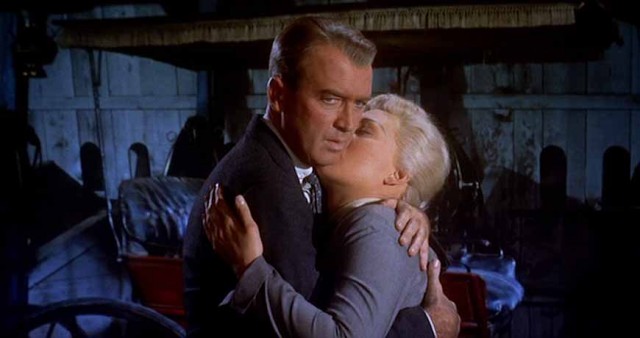
James Stewart and Kim Novak get caught up in a murder mystery in Vertigo
VERTIGO (Alfred Hitchcock, 1958)
IFC Center
323 Sixth Ave. at West Third St.
Opens Friday, January 5
212-924-7771 www.ifccenter.com
Select screenings of The Green Fog will be accompanied by Alfred Hitchcock’s 1958 mind-altering, fetishistic psychological thriller, Vertigo, which heavily influenced Guy Maddin, Evan Johnson, and Galen Johnson’s San Francisco montage. Based on Boileau-Narcejac’s 1954 novel, D’entre les morts, the film delves deep into the nature of fear and obsession. Jimmy Stewart stars as John “Scottie” Ferguson, a police detective who retires after his acrophobia leads to the death of a fellow cop. An old college classmate, wealthy businessman Gavin Elster (Tom Holmore), asks Scottie to look into his wife’s odd behavior; Elster believes that Madeleine (Kim Novak) is being inhabited by the spirit of Carlotta Valdes, her great-grandmother, a woman who committed suicide in her mid-twenties, the same age that Madeleine is now. Scottie follows Madeleine as she goes to Carlotta’s grave, visits a portrait of her in a local museum, and jumps into San Francisco Bay. Scottie rescues her, brings her to his house, and starts falling in love with her. But on a visit to Mission San Juan Bautista, tragedy strikes when Scottie can’t get to the top of the tower because of his vertigo. After a stint in a sanatorium, he wanders the streets of San Francisco where he and Madeleine had fallen in love, as if hoping to see a ghost — and when he indeed finds a woman who reminds him of Madeleine, a young woman named Judy Barton (Novak), he can’t help but try to turn her into his lost love, with tragedy waiting in the wings once again.
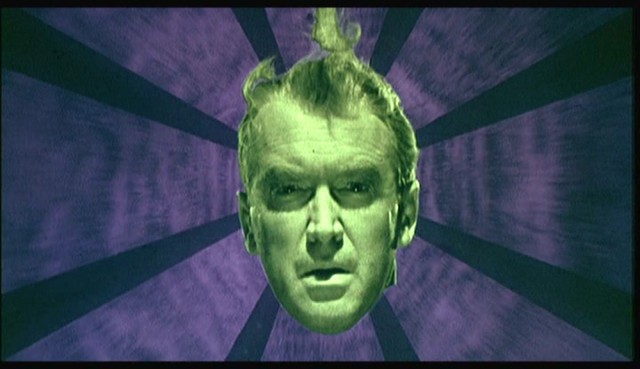
Scottie experiences quite a nightmare in Alfred Hitchcock classic
Vertigo is a twisted tale of sexual obsession, much of it filmed in San Francisco, making the City by the Bay a character all its own as Scottie travels down Lombard St., takes Madeleine to Muir Woods, stops by Ernie’s, and saves Madeleine under the Golden Gate Bridge. The color scheme is almost shocking, with bright, bold blues, reds, and especially greens dominating scenes. Hitchcock, of course, famously had a thing for blondes, so it’s hard not to think of Stewart as his surrogate when Scottie insists that Judy dye her hair blonde. Color is also central to Scottie’s psychedelic nightmare (designed by artist John Ferren), a Spirographic journey through his mind and down into a grave. Cinematographer Robert Burks’s use of the dolly zoom, in which the camera moves on a dolly in the opposite direction of the zoom, keeps viewers sitting on the edge of their seats, adding to the fierce tension, along with Bernard Herrmann’s frightening score. Despite their age difference, there is pure magic between Stewart, forty-nine, and Novak, twenty-four. (Stewart and Novak next made Bell, Book, and Candle as part of the deal to let Novak work for Paramount while under contract to Columbia.)
The production was fraught with problems: The screenplay went through Maxwell Anderson, Alec Coppel, and finally Samuel A. Taylor; shooting was delayed by Hitchcock’s health and vacations taken by Stewart and Novak; a pregnant Vera Miles was replaced by Novak; Muir Matheson conducted the score in Europe, instead of Herrmann in Hollywood, because of a musicians’ strike; associate producer Herbert Coleman reshot one scene using the wrong lens; Hitchcock had to have a bell tower built atop Mission San Juan Bautista after a fire destroyed its steeple; and the studio fought for a lame alternate ending (which was filmed). Perhaps all those difficulties, in the end, helped make Vertigo the classic it is today, gaining in stature over the decades, from mixed reviews when it opened to a controversial restoration in 1996 to being named the best film of all time in Sight & Sound’s 2012 poll to a recent digital restoration.
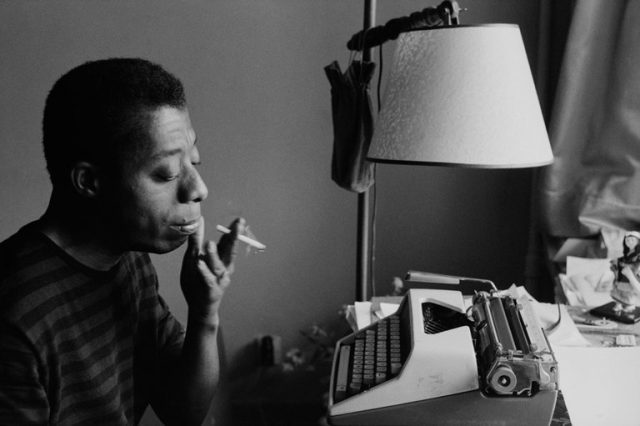
Brooklyn Museum screening of I Am Not Your Negro will be followed by discussion of activism with James Baldwin’s niece
Brooklyn Museum
200 Eastern Parkway at Washington St.
Saturday, January 6, free, 5:00 – 11:00
212-864-5400 www.brooklynmuseum.org
The Brooklyn Museum looks to 2018 with its January First Saturday program, “New Year, New Futures.” There will be live music by Sinkane, BEARCAT, Zaven of Resonator Collective (an in-gallery soundscape for the terrific exhibition “Proof: Francisco Goya, Sergei Eisenstein, Robert Longo”), and New Kingston; a curator tour of “Rodin at the Brooklyn Museum: The Body in Bronze” with Lisa Small; a hands-on art workshop in which participants can make zines inspired by “Proof”; a community talk with Murad Awawdeh, the vice president of advocacy at the New York Immigration Coalition; a screening of the Oscar-nominated documentary about James Baldwin, I Am Not your Negro (Raoul Peck, 2017), followed by a discussion with activists Jessica Green and Aisha Karefa-Smart (Baldwin’s niece); a Feminist Book Club event focusing on the 1970 book Sisterhood Is Powerful: An Anthology of Writings from the Women’s Liberation Movement, edited by Robin Morgan, hosted by Glory Edim of Well-Read Black Girl based on selections by Judy Chicago; pop-up gallery talks on “Roots of ‘The Dinner Party’: History in the Making”; a Brooklyn Dance Festival movement workshop and live performances; pop-up poetry with DéLana R. A. Dameron (Weary Kingdom) and Rickey Laurentiis (Boy with Thorn), followed by a signing; and a NYLaughs comedy showcase with Negin Farsad, Nimesh Patel, and Jordan Carlos, hosted by Ophira Eisenberg and followed by a discussion on humor, activism, and crisis. In addition, the galleries will be open late so you can check out “Roots of ‘The Dinner Party’: History in the Making,” “Soulful Creatures: Animal Mummies in Ancient Egypt,” “Proof: Francisco Goya, Sergei Eisenstein, Robert Longo,” “Arts of Asia and the Middle East,” “Infinite Blue,” “Ahmed Mater: Mecca Journeys,” “Rodin at the Brooklyn Museum: The Body in Bronze,” “A Woman’s Afterlife: Gender Transformation in Ancient Egypt,” and more.
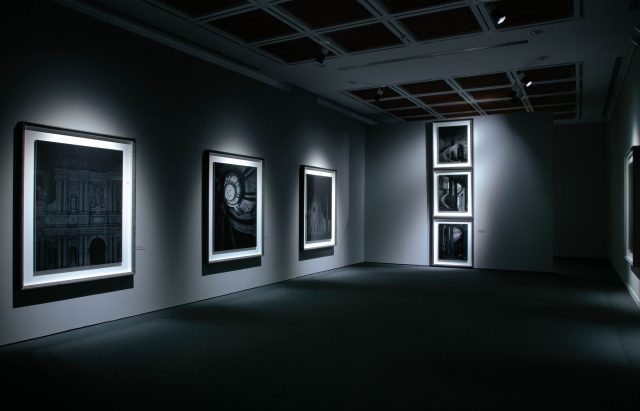
Hiroshi Sugimoto followed the journeys of the Tenshō Embassy through Italy for photographic series (photo by Richard Goodbody)
Japan Society
333 East 47th St. at First Ave.
Through January 7, $12
212-715-1258 www.japansociety.org
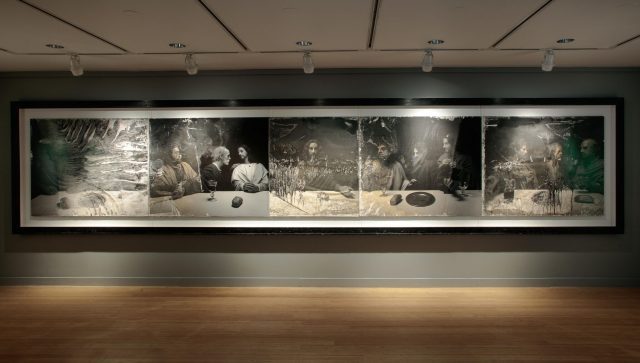
In his 2005-6 Japan Society exhibition “History of History,” Tokyo-born multidisciplinary artist Hiroshi Sugimoto explored time and spirituality by including his photographic works alongside artifacts from his personal collection dating from the prehistoric era to the fifteenth century. Throughout his career, he has constructed his own professional history by photographing dioramas at natural history museums (“Still Life”), capturing electrical discharges on photographic dry plates (“Lightning Fields”), focusing on the horizon line across the ocean (“Seascapes”), shooting wax figures to look like paintings (“Portraits”), using long exposures to reveal the blinding soul of movie palaces (“Theaters”), and turning one thousand gilded wooden Buddha statues at Sanjῡsangen-dō (Hall of Thirty-Three Bays) in Kyoto into a dizzying film (Sea of Buddha). His latest Japan Society show, “Hiroshi Sugimoto: Gates of Paradise,” on view through January 7 as part of the institution’s 110th anniversary celebration, returns to historical investigation, from a larger cultural perspective rather than a personal one.
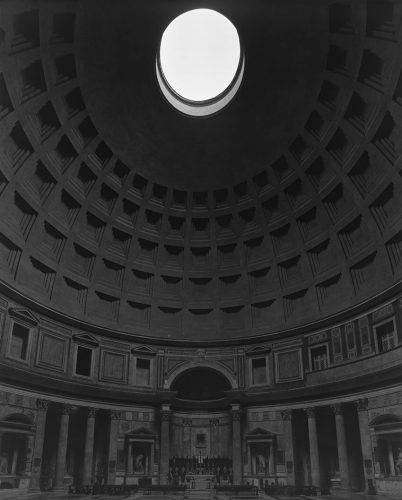
In 2015, while Sugimoto, who is based in Japan and New York City, was traveling through Italy photographing theaters, he learned of the fascinating story of Mancio Ito, Miguel Chijiwa, Juliao Nakaura, and Martinao Hara, four young Japanese men who were sent to Europe in 1582 to experience Western Christian culture. Known as the Tenshō Embassy, they returned eight years later with much information that influenced Japanese and nanban hybrid art, taught by Jesuit missionaries, which combined Eastern and Western subjects and techniques. Sugimoto decided to follow their journey, taking photographs of landmark structures and artworks the young men most likely saw, including the Pantheon in Rome, the Leaning Tower of Pisa, the Siena Duomo, the Duomo in Florence, the Villa Farnese, the Pietà by Michelangelo, and the Teatro Olimpico in Vicenza. Those works are displayed along with related historical objects that add intriguing context. “Pope Gregory XIII welcomed the four boys because he saw them as renewing the spirit of the three wise men coming from the East to pay homage to the newborn Christ,” Sugimoto explains in his artist statement. “That sense of mutual surprise from over four centuries ago still flows, not quite wholly absorbed, in my bloodstream.”
Sugimoto, who will turn seventy this year, produced silver gelatin prints of the places, casting the images in an austere, ghostlike darkness. The hole at the top of the inside of the Pantheon glows with light. The winding staircase at Villa Farnese unfolds in a captivating vertical triptych. The long hallway of the Teatro Olimpico beckons. In its own room, “The Last Supper: Acts of God” features Sugimoto’s more-than-twenty-two-foot-long horizontal photograph of Leonardo da Vinci’s iconic painting; the photo was significantly damaged when Sugimoto’s Chelsea studio was flooded by Hurricane Sandy. However, the destruction lends new meaning to the work, with some sections sharp and distinct, others looking melted and severely scratched — and adding what appears to be a halo around the head of Jesus. “I chose to interpret this as the invisible hand of God coming down to bring my monumental, but unfinished, ‘Last Supper’ to completion,” Sugimoto writes. “Leonardo completed his ‘Last Supper’ over five hundred years ago and it has deteriorated beautifully. I can only be grateful to the storm for putting my work through the same half millennium of stresses in so short a time.” Sugimoto’s photograph is accompanied by a fourteenth-century Japanese bust of Christ’s head that has been badly damaged.
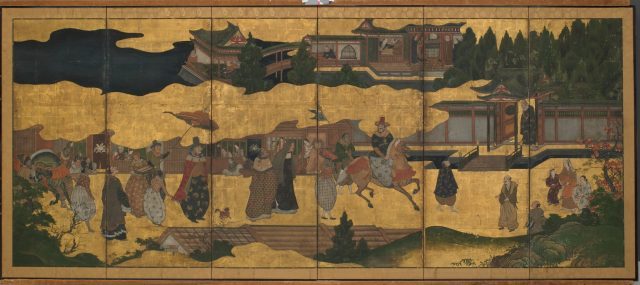
Unidentified artist, “A Portuguese Trading Ship Arrives in Japan,” pair of six-panel folding screens, ink, color, gold, and gold-leaf on paper, early 17th century (Feinberg Collection)
Sugimoto has curated a collection of letters, portraits, scrolls, screens, and other objects that reveals the cross-cultural exchange between Japan and Europe that emerged during the “Christian Century” of the 1500s as missionaries came to the East and converted many Japanese. “A Portuguese Trading Ship Arrives in Japan,” consisting of a pair of early-seventeenth-century six-panel nanban folding screens, uses both European and Japanese techniques to relate the story of the West meeting the East. The details in the individual sections are worth examining at length to explore the architecture, manner of dress, and facial expressions. A bamboo vase, hanging scroll letter, and tea scoop belonging to tea master Sen no Rikyū refers to chanoyu, “the way of tea,” a ritual that was the focus of Sugimoto’s Rikyu-Enoura, an original theatrical production that ran in early November as part of Japan Society’s “NOH NOW” series.
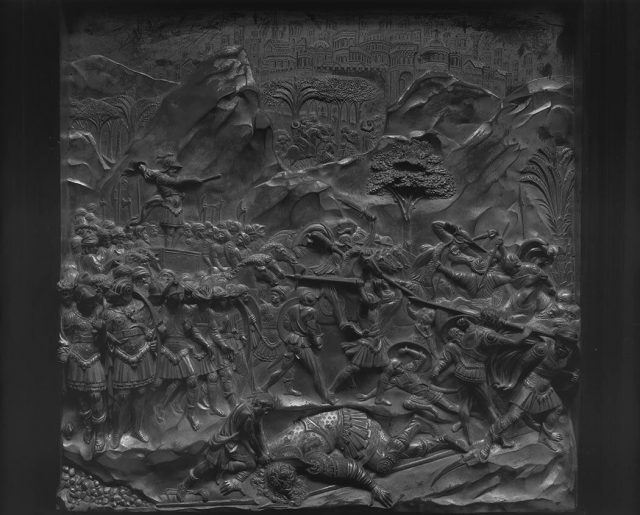
In the final room, Sugimoto debuts his latest series, “Gates of Paradise,” large-scale photographs of the bronze doors created by Lorenzo Ghiberti for the Baptistery of St. John in Florence from 1425 to 1452. Dubbed the “Gates of Paradise” by Michelangelo, the work underwent a major decades-long renovation and was moved to the Opera del Duomo Museum in 2012, where Sugimoto saw them. There are ten pieces from the black-and-white series, gelatin silver prints that give the bronze doors a different, haunting look. Among the subjects are Adam and Eve, Cain and Abel, Noah, Abraham, Jacob and Esau, Solomon, David, and Joshua, in biblical scenes that sometimes require a bit of entertaining deciphering. (And don’t miss Sugimoto’s “Red and White Plum Blossoms Under Moonlight,” a stunning platinum and palladium print on two screens that he produced in commemoration of the three hundredth anniversary of the birth of Japanese artist Ogata Kōrin.) It is an engaging and stimulating conclusion to the exhibit, for which Sugimoto also redesigned Japan Society’s lobby pond and upstairs corner garden, adding a stainless-steel sculpture to each. On January 6 from 6:00 to 9:00, in conjunction with the closing of the show, Japan Society is hosting “Escape East @ 333,” the next edition of its monthly mixer for art enthusiasts, with a viewing of the exhibition, live music from DJ Aki, and sake tastings; admission is free with advance registration.
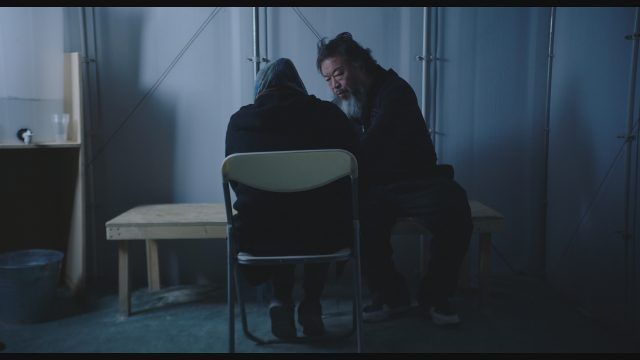
Ai Weiwei takes a close look at the international refugee crisis in Human Flow
HUMAN FLOW (Ai Weiwei, 2017) Quad Cinema, 34 West 13th St. between Fifth & Sixth Aves., 212-255-2243, Wednesday, January 3, 4:30 BAMcinématek, BAM Rose Cinemas, 30 Lafayette Ave. between Ashland Pl. & St. Felix St., 718-636-4100, Wednesday, January 3, 7:00 www.humanflow.com
On January 3, Chinese dissident artist Ai Weiwei will travel from Manhattan to Brooklyn, participating in two Q&As following screenings of his stunning new documentary, Human Flow. This past fall, Ai had several concurrent exhibitions in New York City that dealt with the international refugee crisis. At Deitch Projects in SoHo, “Laundromat” included racks of clothing that had been worn by Syrian refugees at the Idomeni refugee camp in Iraq, all freshly cleaned and pressed, as if ready to give the migrant men, women, and children a new lease on life. Among other items, the gallery show also featured several monitors playing footage that Ai had shot in various refugee camps, film that has now been turned into Human Flow. In 2016, Ai and his crew traveled to twenty-three countries, visiting dozens of camps in a year in which it was estimated that there were as many as 65 million displaced people around the world, fleeing war, poverty, famine, and persecution. In his first full-length documentary, Ai moves from macro to micro, shooting at a variety of scales. He uses drones to photograph tent cities in the desert from high above — reminiscent of the photography of Edward Burtynsky, turning individual items into parts of a vast pattern — along with gorgeous scenes of deserts and seascapes and intimate cell-phone footage and handheld camera shots that put viewers right in the middle of these makeshift villages, where some families live for decades. Ai, with his scruffy gray beard and in a hoodie, is often shown not only taking cell-phone videos but helping out and mingling with the refugees as dinghies arrive on the shores of Lesbos, Greece, or playfully trading passports with a refugee. Throughout the film, men and women stand proudly, often in traditional dress, looking directly at the camera for extended lengths of time, establishing their unique individuality, putting faces to what is most often seen in news clips as swaths of people struggling to survive. As Ai travels to each successive camp, he posts relevant quotes from writers and philosophers from that nation, from Turkish poet Nazim Hikmet, the Dhammapada Buddhist scripture, and Persian poet Baba Tahir to Kurdish poet Sherko Bekas, Syrian poet Adonis, and U.S. president John F. Kennedy. Details about the situations are sometimes delivered news-crawl-style, along the bottom of the screen.
Ai Weiwei gets deeply involved in situation in Human Flow
In addition to giving voice to the refugees themselves — “Where am I supposed to start my new life?” one woman asks — Ai speaks with crisis workers on the ground and United Nations officials and other experts, such as UNHCR Communications Officer Boris Cheshirkov, Princess Dana Firas of Jordan, Human Rights Watch Emergencies Director Peter Bouckaert, UN High Commissioner for Refugees Filippo Grandi, UNHCR Pakistan Senior Operation Coordinator Marin Din Kajdomcaj, UNICEF Lebanon representative Tanya Chapuisat, former Syrian astronaut Mohammad Fares, Dr. Cem Terzi of the Association of Bridging Peoples, and Dr. Kemal Kirişci, a senior fellow at the Brookings Institution who gets right to the point, explaining, “It’s going to be a big challenge to recognize that the world is shrinking, and people from different religions, different cultures, are going to have to learn to live with each other.” The powerful, immersive film was edited by Niels Pagh Andersen, who worked on Joshua Oppenheimer’s searing The Act of Killing and The Look of Silence, from nine hundred hours of footage, with a score by Karsten Fundal and a dozen cinematographers, among them Ai, Christopher Doyle, Zhang Zanbo, Konstantinos Koukoulis, and Johannes Waltermann. “The more immune you are to people suffering, that’s very, very dangerous. It’s critical for us to maintain this humanity,” one woman says, and that gets right to the heart of the film. Human Flow is very personal to Ai, whose own battles with Chinese authorities and exile — he spent much of his childhood in a hard labor camp in the Gobi Desert because his father, a poet and intellectual, was part of a revolutionary group, and as an adult Ai has been imprisoned, placed under house arrest, and beaten for his activism — were detailed in the Ai Weiwei: Never Sorry. A masterful Conceptualist whose work explores sociocultural elements through a historical lens, Ai has always believed that artists have a responsibility to reveal the truth, and that’s precisely what he does in Human Flow, with a determined fearlessness to do what’s right.
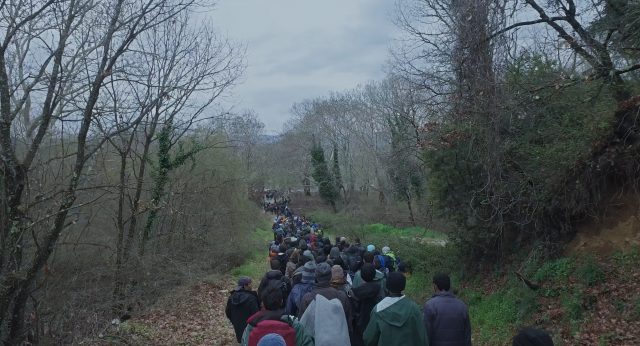
In one of the film’s most heart-wrenching moments, thirteen thousand refugees, mostly from Syria, Iraq, and Afghanistan, walk through the Greek countryside toward the Macedonian border, only to find that a fence has been erected and the entrance is now closed, leaving them with nowhere to go. It’s a harrowing scene, but Ai is no mere doomsayer. There are many shots in the film that show children running about and playing, laughing and smiling for the camera, still filled with hope for a better life. It’s the rest of the world’s job to make that happen, and as Ai exemplifies, every one of us can make a difference. Ai will participate in Q&As following the 4:30 screening at the Quad as part of the “One Shots” series and after the 7:00 show at BAMcinématek, the latter moderated by Laura Poitras (Citizenfour, Astro Noise). The film was released in conjunction with the Public Art Fund project “Ai Weiwei: Good Fences Make Good Neighbors,” consisting of dozens of installations and interventions in all five boroughs: at Doris C. Freedman Plaza, the Washington Square Arch, the Unisphere, Essex Street Market, the Cooper Union, bus shelters, lampposts, newsstand kiosks, and other locations, furthering Ai’s artistic ideas about immigrant bans and the treatment of refugees, spread across a city he called home in the 1980s.
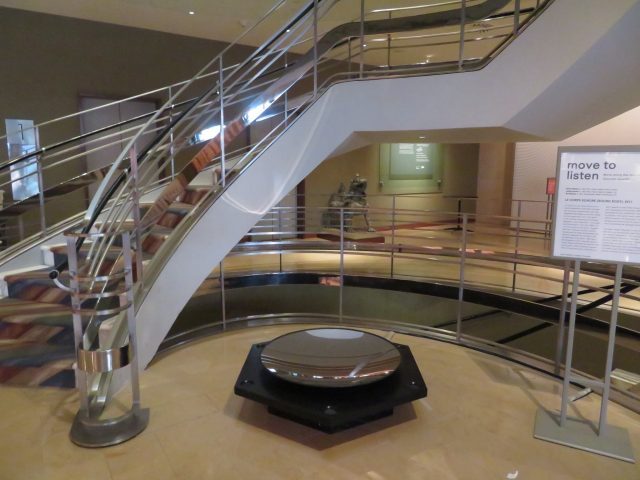
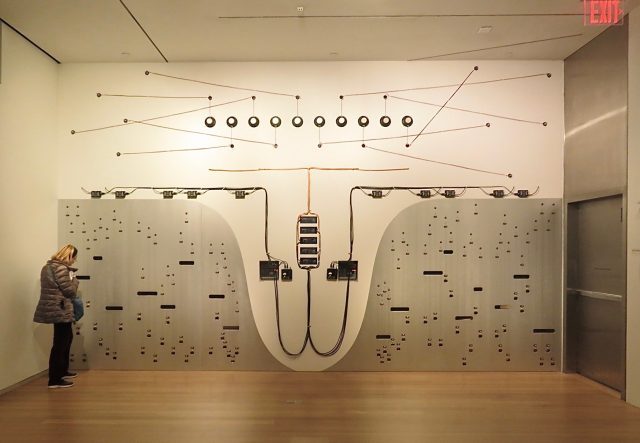
Éliane Radigue, Laetitia Sonami, and Bob Bielecki’s “Le Corps Sonore (Sound Body)” winds its way sonically up the Rubin’s spiral staircase (photo by twi-ny/mdr)
THE WORLD IS SOUND
Rubin Museum of Art
150 West 17th St. at Seventh Ave.
Wednesday – Monday through January 8, $10-$15 (free Fridays 6:00 – 10:00)
212-620-5000 rubinmuseum.org
Listen up now: There are currently two excellent interactive exhibitions in New York City dedicated to the sound of art, and the art of sound, “The World Is Sound” at the Rubin Museum of Art through January 8 and “Sonic Arcade: Shaping Space with Sound” at the Museum of Arts & Design through February 25. “If you focus your attention, you can hear inside sound, you can hear that there’s more there than just what’s on the surface. I find that kind of listening very meditative. It’s centering,” Bob Bielecki says regarding his contribution to the show at the Rubin, “. . . from a distance,” an audio installation of environmental sounds recorded in India and Nepal. Meanwhile, composer Hildegard Westerkamp, who also uses field recordings from India in her piece, “Into India,” notes, “We respond differently when we begin to listen. It can become almost a revolutionary act.” The Rubin exhibition is divided into Body, Creation, Ritual, Listening, Death & Rebirth, and OM Lab, consisting of more than seventy-five works that also incorporate touch and sight while exploring aspects of Tibetan Buddhism relating to the cycle of samsara. Walking up the spiral staircase, you’ll encounter Éliane Radigue, Laetitia Sonami, and Bielecki’s “Le Corps Sonore (Sound Body),” a site-specific sonic labyrinth that rises from a resonant bowl on the floor and reaches up to the ceiling. If you take the elevator instead, you’ll hear fifteen of the artists discussing the first sounds they can remember and the last sound they expect to hear.
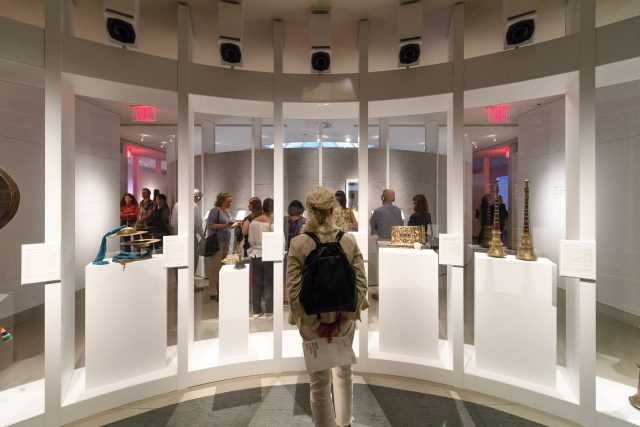
Visitors can immerse themselves in multiple ways in sound exhibit at the Rubin Museum (photo by Filip Wolak)
You need to touch the wall to hear a series of mantras that are paired with related paintings and sculptures from the Rubin collection, including the Manjushri Mantra, the Heart Sutra Mantra, and the Vajrayogini Mantra, while other works are accompanied by chants from monasteries in Nepal and India and a retreat center in upstate New York. In the OM Lab, you can hear a collective OM recorded by museum visitors this past summer, who chanted the seed syllable in a special booth. Christine Sun Kim and John Giorno team up for “Voice” (through January 14), using video, silkscreened text, and abstract, coded poetry in such works as “Words Come from Sounds” and “The Sound of Relevance.” You can hear such instruments as the dung kar (ceremonial conch trumpet), dril bu (bell), dung chen (long horn), and gya ling (oboe) if you get close to them, while you are also invited to lie down on a bench to activate Tibetan funerary text recitations. There are also such videos as Resonant Universe, Daniel Neumann’s Intermediate States, and Robert Aiki Aubrey Lowe’s Harmonic Course, which challenge the senses, while you’ll need to put on headphones to check out audio works by Jules Gimbrone, MSHR, Samita Sinha, Nathan Wooley, C. Spencer Yeh, and others. As the wall text advises, “listen with your whole body” if you want to get the full effect of the exhibition, which was curated by Risha Lee to follow the path from creation to death to rebirth. Be adventurous and follow every passageway, as the exhibit is filled with surprises around every corner. And be sure to read the first issue of the Rubin’s Spiral magazine, which delves even further into the world of sound.
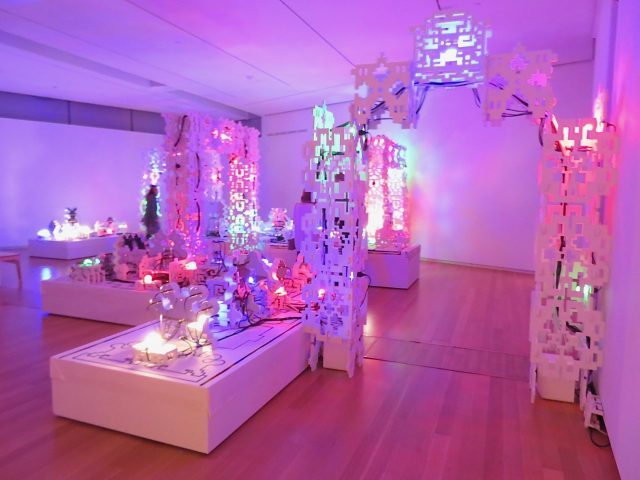
Visitors activate MSHR’s “Knotted Gate Presence Weave” by walking under the arches and following the paths (photo by twi-ny/mdr)
SONIC ARCADE: SHAPING SPACE WITH SOUND
Museum of Arts & Design
2 Columbus Circle at 58th St. & Eighth Ave.
Tuesday – Sunday through February 25, $12-$16 (pay-what-you-wish Fridays 6:00 – 9:00)
212-299-7777 madmuseum.org
You can get even more involved at the Museum of Arts & Design’s “Sonic Arcade: Shaping Space with Sound,” which covers several floors as well as the stairwells and the lobby. The show focuses more on technological innovation and visceral pleasure as visitors make their way through a sonic wonderland where their touch and movement activates the works. “I was interested from an early age in the way our realities and surroundings are constructed, the way an experience is defined and placed,” Naama Tsabar says about “Propagation (Opus 3),” a large-scale wall installation that museumgoers can play by plucking vertical piano wires. She adds, “Sound and music were key players in blocking the outside world as well as in taking someone, and their surroundings, on a journey while inducing movements and interactions among humans specific to those places.” Foo/Skou’s “Format 3” takes people on a sonic journey through stairwell B, where they can perform their own score by touching sculptural squares, circles, and triangles that represent earth, water, and fire. MSHR’s “Knotted Gate Presence Weave” is a cybernetic musical composition consisting of futuristic digital-logic archways that are activated as you move through its mazelike structure, sound and light rattling through the purple space. Visitors are encouraged to remove their shoes and enjoy Studio PSK’s “Polyphonic Playground,” in which children and adults can climb ladderlike objects and ride on swings that respond to touch and movement by emitting musical sounds. One of the artists-in-residence, Stephanie Acosta, NIC Kay, or Steven Reker, is often there to perform and answer questions about the project; there will also be a guided “play time” most Thursdays at 5:00.
Naama Tsabar’s “Propagation (Opus 3)” offers museumgoers the chance to form their own electronic string band (photo by twi-ny/mdr)
You’ll have to pick up a transistor radio and headphone at the front desk to experience Anna Friz’s “Echophone,” one of several works curated by Jeff Kolar and his experimental radio broadcast platform known as Radius. Curator Robert Aiki Aubrey Lowe’s “Subject to Gesture” brings together interactive hand-built analog synthesizers by Emily Counts, Make Noise, and others that people can play by twisting knobs, pushing objects, and filling out a card. Julianne Swartz was inspired by the Buddhist singing bowl in creating “Sine Body,” a table occupied by translucent abstract vessels made of acoustically reflective ceramic and glass that use electronic feedback and air to emit sound with a mallet. And Christie Wright and Arjen Noordeman’s “Audiowear” display features jewelry that acts like idiophone and aerophone instruments; the necklaces and bracelets are joined by videos showing the pieces being used in concerts. In addition, Deborah Stratman’s “Hearsay” and “Siege” can be heard in the Turnstyle Underground Market in the 59th St. – Columbus Circle subway station the first seven minutes of every hour on weekdays except 8:00 – 10:00 am and 5:00 – 7:00 pm. Together, “The World Is Sound” at the Rubin and “Sonic Arcade” at MAD offer visitors the opportunity to reevaluate the potential of sound both as inner healing and pure sensory pleasure.
 The New York Jewish Film Festival gets under way January 10 with an intriguing look at enigmatic filmmaker Michał Waszyński, the director of one of the most important Yiddish movies of all time, the 1937 supernatural tale The Dybbuk. In The Prince and the Dybbuk, directors Piotr Rosolowski and Elwira Niewiera find that discovering who Waszyński was is like chasing a ghost, as he continually reinvented himself while being haunted by a past he tried to erase. Like the characters in many of the films he produced and directed, he was constantly searching for his true identity as he journeyed from Poland and Germany to Italy and Spain. “He was in his world, so mysterious and exciting. Nobody really knows what he’s really like,” one of his assistant directors, Enrico Bergier, says. Throughout the eighty-minute documentary, friends, relatives, colleagues, and others describe Waszyński, who produced and/or directed nearly 150 films, as a gentleman, Jewish, Catholic, noble-minded, lonely, elegant and refined, an exceptional boss, generous, isolated, very smart, a larger-than-life character, an aristocrat, a bit strange, and a mythomaniac. He married a countess, dubbing himself the Polish Prince, and took one of his actors, Albin Ossowski, to gay restaurants. “He was longing for his youth,” Ossowski says. He hobnobbed with Orson Welles, Sophia Loren, Audrey Hepburn, and Claudia Cardinale. He appeared in Joseph L. Mankiewicz’s 1954 film, The Barefoot Contessa. He was singled out by Josef Goebbels as an enemy. He was involved with such 1960s blockbusters as El Cid and The Fall of the Roman Empire as well as smaller Eastern European films, most famously The Dybbuk, about a young bride possessed by a spirit. Rosolowski and Niewiera, who previously collaborated on the award-winning Domino Effect, include newsreel footage, family photos, home movies, a behind-the-scenes promotional piece narrated by James Mason about the making of Anthony Mann’s budget-busting The Fall of the Roman Empire, spoken excerpts from Waszyński’s diaries, and clips from such Waszyński films as His Excellency the Shop Assistant, Unknown Man of San Marino, Dvanáct kresel, Gehenna, Wielka Droga, Zabawka, and Znachor, many of which feature lost characters.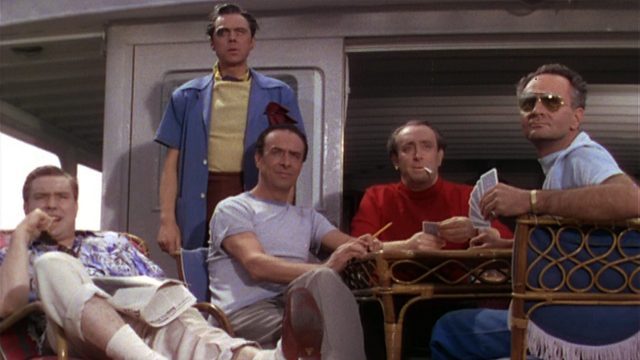
 Winnipeg-based filmmakers Guy Maddin, Evan Johnson, and Galen Johnson ingeniously reimagine Alfred Hitchcock’s psychosexual masterpiece, Vertigo, using clips from dozens of movies and television shows in the mesmerizing pastiche The Green Fog. When Maddin, who has made such previous films as Careful, The Saddest Music in the World, and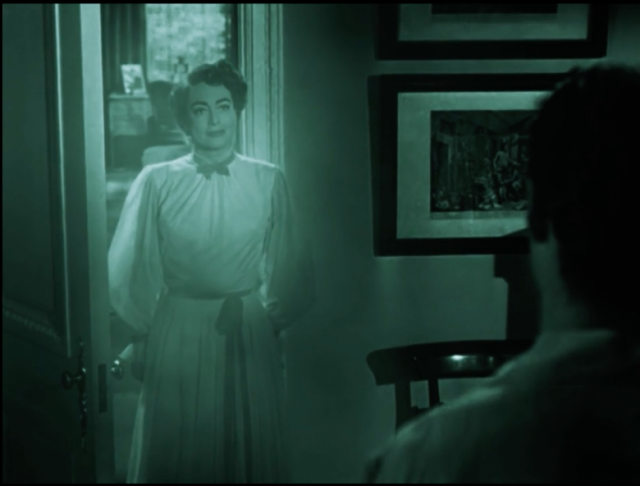
 Select screenings of The Green Fog will be accompanied by Alfred Hitchcock’s 1958 mind-altering, fetishistic psychological thriller, Vertigo, which heavily influenced Guy Maddin, Evan Johnson, and Galen Johnson’s San Francisco montage. Based on Boileau-Narcejac’s 1954 novel, D’entre les morts, the film delves deep into the nature of fear and obsession. Jimmy Stewart stars as John “Scottie” Ferguson, a police detective who retires after his acrophobia leads to the death of a fellow cop. An old college classmate, wealthy businessman Gavin Elster (Tom Holmore), asks Scottie to look into his wife’s odd behavior; Elster believes that Madeleine (Kim Novak) is being inhabited by the spirit of Carlotta Valdes, her great-grandmother, a woman who committed suicide in her mid-twenties, the same age that Madeleine is now. Scottie follows Madeleine as she goes to Carlotta’s grave, visits a portrait of her in a local museum, and jumps into San Francisco Bay. Scottie rescues her, brings her to his house, and starts falling in love with her. But on a visit to Mission San Juan Bautista, tragedy strikes when Scottie can’t get to the top of the tower because of his vertigo. After a stint in a sanatorium, he wanders the streets of San Francisco where he and Madeleine had fallen in love, as if hoping to see a ghost — and when he indeed finds a woman who reminds him of Madeleine, a young woman named Judy Barton (Novak), he can’t help but try to turn her into his lost love, with tragedy waiting in the wings once again.