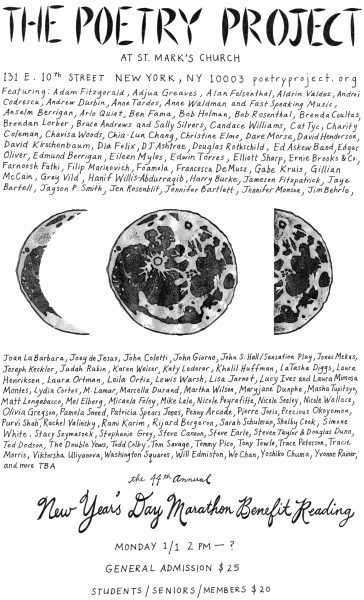
Who:The Poetry Project What:Forty-fourth annual New Year’s Day Marathon Benefit Reading Where: The Poetry Project at St. Mark’s Church-in-the-Bowery, 131 East Tenth St., 212-674-0910 When: Monday, January 1, $25, 2:00 pm Why: More than 150 writers, musicians, actors, dancers, and other artists will take the podium in this annual benefit for the Poetry Project, which “promotes, fosters, and inspires the reading and writing of contemporary poetry by (a) presenting contemporary poetry to diverse audiences, (b) increasing public recognition, awareness, and appreciation of poetry and other arts, (c) providing a community setting in which poets and artists can exchange ideas and information, and (d) encouraging the participation and development of new poets from a broad range of styles.” This year’s forty-fourth annual marathon boasts another fab lineup to welcome in the new year, including Andrei Codrescu, Anne Waldman and Fast Speaking Music, Anselm Berrigan, Bob Holman, Bob Rosenthal, CAConrad, DJ Ashtrae, Ed Askew Band, Edgar Oliver, Edmund Berrigan, Edwin Torres, Eileen Myles, Elliott Sharp, Erica Hunt & Marty Ehrlich, erica kaufman, Ernie Brooks w/Peter Zummo & Jeannine Otis, Jennifer Monson, John Giorno, Jonas Mekas, Joseph Keckler, LaTasha Diggs, Laura Ortman, Lee Ranaldo, Leila Ortiz, Lenny Kaye, Lucy Ives & Lara Mimosa Montes, Lydia Cortes, M. Lamar, Marcella Durand, Martha Wilson, Matt Longabucco, Nicole Wallace, Penny Arcade, Ubu Sings Ubu, Pierre Joris & Nicole Peyrafitte, Precious Okoyomon, Rachel Levitsky, Rachel Valinsky, Sarah Schulman, Shelby Cook, Steve Cannon, Steve Earle, Steven Taylor & Douglas Dunn, Tammy Faye Starlite, Ted Dodson, the Double Yews, Todd Colby, Tom Savage, Tony Towle, Tracie Morris, Washington Squares, Yoshiko Chuma, Yvonne Meier, and Yvonne Rainer, among many others.
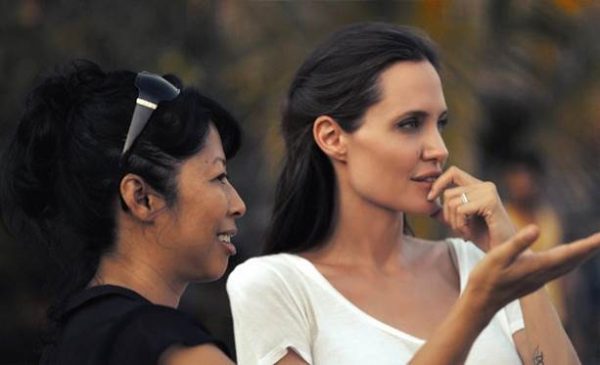
Loung Ung and Angelina Jolie, seen above in Cambodia collaborating on film project, will be at Asia Society on December 14 for panel discussion (photo courtesy of Netflix)
Who: Angelina Jolie, Rithy Panh, Phloeun Prim, Loung Ung, Darren Walker What: Panel discussion on the journey of resilience experienced by the Cambodian people and documented by artists in the post-Khmer Rouge era Where:Asia Society, 725 Park Ave. at 70th St., 212-288-6400 When: Thursday, December 14, $25, 5:00 Why: In conjunction with the outstanding Asia Society exhibition “After Darkness: Southeast Asian Art in the Wake of History” and the U.S. premiere of Him Sophy and Rithy Panh’s Bangsokol: a Requiem for Cambodia at BAM, Asia Society is hosting “Light after Darkness: Memory, Resilience, and Renewal in Cambodia,” a panel discussion on December 14 with American actress, filmmaker, and Special Envoy to UN High Commissioner for Refugees Angelina Jolie, Cambodian director Panh (The Missing Picture), Cambodian Living Arts executive director Phloeun Pri, and memoirist and screenwriter Loung Ung (First They Killed My Father, which was directed by Jolie), moderated by Ford Foundation president Darren Walker. “Some have said that poetry after atrocity is not possible anymore, yet we need to have it. We must continue to create. We can’t start mourning without knowing how, and part of knowing how is to accept something very painful, something unexplainable. This art may bring us answers, help us accept our pain and loss. Yet, it is more than an act of remembrance; it’s an act of transmission and brings humanization,” Panh says about Bangsokol.
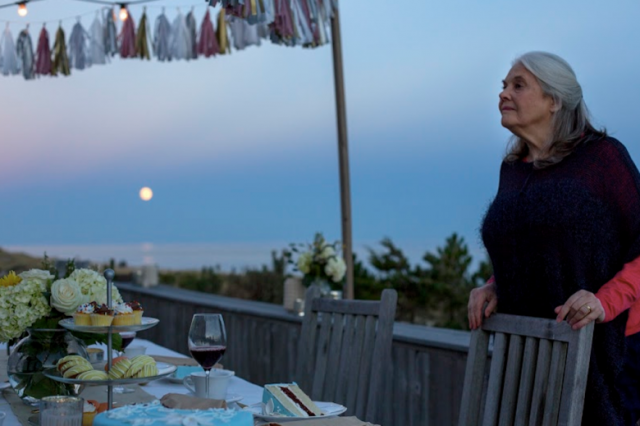
Lois Smith will be at the Quad this week for a celebration of her long career, including her acclaimed performance in Marjorie Prime
Quad Cinema
34 West 13th St. between Fifth & Sixth Aves.
December 12-14
212-255-2243 quadcinema.com
Topeka-born stage and screen actress Lois Smith will be at the Quad this week to celebrate her seven-decade career, which has featured such plays as The Grapes of Wrath, The Trip to Bountiful, Buried Child, and John, earning two Tony nominations and an Obie, and such films as East of Eden; Foxes; Five Easy Pieces; Next Stop, Greenwich Village; and this year’s Marjorie Prime and Lady Bird. Five of those films, with the exception of Lady Bird, make up the Quad series “Prime Lois Smith,” running December 12–14, with Smith either introducing or taking part in Q&As for every screening but one. Among the television programs she’s had recurring roles on are Desperate Housewives, True Blood, ER, and Grace and Frankie. Smith, who was on the November 21, 1955, cover of Life magazine with Judy Tyler, Jayne Mansfield, Susan Strasberg, and Diane Cilento, is still going strong at the age of eighty-seven, with more work on the horizon.
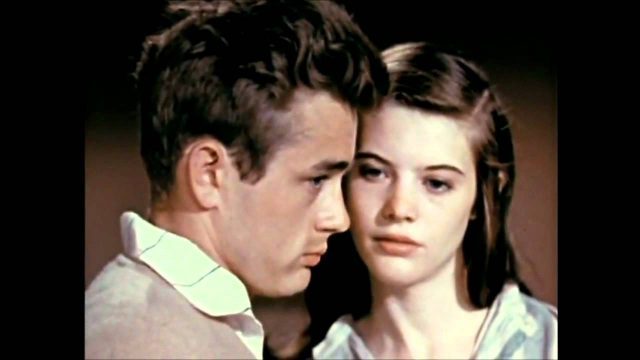
Cal Trask (James Dean) and Anne (Lois Smith) share a tender moment in Elia Kazan’s adaptation of John Steinbeck’s East of Eden
EAST OF EDEN (Elia Kazan, 1955)
Tuesday, December 12, 6:30 quadcinema.com
“I guess there’s just a certain amount of good and bad you get from your parents and I just got the bad,” Cal (James Dean) says in Elia Kazan’s cinematic adaptation of part of John Steinbeck’s 1952 novel, East of Eden, a modern retelling of the biblical Cain and Abel story. In his first starring role, Dean received a posthumous Oscar nomination for his moody, angst-ridden performance as Cal Trask, a troubled young man who discovers that the mother (Best Supporting Actress winner Jo Van Fleet) he thought was dead is actually alive and well and running a successful house of prostitution nearby. Cal tries to win his father’s (Raymond Massey as Adam Trask) love and acceptance any way he can, including helping him develop his grand plan to transport lettuce from their farm via refrigerated railway cars, but his father seems to always favor his other son, Aron (Richard Davalos). Aron, meanwhile, is in love with Abra (Julie Harris), a sweet young woman who takes a serious interest in Cal and desperately wants him to succeed. But the well-meaning though misunderstood Cal does things his own way, which gets him in trouble with his father and brother, the mother who wants nothing to do with him, the sheriff (Burl Ives), and just about everyone else he comes in contact with.
Set in Monterey and Salinas, East of Eden begins with a grand overture by Leonard Rosenman, announcing the film is going to be a major undertaking, and it lives up to its billing. Dean is masterful as Cal, peppering Paul Osborn’s script with powerful improvisational moments as he expresses his frustration with his family and life in general. His inner turmoil threatens to explode in both word and gesture as he just seeks to be loved. Dean would follow up East of Eden with seminal roles in Rebel Without a Cause and Giant before his death in a car crash in 1955 at the age of twenty-four, leaving behind a remarkable legacy that has influenced generations of actors ever since. Lois Smith makes her film debut as Anne, the young woman who works at the brothel and is charmed by Cal in a steamy scene. Smith will be on hand for a Q&A following the December 12 screening of the film at the Quad as part of the series “Prime Lois Smith.”
Lois Smith plays the sister of prodigal son Bobby Dupea (Jack Nicholson) in Bob Rafelson’s Five Easy Pieces
FIVE EASY PIECES (Bob Rafelson, 1970)
Wednesday, December 13, 6:30
Thursday, December 14, 9:10 quadcinema.com
A key film that helped lead 1960s cinema into the grittier 1970s, Bob Rafelson’s Five Easy Pieces is one of the most American of dramas, a tale of ennui and unrest among the rich and the poor, a road movie that travels from trailer parks to fashionable country estates. Caught in between is Bobby Dupea (Jack Nicholson), a former piano prodigy now working on an oil rig and living with a well-meaning but not very bright waitress, Rayette (Karen Black). When Bobby finds out that his father is ill, he reluctantly returns to the family home, the prodigal son who had left all that behind, escaping to a less-complicated though unsatisfying life putting his fingers in a bowling ball rather than tickling the keys of a grand piano. Back in his old house, he has to deal with his brother, Carl (Ralph Waite), a onetime violinist who can no longer play because of an injured neck and who serves as the film’s comic relief; Carl’s wife, Catherine (Susan Anspach), a snooty woman Bobby has always been attracted to; and Bobby’s sister, Partita (Lois Smith), a lonely, troubled soul who has the hots for Spicer (John Ryan), the live-in nurse who takes care of their wheelchair-bound father (William Challee).
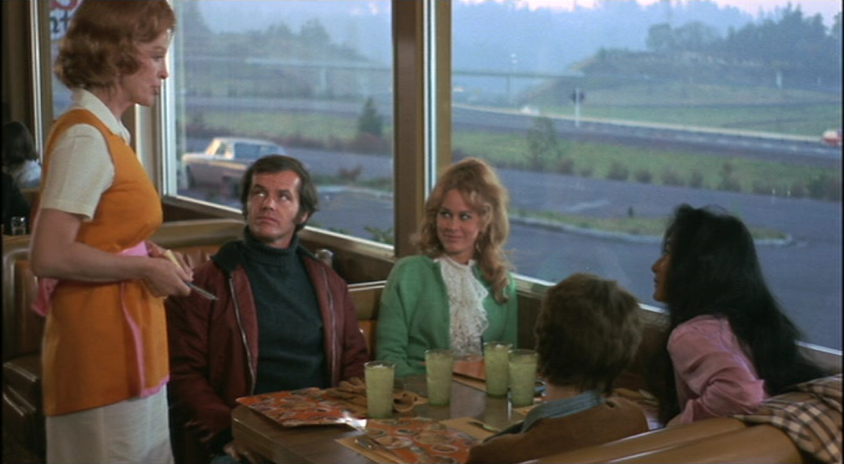
Jack Nicholson, sitting next to Karen Black, is about to place the most famous sandwich order in film history
Rafelson had previously directed the psychedelic movie Head (he cocreated the Monkees band and TV show) and would go on to make such films as The King of Marvin Gardens, Stay Hungry, and Black Widow; written by Carole Eastman, Five Easy Pieces fits flawlessly in between them, a deeply philosophical work that captures the myriad changes the country was experiencing as the Woodstock Generation was forced to start growing up. The film suffers from some unsteady editing primarily in the earlier scenes, but it is still a gem, featuring at least two unforgettable scenes, one that takes place in a California highway traffic jam and the other in a diner, where Bobby places an order for the ages. And as good as both Nicholson, who earned the first of seven Best Actor Oscar nominations, and Black, who was nominated for Best Supporting Actress, are, Helena Kallianiotes nearly steals the picture as a crazy woman railing against the ills of the world from the backseat of Bobby’s car. Five Easy Pieces is screening December 13 and 14 in the Quad series “Prime Lois Smith,” with Smith taking part in a Q&A following the 6:30 screening on the 13th.
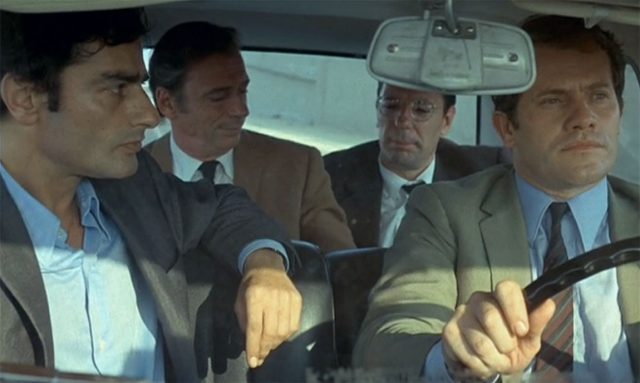
The Deputy (Yves Montand, rear left) is on his way to a fateful encounter in Costa-Gavras’s Z
CINÉSALON: Z (Costa-Gavras, 1969)
French Institute Alliance Française, Florence Gould Hall
55 East 59th St. between Madison & Park Aves.
Tuesday, December 12, $13, 4:00 & 7:30
Series continues Tuesdays through December 19
212-355-6100 fiaf.org
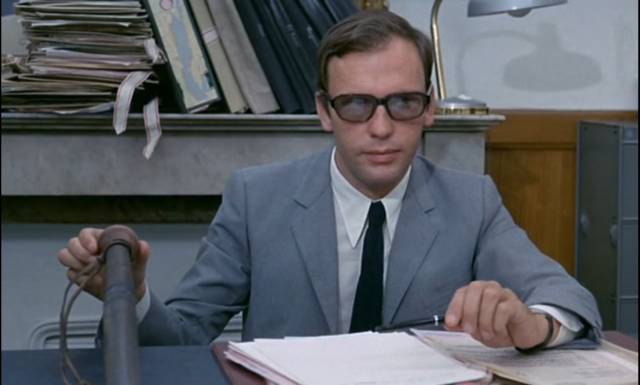
In her new book Cinematic Overtures: How to Read Opening Scenes (Columbia University Press, $20, November 2017), Columbia professor and film historian Annette Insdorf writes that the beginning moments of Costa-Gavras’s masterful 1969 political thriller, Z, “places us metaphorically in the perspective of the investigator even before we meet him: we must be attentive to detail, skeptical, and then capable of seeing the larger picture. Given the film’s incorporation of flashbacks as well, Z builds a cumulative sense of inevitability that the truth will emerge.” Insdorf will be at FIAF on December 12 to sign copies of her book and introduce the 7:30 screening of Z, which is part of the CinéSalon series “Actor’s Choice: Lambert Wilson & Yves Montand,” curated by French actor and singer Wilson. (The film will also be shown at 4:00; both screenings will be followed by a wine reception.) The Algerian-French coproduction was adapted by Costa-Gavras and Jorge Semprún from Vassilis Vassilikos’s novel, a fictionalized account of the 1963 assassination of Greek left-wing antiwar activist Grigoris Lambrakis and the government cover-up that tried to make it look like an unavoidable accident. “Any similarity to real persons and events is not coincidental. It is intentional,” the credits explain. The film opens with rapid cuts of military and religious medals before zeroing in on a meeting in which the General (Pierre Dux) tells fellow law enforcement and governmental figures that they must eradicate the “ideological mildew,” referring to left-wing activists and, specifically, a deputy (Montand), based on Lambrakis, who is scheduled to speak at a large rally. After a violent incident, the Magistrate (Jean-Louis Trintignant) starts interviewing participants and witnesses and refuses to give up even when the General, the Colonel (Julien Guiomar), and other important figures threaten him as he seeks the truth, which doesn’t matter at all to those in power, who feel they understand the larger scheme of things. The Magistrate is helped by a photojournalist (producer Jacques Perrin) who is not afraid of asking penetrating questions and secretly snapping pictures. As the lies build, the truth slowly emerges, but that doesn’t mean the violence is over.
The Magistrate (Jean-Louis Trintignant) is intent on getting to the bottom of a government cover-up in classic political thriller
Costa-Gavras, a Greek expat who lives and works in France, has made many political films in his long career (State of Siege, L’Aveu, Missing, Amen.), influenced by his father, who was part of the anti-Nazi Greek resistance and was later imprisoned by Greece for being a Communist. Z might ostensibly be based on specific events, but unfortunately it’s a universal story that could take place just about anywhere in a world that has lost such leaders as Martin Luther King Jr., the Kennedy brothers, Yitzhak Rabin, Anwar Sadat, Mahatma Gandhi, Malcolm X, and others to assassination. The film, which is in French, never reveals where it is set, and most of the characters are not named, instead identified by their jobs: the deputy, the colonel, the general, the magistrate, etc. Cinematographer Raoul Coutard, best known for his work with Jean-Luc Godard, François Truffaut, and Philippe Garrel, shoots the film in a cinéma-vérité style, favoring handheld cameras (he also plays the English surgeon); Françoise Bonnot’s editing keeps building the tension while flirting with documentary-like elements; and Mikis Theodorakis’s lively score complements the action with energy and fervor. There’s also a huge dose of sly humor bordering on farce throughout. The film is particularly relevant in America, where terms such as “fake news” and “truthiness” have taken hold and the forty-fifth president has repeatedly called for and/or condoned violence against his opponents, his rivals’ supporters, and the free press. The title refers to the French word “Zei,” which means “He lives!” a phrase used by protestors; when the military took over Greece in 1967, it banned the use of the letter “Z” on placards and graffiti, along with many other things, which are listed over the closing credits. “Z” was nominated for five Oscars — Best Picture, Best Adapted Screenplay, Best Director, Best Editing, and Best Foreign Language Film, winning the latter two; it was the first film to be nominated for both Best Picture and Best Foreign Language Film. In addition, Trintignant (Amour, The Conformist, A Man and a Woman) was named Best Actor at Cannes. “Actor’s Choice” concludes December 19 with Jérôme Salle’s The Odyssey, with Lambert Wilson, Pierre Niney, and Audrey Tatou.
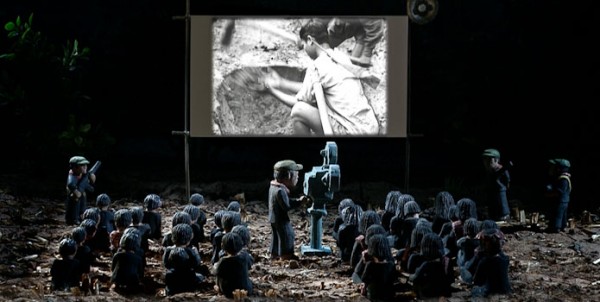
Director Rithy Panh uses dioramas to fill in the gaps in Oscar-nominated The Missing Picture
THE MISSING PICTURE (L’IMAGE MANQUANTE) (Rithy Panh, 2013)
BAMcinématek, BAM Rose Cinemas
30 Lafayette Ave. between Ashland Pl. & St. Felix St.
Tuesday, December 12, $15, 7:00
718-636-4100 www.bam.org www.themissingpicture.bophana.org
In conjunction with the December 15-16 U.S. premiere of Bangsokol: A Requiem for Cambodia as part of the 2017 Next Wave Festival, BAM is presenting Rithy Panh’s The Missing Picture on December 12 at 7:00, with Panh participating in a postscreening Q&A with Ford Foundation program officer Chi-hui Yang. Winner of the Un Certain Regard prize at Cannes and nominated for a Best Foreign Language Film Academy Award, The Missing Picture is a brilliantly rendered look back at the director’s childhood in Cambodia just as Pol Pot and the Khmer Rouge began their reign of terror in the mid-1970s. “I seek my childhood like a lost picture, or rather it seeks me,” narrator Randal Douc says in French, reciting darkly poetic and intimately personal text written by author Christophe Bataille (Annam) based on Panh’s life. Born in Phnom Penh in 1964, Panh, who has made such previous documentaries about his native country as S21, The Khmer Rouge Killing Machine and Duch, Master of the Forges of Hell and wrote the 2012 book L’élimination with Bataille, was faced with a major challenge in telling his story; although he found remarkable archival footage of the communist Angkar regime, there are precious few photographs or home movies of his family and the community where he grew up. So he had sculptor Sarith Mang hand-carve and paint wooden figurines that Panh placed in dioramas to detail what happened to his friends, relatives, and neighbors. Panh’s camera hovers over and zooms into the dioramas, bringing these people, who exist primarily only in memory, to vivid life. When a person disappears, Panh depicts their carved representatives flying through the sky, as if finally achieving freedom amid all the horrors.
He delves into the Angkar’s propaganda movement and sloganeering — the “great leap forward,” spread through film and other methods — as the rulers sent young men and women into forced labor camps. “With film too, the harvests are glorious,” Douc states as women are shown, in black-and-white, working in the fields. “There is grain. There are the calm, determined faces. Like a painting. A poem. At last I see the Revolution they so promised us. It exists only on film.” It’s a stark comparison to cinematographer Prum Mésa’s modern-day shots of the wind blowing through lush green fields, devoid of people. The Missing Picture is an extraordinarily poignant memoir that uses the director’s personal tale as a microcosm for what happened in Cambodia during the 1970s, employing the figures and dioramas to compensate for “the missing pictures.” Like such other documentaries as Jessica Wu’s Protagonist and In the Realms of the Unreal, Michel Gondry’s Is the Man Who Is Tall Happy?, Jeff Malmberg’s Marwencol, and Zachary Heinzerling’s Cutie and the Boxer, which incorporate animation, puppetry, and/or miniatures to enhance the narrative or fill in gaps, Panh makes creative use of an unexpected artistic technique, this time concentrating on painful history as well as personal and collective memory.
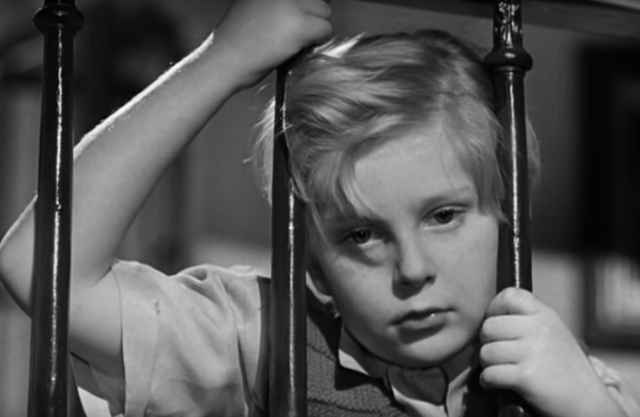
Phile (Bobby Henrey) is trapped in a web of lies and betrayal in The Fallen Idol
THE FALLEN IDOL (Carol Reed, 1948)
Museum of the Moving Image
35th Ave. at 36th St., Astoria
Saturday, December 9, $15 (includes same-day museum admission), 3:00
Series continues through December 29
718-777-6800 www.movingimage.us www.rialtopictures.com
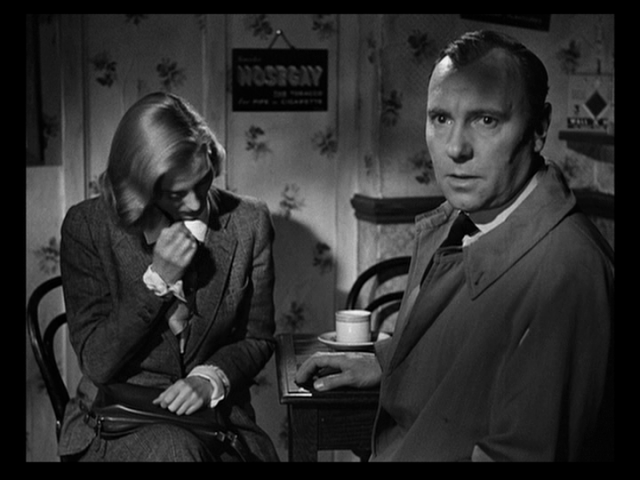
Through much of Carol Reed’s classic 1948 thriller, The Fallen Idol, you’ll be begging for poor little rich boy Phile, played by newcomer Bobby Henrey, to keep his mouth shut, whether he’s lying or desperately trying to tell the truth to nearly every adult around him. But what is the truth? That is the mind-spinning question that cinema has provoked since a train headed down the tracks at an audience and every editor’s cut altered a story. On December 9, Henrey, who made only one other film, Karl Hartl’s 1951 Wonder Boy, before becoming an accountant and deacon, will be at the Museum of the Moving Image, telling the truth about his memories of the role and his life to longtime Film Forum repertory programmer extraordinaire Bruce Goldstein after the 3:00 screening of the film as part of the series “Rialto Pictures: 20 Films for 20 Years.” The first of three collaborations between Reed and Graham Greene — it would be followed the next year by The Third Man and in 1959 by Our Man in Havana — The Fallen Idol, adapted by Greene from his short story “The Basement Room,” is set in London, where eight-year-old Philippe, known as Phile, lives in a mansion with his rarely present parents, the French ambassador (Gerard Heinz) and his ill wife. He is ostensibly being raised by the erudite butler, Baines (Ralph Richardson, in one of his most elegant and nuanced performances). Baines, who plays games with Phile and takes him on walks through the park, is married to a nasty, shrewish woman (Sonia Dresdel) who runs the large household with a cold iron fist. When Phile espies Baines with another woman, Julie (Michèle Morgan), the boy, not fully understanding the lovers’ relationship, agrees not to say anything about it to Mrs. Baines. But she eventually finds out what is going on, leading to a tragedy that Phile misinterprets, thinking that he witnessed a murder. He wants someone, anyone, to listen to him, from doctors to policemen, not knowing that what he has to say could lead to the wrongful imprisonment of his beloved Baines. The ending is a doozy, taking the old axiom “Children should be seen and not heard” to a whole new level.
Baines (Ralph Richardson) has a secret that leads to tragedy in classic Carol Reed / Graham Greene collaboration
Nominated for Oscars for Best Director and Best Adapted Screenplay, The Fallen Idol is a gripping, complex film that questions what we think we see, onscreen and in real life, with sharp editing by Oswald Hafenrichter that relates directly to how Phile views his surroundings, especially the vast, often threatening embassy with its haunting spiral staircase. Phile is often shot behind railings and gates, as if imprisoned, not yet ready for the adult world, which is bathed in shadowy chiaroscuro by cinematographer Georges Périnal. Henrey is a natural as the boy, innocently grabbing cockatoos’ tails at the zoo, asking for an extra pastry at a café, and petting his beloved pet snake, McGregor. Everything is a learning experience for him; there’s nothing he doesn’t want to touch, to know more about, wide-eyed innocence laced with a hint of suspicion. Henrey was the only child interviewed for the role; Reed spotted him in a jacket photo of a book by his mother, a well-respected author who initially wrote under her husband’s name. Despite the changes Reed made to the original story, Greene, the master of moral subtlety, called Reed “the only director I know with that particular warmth of human sympathy, the extraordinary feeling of the right face for the right part, the exactitude of cutting, and not least important the power of sympathizing with an author’s worries and ability to guide him.” Human sympathy is evident in nearly every shot of The Fallen Idol, as a boy attempts to find his place in a world that is not ready to accept him as anything more than a silly child. “Rialto Pictures: 20 Films for 20 Years” continues through December 29 with such other fab pictures as Robert Hamer’s It Always Rains on Sunday, Alain Resnais’s Hiroshima, Mon Amour, introduced by Annette Insdorf, Michael Powell and Emeric Pressburge’s Tales of Hoffmann, and Whit Stillman’s Metropolitan, with Whitman on hand to discuss the film.
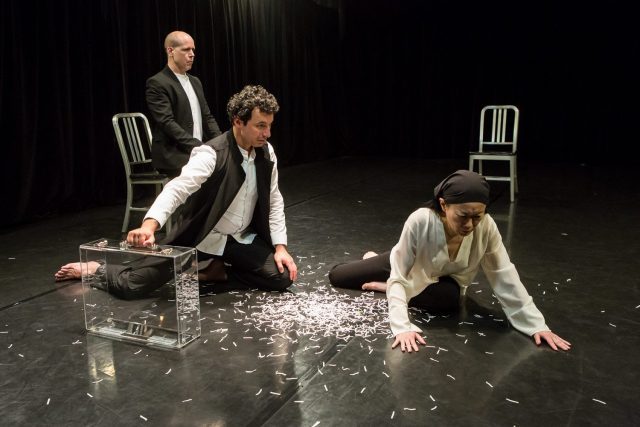
SITI Company presents a new adaptation of Yukio Mishima’s Hanjo at Japan Society
Japan Society
333 East 47th St. at First Ave.
December 7-9, $35, 7:30
212-715-1258 www.japansociety.org siti.org
Japan Society’s four-part “NOH-NOW” series, which began with Luca Veggetti’s Left-Right-Left and Hiroshi Sugimoto’s Rikyu-Enoura, continues with SITI Company’s adaptation of Yukio Mishima’s Hanjo, running December 7-9. (SITI presented a staged reading of Hanjo at Japan Society in May 2007.) Freely adapted by Japanese author, poet, and filmmaker Mishima (The Sailor Who Fell from Grace with the Sea, Madame de Sade) from Seami Motokiyo’s fourteenth-century noh play about love and betrayal, the work features three characters, the mad girl Hanako, the spinster Jitsuko, and a young man, Yoshio, performed in rotation through three iterations by Akiko Aizawa (who just appeared in Ripe Time’s adaptation of Haruki Murakami’s Sleep at BAM), Gian-Murray Gianino, and Stephen Duff Webber. Leon Ingulsrud directs the bilingual production from his translation, with live music composed and played by violist Christian Frederickson, sets and lighting by Brian H Scott, costumes by Mariko Ohigashi, and choreography by Wendell Beavers. Founded by Anne Bogart and Tadashi Suzuki in 1992, the company has previously staged such inventive works as Chess Match No. 5, bobrauschenbergamerica, Steel Hammer, and Bob and, in its early years, were regulars at the Toga Festival in Japan. The December 7 show at Japan Society will be followed by a reception with members of the company, while the December 8 performance will be followed by a Q&A with the artists. “NOH-NOW” concludes January 11-14 with Satoshi Miyagi’s Mugen Noh Othello as part of the Public Theater’s Under the Radar Festival.
 “I guess there’s just a certain amount of good and bad you get from your parents and I just got the bad,” Cal (James Dean) says in Elia Kazan’s cinematic adaptation of part of John Steinbeck’s 1952 novel, East of Eden, a modern retelling of the biblical Cain and Abel story. In his first starring role, Dean received a posthumous Oscar nomination for his moody, angst-ridden performance as Cal Trask, a troubled young man who discovers that the mother (Best Supporting Actress winner Jo Van Fleet) he thought was dead is actually alive and well and running a successful house of prostitution nearby. Cal tries to win his father’s (Raymond Massey as Adam Trask) love and acceptance any way he can, including helping him develop his grand plan to transport lettuce from their farm via refrigerated railway cars, but his father seems to always favor his other son, Aron (Richard Davalos). Aron, meanwhile, is in love with Abra (Julie Harris), a sweet young woman who takes a serious interest in Cal and desperately wants him to succeed. But the well-meaning though misunderstood Cal does things his own way, which gets him in trouble with his father and brother, the mother who wants nothing to do with him, the sheriff (Burl Ives), and just about everyone else he comes in contact with.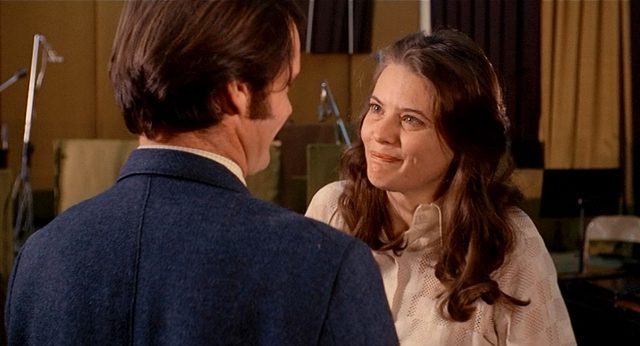
 A key film that helped lead 1960s cinema into the grittier 1970s, Bob Rafelson’s Five Easy Pieces is one of the most American of dramas, a tale of ennui and unrest among the rich and the poor, a road movie that travels from trailer parks to fashionable country estates. Caught in between is Bobby Dupea (Jack Nicholson), a former piano prodigy now working on an oil rig and living with a well-meaning but not very bright waitress, Rayette (Karen Black). When Bobby finds out that his father is ill, he reluctantly returns to the family home, the prodigal son who had left all that behind, escaping to a less-complicated though unsatisfying life putting his fingers in a bowling ball rather than tickling the keys of a grand piano. Back in his old house, he has to deal with his brother, Carl (Ralph Waite), a onetime violinist who can no longer play because of an injured neck and who serves as the film’s comic relief; Carl’s wife, Catherine (Susan Anspach), a snooty woman Bobby has always been attracted to; and Bobby’s sister, Partita (Lois Smith), a lonely, troubled soul who has the hots for Spicer (John Ryan), the live-in nurse who takes care of their wheelchair-bound father (William Challee).