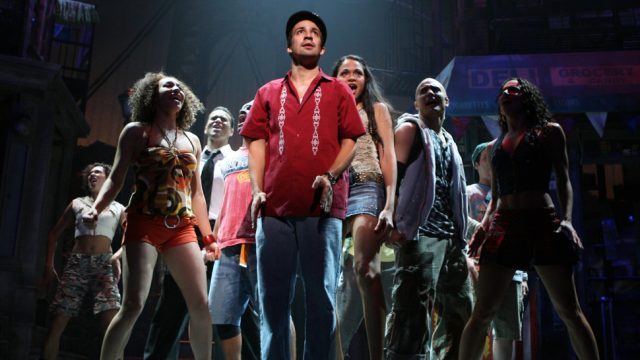
Lin-Manuel Miranda and the original cast of In the Heights will reunite at third annual BroadwayCon (photo by Joan Marcus)
Jacob K. Javits Convention Center
655 West 34th St. (11th Ave. between 34th & 39th Sts.)
January 26-28, $220 General Pass, $90 Day Pass
www.broadwaycon.com
www.javitscenter.com
The third annual BroadwayCon returns to the Javits Center January 26-28 with a full slate of theater-related programming. The Gold Passes ($395) and Platinum Passes ($1000) are sold out, so you better hurry if you want to get a General Pass ($220) or Day Pass ($90). Among this year’s guests are Lin-Manuel Miranda, Laura Benanti, Carolee Carmello, LaChanze, Mo Rocca, Jenn Colella, Alex Brightman, Stephanie J. Block, Liz Callaway, cofounders Anthony Rapp and Melissa Anelli, Steven Levenson, Gideon Glick, Kathleen Marshall, Ruthie Ann Miles, Leigh Silverman, Bryce Pinkham, and Mauritz von Stuelpnagel, participating in photo and autograph sessions, workshops, panel discussions, show spotlights, and more. Below are only some of the highlights.
Friday, January 26
Royal Romanovs: An Anastasia Meetup, with Nia Harvey, Margo Jones Room, 10:00 am
The American Theatre Wing: 100 Years, 100 Voices, 100 Million Miracles, with Allison Considine, Dale Cendali, Heather Hitchens, and Patrick Pacheco, Vinnette Carroll Room, 11:00
The Broadway Ensemble Panel, moderated by Nikka Lanzarone and Mo Brady, Ruth Mitchell Room, 12 noon
Singalong, Hildy Parks Room, 1:00
From Stage to Screen: Going Behind the Curtain of a Broadway Production, with Bonnie Comley, Stewart F. Lane, Gio Messale, Hal Berman, and Lonny Price, Willa Kim Room, 2:00
Everything You’ve Ever Wanted to Know About the Theatre But Were Afraid to Ask, Renee Harris Room, 3:00
The BroadwayCon 2018 Opening Ceremony, with Anthony Rapp and Melissa Anelli, MainStage, 4:30
¡Atención! In the Heights Reunites 10 Years Later, with Janet Dacal, Alex Lacamoire, Luis A. Miranda Jr., Lin-Manuel Miranda, Javier Muñoz, Karen Olivo, and Olga Merediz, MainStage, 5:00
Show Spotlight: Frozen, with Robert Lopez, Greg Hildreth, and Kristen Anderson-Lopez, MainStage, 7:00
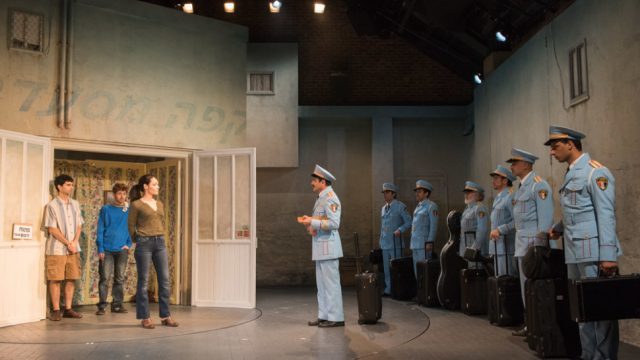
The Band’s Visit takes center stage at BroadwayCon on Saturday (photo by Ahron R. Foster)
Saturday, January 27
Are We Living in Another Golden Age of the Broadway Musical? with William Cortez-Statham, Renee Harris Room, 10:00
Out on Broadway, with Patrick Hinds, Jay Armstrong Johnson, Tyler Hanes, and Caesar Samayoa, Willa Kim Room, 11:00
The Life and Art of Erté, with Stephan, Ruth Mitchell Room, 12 noon
Cosplay Fashion Show, MainStage, 1:00
All My Revels Here Are Over: Remembering the Comet, with Harley Ann Kulp and Chelsea MacKay, Margo Jones Room, 2:00
Follies: The Original Production Reunion, with Jennifer Ashley Tepper, Steve Boockvor, Denise Pence, Ted Chapin, Mary Jane Houdina, Kurt Peterson, and Jonathan Tunick, Ruth Mitchell Room, 3:00
Being a Critic of Color, with Wei-Huan Chen, Naveen Kumar, Kelundra Smith, Karen d’Souza, Jan Simpson, and Jose Solís, Willa Kim Room, 4:00
Show Spotlight: The Band’s Visit, MainStage, 5:00
BroadwayCon Blizzard Party Line, with Melissa Anelli, Anthony Rapp, and David Alpert, MainStage, 7:00
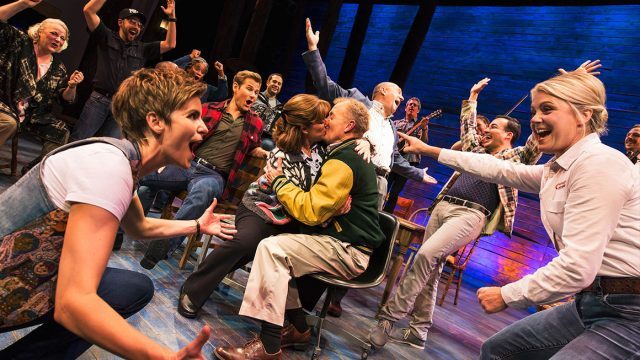
BroadwayCon celebrates the surprise success of Come from Away on Sunday (photo by Matthew Murphy)
Sunday, January 28
Broadway, the Flops! A Singalong Spectacular, with Christian Regan and Rachel Buksbazen, Hildy Parks Room, 10:00
Playing Non-Fiction: The True Story Behind Come from Away, with Chad Kimball and Kevin Tuerff, Margo Jones Room, 11:00
Theater People Live Show! with Patrick Hinds, Willa Kim Room, 12 noon
After Anatevka, with Alexandra Silber and Ruthie Fierberg, Hildy Parks Room, 1:00
No Sex Please, We’re British: The Lord Chamberlain’s Censorship of West Side Story and a Post-War Generation, with Rachel Kwiecinski, Ruth Mitchell Room, 2:00
Spectacular! When the Golden Age of Broadway Met the Golden Age of Television, with Allan Altman, George Dansker, and Jane Klain, Willa Kim Room, 3:00
Structure! The Musical, or Everything You Need to Know About Musicals You Can Learn from Star Wars, with Sammy Buck, Willa Kim Room, 4:00
The Closing Ceremony, MainStage, 5:00
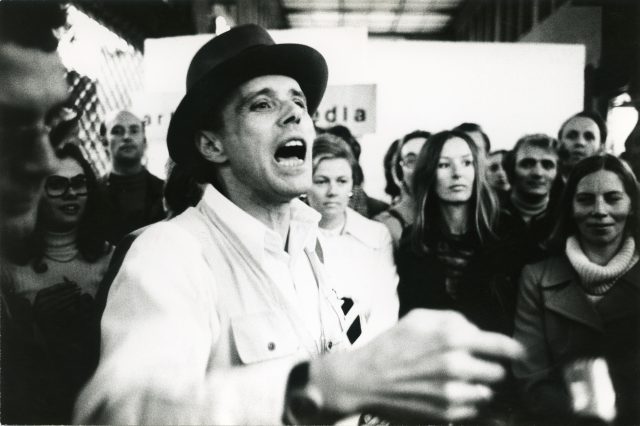
 About ten years ago, I was visiting Chelsea galleries on a sunny afternoon when a car pulled up on the corner of Eleventh Ave. and Twenty-second St. A father and a young boy of about five or six got out, and the man led the child to one of the stone sculptures that make up Joseph Beuys’s “7000 Oaks.” The boy relieved himself on the stone; the pair then returned to the car and the family drove off. I always thought that the German avant-garde artist would have gotten a kick out of that scene; after watching Andres Veiel’s new documentary, Beuys, I’m sure of it. If you’re going to make a documentary about Beuys (pronounced boys), one of the most influential artists of the postwar generation, it had better not be a straightforward, talking-heads film but something that pushes the boundaries and challenges the viewer, much like his art. Award-winning director Veiel (Balagan, Black Box Germany) does just that with the film, which concentrates primarily on rarely shown and never-before-seen archival footage of Beuys, including radio and television interviews, art openings, panel discussions, live performances, photographs, and home movies, mostly in black-and-white. Veiel conducted approximately twenty new interviews and met with more than five dozen people who knew Beuys, but he only uses spare clips from art historian Rhea Thönges-Stringaris, publisher Klaus Staeck, collector Franz Joseph van der Grinten, and critic, curator, and writer Caroline Tisdall, who wrote seven books about Beuys and worked with him on several major exhibitions and lecture tours. “The anonymous viewer is back there, yeah?” Beuys says early on, looking straight into the camera, and it’s a critical moment, as the documentary emphasizes how important it was to him that his work be seen. “I want to inform people about the true culprits in our system. I want to inform and educate people,” he says. Beuys, who also taught at the Kunstakademie Düsseldorf, is eminently quotable, his speech filled with manifesto-like declarations. “Forget the conventional idea of art. Anyone can be an artist. Anything can be art, especially anything that conserves energy,” he explains. “I’m not an artist at all. Except if we say that everyone is an artist,” he opines. “The concept of what art is has expanded to such a degree that, for me, there’s nothing left of it,” he offers.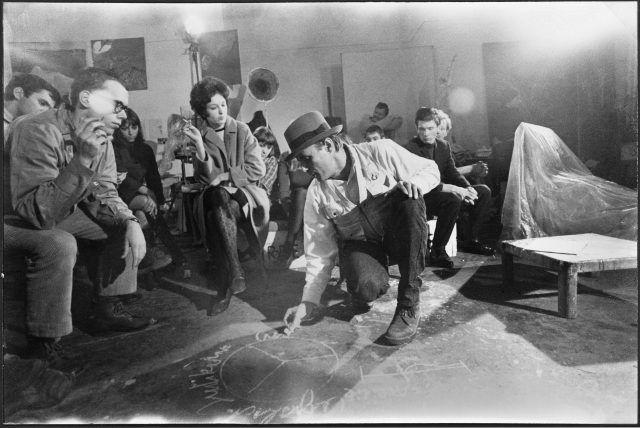
 Visual artist Laurie Simmons makes her feature-film debut as writer, director, and star of the self-indulgent, pretentious romance My Art, which opens at the Quad on January 12. Part of the Pictures Generation, Simmons, who was born in Queens in 1949, has been creating intriguing photographic series since the mid-1970s, often focusing on such inanimate objects as mannequins and dolls, offering a feminist viewpoint of domesticity. In My Art, she plays Ellie Shine, a sixty-five-year-old teacher and artist who decides to house-sit for an upstate friend in order to take advantage of her large studio and to work on a new project, bringing along her ailing dog, Bing, who is suffering from degenerative myelopathy (and is sometimes played by her real dog, Dean, who had the same illness). Although she is seeking privacy and seclusion, she is soon interacting with three men, local gardeners Frank (Robert Clohessy), a widower, and Tom (Josh Safdie), who is married to Angie (Parker Posey), and an oft-divorced lawyer, John (John Rothman). Instead of using dolls and mannequins, she and the three men dress up to re-create scenes from some of Ellie’s favorite films, including John Huston’s The Misfits, Stanley Kubrick’s A Clockwork Orange, Billy Wilder’s Some Like It Hot, and François Truffaut’s Jules and Jim, which involve issues of sex, femininity, age, and gender. Inspired by the work of Cindy Sherman and Gulley Jimson, the painter portrayed by Alec Guinness in Ronald Neame’s The Horse’s Mouth, Ellie reimagines herself as Marilyn Monroe, Kim Novak, Malcolm McDowell, Marlene Dietrich, and other characters as the scenes help drive the narrative of her evolving relationships with the three men as well as the upstate community as a whole. She did not come to the house looking for romance, instead wanting to concentrate on her art, but she can’t help but be beguiled by the three men, particularly Frank, while rediscovering her sexuality.