Brooklyn Cultural District
The Plaza at 300 Ashland and other locations
October 4-6, free – $115 www.dbartsfestival.org
Downtown Brooklyn is the place to be this weekend for the Downtown Brooklyn Arts Festival, taking place around the Plaza at 300 Ashland from Friday to Saturday. There will be an African drum circle, live music and dance, talks and discussions, theater, glass-making demonstrations, film screenings, classes, treasure hunts, art exhibitions, and more; while many events are free, others require ticketing at BAM, Theatre for a New Audience, the Mark Morris Dance Center, and the New York Transit Museum, among others. Below are some of the highlights.
Friday, October 4
Kickoff with live performance by Soul Tigers Marching Band and dance party with Soul Summit, the Plaza at 300 Ashland, free, 5:00 – 8:00
Free Demonstration Night: The Two-Part Mold, with Kellie Krouse and Jeffrey Close, UrbanGlass, free, 6:00 – 9:00
Peter Brook\NY, with Paul Auster, Marie-Hélène Estienne, and Jeffrey Horowitz, Center for Fiction, $10 (includes $10 off at bookstore), 7:00
Pop-Up: An Artistic Treasure Hunt, by Strike Anywhere and the Tours Soundpainting Orchestra, Fort Greene, free, 7:00
Saturday, October 5
African Drum Circle with Mr. Fitz, the Plaza at 300 Ashland, free, 11:00
NYTM Train Operators Workshop, New York Transit Museum, free with museum admission, 11:30 & 3:30
Dance: Pas de Deux, with Brooklyn Ballet, set to Jean-Phillippe Rameau’s “Gavotte et Six Doubles,” the Plaza at 300 Ashland, free, 2:00
Rhys Chatham: The Sun Too Close to the Earth / Jonathan Kane and Zeena Parkins: Oh, Suzanne, ISSUE Project Room, $20-$25, 8:00
Sunday, October 6
Dance: Tribal Truth, in collaboration with Jamel Gaines Creative Outlet, the Plaza at 300 Ashland, free, 12:00
MC Oddissee, the Plaza at 300 Ashland, free, 1:00
Brooklyn Navy Yard: Past, Present & Future Tour, $15-$30, 2:00
Pop-Up: Nkiru Books, with DJ set by Talib Kweli, the Plaza at 300 Ashland, free, 2:00 – 5:00
Who:Arlen Schumer What: The Sixtieth Anniversary of The Twilight Zone: A Live Multimedia Presentation Where:The Triad Theater, 158 West Seventy-Second St. between Amsterdam & Columbus Aves. When: Wednesday, October 2, $15 (plus two-beverage minimum), 9:00 Why: Submitted for your approval: A Connecticut pop culture historian from New Jersey enters the Upper West Side of an area which we call Manhattan, to share his knowledge of a sixty-year-old black-and-white television program — before the boob tube was taken over by a little boy named Anthony, who wanted everyone to live a good life. The show was hosted by a cigarette-obsessed Syracuse native who eloquently wrote of the past, present, and future within a fifth dimension, beyond that which is known to man. Said figure, most definitely not an old man in a cave, is the magisterial Rod Serling, who for five years shot his arrows into the air with a prescient accuracy, particularly when it came to matters of the very nature of humanity, discovering that people just might be alike all over, from Uncle Simon to the Queen of the Nile, from Jess-Belle to Mr. Dingle, the Strong.
On October 2 at the Triad at 9:00 — do not fear the lateness of the hour — a male Earth resident identified as Arlen Schumer, author of such books as Visions from The Twilight Zone and The Silver Age of Comic Book Art (before reading material was declared obsolete) and no mere nervous man in a four-dollar room, will deliver the whole truth about The Twilight Zone, which arrived on this third planet from the sun on October 2, 1959. “The place is here. The time is now, and the journey into the shadows that we are about to watch could be our journey,” the Serling creature announced. Admission to the Triad, which is a nice place to visit and most likely walking distance for some, is $15, with a two-beverage minimum, but you might not have access to a short drink from a certain fountain. There is no dress code, although masks and black leather jackets are encouraged, but beauty, of course, is in the eyes of the beholder; just make sure you haven’t entered the other place by accident. And beware anyone named Mr. Death or Mr. Fate, the player piano, and that stray pair of fancy shoes.
Manfred Kirchheimer’s Free Time is having its world premiere this weekend at the New York Film Festival
FREE TIME (Manfred Kirchheimer, 2019)
Film Society of Lincoln Center
Francesca Beale Theater, Elinor Bunin Munroe Film Center
144 West 65th St. between Broadway & Amsterdam Ave.
Sunday, September 29, 6:15
Festival runs September 27 – October 13
www.filmlinc.org
Eighty-eight-year-old Manfred Kirchheimer will be at Lincoln Center’s Francesca Beale Theater tonight to screen and discuss his latest work, the subtly dazzling Free Time, which had its world premiere yesterday in the Spotlight on Documentary section of the fifty-seventh annual New York Film Festival. The German-born, New York-raised Kirchheimer has taken 16mm black-and-white footage he and Walter Hess shot between 1958 and 1960 in such neighborhoods as Hell’s Kitchen, Washington Heights, Inwood, Queens, and the Upper East Side and turned it into an exquisite city symphony reminiscent of Helen Levitt, Janice Loeb, and James Agee’s classic 1948 short In the Street, which sought to “capture . . . an image of human existence.” Kirchheimer does just that, following a day in the life of New York as kids play stickball, a group of older people set up folding chairs on the sidewalk and read newspapers and gossip, a worker disposes of piles of flattened boxes, laundry hangs from clotheslines between buildings, a woman cleans the outside of her windows while sitting on the ledge, a fire rages at a construction site, and a homeless man pushes his overstuffed cart.
Kirchheimer and Hess focus on shadows under the el train tracks, gargoyles on building facades, smoke emerging from sewer grates, old cars stacked at a junkyard, and grave markers at a cemetery as jazz and classical music is played by Count Basie (“On the Sunny Side of the Street,” “Sandman”), John Lewis (“The Festivals,” “Sammy”), Bach (“The Well Tempered Klavier, Book 1 — Fugue in B flat minor”), Ravel (Sonata for Violin & Cello), and others, with occasional snatches of street sounds. The title of the film is an acknowledgment of a different era, when people actually had free time, now a historical concept with constant electronic contact through social media and the internet and the desperate need for instant gratification. Kirchheimer, whose Dream of a City was shown at last year’s festival and whose poetic Stations of the Elevated was part of the 1981 fest (but not released theatrically until 2014), directed and edited Free Time and did the sound, and it’s a leisurely paced audiovisual marvel. The only unfortunate thing is that is only an hour long; I could have watched it for days. The film is screening September 29 at 6:15, preceded by the fifteen-minute Suite No. 1, Prelude, Nicholas Ma’s tribute to his father, cellist Yo-Yo Ma, with both Kirchheimer and Ma participating in a Q&A afterward.
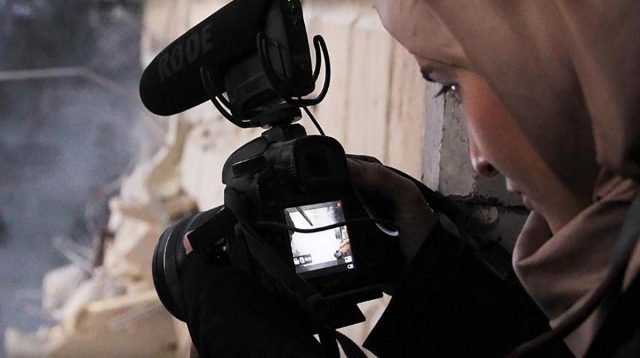
Waad al-Kateab documents daily life under constant bombardment in Aleppo in For Sama
FOR SAMA (Waad al-Kateab & Edward Watts, 2019)
BAMfilm, BAM Rose Cinemas
30 Lafayette Ave. between Ashland Pl. & St. Felix St.
Saturday, September 28, 7:00
Series runs September 27 – October 2
718-636-4100 www.bam.org www.forsamafilm.com
“You’re the most beautiful thing in our life, but what a life I’ve brought you into. You didn’t choose this. Will you ever forgive me?” Waad al-Kateab asks in the extraordinary documentary For Sama. In 2012 during the Arab Spring, Waad, a marketing student at Aleppo University, joined the protests against the regime of President Bashar al-Assad. She started taking photos and cell-phone video, then got a film camera as she became a citizen journalist, documenting the escalating conflict, trying to find moments of joy amid the brutal, senseless murders of innocent men, women, and children. She met and fell in love with heroic doctor Hamza al-Kateab, who was determined to keep his hospital running as the bombings got closer. Waad and Hamza got married, and on January 1, 2016, she gave birth to a healthy girl, Sama.
The film, directed by Waad (who also served as cinematographer and producer) and Edward Watts (Escape from ISIS), is a poignant, unflinching confession from mother to daughter, explaining in graphic detail what the families of Aleppo are going through as Russian and Syrian forces and Islamic extremists maintain a constant attack. “We never thought the world would let this happen,” Waad explains as the body count rises — which she intimately shows, not shying away from shots of bloodied victims being brought into the hospital, a pile of dead children, or a desperate attempt to save the life of a mother and a newborn after an emergency caesarean. “I keep filming. It gives me a reason to be here. It makes the nightmares feel worthwhile,” Waad says.
She captures bombings as they happen, films families huddled inside their homes while machine guns can be heard outside, talks to a child who says he wants to be an architect when he grows up so he can rebuild Aleppo. Because she is a woman, Waad gains access to other women that would not be available to a male filmmaker as they share their stories of love and despair. Waad and Hamza plant a lovely garden to bring color to the dank, brown and gray city. A snowfall covers the turmoil in a beautiful sheet of white. The pitter-patter of rain offers a brief respite. But everything eventually gets destroyed as Waad and Hamza struggle with the choice of leaving with Sama or staying to continue their critical roles in the rebellion, she depicting the personal, heart-wrenching images of war — in 2016, her Inside Aleppo reports aired on British television — he tending to the ever-increasing wounded. “The happiness you brought was laced with fear,” Waad tells Sama in voiceover narration. “Our new life with you felt so fragile, as the freedom we felt in Aleppo.”
Winner of the Prix L’Œil d’Or for Best Documentary at Cannes among other awards, For Sama is screening September 28 at 7:00 in the BAM series “Contemporary Arab Cinema” and will be followed by a Q&A and book signing with journalist Sam Dagher, author of Assad or We Burn the Country. The series runs September 27 to October 2 and includes such other Arab films as Sameh Zoabi’s Tel Aviv on Fire, Mahmoud Ben Mahmoud’s Fatwa, and Nadine Labaki’s Capernaum.
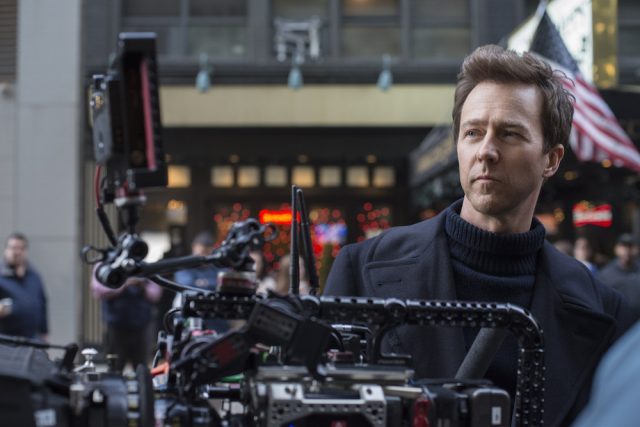
The fifty-seventh New York Film Festival gets under way today with the opening selection, Martin Scorsese’s The Irishman, a crime drama starring Al Pacino, Joe Pesci, and Robert De Niro. The festival continues through October 13 with other Main Slate films by Olivier Assayas, the Dardenne brothers, Arnaud Desplechin, Pedro Almodóvar, Kyoshi Kurosawa, and Agnès Varda, among others, with Noah Baumbach’s Marriage Story the centerpiece and Edward Norton’s Motherless Brooklyn closing things out; the screenings are held at Alice Tully Hall, the Walter Reade Theater, and the Elinor Bunin Munroe Film Center. Documentaries include looks at rare-book sellers, Merce Cunningham, surgical transitioning at Mount Sinai Hospital, Roy Cohn, incarcerated students, and Oliver Sacks.
A stellar lineup of revivals is highlighted by Luis Buñuel’s L’age d’or, William Wyler’s Dodsworth, Jack Arnold’s The Incredible Shrinking Man, and Bert Stern’s Jazz on a Summer’s Day, while Retrospectives boasts such films as Michel Gondry’s Dave Chapelle’s Block Party, Terence Malick’s Days of Heaven, John Ford’s The Grapes of Wrath, and Jim Jarmusch’s Dead Man, focusing on cinematographers. NYFF57 also will host talks, Directors Dialogues, short films, the virtual reality and immersive Emergence section, and Projections, consisting of works that challenge what cinema can be. Below are more than a dozen programs to watch out for.
Saturday, September 28
On Cinema: Martin Scorsese (The Irishman), Alice Tully Hall, 4:15
Saturday, September 28, 8:45
and
Thursday, October 3, 6:00
Man Slate: First Cow (Kelly Reichardt, 2019), followed by Q&As with Kelly Reichardt, John Magaro, and Orion Lee, Alice Tully Hall
Sunday, September 29
On Cinema: Pedro Almodóvar (Pain and Glory), Walter Reade Theater, 3:15
Monday, September 30
Producers on Producing: Hosted by Producers Guild of America, with Emma Tillinger Koskoff and David Hinojosa, Elinor Bunin Munroe Film Center Amphitheater, free, 7:00
Tuesday, October 1
In Conversation with Nadav Lapid, , Elinor Bunin Munroe Film Center Amphitheater, free, 7:00
Wednesday, October 2
Lynne Ramsay’s Brigitte, screening followed by a Q&A with Lynne Ramsay and Brigitte Lacombe, Francesca Beale Theater, free, 1:00
In Conversation with the Dardenne Brothers, Elinor Bunin Munroe Film Center Amphitheater, free, 7:00
Thursday, October 3
In Conversation with Michael Apted, Elinor Bunin Munroe Film Center Amphitheater, free, 7:00
Thursday, October 3, 12:00 – 6:00, 9:00 – 11:00
and
Saturday, October 5
Culture Capture: Terminal Adddition (the New Red Order — Adam Khalil, Zack Khalil, Jackson Polys, 2019), Elinor Bunin Munroe Film Center Amphitheater, free
Thursday, October 3, 6:15
and
Sunday, October 5, 12:15
Spotlight on Documentary: 45 Seconds of Laughter (Tim Robbins, 2019), North American premiere followed by Q&As with Tim Robbins, Walter Reade Theater / Howard Gilman Theater
Friday, October 4
In Conversation with Kelly Reichardt, Elinor Bunin Munroe Film Center Amphitheater, free, 7:00
Friday, October 4, 12:00 – 6:00, 9:00 – 11:00
and
Sunday, October 6, 12:00 – 6:00, 9:00 – 11:00
Free Amphitheater Loops: A Topography of Memory (Burak Çevik, 2019), Elinor Bunin Munroe Film Center Amphitheater, free
Saturday, October 5
Special Events: The Cotton Club Encore (Francis Ford Coppola, 1984), followed by a Q&A with Francis Ford Coppola, Alice Tully Hall, 2:30
Film Comment: Filmmakers Chat, with Luise Donschen, Akosua Adoma Owusu, Pietro Marcello, Corneliu Porumboiu, and Justine Triet, moderated by Nicolas Rapold, Elinor Bunin Munroe Film Center Amphitheater, free, 7:00
Saturday, October 5, 2:15
and
Sunday, October 6, 1:30
Projections: The Tree House (Minh Quý Trương, 2019), North American premiere followed by Q&Ad with Minh Quý Trương, Elinor Bunin Munroe Film Center
Saturday, October 5, 5:30
and
Monday, October 7, 8:30
Spotlight on Documentary: 63 Up (Michael Apted, 2019), followed by Q&As with Michael Apted, Walter Reade Theater / Francesca Beale Theater
Sunday, October 6
Screenwriting Master Class with Olivier Assayas, Howard Gilman Theater, 12:00
Making Uncut Gems, with Josh and Benny Safdie, Ronald Bronstein, Sebastian Bear McClard, Daniel Lopatin, and Jen Venditti, Elinor Bunin Munroe Film Center Amphitheater, free, 7:00
Sunday, October 6, 5:30
and
Monday, October 7, 9:00
Main Slate: The Traitor (Marco Bellocchio, 2019), followed by Q&As with Marco Bellocchio and Pierfrancesco Favino, Alice Tully Hall
Monday, October 7
Denis Lenoir in Conversation with Kent Jones, Elinor Bunin Munroe Film Center Amphitheater, free, 4:00
Writing New York: Hosted by Writers Guild of America, East, with JC Chandor, Geoffrey Fletcher, Elisabeth Holm, Gillian Robespierre, and Steven Zaillian, Elinor Bunin Munroe Film Center Amphitheater, free, 7:00
Tuesday, October 8
Directors Dialogues: Bong Joon Ho (Parasite), Francesca Beale Theater, 6:00
We [heart] Agnès, with Rosalie Varda, Elinor Bunin Munroe Film Center Amphitheater, free, 7:00
Wednesday, October 9
Film Comment: Festival Wrap, with Nicolas Rapold, K. Austin Collins, Nellie Killian, Michael Koresky, and Amy Taubin, Elinor Bunin Munroe Film Center Amphitheater, free, 7:00
Thursday, October 10
Directors Dialogues: Mati Diop (Atlantics), Francesca Beale Theater, 8:30
Revivals: Dodsworth (William Wyler, 1936), introduced by Kenneth Lonergan and followed by a Q&A with Catherine Wyler and Melanie Wyler, Alice Tully Hall, 8:45
Thursday, October 10, 3:15 – 9:00
Friday, October 11, 5:30 – 9:00
Saturday, October 12, 1:00 – 9:00
and
Sunday, October 13, 1:00 – 9:00
Convergence: Holy Night (Casey Stein & Bernard Zeiger, 2019), Elinor Bunin Munroe Film Center lobby, free
Friday, October 11
Holy Night: Meet the Makers, with Casey Stein and Bernard Zeiger, Elinor Bunin Munroe Film Center Amphitheater, free, 7:30
Saturday, October 12 The Raven: Meet the Makers, with Lance Weiler, Ava Lee Scott, Nick Fortungo, and Nick Childs, Elinor Bunin Munroe Film Center Amphitheater, free, 3:00
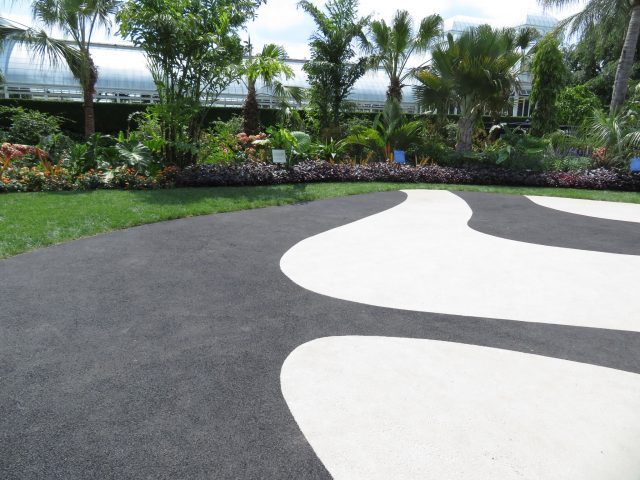
“Gardens are works of art, and have to be treated as such,” the multitalented Roberto Burle Marx said (photo by twi-ny/mdr)
The New York Botanical Garden
2900 Southern Blvd., Bronx
Through Sunday, September 29, $10-$28
718-817-8700 www.nybg.org
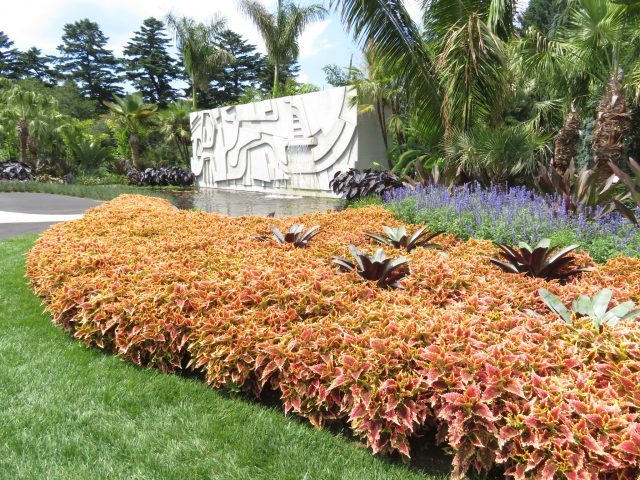
This is the last weekend to see one of the most beautiful exhibits of the summer, “Brazilian Modern: The Living Art of Roberto Burle Marx.” The New York Botanical Garden’s wide-ranging survey of the life and career of São Paulo-born landscape architect and conservationist Roberto Burle Marx is the Bronx institution’s largest botanical exhibition in its history, consisting of plants, painting, sculpture, photographs, quotations, ephemera, and more. The installation is highlighted by a glorious, swirling black-and-white mosaic walkway and Modernist Garden, designed by Burle Marx protégé Raymond Jungles, that leads to a living wall fountain and the Enid A. Haupt Conservatory, which is filled with native Brazilian plants and other species. Marx, who passed away in 1994 at the age of eighty-four, brought back many of them from his extensive travels.
“As far as I’m concerned, there are no ugly plants,” Roberto Burle Marx, “Function of the Garden” lecture (photo by twi-ny/mdr)
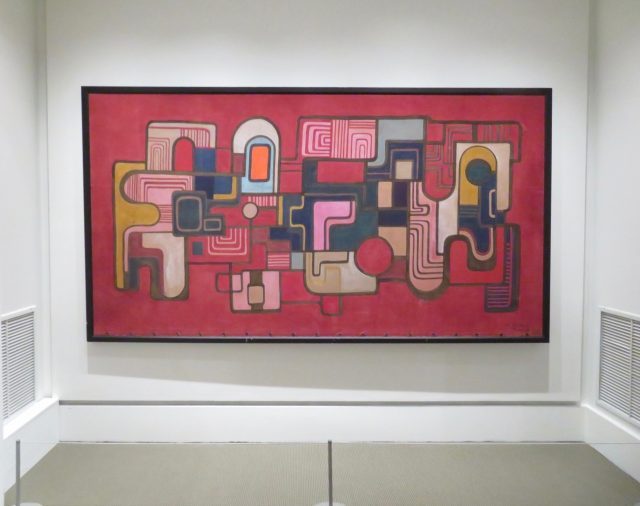
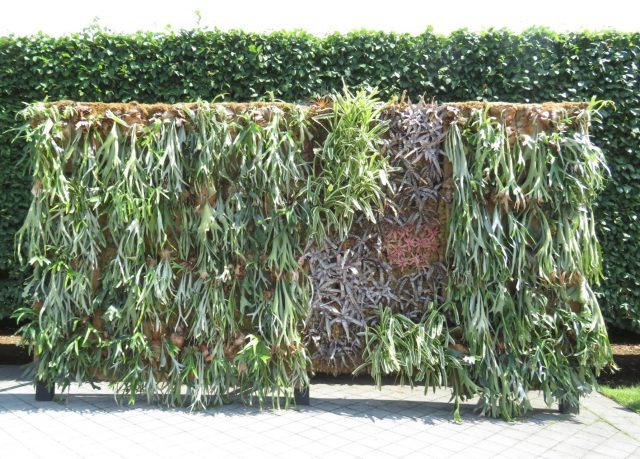
Blue signs identify Brazilian native plants from Neoregelia and Clusia grandiflora to Aechmea blanchetiana and Philodendron Burle Marx. “One must bring nature into the reach of man and, above all, take man back to nature,” he said in his “Gardens and Landscape” lecture. The display, curated by Edward J. Sullivan, Ph.D., also features a water garden with Bismarck palms, Amazonian water lilies, a dazzling wall of staghorn ferns, a room of Marx’s abstract paintings and tapestries and intricate environmental drawings, a detailed timeline, and an interactive look at the Sítio, which served as his home, a studio, and a salon, where he met with major landscape architects and artists.
“Nature is a complete symphony, in which the elements are all intimately related — size, form, color, scent, movement, etc. . . . . It is . . an organization endowed with an immense dose of spontaneous activity, possessing its own modus vivendi with the world around it,” Roberto Burle Marx, 1962 (photo by twi-ny/mdr)
It’s a pleasure to spend hours with Burle Marx, who appears to have been a friendly man with a vivacious thirst for art in every facet of his life. Interestingly, not much is known about his family situation, despite Dr. Sullivan’s attempts to gather information from those who knew him. But what is known is upbeat and positive, as depicted in photos of him with his thick white hair and bushy mustache and through his many quotes.
“The garden is, it must be, an integral part of civilized life: a deeply felt, deeply rooted, spiritual, and emotional experience,” Roberto Burle Marx, “The Garden as a Form of Art,” 1962 lecture (photo by twi-ny/mdr)
On Saturday from 1:00 to 4:00, Artes Brasileiras will present live music, while on Sunday the Silva Dance Company will perform at the same time and the Cinema Brasileiro! film series will screen Joao Vargas Penna’s 2018 documentary Landscape Film: Roberto Burle Marx. Do whatever you can to make sure you experience this one-of-a-kind exhibition about a one-of-a-kind artist and environmentalist.
“Mrinalini Mukherjee: Phenomenal Nature” continues at the Met Breuer through September 29 (photo by twi-ny/mdr)
The Met Breuer
945 Madison Ave. at 75th St.
Through September 29, suggested admission $12-$25
212-731-1675 www.metmuseum.org
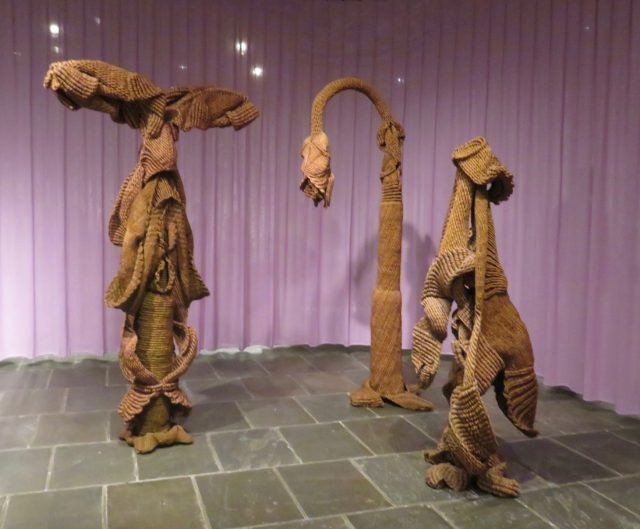
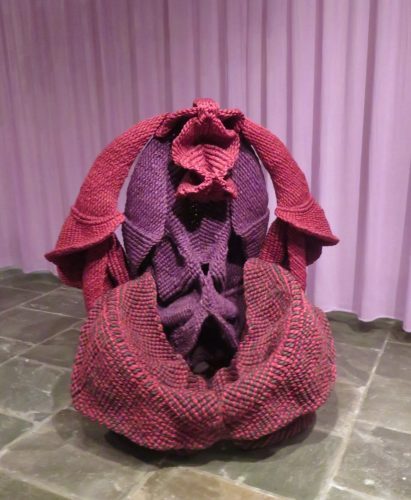
It’s a shame that Indian artist Mrinalini Mukherjee didn’t live long enough to see her lovely Met Breuer retrospective, “Phenomenal Nature.” This first major US survey follows the career of Mukherjee, who passed away in 2015 at the age of sixty-five, as she balanced between figuration and abstraction, the traditional and the modern, and Western and non-Western modalities while moving from fiber wall hangings and free-standing works to ceramic and bronze objects. The show, arranged chronologically, features her feminist totems that at times evoke a walk through the Star Wars Cantina, populated by strange and intriguing, often erotically charged creatures.
Mrinalini Mukherjee, Aranyani
(Goddess of the Forests), fiber, 1996 (photo by twi-ny/mdr)
Inspired by nature, Mukherjee’s colorful fiber and hemp sculptures reference both humans and animals and bear Sanskrit names such as Apsara (Celestial Nymph),Yakshi (Female Forest Deity),Rudra (Deity of Terror), and Black Devi (Black Goddess). Thoughtfully curated by Shanay Jhaveri, it’s a menagerie of snakes, peacocks, palm fronds, flowers, and figures with sexual organs that form their own kind of iconography; other pieces mimic furniture, from chairs to lamps, but there is nothing mundane about Mukherjee’s oeuvre, which she intended to be seen as an artistic whole rather than craft pieces. “My work is physical — my body, my materials, the way of life, the environment, all work together,” she said. The fifty-seven works are on view through September 29, a poignant introduction to a sadly little-known artist you can learn more about at the free MetFridays lecture “Mrinalini Mukherjee: Materials and Experience,” with Julia Bryan-Wilson, Fred Moten, and Jhaveri at the Met Fifth Ave. at 6:30 on September 27.
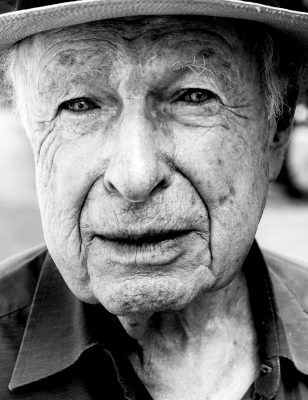

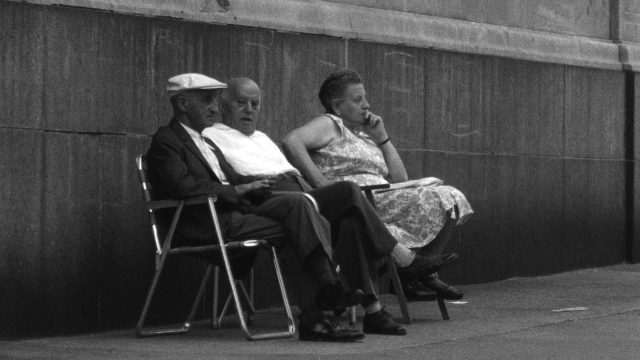
 Eighty-eight-year-old Manfred Kirchheimer will be at Lincoln Center’s Francesca Beale Theater tonight to screen and discuss his latest work, the subtly dazzling Free Time, which had its world premiere yesterday in the Spotlight on Documentary section of the fifty-seventh annual New York Film Festival. The German-born, New York-raised Kirchheimer has taken 16mm black-and-white footage he and Walter Hess shot between 1958 and 1960 in such neighborhoods as Hell’s Kitchen, Washington Heights, Inwood, Queens, and the Upper East Side and turned it into an exquisite city symphony reminiscent of Helen Levitt, Janice Loeb, and James Agee’s classic 1948 short