Who:Niki Russ Federman,Josh Russ Tupper,Joshua David Stein,Reggie Nadelson What:Russ & Daughters: 100 Years of Appetizing, a Conversation Where:The Coffee House Club at the National Arts Club, 15 Gramercy Park South When: Friday, May 8, $85, 11:30 am Why: In 1904, Polish Jewish immigrant Joel Russ started selling herring from a pushcart on the Lower East Side. Ten years later, he opened an appetizing shop on Orchard St., moved to Houston St. in 1920, and renamed it Russ & Daughters in 1933, after his children Hattie, Ida, and Anne. Today it is a thriving business with multiple locations, run by fourth-generation owners and cousins Niki Russ Federman and Josh Russ Tupper. In September 2025, they published Russ & Daughters: 100 Years of Appetizing (Flatiron, $39.99), featuring recipes for such delicacies as smoked whitefish chowder, hot borscht, herring sauces, chopped liver, the Super Heebster bagel sandwich (my favorite), noodle kugel, egg creams, and many more delights.
On May 8, Federman and Tupper will be joined by Brooklyn-based author and journalist Joshua David Stein and author and filmmaker Reggie Nadelson for “Russ & Daughters: 100 Years of Appetizing, a Conversation,” a book talk, signing, Q&A, and three-course prix-fixe lunch hosted by the Coffee House Club at the National Arts Club. Tickets are $85; the intimate event for a limited number of guests is scheduled to conclude at 2:00.
[Mark Rifkin is a Brooklyn-born, Manhattan-based writer; you can follow him on Substack here.]
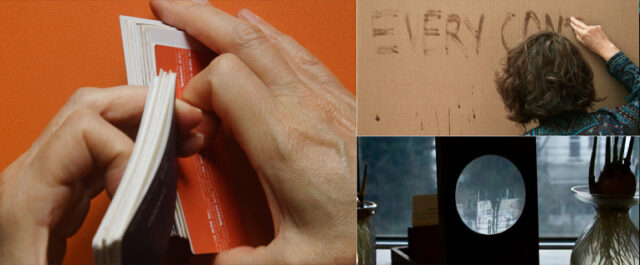
“Evidence does not forget. It is not confused by the excitement of the moment. Am I?” Lynne Sachs asks at the beginning of her latest documentary, Every Contact Leaves a Trace, which is making its New York City premiere at Anthology Film Archives on May 3 as part of the sixth Prismatic Ground festival.
The film has a fascinating premise: Sachs goes through approximately six hundred business cards, or what she calls “memory devices,” she has saved over four decades and decides to reach out to a handful of the people who gave them to her. She calls in forensics experts who confirm that it is still possible to dust the cards for traces of DNA and fingerprints, but Sachs wants to take that to the next level and actually reconnect with seven individuals, remembering how they met in the first place and what they have been doing since.
Among the card givers were professors, filmmakers, doctors, publishers, restaurateurs, contractors, hair salons, a fitness center, a lawyer, museums, her brother Ira Sachs, and even my cinematic mentor, Amos Vogel. She ends up taking a look back with Angela Haardt, a dancer, professor, and filmmaker who cofounded the International Forum of the Film Avant-Garde in Germany; experimental multidisciplinary artist and curator Bradley Eros; textile and mixed media fiber artist Betty Leacraft; educator and former chair of the China Women’s Film Festival Jiang Juan; hair stylist Irina Yekimova; and the late experimental filmmaker and photographer Lawrence Brose, who shares a frightening situation he faced that makes Sachs reconsider whether to keep in the film.
Also participating are Obie winner Rae C. Wright as a therapist, and Sachs’s young twin niece and nephew Felix and Viva Johnson Sachs Torres, who help her pick through the cards and share their thoughts. In addition, Sachs features strikingly poetic visuals in black-and-white and color, card shuffling, geometric drawings, fabulous music by Morton Feldman and Stephen Vitiello, a discussion of German writer Heinrich Heine, and the creation of new artworks.
“It’s rare to take note how an encounter with someone seeps into your way of thinking,” Sachs says as she recalls her initial interactions with these people and investigates the trace elements that they left with each other.
It’s the kind of documentary that is its own time capsule; fewer and fewer business cards are traded today, and an increasing number of meetings are being held online instead of in person, except for, of course, something such as getting one’s hair done.
“Even like for a split second they left something of themselves in me,” Sachs posits. The same can be said for Sachs’s film, which will leave something of her in you, as she has done with such previous works as Tip of My Tongue,Film About a Father Who, and Investigation of a Flame.
Every Contact Leaves a Trace is screening on May 3 at 1:30 at Anthology, preceded by sixth annual Ground Glass Award winner Kohei Ando’s three-minute My Friends in My Address Book and followed by a Q&A.
Chad “Shorty” McDaniel displays his lust for life — and pool — in ReelAbilities documentary
Who: Chad “Shorty” McDaniel, Loren Goldfarb What: East Coast premiere of 96 Pounds of Dynamite at 2026 ReelAbilities Film Festival Where:Fashion Institute of Technology, Pomerantz Center, 300 Seventh Ave. at West Twenty-Seventh St., room D207, and Marlene Meyerson Jewish Community Center Manhattan, 334 Amsterdam Ave. When: Wednesday, April 28, free with advance RSVP, 6:30, and Thursday, April 29, $19.95, 5:30 Why: “I really want to get the message out there that regardless of the circumstances, you can do it in life. You can succeed in life, you can make something of yourself,” Chad “Shorty” McDaniel says at the beginning of 96 Pounds of Dynamite. “But I don’t think any human should have to put up with what I put up with.”
Making its East Coast premiere at the ReelAbilities Film Festival, Loren Goldfarb’s documentary follows McDaniel’s inspiring story. He first met McDaniel in a Florida pool hall, where he plays in a motorized wheelchair because of Osteogenesis Imperfecta, a genetic brittle bone disease that has resulted in his having extremely short arms and legs. But that hasn’t stopped him from becoming an amateur champion — or to enjoy every part of life he possibly can.
“People, they naturally go, ‘Oh the poor little handicap guy,’ you know what I mean?” he says. “Once I open my mouth, I shut that shit down quick. Mm, no. No Napoleon complex here,” he says wryly.
Goldfarb speaks with McDaniel’s friends and relatives, doctors, fellow pool players, his wife, Allison, and others with his disease. Through it all, McDaniel is upbeat and ready to take on anything, determined to win an upcoming tournament.
“I love when people underestimate me. I will eat them alive,” he declares defiantly.
Codirected by Ed Coughlin and featuring pool champion Jeanette “the Black Widow” Lee as one of the executive producers, 96 Pounds of Dynamite is screening April 28 at 6:30 at FIT and April 29 at 5:30 at the Marlene Meyerson JCC; both showings will be followed by a Q&A with McDaniel and Goldfarb. You can also stream the film through May 3 here.
ReelAbilites continues through April 30 with such other screenings as Heavy Healing at Nitehawk, No One Cares About Crazy People at the Joan and Alan Bernikow JCC Staten Island, and Espina at the JCC Manhattan.
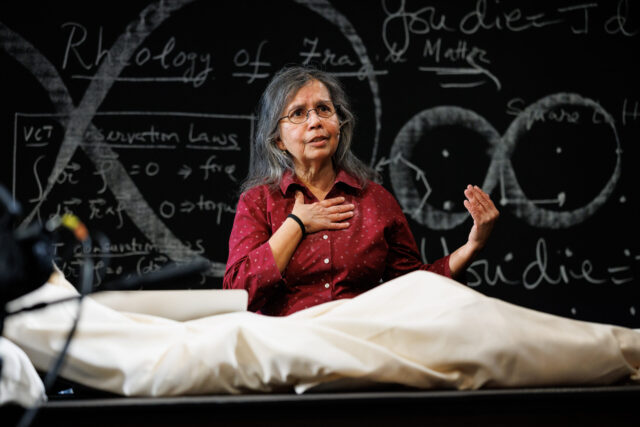
Physicist and professor Bulbul Chakraborty won an Obie for her performance in Rheology (photo by Maria Baranova)
RHEOLOGY
Playwrights Horizons, Peter Jay Sharp Theater
416 West 42nd St. between Ninth & Tenth Aves.
Through May 16, $53.50-$93.50 www.playwrightshorizons.org
When is a physics lecture not a physics lecture? When it’s also a genius theatrical meditation on family and death.
First presented last spring at the Bushwick Starr in association with HERE Arts Center and Ma-Yi Theater Company, Rheology is back for an encore run at Playwrights Horizons, where it is beguiling audiences with its intoxicating mix of science and multimedia art. Written and directed by Obie winner and Pulitzer finalist Shayok Misha Chowdhury, the ninety-minute play was created in collaboration with his mother, renowned theoretical physicist and professor Bulbul Chakraborty, who specializes in condensed matter and how nonthermal systems, particularly sand, respond to external stresses.
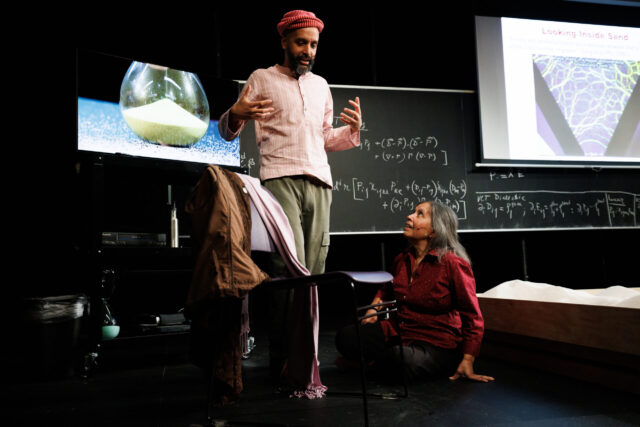
When the doors open, Chakraborty is already onstage, writing down formulas and equations across a long digital blackboard relating to field theory, Gauss’s Law, Faraday’s Law, and the rheology of fragile matter. In this case, the fragile matter is Chowdhury, who is seen in a photo as a child with his mother projected above the blackboard; the screen is also used to share scientific photographic and video information. In addition, a camera zooms in on an hourglass on her table, projecting it onto a side monitor, and a child’s sandbox beckons. (The video design is by Kameron Neal, Chowdhury’s partner, with set by Krit Robinson and live music by cellist George Crotty.)
As Chakraborty performs an experiment describing how the solid sand can behave like a liquid, she starts choking, bending over in distress. Several people in the audience began calling out to her, asking if they should contact 911; a woman sitting behind me was practically freaking out. I didn’t want to ruin the experience for her, but I felt I had to tell her that it was part of the show, that Chakraborty wasn’t dying right in front of us as we did nothing.
She suddenly stops, and a man in the audience asks her why. She explains that she usually pretends to choke longer but she could feel the energy in the room shift to genuine concern. The man then identifies himself as Chowdhury, and he describes what it was like growing up the only child of two physicists; as a bonus, his father, Partha Chowdhury, a graduate professor who specializes in gamma-ray spectroscopy and nuclear structure, was in the audience that night. Chowdhury talks about his nightmares about his mother’s eventual death — she is not ill, but we all die eventually — and so dreamed up this play to savor more experiences with her.
“The time we have left together is finite,” Chowdhury posits. “And it’s almost this . . . pressure I’ve been feeling, like I can’t be . . . in the moment when we’re together because I’m aware that each moment is a moment I’m supposed to be making the most of. Um . . . so . . . what I have done is forced her to . . . be in a show with me . . . so we can spend more time together . . . because as long as we’re doing this show she is literally . . . contractually obligated to be alive. . . . So what we’re doing here is a kind of exposure therapy for me. . . . Whenever I’ve expressed to her that I could not in fact survive her death, my mom is like: But how do you know that, that’s not a statement of fact, that’s a hypothesis, where’s the evidence? You need to gather evidence to support your hypothesis. And I was like: How do I do that? And she was like: I thought you did experimental theater? Why don’t you design an experiment to test your hypothesis? And I was like: You mean, kill you? And she was like: Could you do a simulation?”
And so they do an extremely realistic simulation in a way that regularly circles back to Chakraborty’s studies of the properties of sand, investigating them as both individual grains and how they react with other grains en masse, like a human being relating to other human beings, or to one specifically — for example, a loved one.
Misha Chowdhury faces his fears about his mother’s eventual death in deeply personal play (photo by Maria Baranova)
Not surprisingly, while Chakraborty accepts the facts that she, and the rest of us, are going to die, Chowdhury is far more emotional and dramatic about it, which results in a compelling dynamic between mother and son, scientist and theater maker. Beautifully presented, the show is likely to have each audience member considering their own relationship with death, be it theirs or someone close to them. For me, it instantly brought back memories of the deaths of my mother (at seventy-six) and father (at forty-seven) as well as that of my mother-in-law, who passed last October at the age of eighty-nine. In addition, it was fascinating to look over at Partha Chowdhury every once in a while and wonder what was going through his mind as he watched his wife “die” onstage and his son proclaim that he cannot go on without her.
Chakraborty, who won an Obie for her performance, is utterly charming and engaging playing herself; she appears to be a terrific teacher and a wonderful mother — and an expert improviser. Chowdhury (Public Obscenities,Prince Faggot) holds nothing back as he willingly, and entertainingly, shares his deepest, darkest fears with a combination of sadness and humor, emphasizing his fragility. It all comes together when he goes into the sandbox and attempts to build a castle, a powerful metaphor for everything that has come before it. Kudos should also go out to dramaturg Sarah Lunnie for the tight structure.
In his 1981 song “Every Grain of Sand,” which closes every concert on his neverending tour, Bob Dylan sings, “I hear the ancient footsteps like the motion of the sea / Sometimes I turn, there’s someone there, other times it’s only me / I am hanging in the balance of the reality of man / Like every sparrow falling, like every grain of sand.”
Rheology also concludes with poetry, by Indian polymath Rabindranath Tagore, followed by a moving hypothesis that goes far beyond scientific theory and a lecture on physics.
[Mark Rifkin is a Brooklyn-born, Manhattan-based writer; you can follow him on Substack here.]
John Waters loosens up in preparation for his eightieth-birthday shows, coming to the Society for Ethical Culture on April 19
GOING TO EXTREMES: A JOHN WATERS 80th BIRTHDAY CELEBRATION
Adler Hall at the New York Society for Ethical Culture
2 West Sixty-Fourth St. & Central Park West
Sunday, April 19, $87.97 – $130.69, 7:30 ethical.nyc www.dreamlandnews.com
“Secretly I think that all my films are politically correct, though they appear not to be. That’s because they’re made with a sense of joy,” filmmaker, actor, writer, visual artist, and monologist John Waters has said.
After having spoken with him, I now feel that John Waters himself is made with a sense of joy.
Over a career lasting more than sixty years, the Baltimore native, who turns eighty on April 22, has brought joy to a ravenous public that devours his eclectic movies, books, talk-show appearances, and solo performances. He broke through in the early 1970s with the counterculture trio of Multiple Maniacs,Pink Flamingos, and Female Trouble, all starring the drag queen Divine, and scored more mainstream success later with Polyester,Hairspray,Cry-Baby, and Serial Mom.
His writings include 1981’s Shock Value: A Tasteful Book About Bad Taste, in which he explains, “To me, bad taste is what entertainment is all about. If someone vomits watching one of my films, it’s like getting a standing ovation.”; the 2014 nonfiction Carsick, which details his 2012 cross-country hitchhiking trip; and his first novel, 2022’s Liarmouth . . . A Feel-Bad Romance, about a pair of con artists, luggage, and a chatty penis. Among his numerous acting jobs, he portrayed the Groom Reaper on the based-on-fact legal drama ’Til Death Do Us Part and made a cameo as Jesus in Ash Christian’s Mangus!
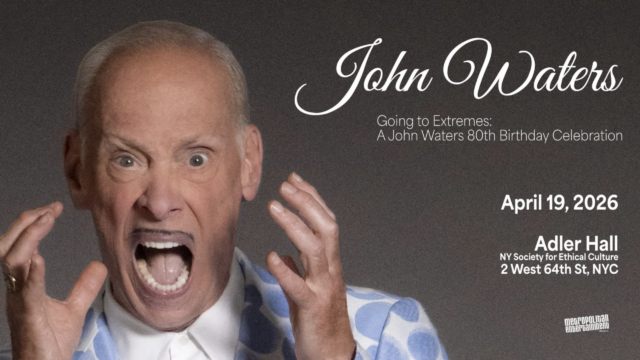
A master of the spoken-word lecture, he has performed such solo shows as This Filthy World,Naked Truth,Make Trouble, and A John Waters Christmas. His latest, Going to Extremes: A John Waters 80th Birthday Celebration, comes to the Society for Ethical Culture on April 19.
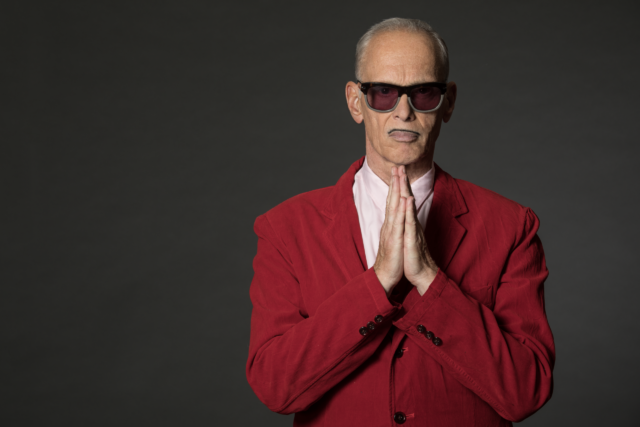
Waters, who is always impeccably dressed and styled, usually in a sports jacket and tie, highlighted by his famous pencil-thin mustache, is utterly charming on the phone, laughing often as we discuss the ins and outs of showbiz, holiday-themed monologues, Howdy Doody, airplane etiquette, and ethical culture.
twi-ny: Hello, John.
john waters: Hey, Mark.
twi-ny: I met you many, many years ago. You would never, ever remember it, but it was at “Outsider Porn,” a marvelous show you curated with Dian Hanson in Chelsea of photos of erect penises by David Hurles.
jw: Yeah, I did that at the Marianne Boesky Gallery. Yes.
twi-ny: I had never seen anything like that kind of show and I just loved it.
jw: It was pretty brave of my gallery to do it.
twi-ny: Yes, but you know what, it was like all of your work, all the things you’re involved in: It makes people experience a different part of the world or a different kind of beauty that they’re not used to seeing.
jw: I’m coming to New York for my eightieth.
twi-ny: How great is that? So when you were a boy and you started doing puppet shows at children’s birthday parties, did you ever think that you would be working harder than ever in the entertainment business when you were eighty?
jw: I didn’t ever think that, but I never thought I wouldn’t do that either. I always was ambitious. My parents taught me I could be anything I wanted, even when what I wanted to be is not what they wanted me to be. So I would say, no. When you’re twelve years old, it seems like it takes a hundred years to be thirteen. When you’re seventy-nine, it takes one second until you’re eighty. So that’s the difference.
twi-ny: I wrote a piece last month about three artists who were all in their nineties, two painters and an actress. They’re doing some of their best work now.
jw: I always say, I’m afraid if I stop, I drop dead. I’m busier than I’ve ever been in my whole life. And I say in my show, I’m not going to give it all away, but I do say if I do drop dead, you can do selfies. I don’t do selfies in real life because I got Covid from doing it.
twi-ny: I read that at some show you were throwing masks around.
jw: I don’t think that’s true. It was before Covid even started; I wouldn’t have ever done that. I read that somewhere online too. It might have been in the very beginning, but I’m not so sure I did do that. Well, if it was ever, it would have been just once. I’ve thrown poppers into the audience. I’ve thrown anal bleach packets into the audience. I’m fine admitting the things I throw. Ground beef I’ve thrown, but I don’t think I ever threw that.
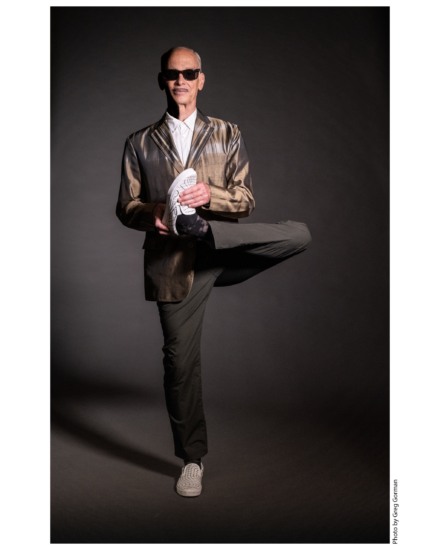
John Waters refers to his solo shows as “sermons” (photo by Greg Gorman)
twi-ny: In Carsick, you wrote that Brigid Berlin said to you, “How can I be bad at seventy? She’s got a point. I’m sixty-six years old, for Christ’s sake.” Now that you’re turning eighty — and, unfortunately, we lost Ms. Berlin in 2020 when she was eighty — can you still be bad at eighty? I’m thinking that you can still be bad at eighty.
jw: I guess, but what do you mean by bad? If anything, trying to be bad may never be good. What she meant by bad was . . . Brigid Berlin changed so much in movies and the conception of a rich girl, of a fag hag, of a junkie, of all the different bad labels. She ended up being a Republican, which is kind of funny.
twi-ny: Right?
jw: Yeah. I think she did find out how to be bad at eighty. She became a Trump supporter.
I hitchhiked across the country by myself at sixty-six. I took LSD with Mink [Stole] at seventy, and I always joked I was gonna turn heterosexual at eighty.
twi-ny: Well, now you’ve got something to look forward to — or not. When you were a kid, your parents took you to see Howdy Doody in New York City.
jw: Yep, I was in the Peanut Gallery at NBC Studios, where later I did David Letterman.
twi-ny: How would you describe that experience? Was that your first trip to New York City?
jw: No, not my first trip, but it was an earth-shattering one that changed my life because I was obsessed by Howdy Doody, as everybody was. It was the first television show in America, practically. My uncle knew someone at NBC Studios; it was not easy to get on that show. There were only, I forget, like twenty kids in the audience, but I remember walking into the studio. It was this giant studio with this tiny little puppet stage surrounded by fifty cameras. There were five Howdy Doody puppets, five of each character.
There was Buffalo Bob, who was mean to us and told us to shut up or we wouldn’t get anything when it was over. I looked around and realized this was all a big lie. And rather than be disillusioned, I knew this was what I wanted to do for the rest of my life.
twi-ny: You got a taste of what was going on behind the scenes, how it’s done.
jw: I saw the illusion, I saw the whole thing, and I knew this would be the only thing I could ever really do.
twi-ny: And it really set in motion everything that you’ve done afterward. Staying in New York for a bit, you live here and in Baltimore and San Francisco?
jw: And Provincetown. And, more than any of them, airports. I did fifty-nine shows last year.
twi-ny: And you have a whole lot more coming up this year. One of my favorite things you’ve said was, “It’s hard to imagine how great and scary Times Square was.” Now, over the years, starting with Giuliani specifically, it’s gone through so many changes.
jw: No, it’s scary now because it’s suburbia.
twi-ny: They sort of Disney-fied it, right?
jw: Not even Disney-fied; it’s not even that good. It’s just people sitting in lawn chairs. I like Times Square, but I miss the . . . no, Times Square got so terrible at the end it had to change. But still, it’s amazing to walk by and think, Oh my God, I had sex in a movie theater in there. That place used to be the most insane place where both homeless and gay people went.
People would be trying to sleep and they’d accidentally put their arm through a glory hole. You think back on these memories and they’re long gone. Even the ghosts are in hell.
twi-ny: You’ll be at the Society for Ethical Culture on April 19. How has the concept of ethical culture changed from from the beginning of your career?
jw: I played there before; it’s an amazing place. Well, ethical culture — what ethnic am I? The filth world. I guess I am filth culture, which is a subculture of radical entertainment. Yes, basically, I’m a carny. That’s what I am.
twi-ny: Many of your shows are built around holidays. You’ve done, in addition to the birthday shows, Valentine’s Day, Christmas, Halloween shows. Is that just a coincidence or are you drawn to holidays?
jw: I’ve done July 4 shows, I’ve done Valentine’s Day, I’ve done all of them. I tell you, I’m going to do Groundhog Day and do my old material.
I rewrite the show completely once a year, which is like writing a short book, because it’s a seventy-minute monologue.
twi-ny: Everybody loves holidays, but do you feel a special connection to holidays, or is it just a good way to give you an idea of how to change the show?
jw: It’s exploitation, that’s all. People always say, What are you doing on Halloween? I say, I’m like a common drag queen; I gotta work. I mean, on the holidays, even at Christmas, when I’m touring around, I think, Where am I supposed to do Christmas shopping, in airports? I try to get people gift certificates for Hudson News but they don’t have them; they looked at me like I was crazy when I asked.
twi-ny: Only certain people would understand that.
jw: I think it’s funny. Of course, now a $50 gift certificate for Hudson News wouldn’t buy you a package of Kleenex. How much is a coffee? Eleven dollars for a small coffee to go?
twi-ny: Is there anything on your birthday that you specifically love to do?
jw: That’s something in my private life that I never share. I’m going to a foreign country and have a vacation. So much of my life is shared with the public, if you don’t keep some things private, you’re oversharing.
twi-ny: That’s a great point, because the films you’ve made, the books you’ve written, your shows, they’re very, very open. They’re not necessarily confessional, but you’re not hiding a lot as far as we can tell. So I would imagine that means people think they can tell you anything or ask you anything.
jw: It doesn’t mean I have to tell you everything.
twi-ny: Definitely not!
jw: They do tell me everything. I’ll sit on an airplane and a stranger next to me will tell me, You know, my parents fucked me in an Easter basket when I was five years old. Please don’t share that with me. I’m sorry for that, but I don’t know what I can do about it.
twi-ny: We’re going put the headphones on and watch that movie, I think.
jw: I read; that’s better. Anne Tyler said she used to always take the longest book on a plane so that she’d never be finished. I used to read a book called Lesbian Nuns and that would stop conversation usually. Now that would make people talk more. People would say, Oh, my sister’s one of them.
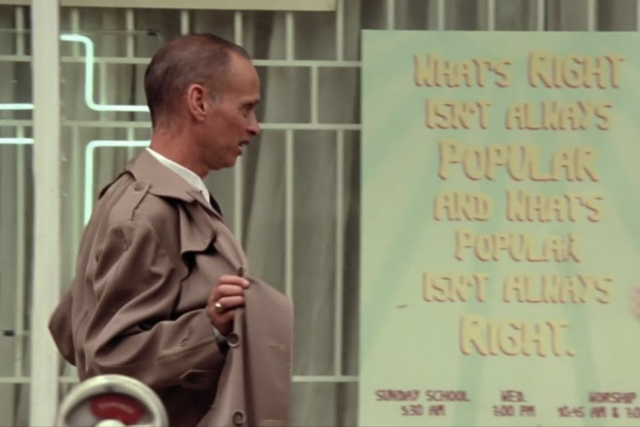
John Waters makes a key cameo in his 1988 hit Hairspray
twi-ny: Now that you’re reaching a certain age, does the number mean anything?
jw: How could I be eighty years old? It’s impossible to even imagine, yet here I am. I’m glad, I’m lucky, alive, to see and be able to be the busiest I’ve ever been in my life.
twi-ny: You’ve made a dozen feature films and many shorts, published ten books, you’re a photographer, you do voiceovers, you do your tours. Are there things in your professional life that you haven’t done yet that you’re itching to try?
jw: And my first poem is being published in The Atlantic this month.
twi-ny: Congratulations!
jw: So there’s one; the only thing left is to write a play. I’ve never done that.
twi-ny: I would love for you to challenge Broadway.
jw: I think I’d have a better chance off Broadway.
twi-ny: What might it be about?
jw: I wouldn’t tell. You never talk about something before you do it. After you do it you have to talk about it for the rest of your life.
twi-ny: You do a lot of interviews. I’m thrilled that you agreed to do this. Does it ever get tiring? Or, like you said before, is it all part of the exploitation?
jw: For every show I do, I’m contracted to do at least two interviews to promote it. It’s part of my job to do the press. I get ten newspapers a day and read about eight more. I like the press. I feel bad what they’re going through right now. So to me, why would you ever be in show business and say you hate the press? I use you to sell tickets and you use me to get people to read you and so that’s fair.
twi-ny: It’s a fair deal. I will say that in my case, I do this so people will know that John Waters is coming to New York City.
jw: You’re a social worker.
twi-ny: You’re most associated with Baltimore, where you filmed all your movies. One of my favorite movies last year was The Baltimorons.
jw: Yes, I liked it. I thought it was a very good religious romantic comedy. Not my favorite genre. They did it really well. The acting was really good in it. It was well shot. I liked it very much.
twi-ny: I imagine you might have been to that holiday Christmas market in the film.
jw: I avoid gatherings of Christmas glee, except my own — I have to be in a show every night. But certainly it fit in very well with films that are made in Baltimore, and I was very glad it’s a success.
twi-ny: I love the title.
jw: That’s a thing people always say here; it’s not negative.
John Waters is ready to scream at New York City show (photo by Greg Gorman)
twi-ny: Getting back to the show. In all the cities you go to, do audiences in different places react differently to John Waters? I’m sorry for talking about you in the third person.
jw: The same. They’re smart. They get dressed up for me. If they don’t get the jokes, they have homework to look it up. They’re very cool, all ages and all sexuality. I did a show this week in Phoenix. I did one in Santa Fe. In El Paso. And in New York. The audiences, I couldn’t tell the difference. And I mean that in a good way.
It was probably elitist of me to think that New York and LA get you but Phoenix and El Paso don’t.
jw: It’s a worldwide infected religion. I’m thankful. I even call my show sermons now.
twi-ny: So for New York, would you want people to come dressed any specific way?
jw: Don’t come dressed like you might on an airplane.
I see people on airplanes in an old filthy T-shirt and shorts in the middle of winter. Get dressed, pig! Really disgusting. So yes, people get dressed for me. I don’t have to tell them. No one wears a dirty sloppy T-shirt and baggy shorts to see me ever; it’s never happened.
twi-ny: I’ve seen that on Broadway.
jw: They know better.
twi-ny: You’re laughing through this entire interview. Every time I see you on talk shows or other programs, you just seem like a happy guy.
jw: Well, I’m not walking around like a lunatic. If you want to know the truth, I’m sick today. I have a really bad cold.
I am an actor. But I am who I say I am in interviews. That is the real me completely. But I’m not always like that all day.
twi-ny: I want to thank you for taking the time to speak with me despite you’re not feeling well.
jw: Thank you for your support. I couldn’t get away with it without people like you.
twi-ny: I’m looking forward to the show.
jw: Thank you. And laugh loudly when you’re there.
[Mark Rifkin is a Brooklyn-born, Manhattan-based writer; you can follow him on Substack here.]
John Kevin Jones pays tribute to Edgar Allan Poe at historic Merchant’s House Museum (photo by Joey Stocks)
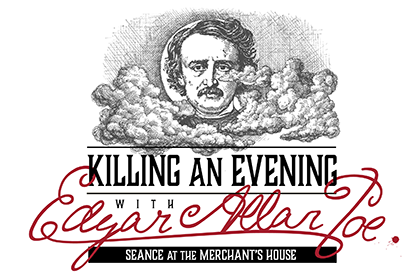
KILLING AN EVENING WITH EDGAR ALLAN POE
Merchant’s House Museum
29 East Fourth St. between Lafayette St. and the Bowery
March 25 – April 5, $65-$75 merchantshouse.org summonersensemble.org
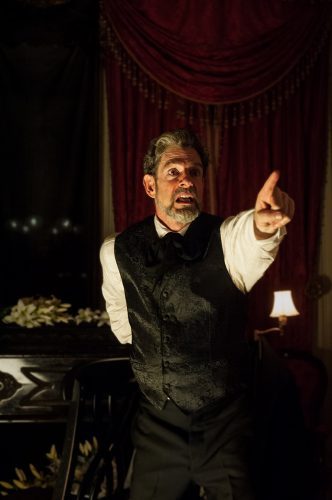
John Kevin Jones is back for his annual residency at the historic Merchant’s House Museum on East Fourth St. with Killing an Evening with Edgar Allan Poe: Murder at the Merchant’s House. Jones has gained a kind of cult fan club for his unique one-man shows, which also include his unique version of A Christmas Carol at the historic museum, a home built in 1831-32 that was occupied continuously by the Tredwell family from 1835 to 1933. The nineteenth century feels very present in the house, which was one of the first twenty buildings to gain landmark status under the city’s 1965 law and functions as a museum, preserving the Tredwell family’s furnishings as they would have appeared when Poe, coincidentally, lived nearby for a time at 85 West Third St. and later in a cottage in the Bronx. Dressed in nineteenth-century-style jacket, vest, top hat, and ascot, Jones celebrates Edgar Allan Poe with three of his most popular writings, preceded by short introductions about each work and Poe’s career.
Forty people are squeezed into the Tredwells’ candlelit double parlor — with a coffin at one end and a dining table at the other — and Jones walks up and down the narrow space between, where the audience is seated on three sides, boldly delivering several classic Poe tales of treachery and murder, “The Tell-Tale Heart,” “The Angel of the Odd,” and “The Cask of Amontillado,” from memory. His deep, theatrical voice resonates through the room as he catches the eye of audience members, adding yet more chills and thrills to the mystery in the air. He then sits down with a book for the long poem “The Raven,” evoking the great Poe actor Vincent Price. Jones, director Dr. Rhonda Dodd, and stage manager Dan Renkin, the leaders of Summoners Ensemble Theatre, keep the focus on Poe’s remarkable narrative technique; you might be watching one man, but you’ll feel like you’re seeing each of Poe’s characters in vivid detail.
Killing an Evening with Edgar Allan Poe runs March 25 through April 5, and for select performances there will be a “Raise a Glass to Edgar” preshow reception option ($30) in which Jones will recite “Annabel Lee” and “Alone,” Natalia “Saw Lady” Paruz will perform, and the kitchen, family room, and garden will be open. In addition, medium Heather Carlucci will give psychic readings after both Sunday shows.
There is also a concerted public effort to save the Merchant’s House from construction next door that could negatively impact its structural future; find out how you can help here.
[Mark Rifkin is a Brooklyn-born, Manhattan-based writer and editor; you can follow him on Substack here.]
Judith Bernstein, Joan Semmel, and Joyce Kozloff will take part in a Feminist Art Roundtable at the Jewish Museum
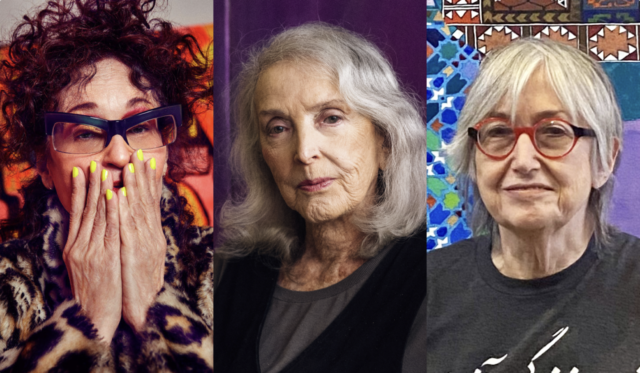
Who:Joan Semmel,Joyce Kozloff,Judith Bernstein,Rachel Corbett What:Feminist Art Roundtable Where:The Jewish Museum, Scheuer Auditorium, 1109 Fifth Ave. at 92nd St. When: Thursday, March 26, $14-$24, 6:30 Why: On New Year’s Eve, I attended a small dinner party in the West Village, where among the other invitees was painter extraordinaire Joan Semmel, whose brilliant exhibition “In the Flesh” is on view at the Jewish Museum through May 31, and the marvelous Joyce Kozloff, whose stunning cartographic works have been on display in such gallery shows as “Collateral Damage,” “Uncivil Wars,” and “Girlhood.” At the last minute, artist Judith Bernstein, whose provocative solo exhibitions include “Truth and Chaos,” “We Don’t Owe You a Tomorrow,” and “Money Shot,” was unable to make the gathering. But now everyone is invited to be in the presence of all three remarkable women — and longtime friends — when they convene at the Jewish Museum on March 26 for a “Feminist Art Roundtable” moderated by Rachel Corbett, author of You Must Change Your Life: The Story of Rainer Maria Rilke and Auguste Rodin and The Monsters We Make.
Semmel’s “In the Flesh” comprises sixteen lush, tender, and potent depictions of naked contorted figures and bodies in motion, dating from 1971 to 2023. “Their reflections are hidden, as is my face in most of my paintings,” Semmel has noted of her subjects. “For women who are always a sight to be seen, not being seen can be an act of defiance.” The show also features “Eye on the Collection,” consisting of forty-two museum works selected by Semmel, among them Bernstein’s 1966 Invest Your Sons (War Is Good Business) and Kozloff’s 2004 American History: 21st Century Crusades.
Don’t miss this rock-star lineup of extraordinary artists who have helped define and expand the concept of feminist art for six decades, demanding to be seen and heard.
[Mark Rifkin is a Brooklyn-born, Manhattan-based writer; you can follow him on Substack here.]