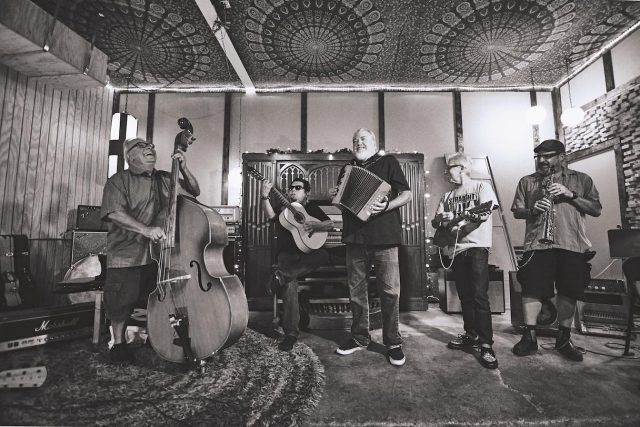
Mexican East LA band Los Lobos, which means “the wolves,” named its second album How Will the Wolf Survive? after an article in National Geographic. “It was like our group, our story: What is this beast, this animal that the record companies can’t figure out? Will we be given the opportunity to make it or not?” founding member Louie Pérez told Rolling Stone in 1989 when the 1984 record was named the thirtieth best of the past decade by the magazine. Los Lobos has made it, and on their own terms, having released more than twenty records and toured relentlessly around the world for more than forty years (they started as a high school group in 1973), led by founding members David Hidalgo and Cesar Rosas on guitar and vocals, Pérez on drums and vocals, Conrad Lozano on bass and vocals (since 1974), and newbie Steve Berlin on keyboards and woodwinds; he came on board in 1984. As is their trademark, Los Lobos, who come to the New York Society for Ethical Culture for a show December 14, is once again venturing into new territory with its first Christmas album, Llegó Navidad (Rhino, October 2019), a collection of eleven traditional Latin holiday tunes and one original.
“We’re not doing the typical ‘Silent Night’ and all that, which is fine,” Pérez says in a promotional video, continuing, “I mean, I wouldn’t mind doing that in our own kind of way. But there is such a wealth of traditional songs, songs that have been around for a while from all over Latin America.” The band explored more than 150 tunes before deciding what to record. “It took us a while to find the stuff we felt comfortable with,” Hidalgo said. The album includes such gems as “La Rama,” “Reluciente Sol,” “It’s Christmas Time in Texas,” “Las Mañanitas,” “Regalo De Reyes,” and “Christmas and You,” bringing Los Lobos’ unique flair and flavor to foster a feliz navidad for everyone. “Is this true to our ethos? I’d say absolutely,” Berlin explains. At Ethical Culture, you can expect a generous mix of old favorites (“One Time One Night,” “Will the Wolf Survive?”), cool covers (“Bertha,” “Volver, Volver”), and soon-to-be-classic Latin Christmas songs.
Brooklyn Museum
200 Eastern Parkway at Washington St.
Saturday, December 7, free (some events require advance tickets), 5:00 – 11:00
212-864-5400 www.brooklynmuseum.org
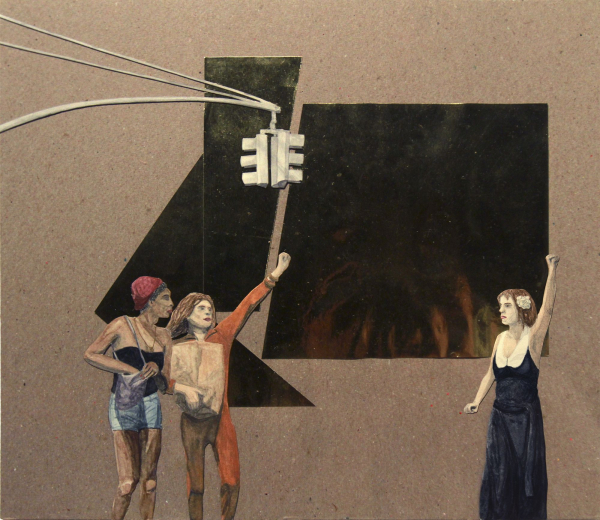
The Brooklyn Museum shows off the best of the borough in the December edition of its free First Saturday program. There will be live performances by Los Hacheros, Gemma, DJ Laylo, Adrian Daniel, and drag collective Switch n’ Play (featuring Divina GranSparkle, K.James, Miss Malice, Nyx Nocturne, Pearl Harbor, and Vigor Mortis with special guest Heart Crimson); Visual AIDS screenings of short films commemorating the annual Day With(out) Art, followed by a conversation between filmmakers Iman Shervington and Derrick Woods-Morrow, moderated by writer Mathew Rodriguez; a book talk on Elia Alba’s The Supper Club with Sur Rodney (Sur) and Jack Waters, focusing on the conversation from the book that asks “What Would an HIV Doula Do?”; a curator tour of the Arts of Japan galleries with Joan Cummins; teen apprentice pop-up gallery talks in “Nobody Promised You Tomorrow: Art 50 Years After Stonewall”; a night market with handmade artisanal products; and a poetry reading and book signing by Brooklyn poet laureate Tina Chang from her latest book, Hybrida. In addition, the galleries will be open late so you can check out “Garry Winogrand: Color,” “Nobody Promised You Tomorrow: Art 50 Years After Stonewall,” “yasiin bey: Negus,” “One: Xu Bing,” “Pierre Cardin: Future Fashion,” “JR: Chronicles,” and more.
Brooklyn Expo Center
72 Noble St.
Saturday, December 7, $70 (use code WHISKEYBK to save $25), 2:00 – 5:00, 6:30 – 9:30 www.brooklynwhiskeyfest.com
“Too much of anything is bad, but too much good whiskey is barely enough,” Mark Twain famously said. You can test his hypothesis on December 7 at the Brooklyn Whiskey and Spirits Fest. Taking place at the Brooklyn Expo Center, the festival is divided into two three-hour sessions, beginning at 2:00 and 6:30. Attendees will be given a souvenir tasting glass with which they can sample more than one hundred varieties of bourbon, blended, Irish, Scotch, Tennessee, rye, single malt, and Canadian whiskey and craft spirits, including gin, tequila, rum, stout, and more. Among the participants are Iron Smoke, the Fighting 69th Irish Whiskey, BSB Brown Sugar Bourbon, the Vale Fox, Sono 1420, Twinstills Moonshine, Cutwater, Copper Sea Distilling, Black Button Distillery, and Elijah Craig, with experts on hand to talk about their offerings. There will be live music as well as food available for purchase. You can also get a designated driver ticket for $15, but if you’re caught stealing a sip, you’ll be escorted out.
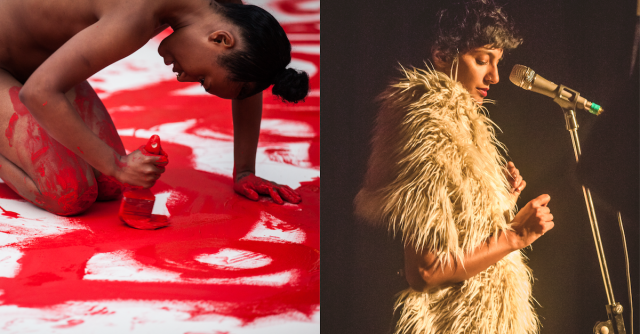
Dana Davenport and Samita Sinha will present new work together for Gibney DoublePlus (photos by Maria Baranova and Yanissa Grand-Pierre)
The Theater at Gibney 280 Broadway
280 Broadway between Chambers & Reade Sts.
December 5-7, 12-14, 19-21, $15-$20, 8:00 gibneydance.org
Gibney’s annual DoublePlus program, in which established artists mentor pairs of emerging choreographers, kicks off December 5-7 with Pilipinx-American producer, administrator, contemporary performance manager, and Current Sessions founder Alexis Convento curating works by Korean and black American interdisciplinary artist Dana Davenport and composer and vocal artist Samita Sinha. Davenport will present the new movement piece Experiments for ~Relaxation~, while Sinha debuts Kaalo Jol (“Black Waters”), a duet with Sunny Jain on dhol on Thursday and guitarist Grey Mcmurray on Friday and Saturday. The December 6 show will be preceded at 7:00 by a free Living Gallery site-specific performance of Capital-D Dance by Brooklyn-based dancer, writer, and producer Tara Sheena. The series continues December 12-14 with Alexander Diaz’s Getting closer to Coral and Jennifer Harrison Newman’s topologies, curated by Charmaine Warren, and December 19-21 with Laurel Atwell’s We Wield and Hyung Seok Jeon’s Deep Out Agents, curated by Tei Blow.
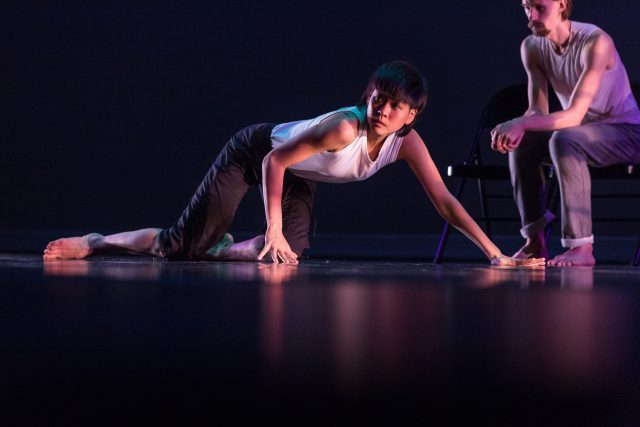
Mei Yamanaka and Jordan Morley are two of six performers in Tiffany Mills world premiere at the Flea (photo by Susan Allen)
The Flea Theater, the Sam
20 Thomas St. between Church St. & Broadway
November 13–16, $15-$20, 7:00
212-226-0051 theflea.org tiffanymillscompany.org
The New York City-based Tiffany Mills Company returns to the Flea, where it presented Blue Room last year, for the world premiere of Not then, not yet, running November 13-16 at the downtown theater. The work is a collaboration between dancer-choreographer Mills with Puerto Rican composer and multi-instrumentalist Angélica Negrón, a founding member of Balún who writes electro-acoustical music for toys, robotic instruments, accordions, ensembles, and orchestras, and Brittany-born neoclassical composer and singer Muriel Louveau; Negrón and Louveau teamed up last week with dancer-choreographer Emily Marie Pope for the improvisational Isterica at National Sawdust, where Negrón is the current artist in residence. Not then, not yet explores transitions through space and time, inspired by the early writings of Mary Wollstonecraft Shelley dealing with creation and destruction, isolation, and endings and beginnings. The evening-length piece will be performed by Mills, Pope, Jordan Morley, Kenneth Olguin, Nikolas Owens, and Mei Yamanaka, with lighting by Chris Hudacs and costumes by Pei-Chi Su. Tickets are $15-$20 except for Friday night’s benefit, which are $50 and includes a postshow reception.
Martin Scorsese’s Netflix doc about Rolling Thunder Revue moves to the big screen for DOC NYC
ROLLING THUNDER REVUE: A BOB DYLAN STORY BY MARTIN SCORSESE (Martin Scorsese, 2019)
Cinepolis Chelsea
260 West 23rd St.
Thursday, November 7, 9:15
Festival runs November 6-15 www.docnyc.net
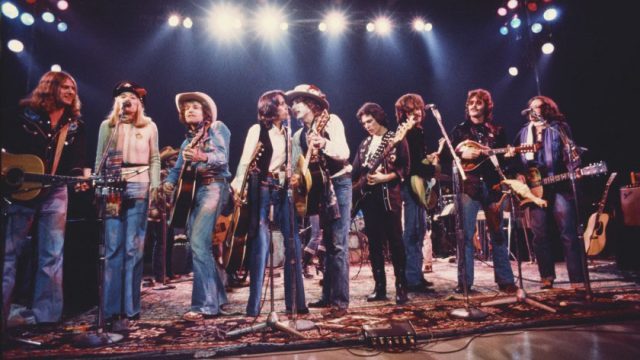
“I wouldn’t say it was a traditional revue but it was in the traditional form of a revue — that’s all clumsy bullshit,” Bob Dylan says at the beginning of Rolling Thunder Revue: A Bob Dylan Story by Martin Scorsese, a documentary about the legendary 1975-76 tour led by Bob with a collection of special guests. “I’m trying to get to the core of what this Rolling Thunder thing is all about, and I don’t have a clue, because it’s about nothing. It’s just something that happened forty years ago. . . . I don’t remember a thing about Rolling Thunder. I mean, it happened so long ago I wasn’t even born. So what do you want to know?” he asks with a wry smile. Scorsese, whose 2005 documentary No Direction Home focused on Dylan’s early years, now takes viewers behind the scenes and onstage of the infamous tour, in which Dylan donned face paint and wore a mask and a southwestern hat with flowers. Along with a load of anecdotes, the film features electrifying versions of such songs as “One More Cup of Coffee (Valley Below),” “Love Minus Zero / No Limit,” “When I Paint My Masterpiece,” “She Belongs to Me,” “It Takes a Lot to Laugh, It Takes a Train to Cry,” “A Hard Rain’s a-Gonna Fall,” “The Ballad of Ira Hayes,” and “Romance in Durango,” among many others.
And what a cast it has: Allen Ginsberg as the Oracle of Delphi, Patti Smith as the Punk Poet, Martin von Haselberg as the Filmmaker, Scarlet Rivera as the Queen of Swords, Joan Baez as the Balladeer, Roger McGuinn as the Minstrel, Larry “Ratso” Sloman as the Rolling Stone Reporter, Jim Gianopulos as the Promoter, Ramblin’ Jack Elliott as the Sailor, Sam Shepard as the Writer, David Mansfield as the Innocent, Sharon Stone as the Beauty Queen, Ronnie Hawkins as the Shitkicker, Anne Waldman as the Word Worker, Ronee Blakley as the Ingénue, Joni Mitchell as the Artist, Chief Rolling Thunder as the Medicine Man, Chief Mad Bear as the Chief, Peter La Farge as the Cowboy Indian, Michael Murphy as the Politician, and Rubin “Hurricane” Carter as the Boxer. The film debuted on Netflix but will look and sound much better in a theater; it is screening November 7 at Cinepolis Chelsea as part of the DOC NYC festival and will be followed by a discussion with producer Margaret Bodde and executive producer/editor David Tedeschi.
Documentary explores the history and legacy of the Band from a singular point of view
ONCE WERE BROTHERS: ROBBIE ROBERTSON & THE BAND (Daniel Roher, 2019)
SVA Theatre
333 West 23rd St. between Eighth & Ninth Aves.
Wednesday, November 6, 7:00 & 7:30
Festival runs November 6-15
212-924-7771 www.docnyc.net www.ifccenter.com
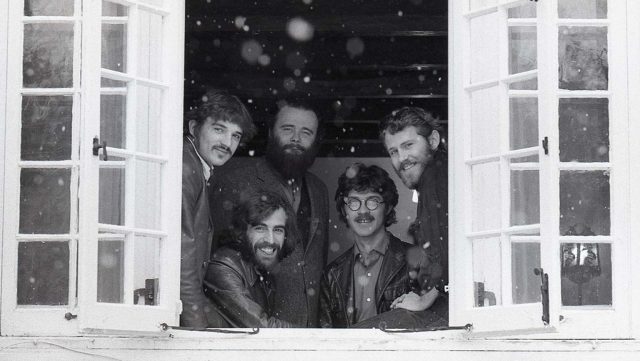
The tenth annual DOC NYC festival, which has grown dramatically since its humble beginnings, consisting now of more than three hundred screenings and special events over ten days at three venues, kicks off in a big way on November 6 with Daniel Roher’s Once Were Brothers: Robbie Robertson & the Band, an intimate, if completely one-sided, look inside one of the greatest, most influential music groups in North American history. The film was inspired by Band cofounder Robbie Robertson’s 2016 memoir, Testimony, offering his take on the Band’s ups and downs, famous battles, and ultimate breakup. “I don’t know of any other group of musicians with a story equivalent to the story of the Band, and it was a beautiful thing. It was so beautiful it went up in flames,” Robertson, sitting in a chair in a vast, empty room, guitars hanging on the wall far behind him, says. The setup puts the focus on Robertson’s individuality, his alone-ness, in what others trumpet as a collection of extraordinary musicians. “There is no band that emphasizes coming together and becoming greater than the sum of their parts, than the Band. Simply their name: The Band. That was it,” fan Bruce Springsteen says. “I was in great awe of their brotherhood. It was the soul of the Band,” notes Eric Clapton, who says he wanted to join the group made up of singer-songwriter and guitarist Robertson, singer and bassist Rick Danko, singer and keyboardist Richard Manuel, singer and drummer Levon Helm, and keyboardist and accordionist Garth Hudson.
When Robertson, who was born in Toronto in 1943, talks about his childhood — his mother was born on the Six Nations of the Grand River Indian reserve, which had a profound effect on him musically, and his biological father was a Jewish gangster, although he was raised by an abusive stepfather — the film is revelatory, with archival photographs and live footage of Robertson’s early bands and his time with Ronnie Hawkins and the Hawks. Robertson shares mesmerizing anecdotes about going electric with Bob Dylan, recording the Basement Tapes in a house called Big Pink, and discussing his craft. “I don’t have much of a process of like I’m thinking about this, and now I’m going to write a song and it’s gonna be about that,” he explains. “A lot of times, the creative process is trying to catch yourself off guard. And you sit down and you’ve got a blank canvas and you don’t know what you’re gonna do and you just see what happens.”
Hawkins speaks glowingly of his protégé Robertson, who wrote his first songs for Hawkins when he was only fifteen. Roher also talks to executive producer Martin Scorsese, Rolling Stone founder Jann Wenner, record producer John Simon, road manager Jonathan Taplin, equipment manager Bill Scheele, photographer John Scheele, Asylum Records creator David Geffen, and musicians Dylan, Taj Mahal, Peter Gabriel, Van Morrison, and Jimmy Vivino, who all rave about Robertson and the Band. “They were totally in love with their music, and they were in love with each other,” photographer Elliott Landy says. “I never saw any jealousy, I never saw any arguments, I never saw them disagree. They were always supporting each other. They were five brothers, very clearly five brothers who loved each other, and I never saw anything but that.”
Of course, Roher cannot talk to Manuel, Danko, and Helm, who are all dead, and Hudson did not participate in the documentary. Robertson and his wife, Dominique, paint a harrowing picture of the Band’s severe strife as drugs and alcohol tear them apart. There’s really no one, aside from a brief point made by guitarist Larry Campbell, to offer an opposing view to Robertson’s tale, which puts him on a golden throne despite some very public disagreements, particularly with Helm over songwriting credit and royalties. Robertson speaks enthusiastically and intelligently throughout the film, but it’s clear from the get-go that these are his carefully constructed, perhaps selective memories about what happened. But Roher doesn’t disguise that conceit; the film is named after one of Robertson’s solo songs, and the second half of the title is, after all, Robbie Robertson & the Band, as if Robertson is separate from the rest.
One of the main surprises is Robertson’s claim that the Last Waltz concert at Winterland in 1976 was not meant as a farewell but just a pause; Roher and Robertson fail to point out that the group continued to tour and record without Robertson. On his sixth solo album, Sinematic, which was released in September, Robertson has a song about the Band, the aforementioned “Once Were Brothers,” that can be heard at the start of the film. “Oh, once were brothers / Brothers no more / We lost a connection / After the war / There’ll be no revival / There’ll be no one cold / Once were brothers / Brothers no more,” Robertson sings. “When that curtain comes down / We’ll let go of the past / Tomorrow’s another day / Some things weren’t meant to last.” It’s a sad testament to a storied legacy. Packed with amazing photos and live clips that make it a must-see for fans of the group, Once Were Brothers: Robbie Robertson & the Band is screening at 7:00 and 7:30 on November 6 at the SVA Theatre, with Roher and Robertson on hand to discuss the work.