this week in music

KARA WALKER’S KATASTWÓF KARAVAN WITH JASON MORAN

Kara Walker, The Katastwóf Karavan, 2017 (Installation view, Prospect.4: The Lotus in Spite of the Swamp, Prospect New Orleans, New Orleans, Louisiana, 2018). Steel frame mounted to lumber running gear, aluminum, red oak and muslin wall panels, propane fired boiler, water tank, gas generator, brass and steel 38-note steam calliope, calliope controller panel with MIDI interface, iPad controller with QRS PNO software; 152 × 216 × 100 inches (386.1 × 548.6 × 254 cm). © Kara Walker. Image courtesy Sikkema Jenkins & Co., New York. Photograph by Alex Marks

Kara Walker, The Katastwóf Karavan, steel frame mounted to lumber running gear, aluminum, red oak and muslin wall panels, propane fired boiler, water tank, gas generator, brass and steel 38-note steam calliope, calliope controller panel with MIDI interface, iPad controller with QRS PNO software, 2017 (© Kara Walker. Image courtesy Sikkema Jenkins & Co., New York. Photograph by Alex Marks)

Whitney Museum of American Art
Pamella and Daniel DeVos Family Largo
99 Gansevoort St.
Saturday, October 12, free, 1:00 – 6:30
whitney.org
www.karawalkerstudio.com

Two years ago, Kara Walker’s site-specific Katastwóf Karavan nearly didn’t make it to New Orleans’ Prospect.4 Triennial: The Lotus in Spite of the Swamp because of disagreements over shipping costs. But it ultimately took its place on Algiers Point, and now the completely fabricated wagon will be pulling into the Pamella and Daniel DeVos Family Largo outside the Whitney, where it will perform for free from 1:00 to 6:30 on Saturday. The California-born, New York-based artist was inspired to construct the wagon after reading an insufficient, small historical plaque (see below) at Algiers Point identifying the location where enslaved Africans were “held before being ferried across the river to the Slave Auctions” as well as after hearing calliope music coming from the Natchez riverboat, a steamboat reminiscent of the kind used to transport the slaves. The four-wheeled, four-ton circus-style wagon features Walker’s trademark silhouette figures of slaves being abused by masters on all four sides in water-cut steel, with a loud, thirty-eight-note steam-powered calliope inside, custom made by Kenneth Griffard. The presentation is taking place in conjunction with jazz musician Jason Moran’s solo show at the Whitney, which continues through January 5; Texas native Moran will play the calliope at 6:00 on Saturday.

In the Prospect.4 performance handout, Walker, whose My Complement, My Enemy, My Oppressor, My Love ran at the Whitney in 2007-8, explained, “I was thinking a lot about music as the bearer of our emotional history, and about the way Jazz and gospel and African American Music are testaments to survival of our culture in the face of unrelenting, nihilistic ‘Progress’ and how it’s regarded as a monument in American History etc. But also thinking about how the Industrial Revolution, the Steam Engine and Cotton Gin were pivotal in usurping and grinding up the bodies of laborers and how much of that action, John Henry style, occurs today, with Humans fighting uphill battles to prove themselves against the latest technology. Steam engines are quaint things of the past, but industry presses on without us. The Machines have changed, but the action stays the same. How would it be if the old steam engines that ate us, swallowed too, our songs and pain, and what if, when its time was done, and slated for the scrapheap, the Steam Engine sang out in solidarity?”

algiers point

Incorporating the Haitian Creole word for “catastrophe” in its name, Katastwóf Karavan — “We simply say ‘Slavery’ as if that were a legitimate job instead of what it was, a Catastrophe for millions,” Walker explains — will also play such civil-rights-era, celebratory, and protest songs as “We Shall Overcome,” Aretha Franklin’s “Respect,” Prince’s “When Doves Cry,” and Marvin Gaye’s “What’s Going On?” Walker, whose Fons Americanus is currently wowing visitors at the Tate Modern and whose Domino Sugar Factory installation A Subtlety caused a sensation in New York five years ago, holds nothing back in her work, confronting racial prejudice and inadequate histories head-on. “Forgetting is preferable to remembering, as remembering stirs action,” she writes in the handout.

NEXT WAVE 2019

(photo by Heidrun Lohr)

The Second Woman repeats the same scene from John Cassavetes’s Opening Night one hundred times (photo by Heidrun Lohr)

BAM Howard Gilman Opera House, Peter Jay Sharp Building, 230 Lafayette Ave.
BAM Fisher, Fishman Space, 321 Ashland Pl.
October 15 – December 15
718-636-4100
www.bam.org

Like myriad loyal BAMgoers, I look forward every year to the announcement of the Next Wave Festival at the Brooklyn Academy of Music, which has been presenting cutting-edge, experimental, and innovative dance, music, film, theater, opera, and hard-to-categorize multidisciplinary performances from around the world for nearly forty years. We eagerly scour the schedule to see when our longtime BAM favorites will be returning, scanning for such beloved names and companies as Robert Wilson, Sasha Waltz, Grupo Corpo, Batsheva, Philip Glass, Sankai Juku, Ivo van Hove, Mark Morris, Théâtre de la Ville, William Kentridge, Laurie Anderson, and the incomparable Pina Bausch, programmed by masterful executive producer Joe Melillo since 1999.

But this year’s lineup features nary a single familiar name, including that of Melillo, who retired after the Winter/Spring season. For his debut Next Wave Festival, new artistic director David Binder has opted to include a roster of performers all making their BAM debuts as well. But don’t be scared off by the lack of recognition. There was a time when no one in New York had ever seen Pina Bausch, Sankai Juku, Batsheva, Sasha Waltz, et al. And by its very nature, the Next Wave is all about the future of performance, delivered to an eager and intrepid audience open to anything and everything.

(photo by Ernesto Galan)

Dead Centre’s Hamnet tells the story of Shakespeare’s son (photo by Ernesto Galan)

“In programming my first season at BAM, I was inspired by the genesis of Next Wave and the groundbreaking work of my predecessors, Harvey Lichtenstein and Joe Melillo,” Binder said in a statement. “Next Wave is a place to see, share, and celebrate the most exciting new ideas in theater, music, dance, and, especially, the unclassifiable adventures. We’ve invited a slate of artists who have never performed at BAM. Each and every one of them is making a BAM debut, with artistic work that’s surprising and resonant. I’m excited to launch this season and to build BAM’s next chapter
with you.”

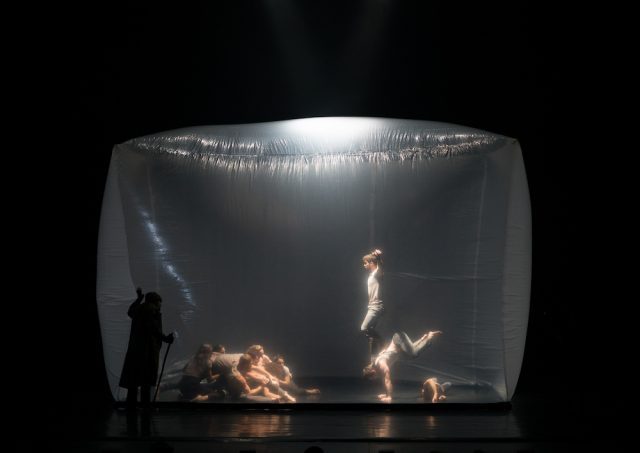
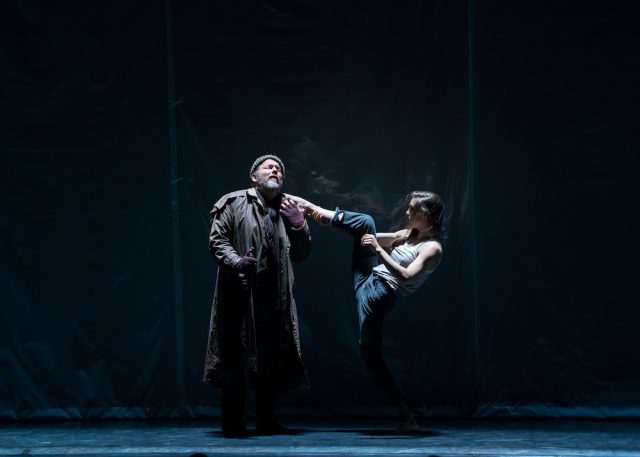
The 2019 Next Wave roster is an impressive one, kicking off October 15-20 with Michael Keegan-Dolan and Teaċ Daṁsa’s Swan Lake / Loch na hEala, about a young girl sexually assaulted by a priest. In The Second Woman, Alia Shawkat performs the same scene from John Cassavetes’s Opening Night one hundred times with one hundred different men over the course of twenty-four consecutive hours. Christiane Jatahy’s What if they went to Moscow? explores film and theater in a retelling of Anton Chekhov’s Three Sisters that takes place concurrently onstage at the BAM Fisher and onscreen at BAM Rose Cinemas, the audiences switching places as the performance repeats. In Dante or Die’s User Not Found, audience members sit in a café at the Greene Grape Annex on Fulton St., following the exploits of a man a few tables away. Dimitris Papaioannou breaks boundaries as he explores human existence in The Great Tamer. And Glenn Kaino’s When a Pot Finds Its Purpose will be the inaugural free exhibition at the new Rudin Family Gallery at BAM Strong.

(photo by Justin Jones)

Dante or Die’s User Not Found takes place in the Greene Grape Annex on Fulton St. (photo by Justin Jones)

The 2019 Next Wave Festival also includes Bruno Beltrão/Grupo de Rua’s Inoah, Dumbworld’s free outdoor art piece He Did What?, Selina Thompson’s free interactive installation Race Cards, Dead Centre’s Hamnet, Marlene Monteiro Freitas’s Bacchae: Prelude to a Purge, Untitled Projects/Unicorn Theatre, UK’s The End of Eddy, Peeping Tom’s 32 rue Vandenbranden, Fuel/National Theatre/Leeds Playhouse’s Barber Shop Chronicles, Kyle Marshall Choreography’s A.D. & Colored, Kate McIntosh’s In Many Hands, and Meow Meow’s A Very Meow Meow Holiday Show. Still worried about unfamiliarity? If you’ve been to BAM before, you should be ready, willing, and able to be surprised, and if you’ve never been to BAM, you should be preparing to make your debut.

DOWNTOWN BROOKLYN ARTS FESTIVAL

Peter Brook (photo ©-Marian Adreani)

Peter Brook will be celebrated at several events during the Downtown Brooklyn Arts Festival this weekend (photo © Marian Adreani)

Brooklyn Cultural District
The Plaza at 300 Ashland and other locations
October 4-6, free – $115
www.dbartsfestival.org

Downtown Brooklyn is the place to be this weekend for the Downtown Brooklyn Arts Festival, taking place around the Plaza at 300 Ashland from Friday to Saturday. There will be an African drum circle, live music and dance, talks and discussions, theater, glass-making demonstrations, film screenings, classes, treasure hunts, art exhibitions, and more; while many events are free, others require ticketing at BAM, Theatre for a New Audience, the Mark Morris Dance Center, and the New York Transit Museum, among others. Below are some of the highlights.

Friday, October 4
Kickoff with live performance by Soul Tigers Marching Band and dance party with Soul Summit, the Plaza at 300 Ashland, free, 5:00 – 8:00

Free Demonstration Night: The Two-Part Mold, with Kellie Krouse and Jeffrey Close, UrbanGlass, free, 6:00 – 9:00

Peter Brook\NY, with Paul Auster, Marie-Hélène Estienne, and Jeffrey Horowitz, Center for Fiction, $10 (includes $10 off at bookstore), 7:00

Pop-Up: An Artistic Treasure Hunt, by Strike Anywhere and the Tours Soundpainting Orchestra, Fort Greene, free, 7:00

Saturday, October 5
African Drum Circle with Mr. Fitz, the Plaza at 300 Ashland, free, 11:00

NYTM Train Operators Workshop, New York Transit Museum, free with museum admission, 11:30 & 3:30

Dance: Pas de Deux, with Brooklyn Ballet, set to Jean-Phillippe Rameau’s “Gavotte et Six Doubles,” the Plaza at 300 Ashland, free, 2:00

Rhys Chatham: The Sun Too Close to the Earth / Jonathan Kane and Zeena Parkins: Oh, Suzanne, ISSUE Project Room, $20-$25, 8:00

Sunday, October 6
Dance: Tribal Truth, in collaboration with Jamel Gaines Creative Outlet, the Plaza at 300 Ashland, free, 12:00

MC Oddissee, the Plaza at 300 Ashland, free, 1:00

Brooklyn Navy Yard: Past, Present & Future Tour, $15-$30, 2:00

Pop-Up: Nkiru Books, with DJ set by Talib Kweli, the Plaza at 300 Ashland, free, 2:00 – 5:00

OEDIPUS: Sex with Mum Was Blinding

(photo by Elias Moraitis) OEDIPUS - Photos OEDIPUS

Elli Papakonstantinou’s multimedia, immersive adaptation of Oedipus Rex debuts at BAM this week (photo by Elias Moraitis)

BAM Fisher, Fishman Space
321 Ashland Pl.
September 25-29, $30
718-636-4100
www.bam.org/oedipus

Perhaps more than any other Greek tragedy, Sophocles’s Oedipus Rex lends itself to all kinds of adaptations. The violent tale of murder, suicide, incest, and self-mutilation has been turned into operas, films, oratorios, and plays in multiple languages around the world; among those who have tackled the 429 BCE work are Pier Paolo Pasolini (Edipo Re), Luis Alfaro (Oedipus El Rey), Toshio Matsumoto (Funeral Parade of Roses), Gabriel García Márquez (Edipo Alcalde), Ola Rotimi (The Gods Are Not to Blame), Peter Schickele (Oedipus Tex), Jean Cocteau (La Machine Infernale), Park Chan-wook (Oldboy), German comedian Bodo Wartke (könig ödipus), and many others, moving the story to South Central LA, the Philippines, Japan, Nigeria, Colombia, and even outer space.

 ( photo by © Karol Jarek)

Lito Messini stars as title character in OEDIPUS: Sex with Mum Was Blinding (photo by © Karol Jarek)

Greek avant-garde creator Elli Papakonstantinou transforms Sophocles’s play into an immersive hybrid opera for the multimedia OEDIPUS: Sex with Mum Was Blinding, running at the BAM Fisher September 25-29. The hundred-minute piece, a collaboration between the Athens-based ODC Ensemble and New York City’s the Directors Company, features a score composed by Tilemachos Moussas and Julia Kent and played live by Kent on cello, Misha Piatigorsky on piano, and Barbara Nerness on live electronics; real-time video by Hassan Estakhrian and Stephanie Sherriff, with cinematic environments by Sherriff; costumes by Jolene Richardson; and masks by Maritina Keleri and Chrysanthi Avloniti. Papakonstantinou, whose previous work includes Louisette: The Backstage of Revolution, Touching the Bottom of the Sea, and The Kindly Ones (at the Mauthausen Concentration Camp Memorial), is credited with the concept, stage direction, libretto, and lighting. Lito Messini stars as Oedipus, with Nassia Gofa as Jocasta, Elias Husiak as the boy, Anastasia Katsinavaki as Teiresias, Theodora Loukas as the woman, Misha Piatigorsky as the MC, and Manos Tsakiris as the researcher. Papakonstantinou developed parts of the show during a residency at Stanford’s Center for Computer Research in Music & Acoustics, where she worked with artists and scientists to address such questions as “Are we free?,” “Dο we experience free will?,” and “Are there real alternatives, or is all that takes place the outcome of necessity?” University of London professor Manos Tsakiris served as the scientific adviser for yet another unusual and original adaptation of this classic story.

CROSSING THE LINE FESTIVAL 2019

Crossing the Line Festival opens with Isabelle Adjani in Opening Night

Crossing the Line Festival opens with Isabelle Adjani in Opening Night (photo © Simon Gosselin)

Crossing the Line Festival
French Institute Alliance Française and other venues
September 12 – October 12
212-355-6160
crossingthelinefestival.org

FIAF’s thirteenth annual Crossing the Line Festival, one of the city’s best multidisciplinary events, opens appropriately enough with the US premiere of French director Cyril Teste’s Opening Night, a multimedia adaptation of John Cassavetes’s 1977 film. The seventy-five-minute presentation, running September 12-14, stars the legendary Isabelle Adjani, along with Morgan Lloyd Sicard and Frédéric Pierrot; the actors will receive new stage directions at each performance, so anything can happen. (In conjunction with Opening Night, FIAF will be hosting the CinéSalon series “Magnetic Gaze: Isabelle Adjani on Screen,” consisting of ten films starring Adjani, including The Story of Adele H, Queen Margot, and Possession, on Tuesdays through October 29.) Also on September 12, Paris-born, New York–based visual artist Pierre Huyghe will unveil his free video installation The Host and the Cloud, a two-hour film exploring the nature of human ritual, set in a former ethnographic museum; the 2009-10 film will be shown on a loop in the FIAF Gallery Monday to Saturday through the end of the festival, October 12. Another major highlight of CTL 2019 is the US premiere of Peter Brook and Marie-Hélène Estienne’s Why? Running September 21 through October 6 at Theatre for a New Audience’s Polonsky Shakespeare Center in Brooklyn, the seventy-five-minute show delves into the very existence of theater itself. The festival also features dance, music, and other live performances by an impressive range of creators; below is the full schedule. Numerous shows will be followed by Q&As with the writers, directors, and/or performers.

Thursday, September 12
through
Saturday, September 14

Opening Night, directed by Cyril Teste, starring Isabelle Adjani, Morgan Lloyd Sicard, and Frédéric Pierrot, FIAF Florence Gould Hall, $45-$55, 7:30

Thursday, September 12
through
Saturday, October 12

The Host and the Cloud, directed by Pierre Huyghe, FIAF Gallery, free

Friday, September 13
through
Sunday, September 15

Manmade Earth, by 600 HIGHWAYMEN, the Invisible Dog Art Center, $15 suggested donation

Tuesday, September 17
and
Wednesday, September 18

The Disorder of Discourse, Fanny de Chaillé’s restaging of a lecture by Michel Foucault, with Guillaume Bailliart, the Cooper Union for the Advancement of Science and Art, free with RSVP, 8:00

Saturday, September 21
through
Sunday, October 6

Why?, by Peter Brook and Marie-Hélène Estienne, Polonsky Shakespeare Center, Theatre for a New Audience, $90-$115

© Louise Quignon

Radio Live makes its New York premiere at Crossing the Line Festival (photo © Louise Quignon)

Wednesday, September 25
Isadora Duncan, by Jérôme Bel, CTL commission, with Catherine Gallant, FIAF Florence Gould Hall, $35, 7:30

Thursday, September 26
through
Saturday, September 28

Somewhere at the Beginning, created and performed by Mikaël Serre, choreographed by Germaine Acogny, set to music by Fabrice Bouillon, La MaMa, $25, 7:00

Wednesday, October 2
Radio Live, with Aurélie Charon, Caroline Gillet, and Amélie Bonnin, based on narratives by young change makers from around the world, FIAF Florence Gould Hall, $15-$35

Thursday, October 3
through
Sunday, October 6

Look Who’s Coming to Dinner, world premiere choreographed by Stefanie Batten Bland, with music by Paul Damien Hogan, inspired by 1967 Stanley Kramer film, La MaMa, $21-$26

Friday, October 4
and
Saturday, October 5

The Sun Too Close to the Earth, world premiere by Rhys Chatham for nine-piece ensemble, inspired by climate change, along with Le Possédé bass flute solo and On, Suzanne featuring harpist Zeena Parkins and drummer Jonathan Kane, ISSUE Project Room, $25, 8:00

Thursday, October 10
When Birds Refused to Fly, conceived, directed, and choreographed by Olivier Tarpaga, featuring Salamata Kobré, Jean Robert Kiki Koudogbo, Stéphane Michael Nana, and Abdoul Aziz Zoundi, with music by Super Volta and others, FIAF Florence Gould Hall, $15-$35, 7:30

Friday, October 11
and
Saturday, October 12

Дyми Moï — Dumy Moyi, solo performance by François Chaignaud, the Invisible Dog Art Center, free with RSVP

CARMEN PAPALIA: MOBILITY DEVICE

Carmen Papalia, Mobility Device, 2013. Photo by John Spiak. Courtesy of Grand Central Arts Center.

Carmen Papalia’s Mobility Device moves onto the High Line on September 11-12 (photo by John Spiak; courtesy of Grand Central Arts Center)

The High Line
Wednesday, September 11
6:30 performance begins at 34th St., traveling southeast
7:00 performance begins at the Spur at 30th St., traveling northwest
Thursday, September 12
7:00 performance begins at Gansevoort St., traveling north
7:30 performance begins at 16th St., traveling south
Admission: free, no RSVP required
646-774-2536
www.thehighline.org
carmenpapalia.com

Originally performed at the Grand Central Art Center in Santa Ana California in 2013 and two years later at the Victoria & Albert Museum in London, Carmen Papalia’s Mobility Device now moves to the High Line for site-specific performances on September 11 and 12. Free with no advance RSVP necessary, Mobility Device has two different start times at two distinct locations each night. Artist and disability activist Papalia, a Vancouver native, transforms his detection cane for the event, redefining how public spaces are used by everyone while raising questions of perceptual mobility and accessibility; people with disabilities are strongly encouraged to attend. He will be accompanied by the eighteen-piece Hungry March Band, playing a site-reactive score; the audience can follow the brass ensemble, as if it is a detection cane leading the way for the visually impaired, or find viewing areas, some with seating, along the routes.

PLAY IT LOUD: INSTRUMENTS OF ROCK AND ROLL

Joan Jett Melody Maker, 1977 Gibson (photo by twi-ny/mdr)

Joan Jett’s 1977 Melody Maker Gibson is part of Met exhibition “Play It Loud” (photo by twi-ny/mdr)

Metropolitan Museum of Art, Met Fifth Ave.
Gallery 199
1000 Fifth Ave. at 82nd St.
Through Through October 1, $25 suggested admission
212-535-7710
www.metmuseum.org

In 2011, the Met hosted “Guitar Heroes: Legendary Craftsmen from Italy to New York,” focusing on the lutherie tradition of Italian Americans in New York and New Jersey, artisans making violins, mandolins, guitars, and other stringed instruments. In the current exhibition “Play It Loud: Instruments of Rock & Roll,” the Met turns it up to eleven, celebrating the stringed and nonstringed apparatus of rock and pop music since the 1950s. In Mott the Hoople’s 1973 staple “All the Way from Memphis,” Ian Hunter refers to his guitar as a “six-string razor,” an “axe,” and “electric junk.” He continues: “Some dude said, ‘Rock ’n’ rollers, you’re all the same / Man, that’s your instrument.’ / I felt so ashamed.” Ian and Mott might not be represented in the Met exhibit — or in the Rock and Roll Hall of Fame — but there’s nothing for anyone to be ashamed of regarding this exciting collection of nearly two hundred items, with most of the instruments displayed in vitrines, like sculptural works of art, which of course they are.

(photo by twi-ny/mdr)

Keith Emerson’s 1960s Modified Hammond L-100 organ features two knives Emerson would stab the keys with (photo by twi-ny/mdr)

Don’t go straight to the labels, which contain information about who made the instrument and who played it on what songs; it’s a lot of fun trying to figure out whose instrument it is. You’re likely to guess twangers by Rick Nielsen of Cheap Trick, Prince, Bo Diddley, Buddy Holly, Ravi Shankar, and Bruce Springsteen, but others will surprise and delight you. One of the first items you’ll encounter is Jerry Lee Lewis’s 1955 Petite Grand Piano; for some reason, the signage refers to Lewis, who is eighty-three, in the past tense. Among the many gems are Chuck Berry’s 1958 Gibson, Louis Jordan’s 1954 Mark VI alto saxophone, Muddy Waters’s 1958 Telecaster known as “the Hoss,” Les Paul’s 1942 “Klunker,” Jimi Hendrix’s 1967 “Love Drops” Flying V, Joni Mitchell’s 1978 GB10NT George Benson Signature, Jack White’s 1964 Airline Res-O-Glas, Joe Perry’s 1985-86 X-100 Blade Runner, Stevie Ray Vaughan’s 1963 “Number One” composite Stratocaster, Robert Trujillo’s 2007–08 “Aztec De La Chloe” five-string bass, Keith Emerson’s 1968 Customized Moog Modular Synthesizer with keyboard, ribbon controllers, and stand, Ian Anderson’s 1975 Model 18-0 flute, Lady Gaga’s 2014 ARTPOP piano with custom housing, and Paul Stanley’s 1979–80 Cracked Mirror Iceman in addition to instruments played by Duane Allman, the Edge, Angus Young, Jeff Beck, Flea, Patti Smith, Ray Manzarek, Paul Butterfield, Nancy Wilson, Clarence Clemons, Steve Vai, Neil Young, Tina Weymouth, Bob Dylan, and dozens more.

(photo by twi-ny/mdr)

Met exhibition is not just about classic guitars (photo by twi-ny/mdr)

These are not mere artifacts; Jerry Garcia’s Wolf was taken out of the museum so John Mayer could play it at a recent Dead & Co. show at CitiField, and a Stones guitar is out on the road with the band right now. There are several striking guitars from Met fave Steve Miller, who will playing a show in the Grace Rainey Rogers Auditorium on September 28 and contributed to the 2011 “Guitar Heroes” exhibit. Don’t miss Kurt Cobain’s destroyed 1993 left-handed Fender Stratocaster, Eric Clapton’s trippy 1964 “The Fool” SG (and the original headstock, which earns its own vitrine), Pete Townshend’s 1973 Gibson SG Special (which he smashed during a photo shoot and is now encased in Lucite), and a fragment of Hendrix’s 1967 Monterey Pop Fender Stratocaster, which he famously lit on fire. Four guitar greats tell their stories in a circular case that houses their gear and video monitors: Jimmy Page, Keith Richards, Eddie Van Halen, and Tom Morello. (Having seen Morello shred live, I understand exactly why he’s part of this elite quartet.) Several bands display their stage setup, including the Beatles, the Who, Metallica, and the Roots. The exhibition, which was inspired by Brad Tolinski and Alan di Perna’s book Play It Loud: An Epic History of the Style, Sound, and Revolution of the Electric Guitar and is co-organized by the Met’s Jayson Kerr Dobney and the Hall of Fame’s Craig J. Inciardi, is supplemented by vintage concert posters by Lee Conklin, Bonnie MacLean, Rick Griffin, and others. It’s easy to argue why certain musicians are not part of the show (What, no Richard Thompson or Lou Reed?!? Where’s Ritchie Blackmore, Bob Mould, and Johnny Ramone?), but it’s better to just enjoy who is in it. Below are the remaining special events being held in conjunction with the exhibition, which runs through October 1.

Prince Love Symbol, 1993

Prince’s 1993 Love Symbol captures his trademark glyph (photo by Cathy Hapka for twi-ny)

Saturday, September 7
Black Rock Coalition: History of Our Future, with the BRC Orchestra, Fantastic Negrito, Nona Hendryx, Vernon Reid, Corey Glover, and Will Calhoun, “Captain” Kirk Douglas, Stew, the Family Stand, Carl Hancock Rux, and Toshi Reagon, Grace Rainey Rogers Auditorium, $25, 7:00

Sunday, September 8
Sunday at the Met — Play It Loud: Instruments of Rock and Roll, panel discussion with Anthony DeCurtis, David Fricke, Holly George-Warren, Jayson Dobney, and Craig J. Inciardi, Grace Rainey Rogers Auditorium, free with Museum admission, 2:00

Friday, September 13
MetFridays: Play It Loud — ETHEL and Friends: Four for Fighting, Great Hall Balcony Bar, 5:00–8:00; screening of Woodstock (Michael Wadleigh, 1970), Bonnie J. Sacerdote Lecture Hall, 6:00; Conversations with . . . curators Jayson Dobney and Craig J. Inciardi, Gallery 199, 6:00; Signs and Symbols of Rock and Roll, with designers from ThoughtMatter, a band-name generator, and a button workshop, Great Hall, 6:00; Building Instruments with Atelier Rosenkrantz, Gallery 681, 6:00; Tie-Dye Workshop, Carroll Classroom, 6:00; Reflections on Woodstock with Chris Molanphy, Art Study Room, 6:30; Lez Zeppelin Live, preceded by discussion with Steph Paynes and Brad Tolinski, free with advance RSVP, Grace Rainey Rogers Auditorium, 7:15; all free with museum admission, 5:00–9:00

Saturday, September 28
Steve Miller Band and Jimmie Vaughan Band in Concert, Grace Rainey Rogers Auditorium, 7:00