this week in music

WHITE LIGHT FESTIVAL: EN MASSE

(photo © David Kelly)

The ten members of Circa Ensemble are trapped in a cube in En Masse (photo © David Kelly)

Gerald W. Lynch Theater at John Jay College
524 West Fifty-Ninth St. between Tenth & Eleventh Aves.
October 23-25, $55-$95
Festival continues through November 24
www.lincolncenter.org
circa.org.au

Australia’s Circa Ensemble returns to Lincoln Center’s White Light Festival for the first time in five years with the death-defying, awe-inspiring En Masse, continuing at the Gerald W. Lynch Theater through October 25. Incorporating acrobatics and gymnastics into contemporary dance with flashes of balletic structures, the Brisbane-based troupe, which presented How Like an Angel at the Union Theological Seminary in 2014, has nothing less than the end of the world on its mind — and what happens after. Created by director and stage designer Yaron Lifschitz with the company, the evening-length work is divided into two related parts. In the first half, the ten extremely talented and brave dancers — Caroline Baillon, Marty Evans, Piri Lee Goodman, Keaton Hentoff-Killian, Cecilia Martin, Hamish McCourty, Daniel O’Brien, Kimberley O’Brien, Jarrod Takle, and Sandy Tugwood — break apart and come together to alternating music by Franz Schubert, Lieders from Schwanengesang (“Ständchen,” “In der Ferne,” “Der Doppelgänger”) and Winterreise (“Der Leiermann,” “Gute Nacht,” “Die Nebensonnen,” “Frühlingstraum”), and electronic music and noise from twenty-six-year-old Swedish composer Klara Lewis (“Msuic I,” “Want,” “Too,” “Beaming”).

(photo © David Kelly)

Tenor Robert Murray beautifully sings Schubert Lieders in En Masse (photo © David Kelly)

The Schubert songs are marvelously sung by tenor Robert Murray, dressed like a vagabond with ratty clothing and carrying a tall, twisted walking stick (the costumes are by associate director Libby McDonnell), accompanied by Tamara-Anna Cislowska on a grand piano. The barefoot performers, wearing jeans and gray T-shirts, move in front of and behind a plastic curtain that comes down and raises again to reveal set changes. A woman crawls across the front of the stage, contorting her lower body into seemingly impossible positions. All ten dancers are trapped in a transparent inflated cube. A parade of solos, duets, and trios marches in the front. Three dancers build a precarious human pyramid, climbing on top of one another. The six men and four women run, jump, slide, get thrown, and threaten to fall against the hard floor — at one treacherous point the audience gasped loudly in unison as a man, fifteen feet in the air, falls, face forward. But Lifschitz has built in various fail safes to try to prevent any potential tragedies, unobtrusively using spotters, and the dancers, who have years of highly specialized circus and acrobatic training, are well-practiced at rolling into somersaults and other moves in case a lift, toss, or carry doesn’t go perfectly.

After intermission, the mood changes. Now that we’re familiar with Circa’s movement vocabulary and impressive skills, we’re not as worried about the safety of the performers, who have formed a kind of postapocalyptic community. All ten dancers are onstage for most of the second half, which is set to Igor Stravinsky’s Le sacre du printemps (“The Rite of Spring”), aggressively played by Cislowska and Michael Harvey on pianos that face each other at the back of the stage, and features dazzling lighting by Lifschitz and Richard Clarke. The situation is not quite as dire as the performers expand their repertoire, creating breathtaking formations, moving in unison, banding together to face the future. It’s no mere pie-in-the-sky hopefulness but a deep-seated belief in the innate instinct of humanity to forge ahead, to do whatever is necessary to survive and thrive. The first act is introduced by a quote from Italian philosopher Antonio Gramsci: “The crisis consists precisely in the fact that the old is dying and the new cannot be born,” while the second starts with a dictum from German philosopher Walter Benjamin: “There is no document of civilization that is not at the same time a document of barbarism.” En Masse is a document showing that something new can indeed be born, even in times of crisis and barbarism.

MOUNTAINTOP

Neil Young

Neil Young goes behind-the-scenes of the recording of Colorado in new documentary

MOUNTAINTOP (Bernard Shakey, 2019)
IFC Center, 323 Sixth Ave. at West Third St., 212-924-7771, 7:30
Landmark at 57 West, 657 West 57th St. at Twelfth Ave., 646-233-1615, 7:30
Nitehawk Cinema Williamsburg, 136 Metropolitan Ave., 9:45
One night only: Tuesday, October 22
mountaintopthemovie.com

Neil Young invites viewers behind the scenes of the making of his latest album, Colorado, in the documentary Mountaintop, playing in theaters one night only on October 22 in advance of the October 25 release of the record, the first he’s done with his longtime band Crazy Horse since 2012’s Psychedelic Pill. Directed by Young’s filmmaking alter ego, Bernard Shakey, Mountaintop takes place over the course of eleven days in the Studio in the Clouds in the San Juan Mountains outside Telluride, about nine thousand feet above sea level, where four old white guys come together to make some grand rockin’ music about love and climate change. “You might say I’m an old white guy / I’m an old white guy / You might say that,” Young sings on “She Showed Me Love,” about the attempted murder of Mother Nature. The seventy-three-year-old Canadian legend is joined by seventy-five-year-old bassist Billy Talbot and seventy-six-year-old drummer Ralph Molina — the two surviving original Crazy Horse members, who first played with Young on 1969’s Everyone Knows This Is Nowhere — and sixty-eight-year-old guitar virtuoso Nils Lofgren, who was eighteen when he played guitar and piano on Young’s 1970 solo record, After the Gold Rush. (Coincidentally, Lofgren’s other boss, seventy-year-old Bruce Springsteen, is releasing his documentary about his latest album, Western Stars, on Friday.) Early on, the band says they are having an “oxygen party” to keep them going, passing around tanks like bongs. “It’s old guys; young souls still alive in old souls and the music they make together,” Young writes on his website about the film. It’s hard not to laugh when you see the size of the type on the lyric sheets these old guys are using.

“Right now it’s a piece of fucking gold. It’s original fucking greatness,” Young says of the big-sounding “Rainbow of Colors.” After the calmer “House of Love,” on which Young plays piano and harmonica and Lofgren tap-dances, he says, “It doesn’t have to be good; just be great. You know, just feel good.” Young lives up to his billing as the Godfather of Grunge on the punk-infused “Help Me Lose My Mind”; Lofgren refers to Young’s singing on the track as “reckless narration with pitch,” which gets a chuckle out of Young, who is serious and ornery most of the time, understandably unhappy with the monitors (ironically, mostly on the song “Shut It Down”) and other details of the recording process, and he lets his longtime producer and engineer, John Hanlon, know it again and again. Hanlon, a coffee addict who is suffering from poison oak on his hand, has a meltdown at one point, screaming, “This is the most fucked-up studio I’ve ever fucking worked in in my life. . . I’m about ready to leave this fucking project, okay?” He demands that all cameras be removed from the studio and that the scene of him yelling and cursing not appear in the film, but. . . .

mountaintop

Young, who as Shakey has directed or codirected Rust Never Sleeps, The Monsanto Years, Human Highway, Journey through the Past, and Greendale, and cinematographer C. K. Vollick leave the studio to show time-lapse shots of the snowy mountains, bright stars, and rolling clouds outside, primarily on “Green Is Blue,” a piano ballad about climate change. There are also snippets of Young performing at one of his solo acoustic concerts, where he surrounds himself with a circle of guitars. He employs split screens, a fish-eye lens (think the cover of Ragged Glory), a handheld camera, and one mounted on the floor to mix things up. Lofgren plays the pump organ and an accordion, Young plays the vibes and a glass harmonica, and the four men gather to sing lofty background harmonies. Amid all the technical problems — “I love singing in a wet sock,” Young says about the sound — he and Crazy Horse prove they still have it after half a century, particularly when they turn it up on the majestic “Milky Way,” which borrows generously from “Cowgirl in the Sands,” and the hard-rocking “She Showed Me Love.” “We’re gonna do it / Just like we did back then,” Lofgren, Molina, and Talbot sing on “I Do.” Mountaintop is an irresistible fly-on-the-wall doc about the creative process, about collaboration and genius, about all the little things that can go wrong — and delightfully right — in the making of great art, in this case by a bunch of old white guys trying to save the planet, one song at a time.

EMPEROR SERIES: KWAIDAN — CALL OF SALVATION HEARD FROM THE DEPTHS OF FEAR

Kwaidan

Shirō Sano and Kyoji Yamamoto team up at Japan Society for Kwaidan

Japan Society
333 East 47th St. at First Ave.
Thursday, October 24, $30, 7:30
212-715-1258
www.japansociety.org

Japan Society gears up for Halloween with the spooky presentation Kwaidan — Call of Salvation Heard from the Depths of Fear. On October 24 at 7:30, popular Japanese film and television actor Shirō Sano (Zutto Anata ga Suki data, Karaoke) will read five tales of the supernatural he selected by Lafcadio Hearn, aka Yakumo Koizumi (1850-1904), with live music played by guitarist Kyoji Yamamoto, of BOW WOW and VOW WOW fame. (Sano and Yamamoto both hail from Matsue City in Shimane Prefecture.) Japanese film fans will be familiar with Hearn’s oeuvre from Masaki Kobayashi’s 1965 horror anthology, Kwaidan, which consists of the Hearn tales “The Black Hair,” “The Woman of the Snow,” “Hoichi the Earless,” and “In a Cup of Tea.” The performance will be preceded by a short lecture by Hearn’s great-grandson, Lafcadio Hearn Memorial Museum director and folklorist Bon Koizumi, and a reception with the artists will follow the show, which is part of Japan Society’s Emperor Series, celebrating Emperor Naruhito’s ascension to the Chrysanthemum Throne on May 1.

WHITE LIGHT FESTIVAL 2019

(photo copyright Hiroshi Sugimoto / courtesy Odawara Art Foundation)

Sugimoto Bunraku Sonezaki Shinju’s The Love Suicides at Sonezaki kicks off Lincoln Center’s tenth annual White Light Festival (photo copyright Hiroshi Sugimoto / courtesy Odawara Art Foundation)

Multiple venues at Lincoln Center
October 19 – November 24, free – $165
212-721-6500
www.lincolncenter.org

Lincoln Center’s multidisciplinary White Light Festival turns ten this year, and it is celebrating with another wide-ranging program of dance, theater, music, and more, running October 19 through November 24 at such venues as the Rose Theater, the Gerald W. Lynch Theater at John Jay College, Alice Tully Hall, and the Church of St. Mary the Virgin. “The resonance of the White Light Festival has only deepened during its first decade, as we have moved into far more challenging times here and around the world,” Lincoln Center artistic director Jane Moss said in a statement. “The Festival’s central theme, namely the singular capacity of artistic expression to illuminate what is inside ourselves and connect us to others, is more relevant than ever. This tenth anniversary edition spanning disparate countries, cultures, disciplines, and genres emphasizes that the elevation of the spirit the arts inspires uniquely unites us and expands who we are.” Things get under way October 19-22 (Rose Theater, $35-$100) with Sugimoto Bunraku Sonezaki Shinju’s The Love Suicides at Sonezaki, a retelling of a long-banned tale by Chikamatsu Monzaemon using puppets, composed and directed by Seiji Tsurusawa, with choreography by Tomogoro Yamamura and video by Tabaimo and artistic director Hiroshi Sugimoto. That is followed October 23-25 by Australia ensemble Circa’s boundary-pushing En Masse (Gerald W. Lynch Theater, $25-$65), directed and designed by Yaron Lifschitz, combining acrobatics and contemporary dance with music by Klara Lewis along with Franz Schubert and Igor Stravinsky.

In Zauberland (Magic Land) (October 29-30, Gerald W. Lynch, $35-$95), soprano Julia Bullock performs Schumann’s Romantic song cycle Dichterliebe while facing haunting memories; the text is by Heinrich Heine and Martin Crimp, with Cédric Tiberghien on piano. The set for Roysten Abel’s The Manganiyar Seduction (November 6–9, Rose Theater, $55-$110) is mind-blowing, consisting of more than two dozen Manganiyar musicians in their own lighted rectangular spaces in a giant red box. Last year, Irish company Druid and cofounder Garry Hynes brought a comic Waiting for Godot to the White Light Festival; this year they’re back with a dark take on Richard III (November 7-23, Gerald W. Lynch, $35-$110) starring Aaron Monaghan, who played Estragon in 2018. Wynton Marsalis will lead The Abyssinian Mass (November 21-23, Rose Theater, $45-$165) with Chorale Le Chateau, featuring a sermon by Rev. Dr. Calvin O. Butts III. In addition to the above, there are also several one-time-only events, listed below.

(photo by Robbie Jack)

DruidShakespeare will present Richard III at the White Light Festival November 7-23 (photo by Robbie Jack)

Thursday, October 24
Jordi Savall: Journey to the East, Alice Tully Hall, $35-$110, 7:30

Tuesday, October 29
Mahler Songs, recital by German baritone Christian Gerhahe with pianist Gerold Huber, Alice Tully Hall, $45-$90, 7:30

Thursday, November 7
Stabat Mater by James MacMillan, with Britten Sinfonia and the Sixteen, conducted by Harry Christophers, Alice Tully Hall, $50-$85, 7:30

Saturday, November 9
White Light Conversation: Let’s Talk About Religion, panel discussion with Kelly Brown Douglas, Marcelo Gleiser, James MacMillan, and Stephen Prothero, moderated by John Schaefer, Daniel and Joanna S. Rose Studio, free, 3:00

Sunday, November 10
Goldberg Variations, with pianist Kit Armstrong, Walter Reade Theater, $25, 11:00 am

Wednesday, November 13
Ensemble Basiani: Unifying Voices, Church of St. Mary the Virgin, $55, 7:30

Thursday, November 14
Attacca Quartet with Caroline Shaw: Words and Music, David Rubenstein Atrium, free, 7:30

Sunday, November 17
Tristan and Isolde, Act II, with the National Symphony Orchestra, conducted by Gianandrea Noseda, featuring Stephen Gould as Tristan and Christine Goerke as Isolde, David Geffen Hall, $35-$105, 3:00

Thursday, November 21
Gloria, with the Orchestra of the Age of Enlightenment and its Choir, conducted by harpsichordist Jonathan Cohen, featuring soprano Katherine Watson, countertenor Iestyn Davies, and soprano Rowan Pierce, Alice Tully Hall, $100, 7:30

Sunday, November 24
Los Angeles Philharmonic: Cathedral of Sound, Bruckner’s “Romantic” Symphony, conducted by Gustavo Dudamel, David Geffen Hall, $35-$105, 3:00

KARA WALKER’S KATASTWÓF KARAVAN WITH JASON MORAN

Kara Walker, The Katastwóf Karavan, 2017 (Installation view, Prospect.4: The Lotus in Spite of the Swamp, Prospect New Orleans, New Orleans, Louisiana, 2018). Steel frame mounted to lumber running gear, aluminum, red oak and muslin wall panels, propane fired boiler, water tank, gas generator, brass and steel 38-note steam calliope, calliope controller panel with MIDI interface, iPad controller with QRS PNO software; 152 × 216 × 100 inches (386.1 × 548.6 × 254 cm). © Kara Walker. Image courtesy Sikkema Jenkins & Co., New York. Photograph by Alex Marks

Kara Walker, The Katastwóf Karavan, steel frame mounted to lumber running gear, aluminum, red oak and muslin wall panels, propane fired boiler, water tank, gas generator, brass and steel 38-note steam calliope, calliope controller panel with MIDI interface, iPad controller with QRS PNO software, 2017 (© Kara Walker. Image courtesy Sikkema Jenkins & Co., New York. Photograph by Alex Marks)

Whitney Museum of American Art
Pamella and Daniel DeVos Family Largo
99 Gansevoort St.
Saturday, October 12, free, 1:00 – 6:30
whitney.org
www.karawalkerstudio.com

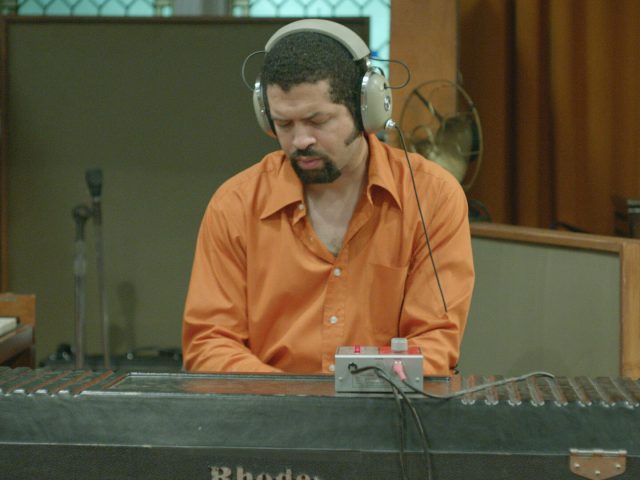
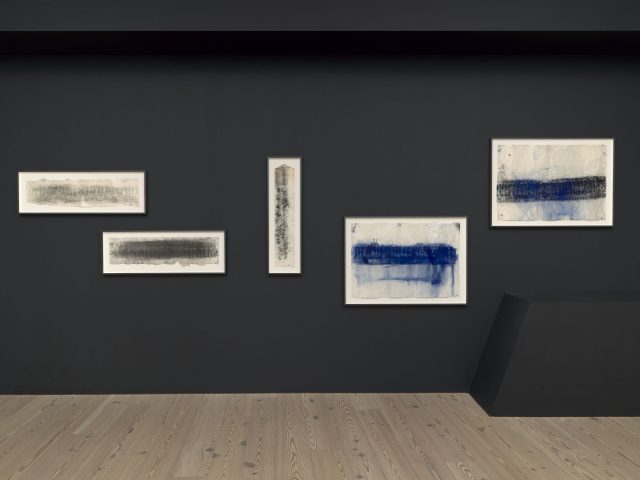
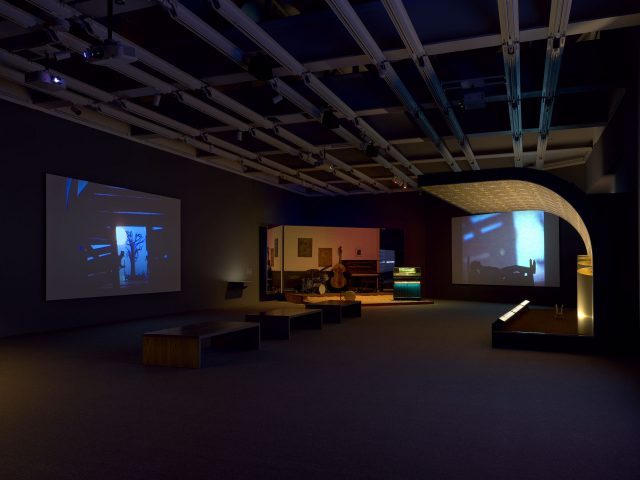
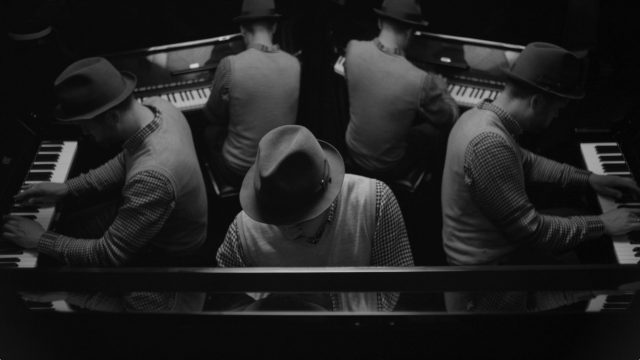
Two years ago, Kara Walker’s site-specific Katastwóf Karavan nearly didn’t make it to New Orleans’ Prospect.4 Triennial: The Lotus in Spite of the Swamp because of disagreements over shipping costs. But it ultimately took its place on Algiers Point, and now the completely fabricated wagon will be pulling into the Pamella and Daniel DeVos Family Largo outside the Whitney, where it will perform for free from 1:00 to 6:30 on Saturday. The California-born, New York-based artist was inspired to construct the wagon after reading an insufficient, small historical plaque (see below) at Algiers Point identifying the location where enslaved Africans were “held before being ferried across the river to the Slave Auctions” as well as after hearing calliope music coming from the Natchez riverboat, a steamboat reminiscent of the kind used to transport the slaves. The four-wheeled, four-ton circus-style wagon features Walker’s trademark silhouette figures of slaves being abused by masters on all four sides in water-cut steel, with a loud, thirty-eight-note steam-powered calliope inside, custom made by Kenneth Griffard. The presentation is taking place in conjunction with jazz musician Jason Moran’s solo show at the Whitney, which continues through January 5; Texas native Moran will play the calliope at 6:00 on Saturday.

In the Prospect.4 performance handout, Walker, whose My Complement, My Enemy, My Oppressor, My Love ran at the Whitney in 2007-8, explained, “I was thinking a lot about music as the bearer of our emotional history, and about the way Jazz and gospel and African American Music are testaments to survival of our culture in the face of unrelenting, nihilistic ‘Progress’ and how it’s regarded as a monument in American History etc. But also thinking about how the Industrial Revolution, the Steam Engine and Cotton Gin were pivotal in usurping and grinding up the bodies of laborers and how much of that action, John Henry style, occurs today, with Humans fighting uphill battles to prove themselves against the latest technology. Steam engines are quaint things of the past, but industry presses on without us. The Machines have changed, but the action stays the same. How would it be if the old steam engines that ate us, swallowed too, our songs and pain, and what if, when its time was done, and slated for the scrapheap, the Steam Engine sang out in solidarity?”

algiers point

Incorporating the Haitian Creole word for “catastrophe” in its name, Katastwóf Karavan — “We simply say ‘Slavery’ as if that were a legitimate job instead of what it was, a Catastrophe for millions,” Walker explains — will also play such civil-rights-era, celebratory, and protest songs as “We Shall Overcome,” Aretha Franklin’s “Respect,” Prince’s “When Doves Cry,” and Marvin Gaye’s “What’s Going On?” Walker, whose Fons Americanus is currently wowing visitors at the Tate Modern and whose Domino Sugar Factory installation A Subtlety caused a sensation in New York five years ago, holds nothing back in her work, confronting racial prejudice and inadequate histories head-on. “Forgetting is preferable to remembering, as remembering stirs action,” she writes in the handout.

NEXT WAVE 2019

(photo by Heidrun Lohr)

The Second Woman repeats the same scene from John Cassavetes’s Opening Night one hundred times (photo by Heidrun Lohr)

BAM Howard Gilman Opera House, Peter Jay Sharp Building, 230 Lafayette Ave.
BAM Fisher, Fishman Space, 321 Ashland Pl.
October 15 – December 15
718-636-4100
www.bam.org

Like myriad loyal BAMgoers, I look forward every year to the announcement of the Next Wave Festival at the Brooklyn Academy of Music, which has been presenting cutting-edge, experimental, and innovative dance, music, film, theater, opera, and hard-to-categorize multidisciplinary performances from around the world for nearly forty years. We eagerly scour the schedule to see when our longtime BAM favorites will be returning, scanning for such beloved names and companies as Robert Wilson, Sasha Waltz, Grupo Corpo, Batsheva, Philip Glass, Sankai Juku, Ivo van Hove, Mark Morris, Théâtre de la Ville, William Kentridge, Laurie Anderson, and the incomparable Pina Bausch, programmed by masterful executive producer Joe Melillo since 1999.

But this year’s lineup features nary a single familiar name, including that of Melillo, who retired after the Winter/Spring season. For his debut Next Wave Festival, new artistic director David Binder has opted to include a roster of performers all making their BAM debuts as well. But don’t be scared off by the lack of recognition. There was a time when no one in New York had ever seen Pina Bausch, Sankai Juku, Batsheva, Sasha Waltz, et al. And by its very nature, the Next Wave is all about the future of performance, delivered to an eager and intrepid audience open to anything and everything.

(photo by Ernesto Galan)

Dead Centre’s Hamnet tells the story of Shakespeare’s son (photo by Ernesto Galan)

“In programming my first season at BAM, I was inspired by the genesis of Next Wave and the groundbreaking work of my predecessors, Harvey Lichtenstein and Joe Melillo,” Binder said in a statement. “Next Wave is a place to see, share, and celebrate the most exciting new ideas in theater, music, dance, and, especially, the unclassifiable adventures. We’ve invited a slate of artists who have never performed at BAM. Each and every one of them is making a BAM debut, with artistic work that’s surprising and resonant. I’m excited to launch this season and to build BAM’s next chapter
with you.”

The 2019 Next Wave roster is an impressive one, kicking off October 15-20 with Michael Keegan-Dolan and Teaċ Daṁsa’s Swan Lake / Loch na hEala, about a young girl sexually assaulted by a priest. In The Second Woman, Alia Shawkat performs the same scene from John Cassavetes’s Opening Night one hundred times with one hundred different men over the course of twenty-four consecutive hours. Christiane Jatahy’s What if they went to Moscow? explores film and theater in a retelling of Anton Chekhov’s Three Sisters that takes place concurrently onstage at the BAM Fisher and onscreen at BAM Rose Cinemas, the audiences switching places as the performance repeats. In Dante or Die’s User Not Found, audience members sit in a café at the Greene Grape Annex on Fulton St., following the exploits of a man a few tables away. Dimitris Papaioannou breaks boundaries as he explores human existence in The Great Tamer. And Glenn Kaino’s When a Pot Finds Its Purpose will be the inaugural free exhibition at the new Rudin Family Gallery at BAM Strong.

(photo by Justin Jones)

Dante or Die’s User Not Found takes place in the Greene Grape Annex on Fulton St. (photo by Justin Jones)

The 2019 Next Wave Festival also includes Bruno Beltrão/Grupo de Rua’s Inoah, Dumbworld’s free outdoor art piece He Did What?, Selina Thompson’s free interactive installation Race Cards, Dead Centre’s Hamnet, Marlene Monteiro Freitas’s Bacchae: Prelude to a Purge, Untitled Projects/Unicorn Theatre, UK’s The End of Eddy, Peeping Tom’s 32 rue Vandenbranden, Fuel/National Theatre/Leeds Playhouse’s Barber Shop Chronicles, Kyle Marshall Choreography’s A.D. & Colored, Kate McIntosh’s In Many Hands, and Meow Meow’s A Very Meow Meow Holiday Show. Still worried about unfamiliarity? If you’ve been to BAM before, you should be ready, willing, and able to be surprised, and if you’ve never been to BAM, you should be preparing to make your debut.

DOWNTOWN BROOKLYN ARTS FESTIVAL

Peter Brook (photo ©-Marian Adreani)

Peter Brook will be celebrated at several events during the Downtown Brooklyn Arts Festival this weekend (photo © Marian Adreani)

Brooklyn Cultural District
The Plaza at 300 Ashland and other locations
October 4-6, free – $115
www.dbartsfestival.org

Downtown Brooklyn is the place to be this weekend for the Downtown Brooklyn Arts Festival, taking place around the Plaza at 300 Ashland from Friday to Saturday. There will be an African drum circle, live music and dance, talks and discussions, theater, glass-making demonstrations, film screenings, classes, treasure hunts, art exhibitions, and more; while many events are free, others require ticketing at BAM, Theatre for a New Audience, the Mark Morris Dance Center, and the New York Transit Museum, among others. Below are some of the highlights.

Friday, October 4
Kickoff with live performance by Soul Tigers Marching Band and dance party with Soul Summit, the Plaza at 300 Ashland, free, 5:00 – 8:00

Free Demonstration Night: The Two-Part Mold, with Kellie Krouse and Jeffrey Close, UrbanGlass, free, 6:00 – 9:00

Peter Brook\NY, with Paul Auster, Marie-Hélène Estienne, and Jeffrey Horowitz, Center for Fiction, $10 (includes $10 off at bookstore), 7:00

Pop-Up: An Artistic Treasure Hunt, by Strike Anywhere and the Tours Soundpainting Orchestra, Fort Greene, free, 7:00

Saturday, October 5
African Drum Circle with Mr. Fitz, the Plaza at 300 Ashland, free, 11:00

NYTM Train Operators Workshop, New York Transit Museum, free with museum admission, 11:30 & 3:30

Dance: Pas de Deux, with Brooklyn Ballet, set to Jean-Phillippe Rameau’s “Gavotte et Six Doubles,” the Plaza at 300 Ashland, free, 2:00

Rhys Chatham: The Sun Too Close to the Earth / Jonathan Kane and Zeena Parkins: Oh, Suzanne, ISSUE Project Room, $20-$25, 8:00

Sunday, October 6
Dance: Tribal Truth, in collaboration with Jamel Gaines Creative Outlet, the Plaza at 300 Ashland, free, 12:00

MC Oddissee, the Plaza at 300 Ashland, free, 1:00

Brooklyn Navy Yard: Past, Present & Future Tour, $15-$30, 2:00

Pop-Up: Nkiru Books, with DJ set by Talib Kweli, the Plaza at 300 Ashland, free, 2:00 – 5:00