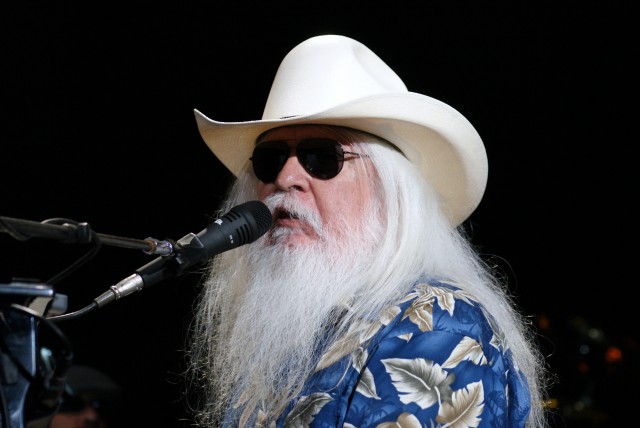
The legendary Leon Russell will play a free show in Rockefeller Park on July 10
Rockefeller Park, Battery Park City
Wednesday, July 10, free, 7:00
www.rivertorivernyc.com
www.leonrussellrecords.com
“About a year ago, Elton came, found me in a ditch by the side of the highway of life. He took me up to the high stages, with big audiences, and treated me like a king,” Leon Russell said in his acceptance speech upon being inducted into the Rock and Roll Hall of Fame by Elton John in 2011. John and Russell, who had played together back in the early 1970s, reunited for 2010’s The Union, which brought Russell back to prominence after nearly fading into obscurity. Over the course of his nearly fifty-year career, the Oklahoma-born musician has written and/or played on myriad classic tracks, from Phil Spector records and the Beach Boys to George Harrison, the Carpenters, Freddie King, Rita Coolidge, the Byrds, Glen Campbell, Willie Nelson, Badfinger, Bob Dylan, the Rolling Stones, Ringo Starr, Herb Alpert, Eric Clapton, and dozens and dozens of others, scoring hits with “Superstar,” “Tight Rope,” “Delta Lady,” “This Masquerade,” and his signature number, “A Song for You.” He was a standout at the Concert for Bangladesh, performing “Jumpin’ Jack Flash” and “Young Blood,” and was a member of Joe Cocker’s Mad Dogs and Englishmen tour. On July 10, Russell, who underwent brain surgery in 2010 while working with John, will be playing a free show in Rockefeller Park as part of the River to River Festival, and concertgoers will most definitely be surprised when they hear plenty of songs they never knew had any relation to this legendary, long white-haired master who marvelously melds pop, rock, and folk with country and blues.
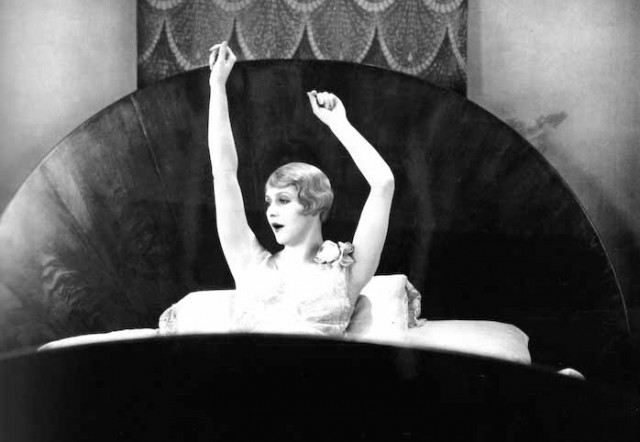
 Loosely based on a Noël Coward play that was recently made into a film starring Colin Firth, Jessica Biel, and Kristin Scott Thomas, Alfred Hitchcock’s Easy Virtue is another of the Master of Suspense’s cleverly told melodramas, a risqué tale of a woman unfairly placed in a lurid situation. Isabel Jeans stars as Larita Filton, a loving wife whose husband, Aubrey (Franklin Dyall), has commissioned her portrait by painter Claude Robson (Eric Bransby Williams). Just as Claude makes a play for Larita, she fights him off and Aubrey walks in. He misinterprets the scene, shots ring out, the artist is dead, and Claude files a highly publicized divorce case in which Larita is found guilty of misconduct. Trying to put her notorious past behind her, she heads for the Mediterranean, where she meets John Whittaker (Robin Irvine), a wealthy mama’s boy who falls instantly in love with her and brings her back to his parents’ country estate. But once there, Whittaker’s nasty mother (Violet Farebrother) and conniving sisters (Dacia Deane and Dorothy Boyd) do everything they can to ruin the relationship, seeking to uncover Larita’s history while also attempting to put her son back together with longtime family friend Sarah (Enid Stamp Taylor). Easy Virtue, which features yet another Hitchcock blonde, is a gripping film about honesty, reputation, individuality, and character as an innocent woman is forced to face undeserved consequences in the superficial world of high society. Hitchcock, who makes his cameo holding a walking stick, gliding past Larita while she sits by a tennis court, includes several wonderful touches involving circles and ovals, from a close-up of a judge’s wig to a shot through a tennis racket’s strings to a dining room dominated by a group of elongated, haloed saints on one wall. Easy Virtue is also one of Hitchcock’s dourest silent melodramas, lacking any comic relief as a wronged woman desperately tries to right her life. A DCP restoration of Easy Virtue is being screened July 2 at 7:30 in the BAM Harvey Theater as part of “The Hitchcock 9,” with live piano music by Stephen Horne. The series continues through July 3 with such other rarely shown Hitchcock silents as The Farmer’s Wife, Downhill, Champagne, and The Pleasure Garden, Sir Alfred’s debut, which has been restored with an additional twenty minutes that have been missing since its initial release.
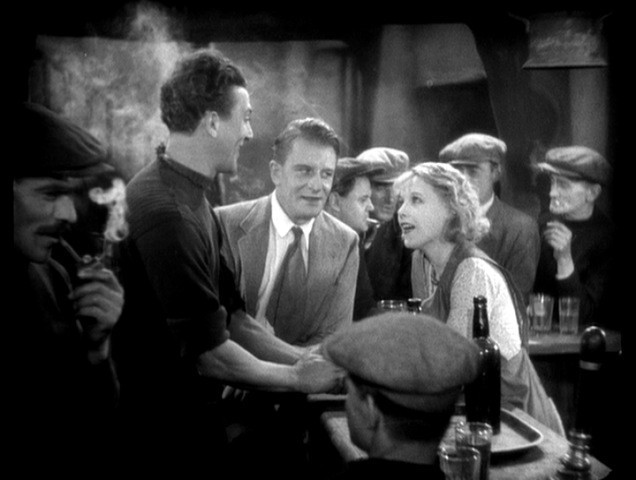
 An underrated gem, The Manxman is one of Alfred Hitchcock’s best early works from his British silent period. Based on an 1896 novel by Hall Caine, the 1929 melodrama, Hitchcock’s last fully silent film, tells the story of a romantic love triangle between two best friends, fisherman Pete Quilliam (Carl Brisson), lawyer Philip Christian (Malcolm Keen), and the woman they both love, Kate Cregeen (Anny Ondra). When Kate’s father, Caesar (Randle Ayrton), rejects Pete’s bid for his daughter’s hand, calling him a “penniless lout,” the fisherman takes to the sea, vowing to return from Africa a wealthy man worthy of marrying her. But while Pete is away, Philip and Kate grow much closer and contemplate whether they should break Kate’s promise to wait for Pete. When they learn of Pete’s death, they are ready to celebrate their love, but when the report turns out to be a mistake and Pete comes back a successful man, the drama heats up amid lies, betrayal, and public humiliation. Set on the Isle of Man but actually filmed on the Cornwall coast, The Manxman is a gripping tale that rises above pure soap opera through Hitchcock and cinematographer Jack E. Cox’s (Blackmail, The Lady Vanishes) intricate compositions and the German Expressionist acting style employed by Keen (The Lodger), who seems to have walked out of a von Sternberg film. One of the most memorable shots occurs with the three protagonists standing as if alone in Kate and Pete’s home, Kate leaning by a window, Philip bowed by the front door, and Pete in the front, head raised, confused and worried about the future. Hitchcock employs his mastery of suspense in several critical scenes, which he lets go on at length without any intertitles, forcing the viewer to wonder what is being said and then surprising them with what actually happens. Hitchcock sold The Manxman short when he told François Truffaut, “It was a very banal picture. . . . It was not a Hitchcock movie.” A DCP restoration of The Manxman, including a long-missing scene, is screening June 30 at 3:00 in the BAM Harvey Theater as part of “The Hitchcock 9,” with live music by pianist Stephen Horne and harpist Diana Rowan. The series continues through July 3 with such other rarely shown, carefully restored Hitchcock silents as The Farmer’s Wife, The Pleasure Garden, Downhill, and Champagne.