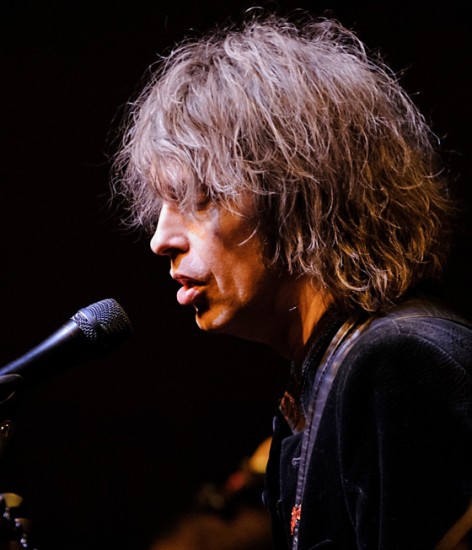
Mike Scott will lead the Waterboys in a special free show in Prospect Park on July 19
Prospect Park Bandshell
Prospect Park West & Ninth St.
Friday, July 19, free (suggested donation $3), 7:30
www.bricartsmedia.org
www.mikescottwaterboys.com
“As for me, I figured music wasn’t worth the air it occupied if it didn’t change both its makers and its listeners, but I was altered by my adventures to a degree beyond my comprehension,” writes Waterboys founder Mike Scott about recording the band’s classic 1988 album, Fisherman’s Blues, in his 2012 memoir, Adventures of a Waterboy. “I stood looking back over the three years, wondering what the hell had happened. Unable to articulate the contents of my mind I decided to give no interviews, and did the one sensible thing I could and took the Waterboys back on the road.” Twenty-five years later, the extremely articulate Scott is taking the Scottish group back out on the road again, on the longest U.S. tour of its thirty-year career. Combining a poetic grace and narrative storytelling with an epic Celtic-rock sound, the Waterboys have recorded such memorable tracks as “Fisherman’s Blues,” “Whole of the Moon,” “And a Bang on the Ear,” “This Is the Sea,” “The Big Music,” and the antiwar paean “Red Army Blues.” Scott has also shown a deep affinity for the work of William Butler Yeats; he included a version of the Irish writer’s “The Stolen Child” on Fisherman’s Blues, and in 2011 he released An Appointment with Mr Yeats, consisting of fourteen Yeats poems set to music, including “News for the Delphic Oracle,” “Sweet Dancer,” “Mad as the Mist and Snow,” and “The Faery’s Last Song.” This fall Scott will be leading two different Waterboys lineups, both featuring fiddler Steve Wickham, as the band embarks on “A Night of Musickal Fireworks and Improvisations” in America, followed by “Fisherman’s Blues Revisited” in Europe. We first saw the Waterboys opening up for U2 at the Tower Theater in Philly on December 1, 1984, and were instantly blown away by Scott’s powerful stage presence and wide-ranging scope, and we’ll be there on July 19 when the band plays a free Celebrate Brooklyn! show in Prospect Park, with Scottish folk musician Alasdair Roberts also on the bill. “I have heard / the big music / and I’ll never be the same / Something so pure / just called my name,” Scott sang on “The Big Music,” from 1984’s A Pagan Place, a feeling that many experience after seeing the Waterboys for the first time.
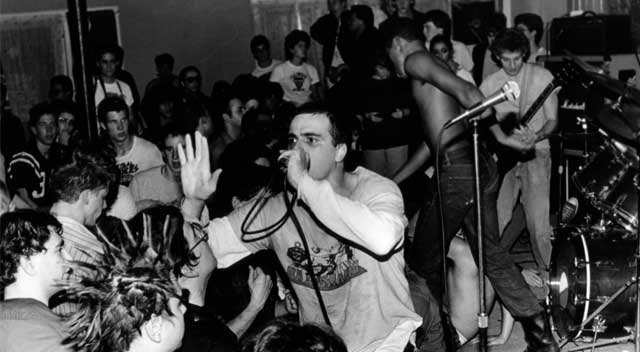
 A must-see for fans of loud, fast, angry music circa 1980-86, American Hardcore looks at one of the smaller but nonetheless influential movements in American music. A basic doc in the classic do-it-yourself sensibility that informed so much of the music scene it chronicles, American Hardcore features interviews with Henry Rollins, lead singer of Black Flag; H.R., the mercurial, difficult, but brilliant lead singer for the Bad Brains; Mike Watt of the Minutemen; and various personnel from the Circle Jerks, Minor Threat, and 7 Seconds. Tommy Stinson of the Replacements and Flea of the Red Hot Chili Peppers weigh in as well. The abundance of old concert footage is fabulous, but director Paul Rachman and writer Steven Blush discovered much of it in shoeboxes in basements during their low-budget cross-country trip while making the movie, so the overall production quality is not high ― which in some ways works better overall. The film does a good job of lovingly showing just how home-grown and amateurish the scene was and debating the importance of the scenes in Houston, Minneapolis, DC, Boston, and Southern California. The finale with a graphic artist and cover designer calling for the next generation of hardcore is a riot. American Hardcore is screening July 13 and 14 at 12 noon as part of the Nitehawk Cinema series “Music Driven”; the Saturday show will be followed by a Q&A with director Rachman, while Blush will be on hand for a Q&A after Sunday’s screening. (In addition to writing the American Hardcore book, Blush has also created one of the great music sites,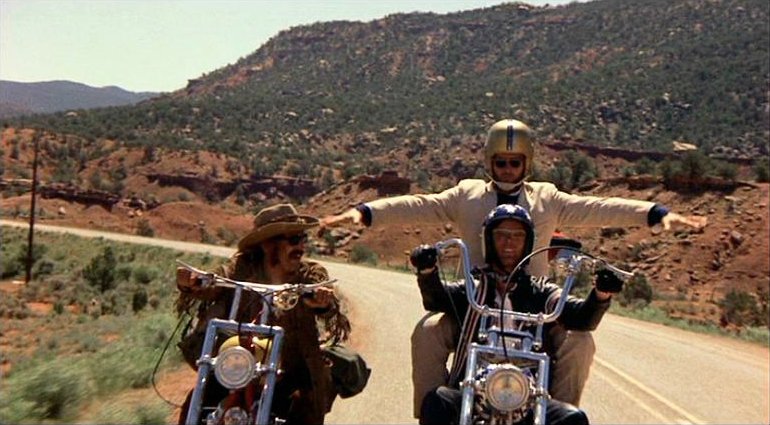
 No mere relic of the late 1960s counterculture movement, Easy Rider still holds up as one of the truly great road movies, inviting audiences to climb on board as two peace-loving souls search for freedom on the highways and byways of the good ol’ U.S. of A. Named after a pair of famous western gunslingers, Wyatt (producer and cowriter Peter Fonda), as in Earp, and Billy (director and cowriter Dennis Hopper), as in “the Kid,” make some fast cash by selling coke to a fancy connection (Phil Spector!), then take off on their souped-up bikes, determined to make it to New Orleans in time for Mardi Gras. Along the way, they break bread with a rancher (Warren Finnerty) and his family, hang out in a hippie commune, pick up small-town alcoholic lawyer George Hanson (an Oscar-nominated Jack Nicholson), don’t get served in a diner, and eventually hook up with friendly prostitutes Karen (Karen Black) and Mary (Toni Basil) in the Big Easy. “You know, this used to be a helluva good country. I can’t understand what’s gone wrong with it,” George says to Billy as they start discussing the concept and reality of freedom. “Oh, yeah, that’s right. That’s what it’s all about, all right. But talkin’ about it and bein’ it, that’s two different things. I mean, it’s real hard to be free when you are bought and sold in the marketplace. Of course, don’t ever tell anybody that they’re not free, ’cause then they’re gonna get real busy killin’ and maimin’ to prove to you that they are. Oh, yeah, they’re gonna talk to you, and talk to you, and talk to you about individual freedom. But they see a free individual, it’s gonna scare ’em.” The always calm Wyatt, who is also known as Captain America, and the nervous and jumpy Billy make one of cinema’s coolest duos ever as they personally experience the radical changes going on in the country, leading to a tragic conclusion. The Academy Award–nominated script, written with Terry Southern, remains fresh and relevant as it examines American capitalism and democracy in a way that is still debated today. And the soundtrack — well, it virtually defined the era, featuring such songs as Steppenwolf’s “The Pusher” and “Born to Be Wild,” Jimi Hendrix’s “If 6 Was 9,” the Electric Prunes’ “I Had Too Much to Dream (Last Night),” the Chambers Brothers’ “Time Has Come Today,” Thunderclap Newman’s “Something in the Air,” and Roger McGuinn’s “Ballad of Easy Rider.”