The idea of the earth overrun by dysentery isn’t the most appetizing of thoughts. But as it turns out, Diarrhea Planet might not be such a bad thing after all. The Nashville six-piece has just released its sophomore full-length, I’m Rich Beyond Your Wildest Dreams (Infinity Cat, August 20), the follow-up to 2011’s Loose Jewels. The new album (which can be streamed here) is a furious forty-minute unrelenting blast of psychedelic garage punk and indie pop, with nods to the ’50s, ’60, ’70s, and ’80s, powered by four shredding guitarists, Jordan Smith, Evan Bird, Brent Toler, and Emmett Miller, along with bassist Mike Boyle and drummer Casey Weissbuch. Citing such wide-ranging influences as Curb Your Enthusiasm, Japanese literature, Steely Dan, the animated movie Heavy Metal, Bad Religion, and Roberto Bolaño’s 2666, DP investigates loneliness, unrequited love, boredom, evil, and dead bodies on I’m Rich Beyond Your Wildest Dreams, although it’s far from depressing. “I feel so lost, man / I try to bring myself down / so I can relate to / the things you think about,” Smith sings on “Kids,” continuing, “Like burning bridges / and happy children / the salty taste of / my sweat in the ocean.” Other explosive tracks include “Separations,” “Hammer of the Gods,” “Ugliest Son,” and “Babyhead.” Diarrhea Planet will be letting loose at Mercury Lounge on August 30 with Brooklyn punks the So So Glos, who are touring behind their latest, Blowout.
this week in music
VIDEO OF THE DAY: “LIGHT ON” BY BAD COP
Nashville anarchic punks Bad Cop are out on the road in support of their latest release, The Light On EP (Jeffery Drag, July 2013), and detailing their madventures through a series of webisodes dubbed The Light On Chronicles. The five-song EP, which can be streamed for free here, includes “Can’t Get Enough,” which cofounder Adam Hoult wrote while in the hoosegow, and “Light On,” which is about other cofounder Alex Hartness’s nearly fatal overdose — he was actually pronounced dead at one point. Fleshed out with bassist Mike Frazier and drummer Kevin Kilpatrick, the band goes all-tilt shriek-out on “Post McDonalds Punks,” while EP opener and closer, “The Wind” and “My Dying Days,” respectively, are downright melodic in comparison. Bad Cop will be at Cameo Gallery on August 27 with Automotive High School, Plastic Visions, and Such Hounds and at Pianos on August 28 with Monogold, Slonk Donkerson, Plastic Visions, and Of the Opera.
THE ART OF THE SCORE: FILM WEEK AT THE PHILHARMONIC
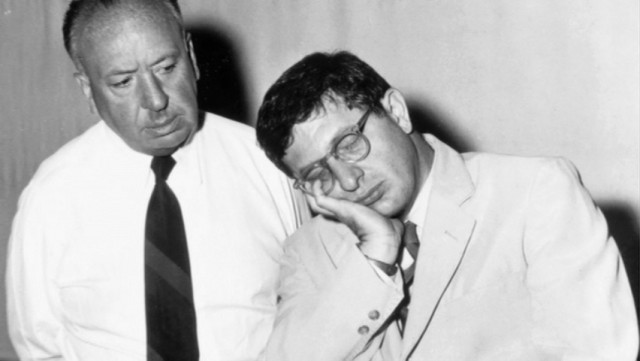
There shouldn’t be much sleeping when the scores of films by Alfred Hitchcock (above, with composer Bernard Herrmann) and Stanley Kubrick take center stage at the Philharmonic
Avery Fisher Hall
10 Lincoln Square, Broadway at 64th St.
September 17-21, $45-$125
www.nyphil.org
Perhaps no two directors used music as effectively as Alfred Hitchcock and Stanley Kubrick, the former employing original compositions to build unwavering suspense, the latter including famous classical pieces to immerse viewers in magical atmospheres. The New York Philharmonic will pay tribute to both men during “The Art of the Score: Film Week at the Philharmonic,” as the orchestra performs the scores while film clips are shown on the big screen at Avery Fisher Hall. Curated by artistic director Alec Baldwin, “The Art of the Score” begins September 17-18 with “Hitchcock!,” comprising music by Lyn Murray (To Catch a Thief), Bernard Herrmann (Vertigo, North by Northwest), Dimitri Tiomkin (Strangers on a Train, Dial M for Murder), and Charles Gounod (“Funeral March of a Marionette,” the theme from Alfred Hitchcock Presents), conducted by Constantine Kitsopoulos; the first night will be hosted by Baldwin, the second by Sam Waterston. The Philharmonic then focuses on Kubrick’s epic 2001: A Space Odyssey on September 20-21, consisting of works by György Ligeti (“Atmosphères,” “Lux aeterna,” “Aventures,” “Kyrie” from Requiem), Richard Strauss (“Also sprach Zarathustra”), and Johann Strauss II (“On the Beautiful Blue Danube”), conducted by Alan Gilbert and featuring the Musica Sacra Chorus, directed by Kent Tritle. The final event, “Mind, Music, and the Moving Image,” being held on September 21 at the Gerald W. Lynch Theatre, in which Baldwin speaks with filmmakers Joel and Ethan Coen, their regular composer, Carter Burwell, and neuroscientest Aniruddh D. Patel, has already sold out.
IGNORANCE
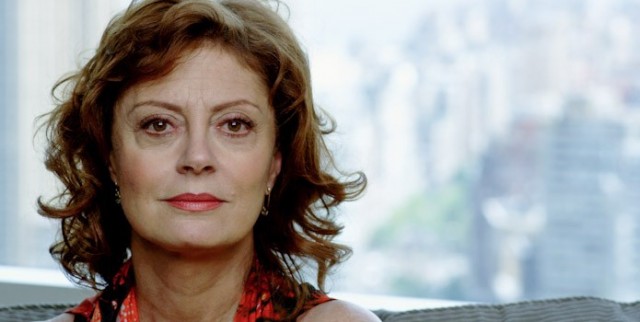
Susan Sarandon will discuss “The Path Itself” with the Gyalwang Drukpa as part of Rubin Museum series on “Ignorance”
Rubin Museum of Art
150 West 17th St. at Seventh Ave.
September 25 – December 27, $15 – $45 (Acoustic Cash $85, Cabaret Cinema free with $7 bar purchase)
212-620-5000
www.rmanyc.org
Last fall, the Rubin Museum examined the concept of happiness through specially introduced film screenings, live performances, and a series of talks pairing artists with scientific and philosophical experts. This fall the museum and its mad-genius programmer, Tim McHenry, tackle a different kind of bliss: ignorance. In 1742, British poet Thomas Gray concluded his “Ode on a Distant Prospect of Eton College” thusly: “Since sorrow never comes too late, / And happiness too swiftly flies. / Thought would destroy their paradise. / No more; where ignorance is bliss, / ’Tis folly to be wise.” More than two centuries earlier, Gautama Buddha explained in the Sutta Nipata that “it is ignorance that smothers, and it is carelessness that makes it invisible. The hunger of craving pollutes the world, and the pain of suffering causes the greatest fear.” The Rubin’s “Ignorance” series, which explores the idea that “what you don’t know could hurt you,” begins September 25 with artist Ernesto Pujol and cultural critic Carol Becker discussing “Ignorance and Ritual,” followed September 26 with lama the Gyalwang Drukpa and actress Susan Sarandon delving into “The Path Itself” and September 27 with psychologist Daniel Gilbert and cartoonist Tim Kreider investigating “Delusion.” Among the other highlights are writer Neil Gaiman and multimedia artist Laurie Anderson sitting down for “Fantasy and Fact,” director Mira Nair and anthropologist Christopher Pinney getting into “Allegory and Illusion,” and playwright Neil LaBute and actor Alec Baldwin rapping about “Ignorance in the Information Age.” Live music includes Holly Near on September 27, Rosanne Cash and Cory Chisel on October 18, and Toshi Reagon on November 8. The Friday-night film programs kicks off September 6 with drama critic John Heilpern introducing Kind Hearts and Coronets and continues with such other beauties as actor and photographer Joel Grey introducing Cabaret, comedian Rachel Dratch introducing Lord of the Flies, and multidisciplinary performance artist John Kelly introducing Shadow of a Doubt. Nineteenth-century British preacher Charles Haddon Spurgeon wrote, “The doorstep to the temple of wisdom is the knowledge of our own ignorance”; this Rubin series should throw that door wide open.
SUMMER HD FESTIVAL 2013
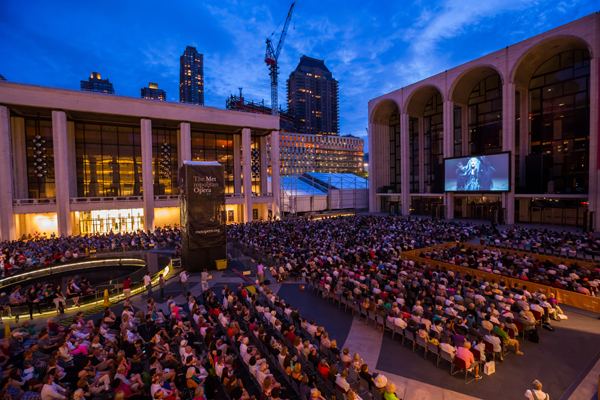
The Met will be screening recent productions of operas for free on Lincoln Center Plaza August 24 – September 2 (photo by Chris Lee)
Lincoln Center Plaza
Broadway at 64th St.
August 24 – September 2, free, 8:00
www.metoperafamily.org
Over the last several years, the Metropolitan Opera has been expanding its reach, presenting HD screenings of its productions, both live and previously recorded, on television and in movie theaters around the country, and more recently it has instituted the Free Summer HD Festival, holding free first-come, first-served screenings outside on Lincoln Center Plaza, by the fountain. This year’s series comprises ten operas recorded between 2008 and 2013, beginning August 24 with Willy Decker’s version of Verdi’s La Traviata, featuring Natalie Dessay, Matthew Polenzani, and Dimitri Hvorostovsky, conducted by Fabio Luisi. Mary Zimmerman’s staging of Donizetti’s Lucia di Lammermoor will be shown August 25, with Anna Netrebko, Piotr Beczala, Mariusz Kwiecien, and Ildar Abdrazakov, conducted by Marco Armiliato, followed August 26 by Robert Lepage’s take on Thomas Adès’s The Tempest, starring Audrey Luna, Isabel Leonard, Alan Oke, Alek Shrader, and Simon Keenlyside, conducted by Adès. The nightly festival continues with Renée Fleming in Verdi’s Otello, Jean-Pierre Ponnelle’s production of Mozart’s La Clemenza di Tito, James Levine conducting Berlioz’s La Damnation de Faust, the 2013 Met premiere production of David McVicar’s version of Donizetti’s Maria Stuarda, Netrebko in Massenet’s Manon, and the return to Sweden of Verdi’s Un Ballo in Maschera, then concluding September 2 with Luisi conducting Liudmyla Monastyrksa in Sonja Frisell’s staging of Verdi’s Aida.
VIDEO OF THE DAY: “YOU RUINED LOVE” BY ASHLEY ALLEN
Ashley Allen burst out of the gate in June with her debut single, the sugary sweet YouTube dance-pop hit “Let’s Go.” The perennially upbeat singer-songwriter gets much more introspective on “You Ruined Love,” a folk-country lament about first love and heartbreak. The New York native, who is currently working on her debut EP, due out later this year, to be followed by a full-length LP in 2014, has also recorded the catchy “Body Say No, Heart Say Yes” and the pop ballad “Dancing in My Head.” According to her Facebook page, Allen is “just a girl from New York City. Total Weirdo and totally okay with it,” which is okay with us too. On “Let’s Go,” she declares, “I wanna scream and lose my voice,” but hopefully the second part of that statement won’t take place when Allen plays Santos Party House on August 23 with Free Keys and Glass Mansion.
ANOTHER DAY, ANOTHER TIME: CELEBRATING THE MUSIC OF “INSIDE LLEWYN DAVIS”
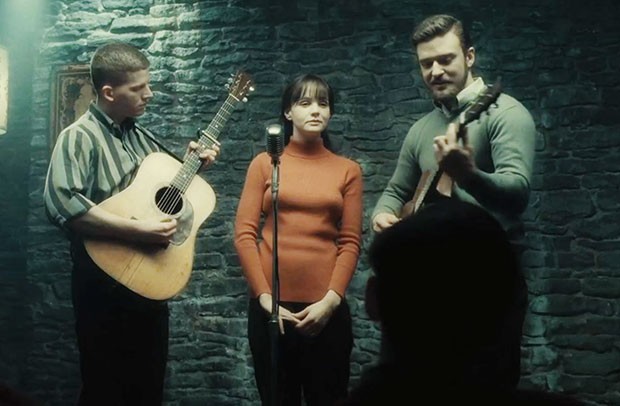
Benefit concert will celebrate music of latest Coen brothers film, INSIDE LLEWYN DAVIS
The Town Hall
123 West 43rd St. between Sixth Ave. & Broadway
Tickets on sale Wednesday, August 21, 12 noon
Concert takes place September 29, $75-$150, 7:30
212-840-2824
www.insidellewyndavis.com
www.the-townhall-nyc.org
In 2000, filmmakers Joel and Ethan Coen teamed up with producer T Bone Burnett to create an award-winning soundtrack for their hit film O Brother, Where Art Thou? The 1930s-set movie featured a mix of traditional Americana, country, folk, and blues, including such songs as “Big Rock Candy Mountain,” “I Am a Man of Constant Sorrow,” “O Death,” and “Lonesome Valley” performed by such musicians as Norman Blake, Jerry Douglas, Alison Krauss, Ralph Stanley, Emmylou Harris, Gillian Welch, and the Soggy Bottom Boys. In their latest film, Inside Llewyn Davis, which premiered at Cannes in May, the Coens tell the story of a week in the life of a 1960s Greenwich Village folksinger, with Burnett once again on board to steer the soundtrack. On September 29, the music of the film will take center stage at the Town Hall, when “Another Day, Another Time: Celebrating the Music of Inside Llewyn Davis” takes place, featuring an all-star lineup raising funds for the National Recording Preservation Foundation. The roster is unusually impressive, featuring the Avett Brothers, Joan Baez, Rhiannon Giddens, Lake Street Drive, Colin Meloy, the Milk Carton Kids, Marcus Mumford, Conor Oberst, the Punch Brothers, Secret Sisters, Patti Smith, Gillian Welch & David Rawlings, Willie Watson, and Jack White in addition to cast members Oscar Isaac, John Goodman, Carey Mulligan, and Stark Sands. The concert will include songs from the film in addition to 1960s tunes that inspired them. The film will screen at this fall’s New York Film Festival before opening in December. Tickets are $75 and $150 and go on sale August 21 at noon.