Eliane Radigue and Xavier Veilhan’s SYSTEMA OCCAM kicks off FIAF’s seventh annual Crossing the Line festival
French Institute Alliance Française and other locations
Florence Gould Hall, 55 East 59th St. between Madison & Park Aves.
Le Skyroom and FIAF Gallery, 22 East 60th St. between Madison & Park Aves.
September 19 – October 13, free – $30
212-355-6160
www.fiaf.org
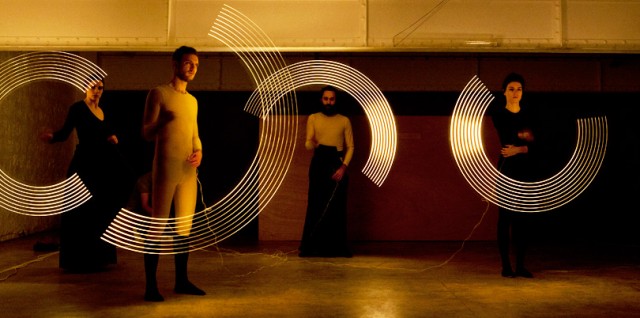
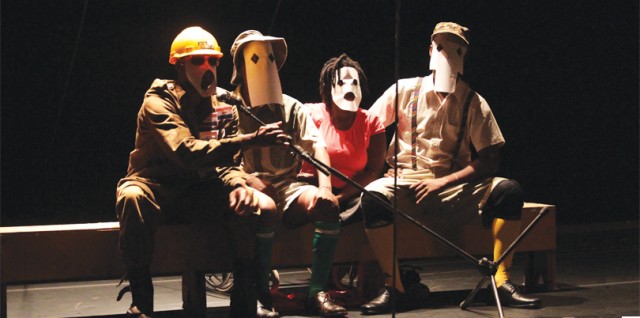
Curators Lili Chopra, Simon Dove, and Gideon Lester have once again put together an impressive, wide-ranging program for the Crossing the Line festival, now in its seventh year. Sponsored by the French Institute Alliance Française and taking place there as well as at other venues around the city, CTL features cutting-edge art, dance, music, theater, discussion, and more from an international collection of multidisciplinary performers, with many events free and nothing costing more than $30. The twenty-five-day festival begins September 19 with electronic music composer Eliane Radigue and artist Xavier Veilhan collaborating on Systema Occam (Florence Gould Hall, $30), a multimedia performance installation that is part of CTL’s “New Settings” series, a joint venture with Hermès; the fashion company will be hosting Martine Fougeron’s “Teen Tribe” photo exhibition at the Gallery at Hermès from September 20 to November 8. In Capitalism Works for Me! True/False (September 20, October 6-9, free), Steve Lambert will keep score in Times Square as people vote on whether capitalism indeed works for them. The award-winning Nature Theater of Oklahoma presents episodes 4.5 and 5 at FIAF of their massive undertaking, Life and Times (September 20-21, $30), accompanied by the FIAF Gallery show “10fps,” consisting of 1,343 hand-colored drawings (September 21 – November 2, free). For “The Library,” Fanny de Chaillé invites people to FIAF’s Haskell Library on September 24 and 26 and the NYPL’s Jefferson Market Branch on September 27 (free), where they can choose books that are actually men and women who will share their stories verbally one on one.
In The Inkomati (dis)cord (September 25-26, New York Live Arts, $20), Boyzie Cekwana and Panaibra Canda use contemporary dance to examine postcolonial Africa. De Chaillé teams up with Philippe Ramette for Passage à l’acte / Acting Out (September 26-28, Invisible Dog, $30), using absurdist human sculpture to “rationalize the irrational.” Dancer and choreographer Nora Chipaumire will perform the CTL-commissioned solo piece rite riot (October 3-5, Le Skyroom, $30), exploring African stereotypes, collaborating with writer Teju Cole and visual artist Wangechi Mutu. Pascal Rembert’s large-scale A (micro) history of world economics, danced (October 11-13, La MaMa, $20) features New Yorkers discussing how the financial crisis impacted their lives. The festival also includes works by Annie Dorsen, Ernesto Pujol and Carol Becker, Bouchra Ouizguen, Tim Etchells, and Kyle deCamp and Joshua Thorson, in addition to a series of talks and conversations.


Art, American consumerism, the Vietnam and Algerian wars, Hollywood, and the cinema itself get skewered in Jean-Luc Godard’s fab feaux gangster flick / road comedy / romance epic / musical Pierrot Le Fou. Based on Lionel White’s novel Obsession, the film follows the chaotic exploits of Ferdinand Griffon (Jean-Paul Belmondo) and Marianne Renoir (Anna Karina, Godard’s then-wife), former lovers who meet up again quite by accident. The bored Ferdinand immediately decides to leave his wife and family for the flirtatious, unpredictable Marianne, who insists on calling him Pierrot despite his protestations. Soon Ferdinand is caught in the middle of a freewheeling journey involving gun running, stolen cars, dead bodies, and half-truths, all the while not quite sure how much he can trust Marianne. Filmed in reverse-scene order without much of a script, the mostly improvised Pierrot Le Fou was shot in stunning color by Raoul Coutard. Many of Godard’s recurring themes and style appear in the movie, including jump cuts, confusing dialogue, written protests on walls, and characters speaking directly at the audience, who are more or less along for the same ride as Ferdinand. And as with many Godard films, the ending is a doozy.

While changing the face of Hollywood cinema with The Godfather and The Godfather Part II, American auteur Francis Ford Coppola snuck in yet another 1970s masterpiece, the dark psychological thriller The Conversation. Gene Hackman gives a riveting performance as Harry Caul, an audio surveillance expert who has been hired to record a meeting between two people (Cindy Williams and Frederic Forrest) in Union Square in San Francisco. Thinking that he might have stumbled onto a murder plot, Caul soon finds himself in the middle of a dangerous conspiracy that threatens the lives of all those involved. The Conversation is a gripping, taut examination of obsession, paranoia, and loneliness as well as an exploration of language and communication. Caul might spend most of his time listening in on the intimate conversations of others, but he is an intensely private individual who is extremely uncomfortable in his own skin. A deeply religious man who also plays the saxophone, Caul has trouble relating to other people; Hackman is particularly outstanding in a party scene where Caul is forced to talk shop with fellow surveillance expert Bernie Moran (Allen Garfield), who wants to know Caul’s secrets, but the always nervous Caul isn’t about to share everything. The film also examines how people hear what they want to hear and see what they want to see, and it takes on even more meaning in a twenty-first century dominated by public and private surveillance, from store security cameras and government monitoring to Facebook, Twitter, and YouTube. The supporting cast, which also features Harrison Ford, Robert Duvall, Teri Garr, and John Cazale, is exceptional, but this is Hackman’s show all the way, leading to one of the great endings in the history of cinema.