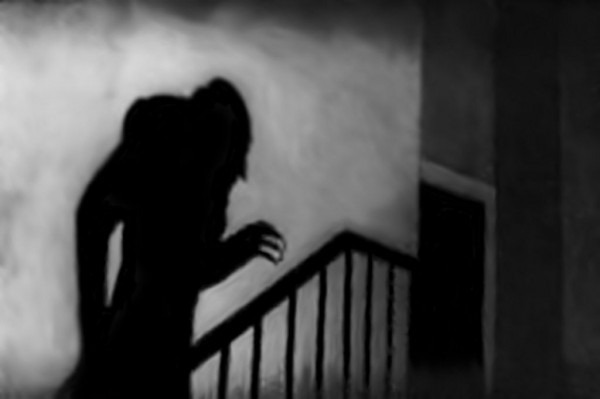
F. W. Murnau’s 1922 version of NOSFERATU is a German expressionist classic
NOSFERATU: A SYMPHONY OF HORROR (NOSFERATU, EINE SYMPHONIE DES GRAUENS) (F. W. Murnau, 1922)
Film Forum
209 West Houston St.
Monday, November 4, $12.50, 7:30
212-727-8110
www.filmforum.org
 In F. W. Murnau’s classic horror film, Max Schreck stars as Count Orlok, a creepy, inhuman-looking Transylvanian who is meeting with real estate agent Thomas Hutter (Gustav von Wangenheim) in order to buy a house in Germany. Hutter soon learns that the count has a taste for blood, as well as lust for his wife, Ellen (Greta Schröder), whom he has left behind in Germany. When Count Orlok, a bunch of rats, and a group of coffins filled with Transylvanian earth head out on a ship bound for Wisborg, the race is on to save Ellen, and Germany. Murnau’s Nosferatu is set in an expressionist world of liminal shadows and fear, as he and cinematographers Fritz Arno Wagner and Günther Krampf continually place the menacing Orlok in oddly shaped doorways that help exaggerate his long, spiny fingers and pointed nose and ears. Unable to acquire the rights from Bram Stoker’s estate to adapt the Gothic horror novel Dracula into a film, writer Henrik Galeen (The Golem, The Student of Prague) and director Murnau (Sunrise, The Last Laugh) instead made Nosferatu, paring down the Dracula legend, changing the names of the characters, and tweaking the story in various parts. Upon its 1922 release, they were sued anyway, and all prints were destroyed except for one, ensuring the survival of what became a defining genre classic. In 1979, German auteur Werner Herzog (Woyzeck, Fitzcarraldo) paid tribute to the earlier film with Nosferatu the Vampyre, a near scene-by-scene homage to Murnau’s original but with Stoker’s character names restored, as the book was by then in the public domain. Hans Erdmann’s complete score no longer exists, so numerous musical compositions have accompanied screenings and DVD/VHS releases over the years; at Film Forum, pianist Steve Sterner will offer his take on November 4 at 7:30.
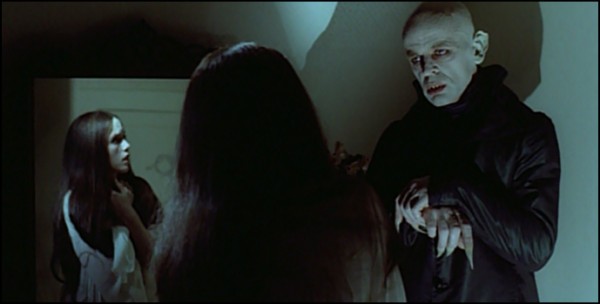
Werner Herzog pays tribute to Murnau classic with his 1979 remake of NOSFERATU
NOSFERATU THE VAMPYRE (NOSFERATU: PHANTOM DER NACHT) (Werner Herzog, 1979)
Film Forum
209 West Houston St.
Through Thursday, November 7, $12.50
212-727-8110
www.filmforum.org
 Nearly sixty years after Murnau battled the Stoker estate, Herzog remade Nosferatu with an all-star cast featuring Bruno Ganz as real estate agent Jonathan Harker, Isabelle Adjani as his wife, Lucy, and Klaus Kinski as Count Dracula. Shot in flat colors by Jörg Schmidt-Reitwein and set to a score by German electronica band Popol Vuh, Herzog’s Nosferatu follows the same path as Murnau’s, as Jonathan Harker travels to Transylvania to have the count sign a contract, discovers that Dracula likes blood and sleeps in a coffin, then tries to save his wife when the count and thousands of (purportedly mistreated) rats sail to Wismar, renewing fears of plague. Kinski plays the count as a sad, lonely figure who no longer belongs in the modern world. He’s desperate for human contact, and his castle has seen much better days. Kinski often seems to be shot in black-and-white, surrounded by color, as if he were from another time, except for his shockingly red lipstick. It’s a virtuoso performance that is significantly more nuanced than Schreck’s, which is a more direct take on the character. Both films are gems; Film Forum is showing a new 35mm print of the rare German-language version of Herzog’s remake through November 7; on November 4 you can see them both, with separate paid admission.

 Photographer Edward Burtynsky has been traveling the world with his large-format viewfinder camera, taking remarkable photographs of environmental landscapes undergoing industrial change. For Manufactured Landscapes, cinematographer Peter Mettler and director Jennifer Baichwal joined Burtynsky on his journey as he documented ships being broken down in Chittagong, Bangladesh; the controversial development of the Three Gorges Dam Project in China, which displaced more than a million people; the uniformity at a factory in Cankun that makes irons and the Deda Chicken Processing Plant in Dehui City; as well as various mines and quarries. Burtynsky’s photos, which were on view at the Brooklyn Museum in late 2005 and often can be seen in New York City galleries (two shows just closed last week), are filled with gorgeous colors and a horrible sadness at the lack of humanity they portray. As in the exhibit, the audience is not hit over the head with facts and figures and environmental rhetoric; instead, the pictures pretty much speak for themselves, although Burtynsky does give some limited narration. Baichwal lets the camera linger on its subject, as in the remarkable opening shot, a long, slow pan across a seemingly endless factory. She is also able to get inside the photographs, making them appear to be three-dimensional as Mettler slowly pulls away. Manufactured Landscapes is screening November 12 as part of the Film Society of Lincoln Center series “Peter Mettler: Pictures of Light,” a midcareer retrospective of the innovative Canadian artist that also features eight shorts and full-length documentaries he directed, including Picture of Light, The End of Time, Plastikman, Petropolis, and Gambling, Gods, and LSD, with Mettler on hand to talk about his work at most shows. In addition, Mettler will participate in the free White Light Festival panel discussion “It’s a Matter of Time” on November 9 at 4:30 with Sylvia Boorstein, Daniel Casasanto, Georg Friedrich Haas, and Alan Lightman and a performance of Steve Reich’s “Clapping Music” by Alan Pierson and Chris Thompson, moderated by John Schaefer.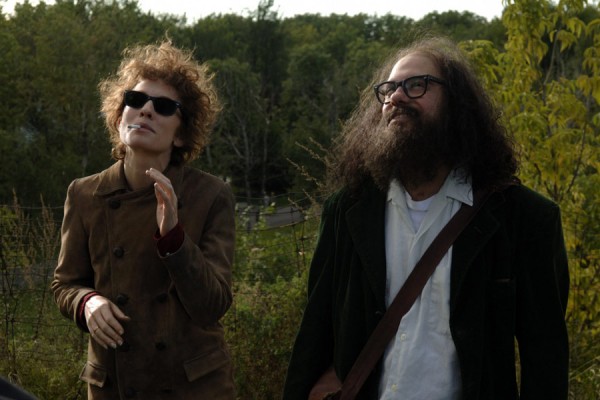
 Todd Haynes’s dramatization of the musical life of Bob Dylan is ambitious, innovative, and, ultimately, overblown and disappointing. Working with Dylan’s permission (though not artistic input), Haynes crafts a nonlinear tale in which six actors play different parts of Dylan’s psyche as the Great White Wonder develops from a humble folksinger to an internationally renowned and revered figure. Dylan is seen as an eleven-year-old black traveling hobo who goes by the name Woody Guthrie (Marcus Carl Franklin); Jack (Christian Bale), a Greenwich Village protest singer who later becomes a pastor; Robbie (Heath Ledger), an actor who has portrayed a Dylan entity and is having marital problems with his wife, Claire (Charlotte Gainsbourg); Arthur Rimbaud (Ben Whishaw), a staunch defender of poetry and revolution; an old Billy the Kid (Richard Gere), who has settled down peacefully in the small town of Riddle; and Jude Quinn (Cate Blanchett), who is attacked by her audience when she goes electric. Each story line is shot in a different style; for example, Jude’s is influenced by Fellini and the Dylan documentary Eat This Document!, Robbie’s by Godard, and Billy’s by Peckinpah. Excerpts from Dylan’s own version of his songs are interwoven with interpretations by Tom Verlaine, Yo La Tengo, Ramblin’ Jack Elliott, Stephen Malkmus, the Hold Steady, Sonic Youth (who do a killer version of the unreleased Basement Tapes–era title track over the closing credits), and many more, with cameos by Kris Kristofferson (as the opening narrator), Richie Havens, Julianne Moore, Kim Gordon, Paul Van Dyck, Michelle Williams, and David Cross (looking ridiculous as Allen Ginsberg). The most successful section by far is Blanchett’s; she takes over the role with relish, and cinematographer Edward Lachman and production designer Judy Becker nail the feel of the mid-’60s energy surrounding Dylan. But the rest of the film is all over the place, a great concept that bit off more than it could chew. I’m Not There is screening November 8 at 7:00 as part of the Museum of the Moving Image’s “See It Big!” series, with Lachman present to talk about the making of the film.