“Is it a good time / or is it highly inappropriate?” Molly Rankin asks in “Adult Diversion,” the first single from Toronto’s Alvvays. You can decide yourself when the group plays Mercury Lounge (incorrectly identified as “Always”) on November 25, opening for Honey Wild, Hippy, and the Sanctuaries, and at Glasslands on November 26, headlining for Jacksie, Boytoy, and No Kill. Singer-guitarist Rankin, the next generation of Nova Scotia folk favorites the Rankin Family — her father, fiddler John Morris Rankin, died in a car accident in 2000 when Molly was twelve — formed Alvvays with her Cape Breton childhood neighbor, keyboardist Kerri Maclellan, later adding guitarist Alec O’Hanley, bassist Brian Murphy, and drummer Phil MacIsaac. The band has posted two songs online, the dreamy indie pop duo “Adult Diversion” and “Archie, Marry Me,” a pair of infectious tunes highlighted by Rankin’s lilting vocals. Alvvays is currently putting together its debut record for Royal Mountain, working with Canadian musician Chad VanGaalen, Graham Walsh of the Holy Fuck, and John Agnello (Sonic Youth, the Hold Steady). The disc is due next year, but you can catch the group this week and check out more of their sweet sound at these two area shows.
this week in music
VIDEO OF THE DAY: “III” BY PERFECT PUSSY
Formed at the spur of the moment when lead singer and lyricist Meredith Graves was asked to perform a song in the upcoming Scott Coffey movie Adult World (starring John Cusack and Emma Roberts), Syracuse-based punks Perfect Pussy are out on the road in support of their demo/EP, April’s fearsome four-track, thirteen-minute I have lost all desire for feeling. Her voice buried in the mix, well-read art aficionado Graves channels early Sonic Youth as she screams, “I’m a real piece of shit / I’m a real lost cause / Dare to act like you’re surviving and get thrown to the dogs,” in “IV,” continuing, “Every dog deserves forgiveness / no matter who he bit / I’m a real lost cause / I’m a real piece of shit.” But Perfect Pussy is no lost cause, tearing through vicious songs that even feature an occasional synth line and, of course, lots of feedback. Yes, as in Graves’s previous band, Shoppers, the songs are titled with sequential Roman numerals, although she claims it is not for artistic reasons this time around but just that she couldn’t decide what to call the deeply personal confessions. Well, we call them fuckin’ awesome. Graves, guitarist Ray McAndrew, noise synthesist Shaun Sutkus, bassist Greg Ambler, and drummer Garrett Koloski will be at 285 Kent on November 22 with Beach Fossils and on November 23 with Shannon and the Clams, then the band will be back for a show at NYU’s Kimmel Center on December 5 with Ceremony, White Lung, and Sleepies.
HERE LIES LOVE: THE CONCERT FOR THE PHILIPPINES

Terminal 5
610 West 56th St.
Monday, November 25, $30-$150, 8:00
800-7453000
www.publictheater.org
www.terminal5nyc.com
Earlier this month, Super Typhoon Haiyan (aka Yolanda) struck the Philippines, leaving thousands dead, nearly two million homeless, and costing the country hundreds of millions of dollars. International rescue efforts are ongoing, and there are now more and more ways for people to contribute. On November 25, David Byrne will team up with the original cast of his and Fatboy Slim’s breakout hit, Here Lies Love, for a one-time-only fundraising concert at Terminal 5. The sensational immersive Public Theater musical is set in the Philippines, where it follows the rise and fall of Imelda Marcos (Ruthie Ann Miles) as she turns her back on her childhood friend Estrella (Melody Butiu), is romanced by Ninoy Aquino (Conrad Ricamora), and ends up marrying Ferdinand Marcos (Jose Llana) and losing touch with the citizenry. Byrne, Miles, Ricamora, Llana, and Butiu will be joined by ensemble members Renée Albulario, Natalie Cortez, Debralee Daco, Jaygee Macapugay, Jeigh Madjus, Maria-Christina Oliveras, George Salazar, Trevor Salter, and Janelle Velasquez as they perform the entire soundtrack song by song, in order, including “The Rose of Tacloban,” “Eleven Days,” “Order 1081,” and “Here Lies Love.” All proceeds from this special event go to Doctors Without Borders/Mèdecins Sans Frontières, which notes on its website, “Almost ten days have passed since Typhoon Haiyan struck the Philippines, and while aid is reaching airports, seaports, and cities, people in many rural areas are still struggling without assistance.” In a statement announcing the benefit, Public Theater artistic director Oskar Eustis said, “Here Lies Love made us feel a deep connection to the Philippine people, and to Tacloban specifically. Now we have a chance to make that connection matter. We hope this concert will raise money, raise awareness, and provide support for those who have lost so much.” Tickets are $30 for the balcony, $50 for the main floor, and $150 for VIP floor seating.
THE LINE KING’S LIBRARY: AL HIRSCHFELD AT THE NEW YORK PUBLIC LIBRARY
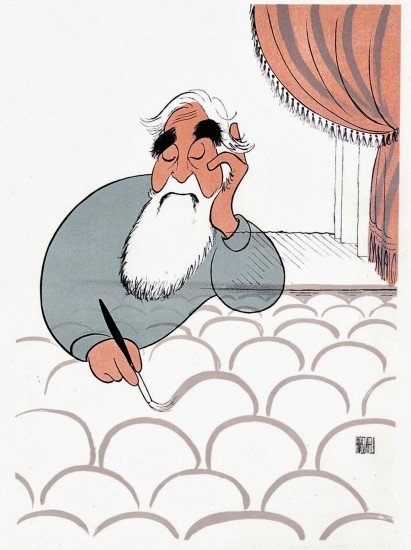
Al Hirschfeld’s long relationship with the New York Public Library and the arts is celebrated in exhibit at Lincoln Center
New York Public Library for the Performing Arts
40 Lincoln Center Plaza
Exhibition continues through January 4
Film screening: Bruno Walter Auditorium, 111 Amsterdam Ave., Monday, November 18, free, 6:00
212-642-0142
www.nypl.org/lpa
Twelve years ago, New York celebrated the life and eighty-plus-year career of legendary artist Al Hirschfeld with a major retrospective at the Museum of the City of New York and an exhibit of his celebrity caricatures at the New York Public Library’s main branch; in addition, Abrams released two books of his work, one focusing on New York, the other on Hollywood, and Hirschfeld made appearances to promote the publications. Nearly eleven years after his passing in January 2003 at the age of ninety-nine, the New York Public Library is honoring Hirschfeld again with a lovely exhibit at the Dorothy and Lewis B. Cullman Center, “The Line King’s Library: Al Hirschfeld at the New York Public Library.” Visitors can first stop by a re-creation of Hirschfeld’s work area, complete with his drawing table and barber chair, which is on permanent view at the library entrance. The exhibition is straight ahead, consisting of more than one hundred color and black-and-white drawings and lithographs, posters, books, letters, video, newspaper and magazine clippings, and various other ephemera, divided by the discipline of Hirschfeld’s subjects: theater, music, dance, and film, in addition to a section on those artists who influenced the man known as the Line King.
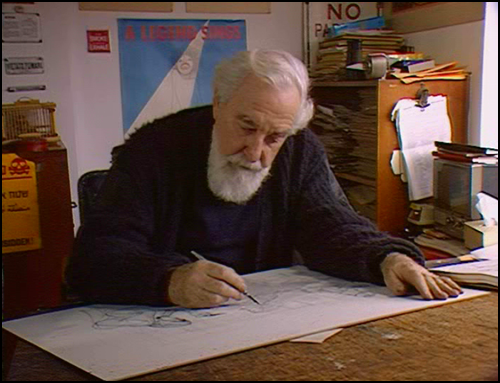
Oscar-winning documentary on Al Hirschfeld screens for free at NYPL on November 18
“My contribution is to take the character — created by the playwright and acted out by the actor — and reinvent it for the theater,” Hirschfeld once explained, and the evidence is on the walls, including works depicting Jack Lemmon in Tribute, Lee J. Cobb in Death of a Salesman, Christopher Plummer in Macbeth, Jessica Tandy and Marlon Brando in A Streetcar Named Desire, Rex Harrison and Julie Andrews in My Fair Lady, Alan Cumming in Cabaret, and Jackie Mason in The World According to Me, among so many more. There are also caricatures of Marcel Marceau, S. J. Perelman, George Bernard Shaw, Leonard Bernstein, Vladimir Horowitz, Dizzy Gillespie, Katharine Hepburn, and a dazzling, rarely shown 1969 print of Martha Graham. Another highlight is the original drawing for “Broadway First Nighters,” along with a key identifying the dozens of celebrities gathered in a packed room, and paraphernalia from Hirschfeld’s musical comedy Sweet Bye and Bye, a collaboration with Perelman, Vernon Duke, and Ogden Nash. And for those fans who have spent years trying to find all the inclusions of “Nina” in Hirschfeld’s drawings, “Nina’s Revenge” features his daughter holding a brush and smiling, the names “Al” and “Dolly” (for Dolly Haas, her mother and Hirschfeld’s second wife) in her long hair. In conjunction with the exhibition, there will be a free screening of the Oscar-winning 1996 documentary The Line King: The Al Hirschfeld Story, introduced by the director, Susan W. Dryfoos, on November 18 at 6:00 in the Bruno Walter Auditorium at the New York Public Library for the Performing Arts.
DOC NYC: THE PUNK SINGER
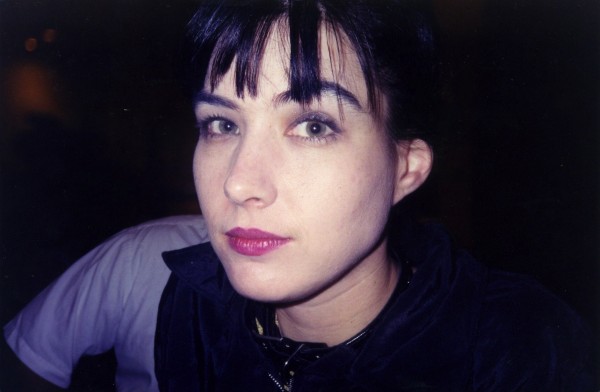
Riot grrrl Kathleen Hanna opens up about her life in intimate documentary (photo courtesy of Pat Smear)
SONIC CINEMA — THE PUNK SINGER: A FILM ABOUT KATHLEEN HANNA (Sini Anderson, 2013)
SVA Theatre
333 West 23rd St. between Eight & Ninth Aves.
Saturday, November 16, 7:15
Festival runs November 14-23
212-924-7771
www.thepunksinger.com
www.docnyc.net
 A cofounder of the riot grrrl movement, Kathleen Hanna was an outspoken feminist as she toured the world with Bikini Kill and then Le Tigre starting in 1991. But it all came to a mysterious halt in 2005 when the Portland, Oregon, native suddenly went on what became a long hiatus for undisclosed health reasons. Director Sini Anderson gets to the heart of the matter in the intimate, revealing documentary The Punk Singer: A Film About Kathleen Hanna. Incorporating rousing archival footage and photographs along with new interviews, Anderson, in her feature debut, gets Hanna to open up about her life and career, discussing such influences as Kathy Acker and Gloria Steinem as well as the serious health problem that kept her out of the public eye for five years. Hanna also talks about her childhood, a sexual assault that happened to her best friend, her photography and fashion work in college, her zine writing, and the formation of her bands, along the way always pushing her message. “We didn’t give a shit,” she says about the beginnings of Bikini Kill. “We weren’t making money; we knew we were never going to make money. And it was really important that we made our music. We were on a mission. We were going to do what we did whether we got attention or not.” Anderson also speaks with such former and current Hanna bandmates as Johanna Fateman, JD Samson, Kathi Wilcox, and Tobi Vail, musical icons Joan Jett and Kim Gordon, Sleater-Kinney’s Corin Tucker and Carrie Brownstein, and Hanna’s husband, Beastie Boy Adam Horovitz; many are interviewed in the back of a snazzy van during a Hanna tribute concert at the Knitting Factory in 2010.
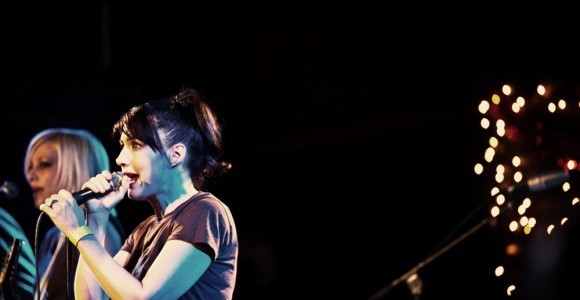
Kathleen Hanna gets her message out with Bikini Kill, Le Tigre, and the Julie Ruin
Anderson weaves in plenty of music clips that display Hanna’s powerful stage presence, including snippets of such songs as “Rebel Girl,” “White Boy,” “Distinct Complicity,” “Hot Topic,” “Deceptacon,” and “Aerobicide” from Bikini Kill, Le Tigre, and the Julie Ruin. The Punk Singer is a gripping portrait of a fearless, talented woman who continues to do whatever it takes to get her message out. “What is the story of my life?” Hanna says near the end. “I have no fucking idea.” But now, thanks to Anderson, we do, even if that story is still being written. The Punk Singer is having its New York City premiere November 15 at 9:45 at the SVA Theatre as part of the “Sonic Cinema” section of this year’s DOC NYC festival, with Hanna on hand to talk about the film. DOC NYC, which seeks to “curate [by] guiding audiences toward inspiring work,” runs November 14-21 at the IFC Center and the SVA Theatre; among the other “Sonic Cinema” selections are Rodrigo H. Vila’s Mercedes Sosa: Voice of Latin America, Trevor Laurence and Simeon Hutner’s Harlem Street Singer, Joe Angio’s Revenge of the Mekons, and Jeremy Xido’s Death Metal Angola.
DOC NYC: REVENGE OF THE MEKONS
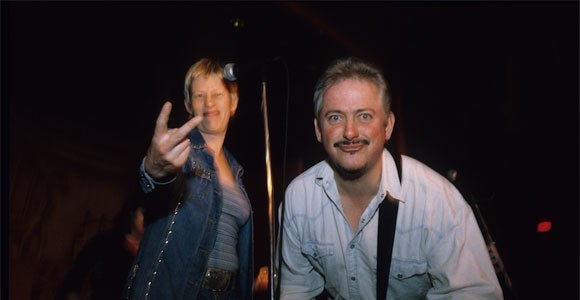
Sally Timms and Jon Langford fight the curse of the Mekons in stirring documentary
SONIC CINEMA: REVENGE OF THE MEKONS (Joe Angio, 2013)
SVA Theatre
333 West 23rd St. between Eighth & Ninth Aves.
Friday, November 15, 9:45
Festival runs November 14-21
212-924-7771
www.mekonsmovie.com
www.docnyc.net
 Called “the most revolutionary group in the history of rock ‘n’ roll” by Lester Bangs, the Mekons have been making some of the best music on the planet for more than thirty-five years. But despite a rabid fan base and constant critical adoration, the band, which formed at the University of Leeds back in 1977, has never quite made the big time. Joe Angio captures the wild, DIY spirit of this unique music and art collective in the stirring documentary Revenge of the Mekons. Angio (How to Eat Your Watermelon in White Company [and Enjoy It]) follows the self-deprecating band — the members of which are quick to joke about their lack of financial and popular success, especially when they’re onstage and learn from fans that an upcoming gig has been canceled — as they celebrate their thirtieth anniversary and record their most recent excellent album, Ancient and Modern. Angio talks with the current Mekons lineup, which includes cofounders Tom Greenhalgh and Jon Langford along with Susie Honeyman, Rico Bell, Lu Edmonds, Sarah Corina, Steve Goulding, and Sally Timms, as well as such former members as Kevin Lycett, Mark “Chalkie” White, Andy Corrigan, and Dick Taylor, as they recount the band’s rollicking history, beginning with its Leeds days as a socialist punk band battling over shows with Gang of Four through its mid-1980s transformation into alt-country folk rockers.
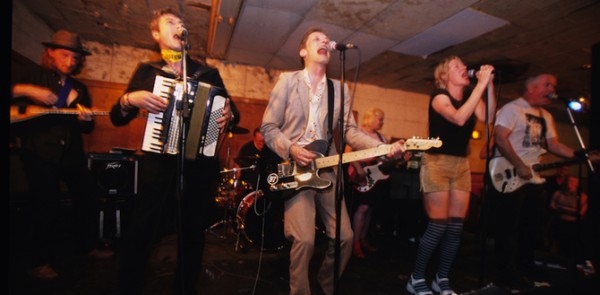
Mekons doc is one helluva wild and crazy ride, just like their long career
Angio mixes in amazing raw footage from the 1970s with more contemporary scenes as the Mekons, with their usual reckless abandon and utter joyfulness, play such songs as “Where Were You,” “The Hope and the Anchor,” “Ghosts of American Astronauts,” “Millionaire,” “Hello Cruel World,” “Hard to Be Human,” “Memphis, Egypt,” and “The Curse.” Sharing their love of all things Mekons are such wide-ranging pundits as Jonathan Franzen, Greil Marcus, Gang of Four’s Hugo Burnham and Andy Gill, Will Oldham, Greg Kot, Craig Finn, Luc Sante, Mary Harron, and performance artist Vito Acconci. Back in October 2011, we wrote that “a world that includes the Mekons is just a better place for everyone,” and that still holds true. So start by watching this wonderfully crazy documentary, about a group of crazy characters who have formed a crazy kind of family, then go out and pick up such seminal records as Fear and Whiskey, The Mekons Honky Tonkin’, So Good It Hurts, The Mekons Rock‘n’Roll, Natural, Ancient Modern, etc., and be sure to catch them live when they come anywhere near your town. Revenge of the Mekons is having its world premiere November 15 at 9:45 at the SVA Theatre as part of the “Sonic Cinema” section of this year’s DOC NYC festival, with Angio, Langford, Timms, Bell, and Goulding on hand to talk about the film. DOC NYC, which seeks to “cultivate new audiences [by] attracting newcomers with the excitement of a festival atmosphere,” runs November 14-21 at the IFC Center and the SVA Theatre; among the other “Sonic Cinema” selections are Rodrigo H. Vila’s Mercedes Sosa: Voice of Latin America, Trevor Laurence and Simeon Hutner’s Harlem Street Singer, and Jeremy Xido’s Death Metal Angola.
VIDEO OF THE DAY: “FIRE” BY ANNA CALVI
On December 23, sultry British-Italian singer Anna Calvi will release the single “Suddenly” from her sophomore album, One Breath (Domino, October 2013), backed by a cover of Bruce Springsteen’s “Fire.” But you don’t have to wait till Christmastime to hear the Bruce cover, as you can check out her recent solo performance of the song above, and maybe she’ll play it when she appears November 11 at the Music Hall of Williamsburg with DC duo GEMS. On the new record, the classically trained, London-born Calvi melds together wide-ranging genres to create a haunting cinematic atmosphere on such tracks as “Suddenly,” “Eliza,” and “Sing to Me.” “I’ve got one / one breath to give / I’ve got one / one second to live / before I say / what I’ve got to say / before I breathe / It’s gonna change everything,” Calvi seductively whispers on the title track, while on the emotionally powerful “Cry” she cuts loose ever so briefly with her intense, unique guitar style. The Brooklyn show is only one of three in America (Los Angeles and San Francisco are the other two) before Calvi heads out to France, Spain, Portugal, Ireland, Germany, Switzerland, Italy, Scandinavia, Slovenia, and other European destinations. You can get another taste of Calvi in a recent concert streaming here.