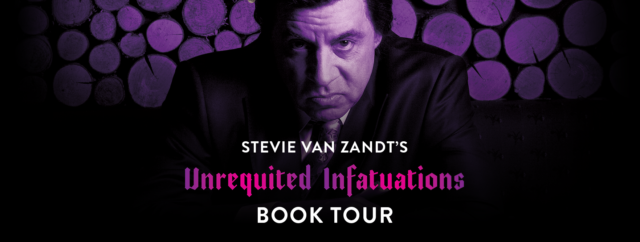
Who:Stevie Van Zandt, Bruce Springsteen, Jay Cocks, Joel Selvin, Chris Columbus, Budd Mishkin What: Interviews with Stevie Van Zandt in conjunction with the launch of his new memoir, Unrequited Infatuations (Hachette, $31) Where: Multiple sites online and in person When: September 28 – October 3, $5-$100 Why: “Silence. He was under a blanket in the back of the car on the floor in the crazy spooky silence. Nobody spoke. No radio. Just the lazy hum of the motor, and him alone with his thoughts. And ooh daddio, that was not his favorite thing. His two coconspirators were sneaking him past the military blockade into the black township of Soweto. The ‘native unrest,’ as the government liked to call it, erupted every few years, but lately it had become more frequent, and now, constant.” So begins Stevie Van Zandt’s new memoir, Unrequited Infatuations: Odyssey of a Rock and Roll Consigliere (A Cautionary Tale), as he writes in the third person about his secret trip into South Africa in 1984. “How the fuck did a half-a-hippie guitar player get here? For seven glorious years, Bruce Springsteen and the E Street Band were Rock and Roll’s Rat Pack, and he happily and naturally played the Dean Martin role. If you were even thinking of throwing a party, you called him. That was the extent of his politics. He was the fun guy. The court jester. Always good for a laugh. Sex, booze, drugs, Rock and Roll, and . . . more sex. Yo bartender, another round for the house! A whole lot had to go sideways to find him under that blanket. . . . He chose to take the adventure instead of the money. What a putz.” Among the chapters in the book are “Epiphany,” “The Boss of All Bosses,” “The Punk Meets the Godfather,” “Freedom — No Compromise,” “Seven Years in the Desert,” and “Summer of Sorcery.”
Alternately known as Miami Steve, Little Steven, and Stevie for the last fifty years, Van Zandt is now detailing his unique life and career in the book, which launches this week with a series of in-person and online events. The memoir takes readers from the Jersey Shore to Sun City, from South Africa and Hollywood to Norway and the Super Bowl. A longtime member of the E Street Band and a ferocious political activist, Van Zandt also starred as Silvio Dante in The Sopranos — a role he helped create after HBO said no to him as Tony — wrote and produced songs for Southside Johnny and the Asbury Jukes, has been hosting the nationally syndicated radio show Little Steven’s Underground Garage since 2002, started Wicked Cool Records, played the lead in the Norwegian crime drama Lilyhammer, founded the nonprofit TeachRock to promote music education in schools, records and tours with his own band, Little Steven and the Disciples of Soul, and is the founder of Renegade Nation, the umbrella company for many of his wide-ranging pursuits. I’ve had the privilege of meeting him several times over the years, interviewing him, and seeing him play live with the E Street Band and with the Disciples going back to the 1970s and ’80s, and he has never failed to impress as a performer and a straight-shooting human being.
There are five programs being held in conjunction with the publication of Unrequited Infatuations, pairing him with film critic and screenwriter Jay Cocks, music critic and author Joel Selvin, director and screenwriter Chris Columbus, broadcast journalist Budd Mishkin — oh, and Stevie’s boss and best friend, Bruce Springsteen. Below is the full schedule; take note of which events come with a copy of the book, in some cases pre-signed as well.
Tuesday, September 28
Stevie in conversation with Bruce Springsteen, $35 with unsigned book, $45 with signed book, 8:00
Wednesday, September 29
Stevie in conversation with Jay Cocks, online and at the 92nd St. Y, $20 online, $35 in person with book, 7:30
Thursday, September 30
Stevie in conversation with Joel Selvin, Commonwealth Club online, $5 general admission, $35 with book, 8:00
Friday, October 1
Stevie in conversation with Chris Columbus, Book Soup at the Colburn Music School, $40 with book, 7:00
Sunday, October 3
Stevie in conversation with Budd Mishkin, Montclair Literary Festival, $40 with signed book, $100 with signed book and VIP seating, 5:00
Boston-based activist opera company White Snake Projects concludes its inspiring, barrier-breaking livestreamed opera trilogy with A Survivor’s Odyssey: The Journey of Penelope and Circe, which opened on September 24 and has two more presentations, on September 26 and 28 at 7:30. In October 2020, WSP debuted Alice in the Pandemic, which took place in a video-game-like world as Alice searches for her mother while a hospital fills up with Covid-19 patients. In May 2021, WSP premiered Death by Life: A Digital Opera in One Act, following the stories of several incarcerated individuals facing racism and injustice, with music by five Black composers and accompanied by an online art exhibition.
WSP reinterprets Greek mythology and Homer’s Odyssey in A Survivor’s Odyssey: The Journey of Penelope and Circe, reimagining Odysseus’s (James Demler) long-suffering wife, Penelope (Amanda Crider), and the witch-goddess Circe (Teresa Castillo) as survivors of sexual and physical abuse. The show begins with the two women, along with two men, Mark and Jan (Patrick Dailey and James Demler), in an online therapy group helping one another. “Is he still hurting you?” Circe asks Penelope, who replies, “It’s hard being locked down with him.”
Penelope has been weaving and unraveling a shroud to turn away suitors as she waits for her husband to return to her after twenty years away fighting the Trojan War; she is also hoping for her son, Telemachus (Dailey), to come home, having been banished by his father, who believes a prophecy that says he will be killed by his male child. Meanwhile, Circe is terrified of telling her sixteen-year-old boy, Telegonus (Dailey), her “dirty little secret” about his birth. When Odysseus ultimately returns, battle lines are drawn and blood flows.
White Snake Projects incorporates magic and cutting-edge technology in livestreamed opera
Made with the support of the Boston Area Rape Crisis Center, Casa Myrna, Asian Task Force Against Domestic Violence, the Network/La Red, a Call to Men, a Window Between Worlds, and Jane Doe Inc., A Survivor’s Odyssey is a riveting tale reinvented for the twenty-first century and particularly during the coronavirus crisis, responding to the rise in intimate partner violence (IPV) that has been occurring around the globe during the pandemic lockdown. “I’ve been thinking about why IPV is endemic in the world. I keep coming back to the male gaze, the power of the patriarchy to shape every country’s and every culture’s perceptions of who and what women are,” librettist and WSP founder Cerise Lim Jacobs writes in a program note. “Women, myself included, have been imprisoned by the male gaze. Our aspirations, hopes, and dreams have been limited by this gaze; our fears, insecurities, and nightmares magnified by this gaze. The male gaze has defined our world’s ideas, imaginations, cultures, and subconscious dreams of womanhood. . . . This has to stop.” The women characters ultimately take back the power in A Survivor’s Odyssey, refusing to allow the patriarchy to run roughshod over them anymore. Composer Mary Prescott’s lovely score was inspired by the idea of weaving, long considered women’s work, to create a tapestry of sounds, linking the past and the present and denouncing misogyny.
Despite their far-flung locations, soprano Castillo (in New York City), countertenor Dailey (in Nashville), mezzo-soprano Crider (in Miami), and bass-baritone Demler (outside Boston) pull off the near-impossible, appearing to be performing together in front of such backdrops as Helios’s lush garden, Circe’s mountain home on Aeaea, and the courtyard of Odysseus and Penelope’s grand estate in Ancient Greece when actually in front of green screens in their bedrooms and basements. Elena Araoz, who has never met her cast in person, directs the piece virtually, with music direction by Tian Hui Ng featuring the Victory Players, with Nathan Ben-Yehuda on piano, Clare Monfredo on cello, Giovanni Perez on flute, and Elly Toyoda on violin and viola. The costumes are by Christopher Vergara, with playful 3D animation of the pigs by Lesley University senior Paola Almonte. An online exhibition also accompanies this production, “To Live: Transcending Trauma Through Art,” with works by Carole Alden, Taecia Prows, Cedar Annenkovna, Zhi Kai Vanderford, Ruby Rumié, Annie Chang, Catriona Baker, and Tashi Farmilo-Marouf.
The performers have earpieces in which they can hear a recording of the others singing; the live vocals are sent to electronic music designer and audio engineer Jon Robertson (in Kansas City) and the video to projections designer and broadcast engineer Paul Deziel (in New York), who mix the sound and images using the Unreal Engine video game platform by Curvin Huber and their proprietary audio plugin Tutti Remote to instantaneously sync it all. It’s a massive undertaking, and there were a few glitches and delays, but don’t go anywhere if that happens; the live chat fills the gaps and offers more information about the cast, crew, and technology. After the show’s over, stick around for a live discussion and Q&A that answers just about every question you can think of.
One of the main themes of A Survivor’s Odyssey is the lost connection that the pandemic has wrought, between friends, family members, and performers and audience. At one point during a Zoom therapy meeting, the participants reach out their hands, proclaiming, “I touch you, I hold you, I feel you.” In its remarkable trilogy of live online opera, WPS reaches out to us, immersing us in their spectacularly creative storytelling, and we feel them.
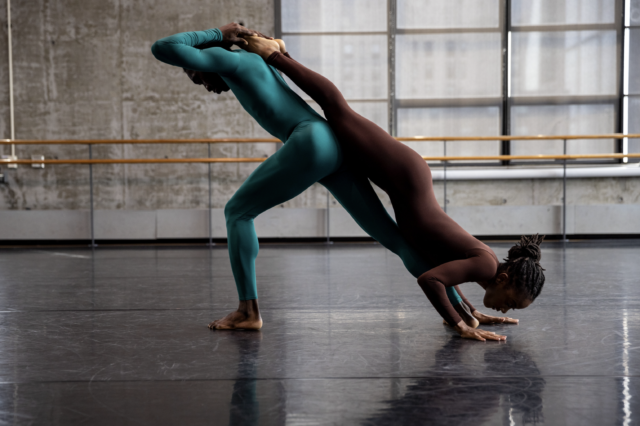
Jacquelin Harris and Chalvar Monteiro perform excerpts from Merce Cunningham’s Landrover in online celebration (photo by Maria Baranova)
Who: Jacquelin Harris and Chalvar Monteiro, Mariah Anton and Cemiyon Barber, Claude “CJ” Johnson and Donovan Reed, Patricia Lent, Kyle Abraham, Liz Gerring What: Celebration of Merce Cunningham’s Landrover Where:Baryshnikov Arts Center online When: September 20-30, free Why: In honor of the upcoming fiftieth anniversary of Merce Cunningham’s Landrover, which premiered at BAM on February 1, 1972, the Baryshnikov Arts Center is presenting the free online program “In Conversation with Merce,” available on demand through September 30 at 5:00. The work, described by Cunningham as “people moving in different landscapes. American perhaps in the sense that we move in our country — across varied spaces — with varied backgrounds,” featured an original score by John Cage, David Tudor, and Gordon Mumma, boasted costumes by Jasper Johns, and was performed by Carolyn Brown, Ulysses Dove, Douglas Dunn, Meg Harper, Nanette Hassall, Susana Hayman-Chaffey, Chris Komar, Sandra Neels, Chase Robinson, Valda Setterfield, and Cunningham.
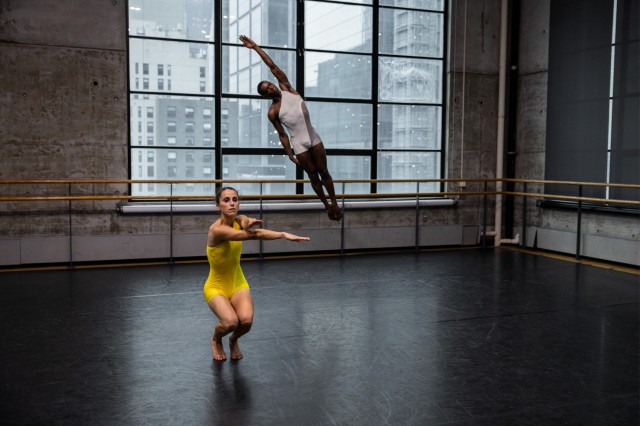
Mariah Anton and Cemiyon Barber perform in Liz Gerring’s Dialogue as part of BAC’s Merce tribute (photo by Maria Baranova)
“This program is the latest realization of a concept we began experimenting with during Merce Cunningham’s centennial,” Merce Cunningham Trust trustee Patricia Lent says in an introduction. “At its core is the idea of exploring Merce’s work as a resource for generating new work by contemporary artists.” Beautifully filmed by Tatyana Tenenbaum at BAC’s John Cage & Merce Cunningham Studio, “In Conversation with Merce” starts with a thirteen-minute excerpt of Landrover, a series of solos performed by Alvin Ailey American Dance Theater members Chalvar Monteiro in green and Jacquelin Harris in brown, moving about the spare space dominated by large windows and a mirrored wall, as the music fades to silence. (The lovely costumes for all three pieces are by Reid Bartelme and Harriet Jung.)
That is followed by two specially commissioned works made in response to Landrover, each introduced by the choreographer, beginning with Liz Gerring’s nine-minute Dialogue, in which Mariah Anton in yellow and Cemiyon Barber in white display numerous geometric possibilities of the human body, set to minimalist music by Michael Schumacher. “In Conversation” concludes with Kyle Abraham’s fourteen-minute MotorRover, a slow, intimate duet performed by Claude “CJ” Johnson and Donovan Reed in loose-fitting two-color costumes, the only sound that of the air-conditioning. BAC has presented a bevy of terrific filmed programs during the pandemic, and this is yet another winner; coming up next are digital works by Mats Ek and Ana Laguna, River L. Ramirez, Sooraj Subramaniam, Jordan Demetrius Lloyd, Ella Rothschild, and Molly Lieber and Eleanor Smith.
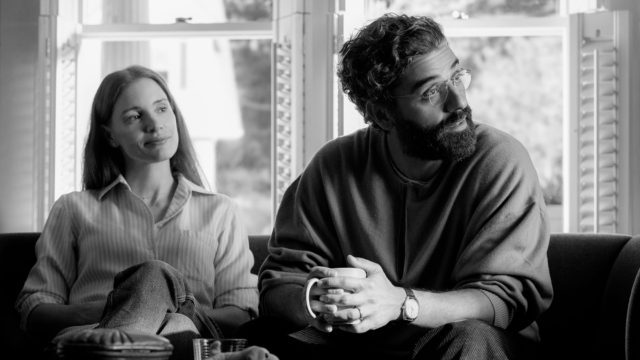
Jessica Chastain and Oscar Isaac will talk about their new HBO series at New Yorker Festival
Who: Jessica Chastain, Oscar Isaac, Dave Grohl, Aimee Mann, Stanley Tucci, Jelani Cobb, Siddhartha Mukherjee, Jonathan Franzen, Tara Westover, Liza Donnelly, Roz Chast, Viet Thanh Nguyen, Jane Goodall, Andy Borowitz, Beanie Feldstein, Jayne Houdyshell, Richard Jenkins, more What: Hybrid New Yorker Festival Where:Skyline Drive-In, 1 Oak St. in Brooklyn, and online When: October 4-10, free – $180, virtual all-access pass $59 Why: Tickets for the in-person outdoor events at this year’s New Yorker Festival go on sale September 14 at noon, along with the specially curated culinary meals, which will be delivered to your door (as long as you live in New York City). Among those appearing live at the Skyline Drive-In on the Brooklyn waterfront are Aimee Mann and Dave Grohl (separately), who will talk and sing, as well as Jessica Chastain and Oscar Isaac, who will discuss their new HBO series, Scenes from a Marriage, and Beanie Feldstein, Jayne Houdyshell, and Richard Jenkins, who will screen and discuss their new film, Stephen Karam’s The Humans, an adaptation of his hit play. The virtual programs, featuring Jane Goodall, Stanley Tucci, Emily Ratajkowski, Amy Schumer, Jonathan Franzen, Tara Westover, Roz Chast, and others, will be available September 20, including an all-access pass for $59. As always, you can expect tickets to go fast, especially for the free events and the food deliveries. Below is the full schedule.
Monday, October 4 Dining In with the New Yorker Festival: Yellow Rose, three-course vegan menu delivered, with on-demand access to Helen Rosner’s interview with the chefs, Dave and Krystiana Rizo, $50
Tuesday, October 5 Dining In with the New Yorker Festival: Dacha 46, three-course vegetarian meal delivered, with on-demand access to Helen Rosner’s interview with the chefs, Jessica and Trina Quinn, $50
Wednesday, October 6 Dining In with the New Yorker Festival: Reverence, three-course vegetarian meal delivered, with on-demand access to Helen Rosner’s interview with the chef, Russell Jackson, $50
Thursday, October 7 Dining In with the New Yorker Festival: Kimika, three-course meal delivered, with on-demand access to Helen Rosner’s interview with the chef, Christine Lau, $50
Friday, October 8
Jessica Chastain, Oscar Isaac, and Hagai Levi talk with Esther Perel about Scenes from a Marriage, free, 6:30
Dave Grohl talks with Kelefa Sanneh about his upcoming memoir and performs, $90-$180, 9:00
Saturday, October 9
Aimee Mann talks with Atul Gawande and performs, $60-$120, 6:30
Drive-In: The Humans, preview screening of Stephen Karam’s debut film, followed by a conversation with Karam, Beanie Feldstein, Jayne Houdyshell, and Richard Jenkins, moderated by Michael Schulman, $25-$50, 9:00
Liza Donnelly, Roz Chast, Liana Finck, and Amy Hwang will celebrate the history of women cartoonists at the New Yorker at virtual event (illustration by Liana Finck)
Virtual Events, available September 20
Jane Goodall talks with Andy Borowitz
The Matter of Black Lives, with Chimamanda Ngozi Adichie, Charlayne Hunter-Gault, and Jamaica Kincaid, moderated by Jelani Cobb
Stanley Tucci talks with Helen Rosner about his TV series and his new book, Taste: My Life Through Food
Politics and the Novel, with Yiyun Li, Valeria Luiselli, and Viet Thanh Nguyen, moderated by Parul Sehgal
Emily Ratajkowski and Amy Schumer talk with Michael Schulman
Globalism’s Legacy, with Esther Duflo, Siddhartha Mukherjee, and Anne-Marie Slaughter, moderated by Evan Osnos
Jonathan Franzen and Tara Westover talk with Henry Finder
Some Very Funny Ladies, with Liza Donnelly, Roz Chast, Liana Finck, and Amy Hwang, celebrating the history of women cartoonists at the New Yorker, moderated by Emma Allen, free
Rachel Cusk and Patricia Lockwood talk with Deborah Treisman
How to Accelerate Climate Action, with Katharine Hayhoe, Bill Ulfelder, and Allegra Kirkland, free
Rich Little will shares his impressions of his life and career in free National Arts Club talk
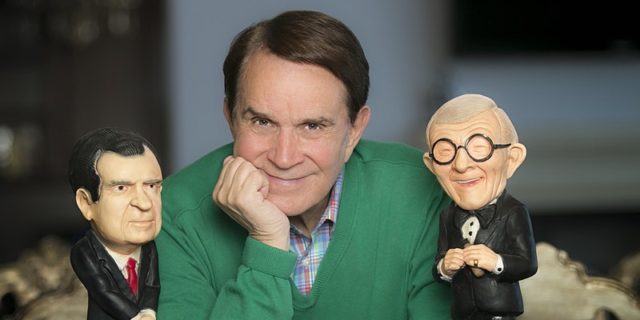
Who:Rich Little What: Livestreamed conversation Where:National Arts Club online When: Wednesday, September 15, free with RSVP, 6:00 Why: “How did I become an impersonator? Perhaps my mother was conceived by a Xerox machine!” Rich Little writes in his 2016 book, People I’ve Known and Been: Little by Little. In conjunction with the rerelease of the book and the November premiere of his new autobiographical one-man show, Rich Little Live, at the Laugh Factory at the Tropicana in Las Vegas, the Canadian-born comedian, who became a US citizen in 2010, will discuss his life and career in a livestreamed National Arts Club discussion on September 15 at 6:00. Little will talk about his many impressions, which famously include presidents (John F. Kennedy, Lyndon Johnson, Richard Nixon, Gerald Ford, Jimmy Carter, Ronald Reagan, Bill Clinton, both George Bushes, and Barack Obama), movie stars (Jimmy Stewart, Jack Lemmon, John Wayne, Humphrey Bogart, Arnold Schwarzenegger, Sylvester Stallone, Jack Nicholson, and Clint Eastwood), and pop-culture figures (George Burns, Paul Lynde, Kermit the Frog, Andy Rooney, and Dr. Phil); go behind the scenes of his recent off-Broadway debut playing Nixon in Trial on the Potomac: The Impeachment of Richard Nixon at Theatre at St. Clements; and share show business anecdotes. Admission is free with advance RSVP.
GREGG BORDOWITZ: I WANNA BE WELL
MoMA PS1
22-25 Jackson Ave., Queens
Virtual performance lectures September 17-19, free with advance RSVP
Exhibition continues Thursday – Monday through October 11, $5-$10 (free for NYC residents) www.moma.org www.greggbordowitz.com
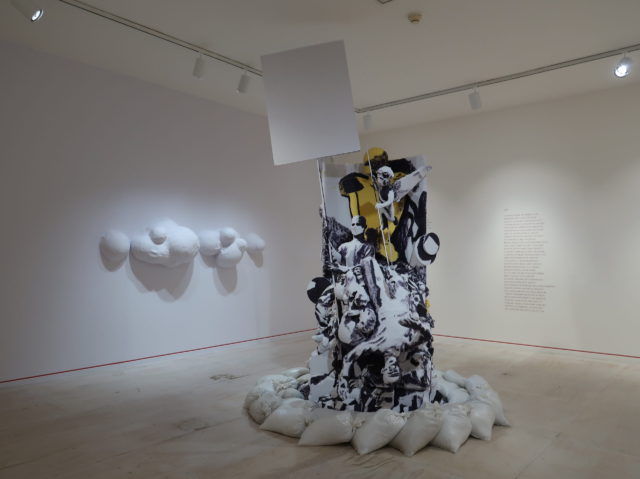
At the heart of the MoMA PS1 exhibition “Gregg Bordowitz: I Wanna Be Well” are two disparate images. On your way into the building itself and in the gallery, you will see a large banner declaring, “The AIDS Crisis Is Still Beginning.” Meanwhile, at the top of Bordowitz’s 2021 mixed-media sculpture Pestsäule (after Erwin Thorn), inspired by a seventeenth-century plague monument in Vienna as well as the murder of George Floyd, the AIDS epidemic, and the Covid-19 pandemic, is a blank protest sign, raised up by a man in a medical mask surrounded by a maelstrom of bodies, a murderous cherub, and sandbags on the floor, like a warped scene from Les Miz. “Hey Johnny, what are you rebelling against?” Mildred (Peggy Maley) asks Johnny (Marlon Brando) in the 1954 film The Wild One. “Whadda you got?” Johnny replies.
Born in Brooklyn in 1964 and raised in Queens — home base for the Ramones, whose 1977 song “I Wanna Be Well” from the Rocket to Russia album gives the exhibit its name — Bordowitz, who has been living with HIV/AIDS for more than three decades, was an early member of ACT UP (AIDS Coalition to Unleash Power), which was founded in 1987. He has been documenting his own life and the global AIDS crisis through film and video, poetry, sculpture, lectures, and poetry, much of which is on view at MoMA PS1 through October 11. His 2014 twenty-four-part poem Debris Fields lines the walls of the galleries, amid such works as self-portraits in mirror, Tom McKitterick’s black-and-white photographs of Bordowitz and others at AIDS protests in the late 1980s, the corner wall drawing and sculpture installation Kaisergruft (centered by the word Sympathy), and Drive, a repurposed vintage derby car stickered with Big Pharma logos.
The show also features several of Bordowitz’s films, including the 1993 autobiographical documentary Fast Trip, Long Drop, which deals with his contracting HIV, coming out to his parents, a friend getting breast cancer, and the tragic deaths of his grandparents; the 2001 documentary Habit, about the AIDS epidemic in South Africa; the five-minute The Fast That I Want video he made last year with Morgan Bassichis for his family’s virtual Yom Kippur; and the vastly entertaining Only Idiots Smile, a 2017 lecture commissioned for the New Museum presentation “Trigger: Gender as a Tool and a Weapon” and that, at only twenty-two minutes, is far too short as Bordowitz discusses his relationship with his father, Judaism, Eastern European men kissing on the lips, and homophobia.
You can see much more of Bordowitz this week when MoMA hosts several special events held in conjunction with “I Wanna Be Well.” On September 13 (and available on demand through September 27, for members only), “Modern Mondays: An Evening with Gregg Bordowitz and Jean Carlomusto” consists of a live discussion between the longtime friends, artists, collaborators, and activists, along with videos they made in the late 1980s for the Gay Men’s Health Crisis in New York City. From September 14 to 28, MoMA Film will stream Bordowitz’s 1996 reimagination of Nicolai Erdman’s 1932 long-banned play The Suicide, also for members only.
From September 17 to 19, Benyamin Zev’s Succos Spectacular! comprises a trio of livestreamed performances, free with advance RSVP, specifically taking place after Rosh Hashanah (the Jewish New Year), the ten Days of Awe (meditation and reflection), and Yom Kippur (the Day of Atonement) and before Sukkot (the Harvest Festival and the Feast of Tabernacles). The three shows — “The Rock Star” on Friday at 7:00, “The Rabbi” on Saturday at 7:00, and “The Comedian” on Sunday at 4:00 — feature Bordowitz as his alter ego, Benyamin Zev (his Hebrew name), a Jewish entertainer, stand-up comic, and tummler, hanging out in a Sukkah, joined by special guests and the klezmer ensemble Isle of Klezbos. “Any laughter is purely accidental,” Bordowitz says on the MoMA website. “My performances disturb, upset, and resist the pressures to conform and align genders and ethnicities within a fascist phantasy of American nationalism.” And finally, on October 2 at 5:00, in person and online, Bordowitz will launch his new book from Triple Canopy, Some Styles of Masculinity, at the Artbook @ MoMA PS1 Bookstore, where he will speak with poet, professor, and cultural theorist Fred Moten.
Seth David Radwell discusses American Schism with Tucker Carlson
AMERICAN SCHISM: HEALING A DIVIDED NATION
Smithsonian Associates lecture
Monday, September 13, $25, 6:45 www.si.edu americanschismbook.com
During the pandemic, I had a regular Zoom happy hour with a group of longtime friends going back to nursery school and grade school. Our politics were all similar, so we avoided fights about Trump, Fauci, the Supreme Court et al. One of our regulars was Seth David Radwell, who, following a successful business career that has included being the head of e-Scholastic and Bookspan and president and CEO of direct-to-consumer company Guthy-Renker, was so disturbed by the state of political discourse across the nation that he wrote a book about it.
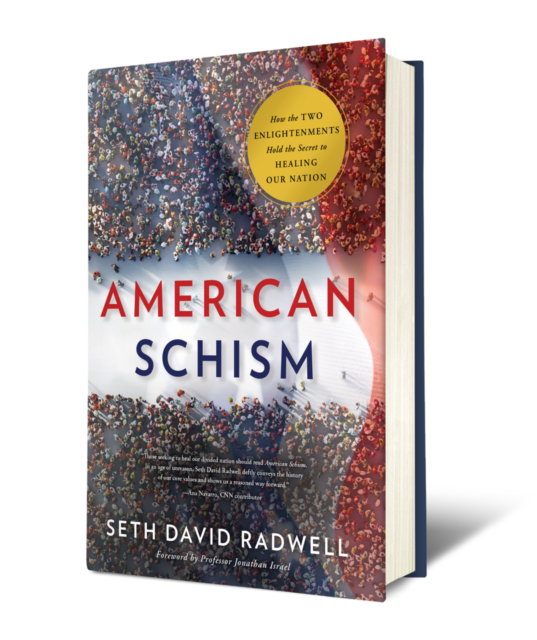
American Schism: How the Two Enlightenments Hold the Secret to Healing Our Nation (Greenleaf, June 29, $25.95) examines our current partisan situation, and inability to talk to one another about virtually anything without it becoming political, through the lens of the two Enlightenments of the eighteenth century, the Radical and the Moderate. Radwell is on a furious book tour, making appearances on numerous podcasts and online interview shows. On September 13 at 6:45, he will deliver a lecture, “American Schism: Healing a Divided Nation,” as part of the Smithsonian Associates streaming series.
Radwell writes in the prologue of his book, “As I hunkered down at home to weather the global COVID-19 pandemic of 2020, I struggled to overcome the sense of shock at how suddenly and utterly our world had been turned upside down. But as I contemplated my state of mind, oscillating rapidly between depression, anxiety, and frustration, I sensed that well before the onslaught of the pandemic I had already fallen into a profound state of disillusionment. As the world came to a halt, the health crisis simply gave me the time and space to realize it. The root cause of this disillusionment was related to the shattering of an ideal image that I had, perhaps, clung on to for far too long.”
He continues, “How had it come to be that over the last four years my entire conception of the American credo had crumbled? My vision of America was firmly rooted in the ethos of both freedom and equality; my America was a place where everyone had a fair shot at building a rewarding and fulfilling life, where each individual could define their own idiosyncratic version of success, and where we collectively formed a country of shared values with mutual respect for individual differences. That vision felt unambiguously inconsistent with the America of 2020. Just how and when did my America disappear? Did my vision of America ever exist at all, or was it but a myth? If it did exist, how did it disintegrate so quickly in just a few years? Or was its ruin a slow process of decay that began undetected (by me) much earlier? I was determined to explore these questions, to understand the origins of my disillusionment.”
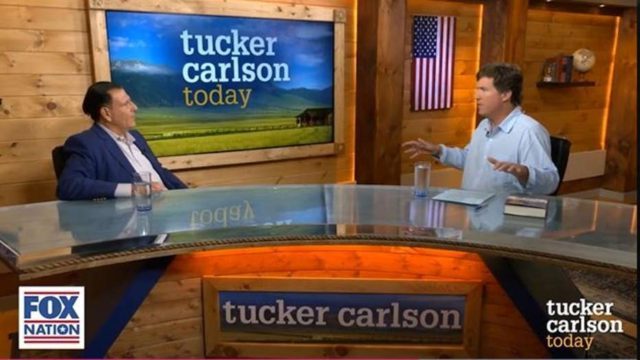
Radwell not only searches out the causes but provides answers for how we can move forward together. One of his themes is getting the two Americas to talk to each other in a reasonable manner. He brought this plan into reality recently when he sat down for a long-form interview on Tucker Carlson Today, for which some of his readers chastised him. “I received an onslaught of feedback related to my appearance on Tucker Carlson Daily on Fox Nation and the clip shown on his evening cable show,” he wrote in an email blast to his subscribers. “Some chided me for appearing on Fox since the station has a ‘track record of misinformation and propaganda masquerading as news,’ as one person wrote me. Others congratulated me for having the ‘courage’ to appear on such a venue.” The divide is everywhere.
Amid a flurry of interviews and his preparation for the Smithsonian lecture, Radwell took the time to answer questions about the Counter-Enlightenment, reason and unreason, top-down populism, Tucker Carlson, fine wine, and more.
twi-ny: You’ve been working on the book for several years; what effect did the pandemic lockdown have on your research and writing?
seth david radwell: It’s been about three years, although I had developed some of the ideas before that. I have been reading and researching the thesis actively starting in late 2018. I had much material in the form of notes up through 2019. But it was March 2020 when COVID first hit that I sat down and began writing every day in intense twelve-hour sessions. Since that time I have been working on it full-time.
twi-ny: In addition to discussing the two Enlightenments, you also delve into the Counter-Enlightenment, tracing it to the Second Great Awakening, the religious fervor of the first decades of the nineteenth century, as well as anti-elite and anti-intellectual sentiments. Would you characterize the American right’s embrace of Hungarian dictator Viktor Orbán, or Tucker Carlson’s recent encomium to the Taliban, as an expression of top-down populism (populist sentiments exploited by elite actors for their own ends), the Counter-Enlightenment, or something more ominous?
sdr: There is certainly a global trend toward autocracy characterized by “strongmen” who win some sort of election to gain legitimacy but then consolidate, usurp and abuse power, and begin curtailing the freedoms associated with an open liberal society. The American right has embraced this. One of the tools that most of these autocrats deploy, along with those associated with Trumpism, is the top-down populism described in the book.
At the same time, as I discuss in the book, populism is complex — there are many strains of it, often with both positive and negative characteristics. The top-down populism we are talking about here is an emotional appeal that plays on people’s fears of both the “other” (immigrants, African Americans, Latinos, etc.) as well as the elite establishment (who they perceive has ignored their concerns for too long). Autocratic politicians are hostile to elite institutions, and to expertise in general, and pronounce these feelings regularly to gain support and relate to their base. Because this later trend rejects expertise overall, it is also hostile to truth and data. That is the Counter-Enlightenment.
twi-ny: In the current political climate, do you have a recommendation for accommodating both Counter-Enlightenment forces as well as the Radical and Moderate Enlightenment thinkers, or must one be decisively excluded from power?
sdr: “Counter-Enlightenment forces” can be a confusing phrase. For example, most religious movements are based in faith and rely less on reason. So these are Counter-Enlightenment forces that are very much involved in the lives of most Americans. But our republic was founded on the premise that these domains should be kept outside the civic arena — with a firm separation of church from state. This has been frequently violated in our history — as one example, Billy Graham was quite close and influential to many presidents.
twi-ny: In researching and writing the book, did you reconsider a specific political belief you have held?
sdr: Yes, I had always considered myself fairly left leaning, but I began to appreciate aspects of conservative/libertarian philosophy more thoroughly.
twi-ny: How did your business experience help you when marketing the book?
sdr: Well, there is no question that my marketing expertise has played a role. But most ventures I led professionally (i.e., Proactiv) were multimillion-dollar brands with huge advertising budgets. My marketing of the book has been mostly guerrilla tactics and “hand selling” that I am doing personally as a labor of love.
twi-ny: As part of that hand selling, you’ve been interviewed on many podcasts, in lieu of in-person readings and signings. Were you a podcast listener prior to the pandemic? If so, what are some of your favorites?
sdr: Yes, I love podcasts, mostly of the NPR variety — I was a religious listener to Ezra Klein on VOX Media.
twi-ny: You recently appeared on Tucker Carlson Today and managed to have a productive and engaging discussion. What was that experience like?
sdr: He was extremely generous, thoughtful, and open to the ideas in the book. Quite a different persona than his cable “news” show at night.
twi-ny: Did meeting him in that way change any feelings you previously might have had about him?
sdr: He is very intelligent and deeply appreciative of the ideas in American Schism. His on-air celebrity status is an entirely different matter.
twi-ny: On September 13 at 6:45, you will be delivering the Smithsonian lecture “American Schism: Healing a Divided Nation.” What will you be concentrating on?
sdr: The session will summarize certain aspects of the book but will focus on the path forward out of this mess, delineating both structural changes and mindset changes that can begin the healing process.
twi-ny: Is America in as much trouble as it seems?
sdr: The fundamental change begins with taking back control of the debate from the extremes to the frustrated majority.
twi-ny: American Schism has been a great success, reaching #1 on Amazon. What were your initial goals in writing the book?
sdr: It has been doing well, but remember it has gone to #1 on Amazon in very niche categories, like rational philosophy and civics. In the broader areas such as comparative politics and political parties, it has often been a top-ten bestseller.
twi-ny: What’s your next step?
sdr: I would like to build a ground-up movement, which I call Fight Unreason with Reason, by sharing the ideas in the book with a larger audience. So I am hopeful the book will gain more momentum in the months forward. But we are off to a good start. My biggest hope is the viral marketing element — that readers who appreciate the ideas share them. For example, of the seventy-five reviews on Amazon, sixty-nine are five-star, so most readers like the book so far.
twi-ny: You’re a gourmand and wine connoisseur with a partner who knows his way around the kitchen. What is the latest amazing meal the two of you have had at home, and what wine did you have to go with it?
sdr: I am very lucky to have such an excellent cook as a partner. Tonight he is preparing roasted Cornish hens with braised vegetables. I will open a Grand Cru burgundy to pair, but I haven’t picked it yet.
twi-ny: You are also a big-time theater and opera fan. Have you been to any live indoor performances yet?
sdr: I have not yet been back to performances, with the exception of Tony Bennett and Lady Gaga at Radio City. I love opera and theater and I miss both terribly. But the positive is that without them, I have had more time to focus on the book.