GREGG BORDOWITZ: I WANNA BE WELL
MoMA PS1
22-25 Jackson Ave., Queens
Virtual performance lectures September 17-19, free with advance RSVP
Exhibition continues Thursday – Monday through October 11, $5-$10 (free for NYC residents) www.moma.org www.greggbordowitz.com
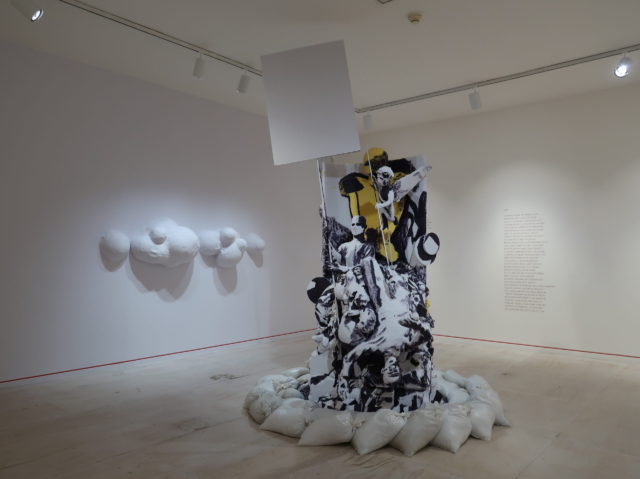
At the heart of the MoMA PS1 exhibition “Gregg Bordowitz: I Wanna Be Well” are two disparate images. On your way into the building itself and in the gallery, you will see a large banner declaring, “The AIDS Crisis Is Still Beginning.” Meanwhile, at the top of Bordowitz’s 2021 mixed-media sculpture Pestsäule (after Erwin Thorn), inspired by a seventeenth-century plague monument in Vienna as well as the murder of George Floyd, the AIDS epidemic, and the Covid-19 pandemic, is a blank protest sign, raised up by a man in a medical mask surrounded by a maelstrom of bodies, a murderous cherub, and sandbags on the floor, like a warped scene from Les Miz. “Hey Johnny, what are you rebelling against?” Mildred (Peggy Maley) asks Johnny (Marlon Brando) in the 1954 film The Wild One. “Whadda you got?” Johnny replies.
Born in Brooklyn in 1964 and raised in Queens — home base for the Ramones, whose 1977 song “I Wanna Be Well” from the Rocket to Russia album gives the exhibit its name — Bordowitz, who has been living with HIV/AIDS for more than three decades, was an early member of ACT UP (AIDS Coalition to Unleash Power), which was founded in 1987. He has been documenting his own life and the global AIDS crisis through film and video, poetry, sculpture, lectures, and poetry, much of which is on view at MoMA PS1 through October 11. His 2014 twenty-four-part poem Debris Fields lines the walls of the galleries, amid such works as self-portraits in mirror, Tom McKitterick’s black-and-white photographs of Bordowitz and others at AIDS protests in the late 1980s, the corner wall drawing and sculpture installation Kaisergruft (centered by the word Sympathy), and Drive, a repurposed vintage derby car stickered with Big Pharma logos.
The show also features several of Bordowitz’s films, including the 1993 autobiographical documentary Fast Trip, Long Drop, which deals with his contracting HIV, coming out to his parents, a friend getting breast cancer, and the tragic deaths of his grandparents; the 2001 documentary Habit, about the AIDS epidemic in South Africa; the five-minute The Fast That I Want video he made last year with Morgan Bassichis for his family’s virtual Yom Kippur; and the vastly entertaining Only Idiots Smile, a 2017 lecture commissioned for the New Museum presentation “Trigger: Gender as a Tool and a Weapon” and that, at only twenty-two minutes, is far too short as Bordowitz discusses his relationship with his father, Judaism, Eastern European men kissing on the lips, and homophobia.
You can see much more of Bordowitz this week when MoMA hosts several special events held in conjunction with “I Wanna Be Well.” On September 13 (and available on demand through September 27, for members only), “Modern Mondays: An Evening with Gregg Bordowitz and Jean Carlomusto” consists of a live discussion between the longtime friends, artists, collaborators, and activists, along with videos they made in the late 1980s for the Gay Men’s Health Crisis in New York City. From September 14 to 28, MoMA Film will stream Bordowitz’s 1996 reimagination of Nicolai Erdman’s 1932 long-banned play The Suicide, also for members only.
From September 17 to 19, Benyamin Zev’s Succos Spectacular! comprises a trio of livestreamed performances, free with advance RSVP, specifically taking place after Rosh Hashanah (the Jewish New Year), the ten Days of Awe (meditation and reflection), and Yom Kippur (the Day of Atonement) and before Sukkot (the Harvest Festival and the Feast of Tabernacles). The three shows — “The Rock Star” on Friday at 7:00, “The Rabbi” on Saturday at 7:00, and “The Comedian” on Sunday at 4:00 — feature Bordowitz as his alter ego, Benyamin Zev (his Hebrew name), a Jewish entertainer, stand-up comic, and tummler, hanging out in a Sukkah, joined by special guests and the klezmer ensemble Isle of Klezbos. “Any laughter is purely accidental,” Bordowitz says on the MoMA website. “My performances disturb, upset, and resist the pressures to conform and align genders and ethnicities within a fascist phantasy of American nationalism.” And finally, on October 2 at 5:00, in person and online, Bordowitz will launch his new book from Triple Canopy, Some Styles of Masculinity, at the Artbook @ MoMA PS1 Bookstore, where he will speak with poet, professor, and cultural theorist Fred Moten.
Seth David Radwell discusses American Schism with Tucker Carlson
AMERICAN SCHISM: HEALING A DIVIDED NATION
Smithsonian Associates lecture
Monday, September 13, $25, 6:45 www.si.edu americanschismbook.com
During the pandemic, I had a regular Zoom happy hour with a group of longtime friends going back to nursery school and grade school. Our politics were all similar, so we avoided fights about Trump, Fauci, the Supreme Court et al. One of our regulars was Seth David Radwell, who, following a successful business career that has included being the head of e-Scholastic and Bookspan and president and CEO of direct-to-consumer company Guthy-Renker, was so disturbed by the state of political discourse across the nation that he wrote a book about it.
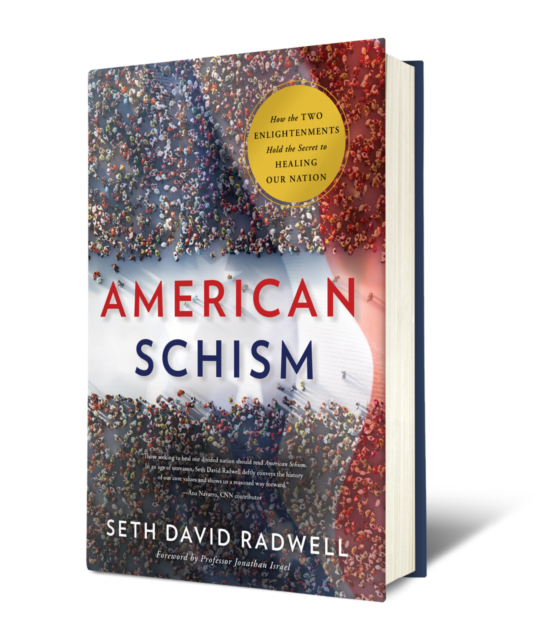
American Schism: How the Two Enlightenments Hold the Secret to Healing Our Nation (Greenleaf, June 29, $25.95) examines our current partisan situation, and inability to talk to one another about virtually anything without it becoming political, through the lens of the two Enlightenments of the eighteenth century, the Radical and the Moderate. Radwell is on a furious book tour, making appearances on numerous podcasts and online interview shows. On September 13 at 6:45, he will deliver a lecture, “American Schism: Healing a Divided Nation,” as part of the Smithsonian Associates streaming series.
Radwell writes in the prologue of his book, “As I hunkered down at home to weather the global COVID-19 pandemic of 2020, I struggled to overcome the sense of shock at how suddenly and utterly our world had been turned upside down. But as I contemplated my state of mind, oscillating rapidly between depression, anxiety, and frustration, I sensed that well before the onslaught of the pandemic I had already fallen into a profound state of disillusionment. As the world came to a halt, the health crisis simply gave me the time and space to realize it. The root cause of this disillusionment was related to the shattering of an ideal image that I had, perhaps, clung on to for far too long.”
He continues, “How had it come to be that over the last four years my entire conception of the American credo had crumbled? My vision of America was firmly rooted in the ethos of both freedom and equality; my America was a place where everyone had a fair shot at building a rewarding and fulfilling life, where each individual could define their own idiosyncratic version of success, and where we collectively formed a country of shared values with mutual respect for individual differences. That vision felt unambiguously inconsistent with the America of 2020. Just how and when did my America disappear? Did my vision of America ever exist at all, or was it but a myth? If it did exist, how did it disintegrate so quickly in just a few years? Or was its ruin a slow process of decay that began undetected (by me) much earlier? I was determined to explore these questions, to understand the origins of my disillusionment.”
Radwell not only searches out the causes but provides answers for how we can move forward together. One of his themes is getting the two Americas to talk to each other in a reasonable manner. He brought this plan into reality recently when he sat down for a long-form interview on Tucker Carlson Today, for which some of his readers chastised him. “I received an onslaught of feedback related to my appearance on Tucker Carlson Daily on Fox Nation and the clip shown on his evening cable show,” he wrote in an email blast to his subscribers. “Some chided me for appearing on Fox since the station has a ‘track record of misinformation and propaganda masquerading as news,’ as one person wrote me. Others congratulated me for having the ‘courage’ to appear on such a venue.” The divide is everywhere.
Amid a flurry of interviews and his preparation for the Smithsonian lecture, Radwell took the time to answer questions about the Counter-Enlightenment, reason and unreason, top-down populism, Tucker Carlson, fine wine, and more.
twi-ny: You’ve been working on the book for several years; what effect did the pandemic lockdown have on your research and writing?
seth david radwell: It’s been about three years, although I had developed some of the ideas before that. I have been reading and researching the thesis actively starting in late 2018. I had much material in the form of notes up through 2019. But it was March 2020 when COVID first hit that I sat down and began writing every day in intense twelve-hour sessions. Since that time I have been working on it full-time.
twi-ny: In addition to discussing the two Enlightenments, you also delve into the Counter-Enlightenment, tracing it to the Second Great Awakening, the religious fervor of the first decades of the nineteenth century, as well as anti-elite and anti-intellectual sentiments. Would you characterize the American right’s embrace of Hungarian dictator Viktor Orbán, or Tucker Carlson’s recent encomium to the Taliban, as an expression of top-down populism (populist sentiments exploited by elite actors for their own ends), the Counter-Enlightenment, or something more ominous?
sdr: There is certainly a global trend toward autocracy characterized by “strongmen” who win some sort of election to gain legitimacy but then consolidate, usurp and abuse power, and begin curtailing the freedoms associated with an open liberal society. The American right has embraced this. One of the tools that most of these autocrats deploy, along with those associated with Trumpism, is the top-down populism described in the book.
At the same time, as I discuss in the book, populism is complex — there are many strains of it, often with both positive and negative characteristics. The top-down populism we are talking about here is an emotional appeal that plays on people’s fears of both the “other” (immigrants, African Americans, Latinos, etc.) as well as the elite establishment (who they perceive has ignored their concerns for too long). Autocratic politicians are hostile to elite institutions, and to expertise in general, and pronounce these feelings regularly to gain support and relate to their base. Because this later trend rejects expertise overall, it is also hostile to truth and data. That is the Counter-Enlightenment.
twi-ny: In the current political climate, do you have a recommendation for accommodating both Counter-Enlightenment forces as well as the Radical and Moderate Enlightenment thinkers, or must one be decisively excluded from power?
sdr: “Counter-Enlightenment forces” can be a confusing phrase. For example, most religious movements are based in faith and rely less on reason. So these are Counter-Enlightenment forces that are very much involved in the lives of most Americans. But our republic was founded on the premise that these domains should be kept outside the civic arena — with a firm separation of church from state. This has been frequently violated in our history — as one example, Billy Graham was quite close and influential to many presidents.
twi-ny: In researching and writing the book, did you reconsider a specific political belief you have held?
sdr: Yes, I had always considered myself fairly left leaning, but I began to appreciate aspects of conservative/libertarian philosophy more thoroughly.
twi-ny: How did your business experience help you when marketing the book?
sdr: Well, there is no question that my marketing expertise has played a role. But most ventures I led professionally (i.e., Proactiv) were multimillion-dollar brands with huge advertising budgets. My marketing of the book has been mostly guerrilla tactics and “hand selling” that I am doing personally as a labor of love.
twi-ny: As part of that hand selling, you’ve been interviewed on many podcasts, in lieu of in-person readings and signings. Were you a podcast listener prior to the pandemic? If so, what are some of your favorites?
sdr: Yes, I love podcasts, mostly of the NPR variety — I was a religious listener to Ezra Klein on VOX Media.
twi-ny: You recently appeared on Tucker Carlson Today and managed to have a productive and engaging discussion. What was that experience like?
sdr: He was extremely generous, thoughtful, and open to the ideas in the book. Quite a different persona than his cable “news” show at night.
twi-ny: Did meeting him in that way change any feelings you previously might have had about him?
sdr: He is very intelligent and deeply appreciative of the ideas in American Schism. His on-air celebrity status is an entirely different matter.
twi-ny: On September 13 at 6:45, you will be delivering the Smithsonian lecture “American Schism: Healing a Divided Nation.” What will you be concentrating on?
sdr: The session will summarize certain aspects of the book but will focus on the path forward out of this mess, delineating both structural changes and mindset changes that can begin the healing process.
twi-ny: Is America in as much trouble as it seems?
sdr: The fundamental change begins with taking back control of the debate from the extremes to the frustrated majority.
twi-ny: American Schism has been a great success, reaching #1 on Amazon. What were your initial goals in writing the book?
sdr: It has been doing well, but remember it has gone to #1 on Amazon in very niche categories, like rational philosophy and civics. In the broader areas such as comparative politics and political parties, it has often been a top-ten bestseller.
twi-ny: What’s your next step?
sdr: I would like to build a ground-up movement, which I call Fight Unreason with Reason, by sharing the ideas in the book with a larger audience. So I am hopeful the book will gain more momentum in the months forward. But we are off to a good start. My biggest hope is the viral marketing element — that readers who appreciate the ideas share them. For example, of the seventy-five reviews on Amazon, sixty-nine are five-star, so most readers like the book so far.
twi-ny: You’re a gourmand and wine connoisseur with a partner who knows his way around the kitchen. What is the latest amazing meal the two of you have had at home, and what wine did you have to go with it?
sdr: I am very lucky to have such an excellent cook as a partner. Tonight he is preparing roasted Cornish hens with braised vegetables. I will open a Grand Cru burgundy to pair, but I haven’t picked it yet.
twi-ny: You are also a big-time theater and opera fan. Have you been to any live indoor performances yet?
sdr: I have not yet been back to performances, with the exception of Tony Bennett and Lady Gaga at Radio City. I love opera and theater and I miss both terribly. But the positive is that without them, I have had more time to focus on the book.
Eiko Otake returns to Belvedere Plaza in Battery Park City for twentieth anniversary of 9/11 (photo by William Johnston)
EIKO OTAKE: SLOW TURN
Belvedere Plaza, Battery Park City
Saturday, September 11, free with advance RSVP, 7:00 am & 6:00 pm lmcc.net www.eikootake.org
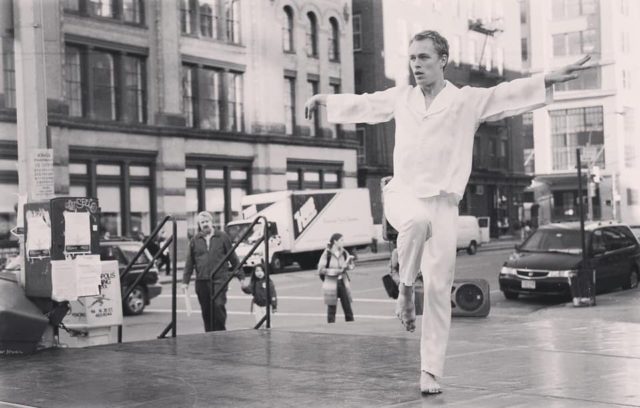
In 2000, Eiko & Koma were artists in residence on the ninety-second floor of the World Trade Center, in the North Tower. In July 2002, they presented Offering: A Ritual of Mourning in six city parks, starting at the Belvedere in Battery Park City, just west of where the towers stood. The meditation on loss ultimately toured the world. On September 11, Eiko Otake, who has been performing solo for several years, returns to the Belvedere for Slow Turn, consisting of movement, a monologue of personal memories of 9/11, and music by clarinetist and composer David Krakauer. Presented in partnership with NYU Skirball, the Battery Park City Authority, and the Lower Manhattan Cultural Council, Slow Turn takes place at 7:00 am, as the sun reaches the plaza, and again at 6:00 pm, as the sun sets over the Hudson River. Admission is free with advance RSVP.
BUGLISI DANCE THEATER: TABLE OF SILENCE PROJECT 9/11
Josie Robertson Plaza, Lincoln Center
65th St. between Broadway & Amsterdam Ave.
Friday, September 11, free, 8:00 am www.tableofsilence.org www.lincolncenter.org
Every September 11, there are many memorial programs held all over the city, paying tribute to those who were lost on that tragic day while also honoring New York’s endless resiliency. One of the most powerful is Buglisi Dance Theatre’s “Table of Silence Project,” a multicultural public performance ritual for peace, inaugurated in 2011, that annually features more than one hundred dancers on Josie Robertson Plaza at Lincoln Center. Because of the coronavirus crisis, it has been reimagined for the twentieth anniversary of the 9/11 attacks, as part of Lincoln Center’s “Restart Stages” programming. The event will begin with artistic director Jacqulyn Buglisi’s 2001 piece Requiem, her response to 9/11, with costume designer Elena Comendador transforming the original ten-foot-long red, gold, and green silk costumes into white and silver, representing ashes, purity, and sacredness.
Thirty-two dancers will gather around the Revson Fountain for Table of Silence Prologue, joined by bell master and principal dancer Terese Capucilli, electric violinist Daniel Bernard Roumain, and spoken-word artist Marc Bamuthi Joseph delivering “Awakening.” The performance will be livestreamed on Facebook and YouTube, and will also include the world premiere of Nel Shelby Productions’ short film Études II and the full 2019 performance of Table of Silence Project 9/11.
Tadej Brdnik will come out of retirement to honor the twentieth anniversary of 9/11 with Battery Dance (photo courtesy Battery Dance)
BATTERY DANCE MEMORIAL
Traffic island bordered by Varick and Franklin Sts. and West Broadway
Saturday, September 11, free, 8:46 am facebook.com/BatteryDance
On September 11, 2001, shortly after the towers fell, Tadej Brdnik of Tribeca-based Battery Dance performed a solo on the traffic island bordered by Varick and Franklin Sts. and West Broadway, accompanied by four musicians. For the twentieth anniversary of 9/11, Brdnik will come out of retirement, joined on the same location by company members Sarah Housepian, Jill Linkowski, and Vivake Khamsingsavath, who will direct the piece, set to a composition by violinist Yu-Wei Hsiao. There will be no speeches, no fanfare, just a peaceful memorial of movement and music, occurring at the exact moment the first tower was hit on that fateful day. “We welcome passersby, neighbors, and anyone who may feel inspired to join us as a way of marking this tragic, life-changing occasion with the beauty and solemnity of this performance,” Battery Dance founding artistic director Jonathan Hollander said in a statement.
New York City AIDS Memorial Park will honor twentieth anniversary of 9/11 with special gathering
A VILLAGE GATHERING: HONORING AND REMEMBERING 9/11
New York City AIDS Memorial Park
76 Greenwich Ave.
Saturday, September 11, free with advance RSVP, 5:00 villagepreservation.force.com
Art2Action, Greenwich House Music School, Rattlestick Playwrights Theater, and Village Preservation are joining forces on September 11 at 5:00 for a twentieth-anniversary remembrance at New York City AIDS Memorial Park, a safe space where people can participate in sharing stories, singing songs, and expressing themselves in other ways to honor those lost on 9/11 as well as celebrate the resiliency of the city.
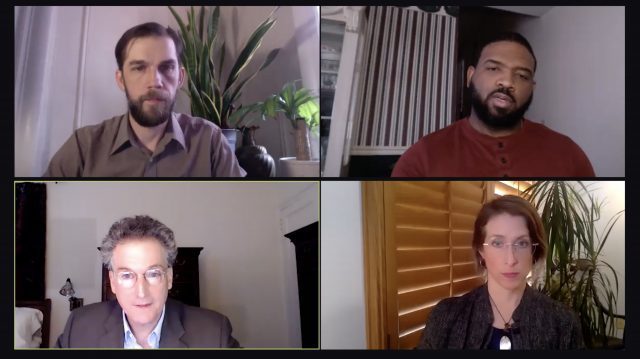
Screenshots from Zoom presentation Return the Moon by Third Rail Projects
RETURN THE MOON
Third Rail Projects
Select nights on Zoom through December 11, $15, $42, $67, 8:00 thirdrailprojects.com
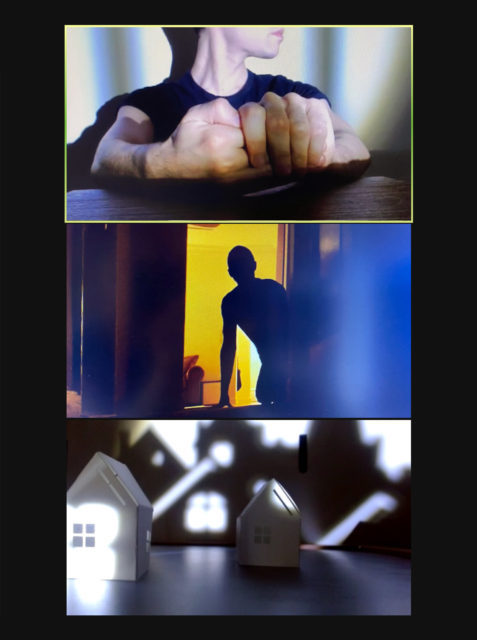
Brooklyn-based Third Rail Projects specializes in site-specific immersive productions in unique locations, from a Bushwick warehouse to a former parochial school to backstage at Lincoln Center’s Claire Tow Theater. That’s not feasible during a pandemic lockdown, so the company has devised an interactive piece for Zoom, Return the Moon. Presentations over the platform have been slowing down dramatically now that theaters are opening and Zoom fatigue has more than set in, but Third Rail is forging ahead with the seventy-five-minute show, a melding of celebratory toast, ritual, and folktale made for a maximum of sixty audience members at a time.
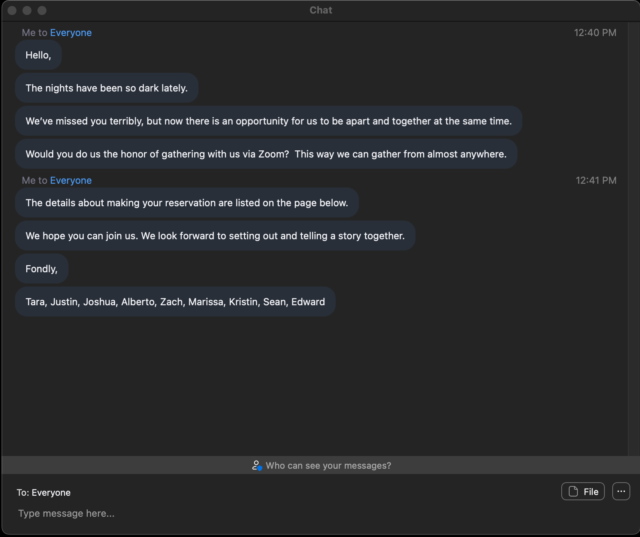
Conceived and directed by Zach Morris and created by Morris, Alberto Denis, Kristin Dwyer, Joshua Gonzales, Sean Hagerty, Justin Lynch, Marissa Nielsen-Pincus, Tara O’Con, and Edward Rice, the live, online gathering is guided by a set of prompts that include being sent to a breakout room and sharing personal thoughts and memories in the chat. (Everyone renames themselves identically, ensuring anonymity.) The centerpiece is a tale about the New Moon told using a small shadowbox constructed of white paper. “Once upon a time, you, me, all of us, we found ourselves in a village,” the story begins. “Now, this was a long time ago. So long ago, in fact, that the sun hadn’t been born yet. And all we knew was night. And the Moon. Who back then didn’t wax and wane but instead always moved through the sky full and luminous. And the Moon shone on our village.”
As opposed to such previous Third Rail shows as Then She Fell,Ghost Light, and The Grand Paradise, this one takes place mostly in your mind, using your imagination to generate the shared space. It can get a bit twee and treacly, lacking the exciting cutting-edge twists and turns so prominent in Third Rail’s in-person stagings, but as the narrator says in the story, “For some of us, the village felt like a homeplace. For others, it did not. For some of us, it felt good and safe, but others longed to be somewhere else. Nonetheless, this is where we all were.” As a bonus, participants get a little package in the mail a few days after the show that lets them relive the tale as well as make their own, which is a lovely touch.
Adam Files, Nicholas Miles Newton, Meagan Moses, and Ed Altman (clockwise from top left) get into a tense Zoom meeting in Adjust the Procedure
ADJUST THE PROCEDURE
Philadelphia Fringe Festival
Available on demand through October 4, $10 fringearts.com spincyclenyc.com
Note: The following review was written in March 2021, when Adjust the Procedure debuted online. It is now back for an encore presentation during the Philadelphia Fringe Festival.
A new genre of theater has arisen during the pandemic lockdown: Zoom plays about Zoom gatherings, both personal and professional. I’m not talking about Zoom benefits with actors reading Shakespeare and Sophocles or Fast Times at Ridgemont High and The Princess Bride but new works written for Zoom, performed on Zoom — and set on Zoom. For the Public, Richard Nelson’s What Do We Need to Talk About? reunited the familiar Apple family with the original cast — Jon DeVries (Benjamin Apple), Stephen Kunken (Tim Andrews), Sally Murphy (Jane Apple Halls), Maryann Plunkett (Barbara Apple), Laila Robins (Marian Apple Platt), and Jay O. Sanders (Richard Apple) — holding a Zoom family meeting. Rough & Ready Productions’ seven-minute Brown, an early entry from April 2020, imagines a Zoom brainstorming session about the color of cruise line swimwear, particularly prescient given the status of cruises over the last year. And Jordan E. Cooper’s Mama’s Got a Cough (with the wonderful Danielle Brooks) is fourteen of the funniest minutes you’ll ever spend on Zoom, as a family convenes an emergency online meeting to figure out what to do about their elderly matriarch.
Spin Cycle and JCS Theater Company take it to the next level with Adjust the Procedure, which delves deep into the psychological impact the coronavirus crisis is having on individuals as well as institutions, in this case a university. Written and directed by Jake Shore, the play is built around several Zoom meetings dealing with the school’s Counseling and Wellness center and what might have gone wrong in the case of student David De La Cruz. Director of academic development Kyle (Adam Files) first discusses the issue with assistant dean of student achievement Ben (Nicholas Miles Newton), relating a call he received from the suicidal undergraduate.
“In most circumstances I wouldn’t have pressed him on it at all, I would’ve just followed the procedure, but I felt I had a responsibility to deal with it on my own for some reason,” a concerned Kyle says.
Ben initially seems more interested in following the rules than facing the reality of the situation. He replies, “I would advise against intervening. . . .” That conversation ends with Ben’s advice:
“You need to know your role, Kyle, and it’s going to help a great deal in the long run. The life of this student is not on your back. It does not hang in the balance due to anything that you’ve done or will do. That’s just not the way it is. You talking to him, interfering, it’s just not going to matter that much in the grand scheme of things. It’s brutal, I’m sorry to say it, but it’s the truth. You don’t have that type of responsibility to him, or to any other student. It’s just not your job.”
On another call they are joined by director of enrollment management Aimee (Meagan Moses), who appears to only care about the numbers on her spreadsheet rather than the students themselves. She explains with robotic precision, “As you both know, for the most part, we weathered the storm caused by the international student problem, and in addition to that, we’ve made up for the additional students who either dropped out, transferred, or exited for reasons directly tied to the pandemic.” Those reasons include deportation.
Despite Ben’s pleas for Kyle to stop, the latter continues to press the issue as they discover more about Counseling and Wellness and where the De La Cruz case failed. Soon Kyle, Ben, and Aimee are on a Zoom call with executive dean Frank (Ed Altman), who is all about protecting the university’s reputation and avoiding any kind of legal trouble, no matter the truth. The four of them get into it, ascertaining things about themselves and their colleagues they might not like, leading to a surprise ending.
Available on demand through October 4 as part of the Philadelphia Fringe Festival, Adjust the Procedure gets off to a slow start, just talking heads Zooming in from wherever they are sheltering in place, but Shore (The Devil Is on the Loose with an Axe in Marshalltown,Down the Mountain and Across the Stream) picks up the pace as he brings up pertinent issues that address how the pandemic has been handled from multiple perspectives. Kyle represents the person who wants to do right but is thwarted by rules and procedures that need to be reevaluated. Ben is the earnest employee who might agree with Kyle but is not about to rock the boat. Aimee is the efficiency expert who can’t see the human component. And Frank claims that he is “worried about society unraveling,” but his beliefs about just what that society is don’t necessarily gel with the others’.
No one comes out unscathed in this trenchant Covid-19 parable; it might be specifically about a university, since education has been so hard hit during the pandemic, but it could also be about corporations and local, state, and federal governments as they face the reality of mounting death tolls and economic collapse and decide how they are going to proceed, choosing whose interests to put first amid the bureaucracy and numbers crunching.
At one point the four characters are discussing a new class at the school, “Free Will: The Big Lie.” Frank pounces on the subject, declaring, “Do you know what an immature adolescent is going to think when he finds out that free will doesn’t exist? He’ll misconstrue it. All of a sudden, there’s no accountability for one’s actions. If there’s no free will, then there’s no control.”
As has been made all too clear during this crisis, control is all about power — control of information, of the media, of statistics, of money, of scientific interpretation — primarily at the expense of the individual, the poor schnooks trying to do right by themselves, their family, their school district, and their community, attempting to assert whatever free will is supposed to exist in a representative democracy. And as we have learned, procedures need to be adjusted, and fast.
STREB’s August performance at Jacob’s Pillow is streaming for free through September 16 (photos by Christopher Duggan and Jamie Kraus, courtesy of Jacob’s Pillow)
In July 2020, STREB Extreme Action shared Best Zoom Dance (with Martha Graham Dance Company) in twi-ny’s Pandemic Awards for Body Grammar, an inventive way to utilize dancers’ body parts to play with ideas of community and movement online, especially for a troupe used to working with unique action machines that often place the performers in physical danger. The Brooklyn-based company, founded in 1985 by Elizabeth Streb, maintained a continuous virtual presence during the lockdown, but you can now catch the troupe in person when they perform five outdoor shows September 17-19 at Manhattan West. (Admission is free with advance RSVP.)
The bill includes Molinette, in which three STREB action heroes have their feet affixed to a twenty-foot-high horizontal swivel pipe designed by Noe España, commissioned for the 2019 reopening of Théâtre du Châtelet in Paris; Add, a 1983 solo piece in which the dancer must stay within a cross taped to the floor; Plateshift, featuring six action heroes on a sprung floor that incorporates centrifugal force; and the world premiere of Kaleidoscope, in which eight action heroes are fastened to LERU (London Eye Rehearsal Unit), a solid steel circle that has them defying gravity, a STREB tradition.
To get in the mood, you must check out STREB’s return to Jacob’s Pillow last month after twenty years, streaming for free through September 16. The show consists of twelve repertory works from 1978 to 2006, performed on the outdoor Henry J. Leir Stage in front of a matinee audience by Jackie Carlson, Daniel Rysak, Tyler DuBoys, Justin Ross, Kairis Daniels, Luciany Germán, Leonardo Girón Torres, and associate artistic director Cassandre Joseph, wearing tight-fitting blue superhero costumes. The technical direction is by company emcee and DJ Zaire Baptiste, who knows how to rile up a crowd.
It shows the range of Streb’s choreography and her spirited use of existing and invented objects that often put the action heroes in danger, an astonishing melding of acrobatics, gymnastics, modern dance, and circuslike peril set to original music by technoaxe and compilations produced by Voodo Fé and Freshbeatz. Streb introduces each work with a quote from a review of the piece (from the Village Voice, the Washington Post, the Philadelphia Inquirer, the San Francisco Examiner, and the New York Times) and a snippet about where the idea originated.
It begins with 2006’s Tip, in which seven dancers move precariously on a tipping machine, a twelve-feet-in-diameter wheel cut in half, able to achieve complete verticality. Carlson twirls a wooden dowel like a baton in 1978’s Pole Vaults, Rysak brandishes a rope in 1983’s Whiplash, Carlson, Rysak, Daniels, and Germán toss around a heavy twelve-foot-long, three-inch-wide dowel in 1990’s Log, Daniels is trapped in a box modeled for Streb’s size in 1985’s Little Ease, Germán plays with a hula hoop in 1983’s Target, Joseph and Ross turn a long dowel into a third dancer in 1992’s Link, the troupe pays homage to the Three Stooges and Buster Keaton with a long dowel and a ramp with a cut-out window in 2002’s Buster, and the company does miraculous things with a pair of rectangular doorlike plywood slabs in 1984’s Surface.
There are also two brief pieces with no props, Ross honoring Merce Cunningham in 1978’s 7′ 43″ and DuBoys re-creating Streb’s 1983 solo, Add, which she remembers as being “the most painful two minutes of my life.” The show concludes in a big way with 2003’s breathtaking Air, in which all eight action heroes jump off a trampoline, landing on a large mat over and over again. As with so many of Streb’s works, you can’t help but wait for disaster to occur, but it never does, at least not in the numerous times I’ve been fortunate to see the endlessly brave and talented troupe perform, at such diverse locations as Park Ave. Armory, Gansevoort Plaza, and the World Financial Center as well as in the documentaries Born to Fly: Elizabeth Streb vs. Gravity and One Extraordinary Day. Be sure to stick around for the postshow talk with Streb, Joseph, and Baptiste, moderated by Pillow scholar-in-residence Maura Keefe.
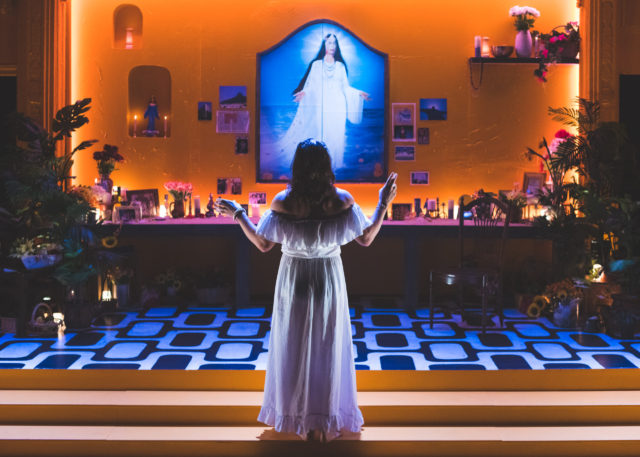
Stephanie Osin-Cohen’s set design is a highlight of new play at Rattlestick (photo by Andrew Soria)
NI MI MADRE
Rattlestick Playwrights Theater
224 Waverly Pl. between Eleventh & Perry Sts.
Tuesday – Sunday through September 19, $40
866-811-4111 www.rattlestick.org
“Gender’s confusing in our family,” Bete (pronounced “BET-chi”) says in Arturo Luís Soria’s one-person show, Ni Mi Madre, performed live at Rattlestick and streaming online through September 19. In the sixty-minute play, writer-star Soria portrays his domineering Brazilian mother, zeroing in on their complicated relationship.
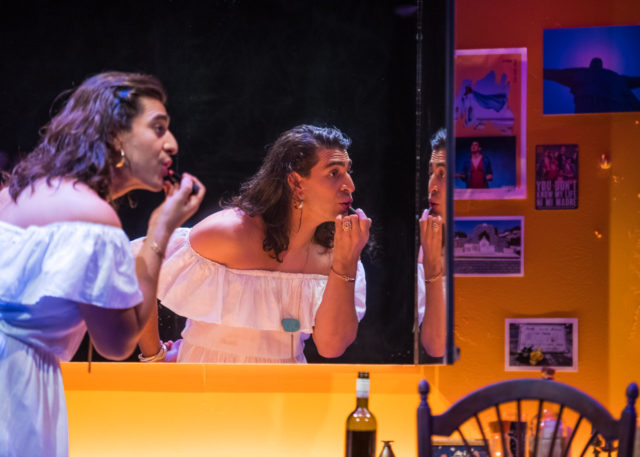
Ni Mi Madre, which means “not (or “nor”) my mother,” begins with Soria, in a long white gown (by Haydee Zelideth) that bares his hirsute chest, walking onstage carrying a row of ritual candles and flowers. He puts the objects down carefully and pulls the top of the dress over his chest and voilà, he is now his mother. He spends the remainder of the show acting and speaking like her as she discusses life and love, family and children, with a particular focus on her queer Latino son, Arturo.
“You know, he had the right idea going gay,” she says. “I just don’t think he executed it properly, because when he came out . . . He. Came. Out! I mean, it was like the Fourth of July on New Year’s, okay. Then he tells me he’s not just gay, he’s bisexual. So I say, ‘Listen, bisexuals are greedy, okay. The world is gay and it’s straight; it’s black and it’s white; it’s in and it’s out, so figure it out.’”
Arturo Luís Soria portrays his mother in one-person show (photo by Andrew Soria)
Elegant and proud, Bete talks about her three marriages, to Inebriated Jew, Ecuadorian Commie, and Gay Dominican; how it’s okay for her to beat her children; her dedication to Meryl Streep; and her own difficult mother. “My mother never wanted to be a mother. Never,” she explains. “You only get one mom. And my mother didn’t want me.” However, she’s not seeking sympathy but instead defends her treatment of her children.
“My kids don’t know how lucky they are to have a mother like me. I am their inspiration and they don’t even know it and I went through a lot of trouble to raise them,” she says. “I was a good mother to them. And I never abandoned them nor shipped them off to boarding school. I thought about it. Arturo was such a maniac as a kid I used to pray to God that he would go to sleep and not wake up until college, but those were only empty prayers. Kind of. Arturo thinks I was a bad mother to him. I wasn’t bad. He was a fuckin’ lunatic.” She might be harshly critical of him, but she also loves and supports him. “He’s following his dreams,” she adds. “He’s doing what I always wanted but never could because I didn’t have a mother like me.’
The night I saw the show, it was followed by a talkback with Soria and director Danilo Gambini (The Swallow and the Tomcat,An Iliad), a native Brazilian who has been working with Soria on the play since their Yale days going back to 2017 (in addition to other collaborations); Soria began writing Ni Mi Madre in 2008, and it has gone through numerous iterations before opening in New York City on August 25, when Soria’s mother was present in the audience. The postshow discussion lent further insight into mother and son, especially how the latter came to better understand and humanize the former through forgiveness and love as the play developed and he grew in the role. (There will be a free Zoom community conversation with Soria, Gambini, and Sam Morreale on September 2 at 5:00, and if you bring your own mother to the play, you can use code HIMOM to get her in for free September 2-6.)
The show, which features songs by Cher, Cyndi Lauper, Gloria Estefan, and Maria Bethania, lip-synced in drag finery by Soria, takes place on Stephanie Osin-Cohen’s gorgeous stage, a kind of shrine room with ritual objects, including candles galore, a bedecked vanity, and a large depiction of Iemanjá, the Umbanda (Candomblé) goddess of the sea, protector of fishermen and pregnant women — and who looks suspiciously like Cher. The floor is patterned like an Ipanema sidewalk of twisting black-and-white designs in the style of Roberto Burle Marx, which was highlighted in 2019 at the New York Botanical Garden. The walls are “persuasive papaya,” as Bete believes that “you have to paint the colors of your walls something that has to do with suggestive foods.” Krista Smith’s lighting shines brightly on Soria and casts long shadows on either side of the stage in one scene when Bete confronts her own parents.
Bold and barefoot, Soria (The Inheritance,Hit the Wall) fully inhabits the character of his mother. Too many of the lines fall flat and it can feel a bit repetitive even at only an hour, but Ni Mi Madre is a potent and poignant observation of first-generation immigrants, queer Latinidad, and the importance of family, despite the headaches.
“No matter how hard I try / You keep pushing me aside / And I can’t break through / There’s no talking to you,” Cher sings in “Believe,” which Bete mistakenly thinks is by Madonna. With Ni Mi Madre, Soria has taken a very public platform and touching way to break through to his mother.