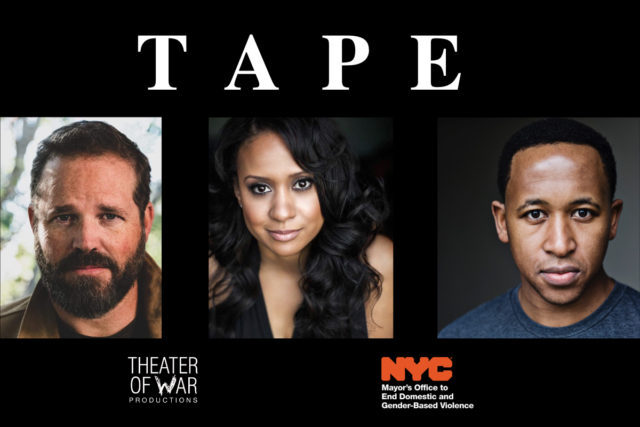
Who: Tracie Thoms, David Denman, Nyasha Hatendi, Bryan Doerries, more What: Livestreamed play reading followed by community discussion Where:Theater of War Productions Zoom When: Thursday, October 21, free with advance RSVP, 7:00 Why: Theater of War’s live presentations of play readings followed by community discussions continue October 21 with an investigation into consent, power dynamics, and sexual assault. The evening begins with a dramatic reading of scenes from Stephen Belber’s 1999 play, Tape, about two friends who meet with a woman one of them might have date raped back in high school; it was made into a 2001 film by Richard Linklater starring Ethan Hawke, Robert Sean Leonard, and Uma Thurman. The reading will be performed by Tracie Thoms, David Denman, and Nyasha Hatendi, helmed by Theater of War artistic director Bryan Doerries. Immediately following the reading, Doerris will facilitate a discussion held in conjunction with Go Purple Day.
“Awareness is the first defense against domestic violence, and every year, with NYC Go Purple, we keep this important issue in front of New Yorkers,” Mayor’s Office to End Domestic and Gender-Based Violence commissioner Cecile Noel said in a statement. “Domestic violence awareness and prevention is not confined to one day of the year. NYC Go Purple reminds us that, every day, every New Yorker can play an important role in ending domestic violence.”
On October 28, Doerries will speak with author Margaret Atwood about social activism and his new translation of the Oedipus Trilogy; on October 27, David Patrick Kelly, Glenn Davis, Amy Ryan, David Strathairn, Marjolaine Goldsmith, and Jumaane Williams will perform Oedipus the King, followed by a discussion on the pandemic and the climate crisis hosted by the University of Notre Dame as part of its “Care for Our Common Home: Just Transition to a Sustainable Future” forum.
Who: Frank Gehry, Eric Garcetti, Vishaan Chakrabarti, Kunlé Adeyemi, Angela Hsu, more What: Livestreamed discussion Where:92nd St. Y online When: Wednesday, October 20, free, noon – 3:00 Why: On October 20, the 92nd St. Y is convening a three-hour summit on the future of American cities in light of health crises, climate change, growing income inequality, transportation complications, and other critical matters. The seven panels and two keynotes will feature prominent architects, designers, urban planners, arts leaders, and others offering ways to face numerous problems, including architect Frank Gehry, LA mayor Eric Garcetti, Citizen University cofounder and CEO Eric Liu, Practice for Architecture and Urbanism founder and creative director Vishaan Chakrabarti, BAM president emerita Karen Brooks Hopkins, architect and professor Kunlé Adeyemi, UNC public policy assistant professor Angela Hsu, and New York City Employment and Training Coalition CEO Jose Ortiz Jr.
“The role of cities in American life has remained essential throughout the pandemic, notwithstanding early predictions to the contrary,” 92Y CEO Seth Pinsky announced in a statement. “That said, it is clear that as a result of the pandemic, the fundamental changes that our cities were undergoing even pre-COVID have only accelerated. Adapting to climate change, investing in infrastructure, including open spaces and parks, distributing prosperity more evenly, while ensuring that business, including the arts and entertainment, thrive — those are just some of the big issues of the day.” Virtual admission is free; below is the full lineup.
Opening Keynote: “Frank Gehry on the Future of Cities,” moderated by Alex Ross
“The Renewal of the American City,” with Anne-Marie Slaughter, Eric Liu, and Ai-Jen Poo
“Arts and the City,” with Karen Brooks Hopkins and Seth Pinsky
“The Future of New York City,” with Vishaan Chakrabarti, Bruce Katz, and Julie Samuels
“Jane Jacobs’s Big Ideas,” with Rana Foroohar
“Cities on the Frontlines of Climate Change,” with Angel Hsu, Rohit Aggarwala, Kunlé Adeyemi, and Emily Tisch Sussman
“The Equitable City: A Design for Fairer Living,” with Ifeoma Ebo, Jose Ortiz Jr., and Jennifer Rittner
Closing Keynote: “How Do Megacities Confront Their Biggest Challenge, Climate Change?” with Eric Garcetti
CROSSING THE LINE FESTIVAL
FIAF and other locations
55 East 59th St. between Madison & Park Aves.
October 20 – November 6, free – $25
212-355-6100 fiaf.org
Igbo-Nigerian American multidisciplinary artist Okwui Okpokwasili has not let the pandemic lockdown slow her down. After appearing in the Public’s outstanding revival of Ntozake Shange’s for colored girls who have considered suicide / when the rainbow is enuf in the late fall of 2019, Okpokwasili has taken part in Danspace Project’s Platform series, the New Museum exhibition “Grief and Grievance: Art and Mourning in America,” and numerous online discussions and special presentations. Her 2017 film, Bronx Gothic, was screened virtually by BAM. In June, she led a procession through Battery Park City for the River to River Festival. And in May, I caught her captivating project On the way, undone, in which she and a group of performers walked across the High Line wearing futuristic head gear made of light and mirrors, vocalizing as they headed toward Simone Leigh’s Brick House sculpture.
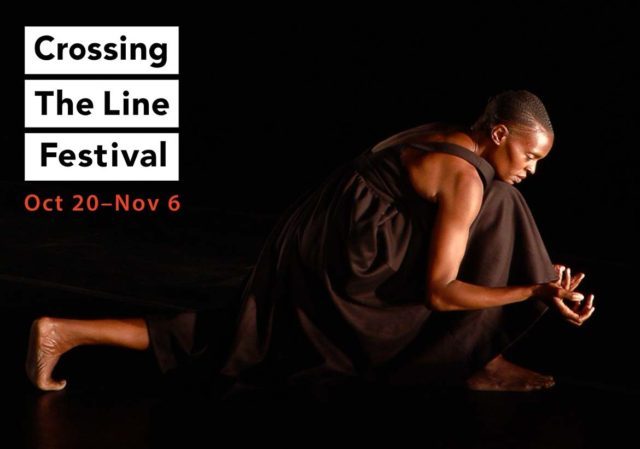
Okpokwasili is now the centerpiece of FIAF’s 2021 Crossing the Line Festival, taking place at multiple locations from October 20 to November 6. Throughout the festival, her video installation Before the whisper becomes the word, made with her regular collaborator, director, and husband, Peter Born, will be on view in the FIAF Gallery, exploring remembrance, community mourning, and history. On October 20 at 7:00, she will speak with festival curator Claude Grunitzky in the FIAF Skyroom about the show. “This installation is a crossroads, a midpoint, a caesura. A place caught between worlds,” she said in a statement. “Can we remember what came before while imagining the shape of a future landscape? We enter mid-song, a song that marks a singular moment in time while also expressing an entire lineage. The song is a container for an unreliable memory. From whose mouth is history born? Whose words are trusted when it comes to the telling of what happened? If the history we learn is that which is spoken aloud, what is learned by listening to the whispers that have not been written?”
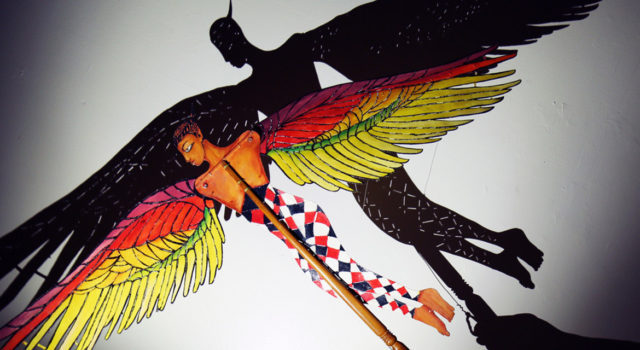
Christopher Myers’s Fire in the Head will make its world premiere at FIAF’s Crossing the Line Festival
Okpokwasili will also be presenting On the way, undone at the Weeksville Heritage Center in Brooklyn October 21-23 ($25). In a High Line video, she says about the work, “I hope it’s a kind of medicine . . . an architecture of sound, light, that is in some way trying to imagine a portal, an opening through space and time, and it’s imagining a woman’s future self, a young girl’s future self singing back to her.”
In addition, the festival includes nora chipaumire’s Nehanda, an opera that was excerpted for River to River at the Clemente Soto Vélez Cultural & Educational Center and for FIAF will be broadcast in two cycles both online ($15) and in person ($25) at FIAF’s Tinker Auditorium, divided into eight “days”: natives, whites, pungwe, thinkers, komuredhi judhas nemajekenisheni, white verdict, killings, and manifesting, with an artist talk on October 30 at 5:00; a concert by Grammy nominee Somi in Florence Gould Hall on October 28 ($25); Christopher Myers’s Fire in the Head, a tribute to Vaslav Nijinsky with shadow puppets taking place October 29 and 30 ($25, 7:30) at the Chinese Consolidated Benevolent Association; and Kaneza Schaal’s work-in-progress KLII, November 4-6 in Florence Gould Hall ($25), an exorcism of colonialism and the ghost of King Leopold II, incorporating archival footage and texts by Mark Twain and Patrice Lumumba.
Who:Red Bull Theater What: Online reading and discussions about Shakespeare’s Pericles Where:Red Bull Theater YouTube and Facebook When: Livestreamed events October 4, 11, 18, 25, 28, free with advance RSVP Why: Last year Red Bull Theater presented “Othello 2020,” a deep dive into the Shakespeare tragedy through performances and discussions. This year Red Bull is digging into one of Shakespeare’s lesser-known works, Pericles, about the Prince of Tyre, who sets out on a series of adventures when the answer to a riddle goes awry. In a statement, Red Bull founding artistic director Jesse Berger explains, “Shakespeare’s Pericles is at the heart and soul of Red Bull in many ways: our founding play, Jacobean in period, hopeful in spirit, and about the power of imagination at its core. ‘It hath been used as restoratives,’ the poet Gower says right at the beginning of the play. To me, this play is about restoring hope and peace after a period of turmoil and tragedy. I’ve always loved the idea of this play as a hero journey, and a play about the healing power of storytelling itself. As the play that began the life of our theater company, it seems most appropriate that we explore this play anew, continuing our journey — toward our twentieth year of existence as a company, reemerging out of the pandemic shutdown, and inviting new voices to be in creative conversation with the play and the Western classical canon.”
Red Bull’s inaugural production, in 2003, featured Daniel Breaker in the title role, with Raphael Nash Thompson as Gower and Cerimon; on October 4, Thompson, who also portrayed Gower in Sir Trevor Nunn’s version at TFANA in 2016, performed the prologue “To sing a song that old was sung” and discussed the play in a RemarkaBULL Podversation with Red Bull associate artistic director Nathan Winkelstein that you can watch here. “Exploring Pericles in 2021” began on October 11 and continues October 18, with BIPOC artists Grantham Coleman, Kimberly Chatterjee, Callie Holly, Mahira Kakkar, Jordan Mahome, Anthony Michael Martinez, Clint Ramos, Kenny Ramos, Madeline Sayet, and Craig Wallace delving into what Pericles means today. On October 25, Kent Gash will direct a livestreamed benefit reading of the play, with Coleman as Pericles. The programming concludes October 28 with an interactive Bull Session featuring Gash, scholar Noémie Ndiaye, and members of the company.
“Over the last two decades, Pericles has been produced around the world more often than in the entire twentieth century,” writes Ndiaye, an assistant professor of English at the University of Chicago. “The play was wildly popular in its own time, and it is now poised to become one of the twenty-first century favorite rediscovered Shakespearean plays. It may have caught the attention of contemporary theatermakers invested in diversifying Shakespeare in part because its geographical location, which moves between ancient Lebanon, Turkey, Libya, and Greece, makes it suitable for cross-cultural multiracial casting. And, certainly Pericles is a fertile terrain for racial investigation. Yet at the same time, the play’s consistent characterization of ‘fairness’ (a word used twenty-three times) as the feminized object of Pericles’s desire and the curative means of his salvation frames his journey as a romantic quest for whiteness and white world-making at the dawn of modernity. It is that fraught and complex racial terrain with which contemporary theatermakers must reckon when they stage Pericles today, finding new creative ways of doing Shakespeare better, Shakespeare with us and for us.”
Todd Haynes tells the true story of the Velvet Underground in new documentary opening at Film Forum
THE VELVET UNDERGROUND (Todd Haynes, 2021)
Film Forum
209 West Houston St.
Opens Wednesday, October 13
212-727-8110 filmforum.org
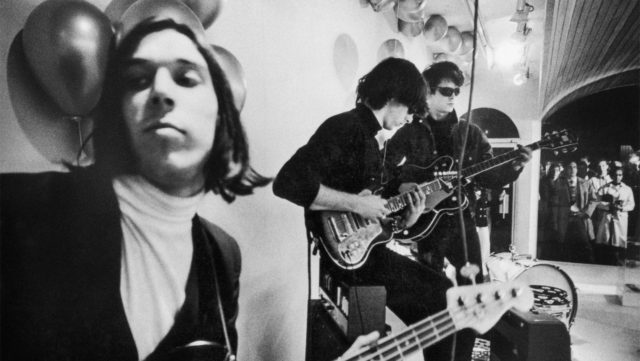
The Velvet Underground was more than just a music group; they electrified a generation, and continue to do so today, half a century later. Todd Haynes, whose 1998 Velvet Goldmine was set in the world of glam rock and whose 2007 I’m Not There explored the career of Bob Dylan through six characters and a nonlinear narrative, now turns his attention to the true story behind the Velvets. Haynes details the history of the band by delving into leaders John Cale and Lou Reed’s initial meeting, the formation of the Primitives with conceptual artists Tony Conrad and Walter DeMaria, and the transformation into the seminal VU lineup at the Factory under Pop icon Andy Warhol’s guidance: singer-songwriter-guitarist Reed, Welsh experimental composer and multi-instrumentalist Cale, guitarist Sterling Morrison, drummer Maureen Tucker, and German vocalist Nico. Much of Haynes’s documentary focuses on Warhol’s position in helping develop and promote the Velvets. “Andy was extraordinary, and I honestly don’t think these things could have occurred without Andy,” Reed, who died in 2013, says. “I don’t know if we would have gotten the contract if he hadn’t said he’d do the cover or if Nico wasn’t so beautiful.”
Haynes and editors Affonso Gonçalves and Adam Kurnitz pace the film like VU’s songs and overall career, as they cut between new and old interviews and dazzling archival photographs and video, frantic and chaotic at first, then slowing down as things change drastically for the band They employ split screens, usually two but up to twelve boxes at a time, to deluge the viewer with a barrage of sound and image. Among the talking heads in the film are composer and Dream Syndicate founder La Monte Young, actress and film critic Amy Taubin, actress and author Mary Woronov, Reed’s sister Merrill Reed-Weiner, early Reed bandmates and school friends Allan Hyman and Richard Mishkin, filmmaker and author John Waters, manager and publicist Danny Fields, composer and philosopher Henry Flynt, and avant-garde filmmaker and poet Jonas Mekas. “We are not part really of the subculture or counterculture. We are the culture!” Mekas, who passed away in 2019 at the age of ninety-six, declares.
Haynes also talks extensively with Cale and Tucker, who hold nothing back, in addition to Morrison’s widow, Martha Morrison; singer-songwriter Jackson Browne, who opened up for the Velvets back in their heyday; and big-time fan Jonathan Richman (of Modern Lovers fame). While everyone shares their thoughts about Warhol, the Factory, the Exploding Plastic Inevitable shows, and the eventual dissolution of the band, Haynes bombards us with clips from Warhol’s Sleep,Kiss,Empire, and Screen Tests (many opposite the people who appear in the film) as well as works by such artists as Maya Deren, Jack Smith, Kenneth Anger, Barbara Rubin, Tony Oursler, Stan Brakhage, and Mekas and paintings by Warhol, Jasper Johns, Robert Rauschenberg, and Mark Rothko. It’s a dizzying array that aligns with such VU classics as “I’ll Be Your Mirror,” “I’m Waiting for the Man,” “Heroin,” “White Light / White Heat,” “Sister Ray,” “Pale Blue Eyes,” and “Sweet Jane.”
Several speakers disparage the Flower Power era, Bill Graham, and Frank Zappa and the Mothers of Invention, with Tucker admitting, “This love-peace crap, we hated that. Get real.” They’re also honest about the group’s own success, or lack thereof. Tucker remembers at their first shows, “We used to joke around and say, ‘Well, how many people left?’ ‘About half.’ ‘Oh, we must have been good tonight.’” And there is no love lost for Reed, who was not the warmest and most considerate of colleagues.
The Velvets still maintain a remarkable influence on music and art today despite having recorded only two albums with Cale (The Velvet Underground and Nico and White Light / White Heat) and two with Doug Yule replacing Cale (The Velvet Underground and Loaded) in a span of only three years. (For example, the tribute album I’ll Be Your Mirror was released in September, featuring VU covers by Michael Stipe, Matt Berninger, Andrew Bird & Lucius, Kurt Vile, St. Vincent & Thomas Bartlett, Thurston Moore & Bobby Gillespie, Courtney Barnett, Iggy Pop & Matt Sweeney, and others.) Haynes (Far from Heaven,Safe) sucks us right into their extraordinary orbit and keeps us swirling in it for two glorious hours of music, gossip, art, celebrity, and backstabbing. The documentary, which premiered earlier this month at the New York Film Festival, opens at Film Forum on October 13 and begins streaming on Apple+ two days later. If you end up watching the film at home, turn it up loud. No, louder than that. Even louder. . . .
[Film Forum will be hosting Q&As with Gonçalves and Kurnitz on October 14 and 16 following the 7:50 shows, and Taubin will introduce the 7:50 screening on October 15. In addition, Haynes will join Gonçalves and Kurnitz at Film Forum for the 7:50 screening on November 12.]
Xandra Nur Clark wrote and stars in one-person show about ethical nonmonogamy (photo by Ashley Garrett)
HERE Arts Center
145 Sixth Ave.
In person through October 9, $40
On-demand streaming through October 13, $20-$25 here.org/shows www.polyloguesplay.com
A few years ago, a friend of mine told me that his girlfriend had just explained to him that she was polyamorous. I had not heard that term before, and he wasn’t quite sure what it meant either, but it wasn’t merely that his partner wanted an open relationship so she could see other people. It went well beyond that.
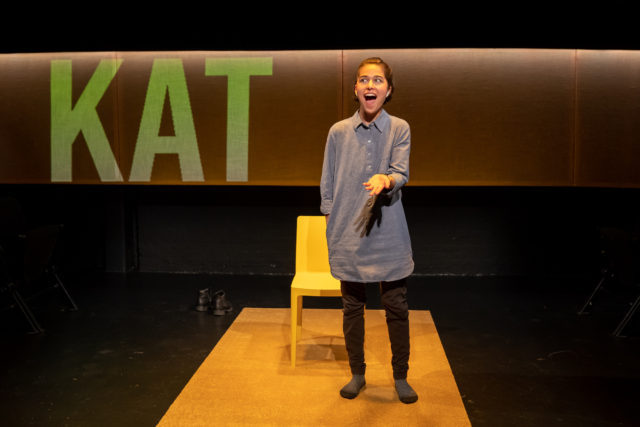
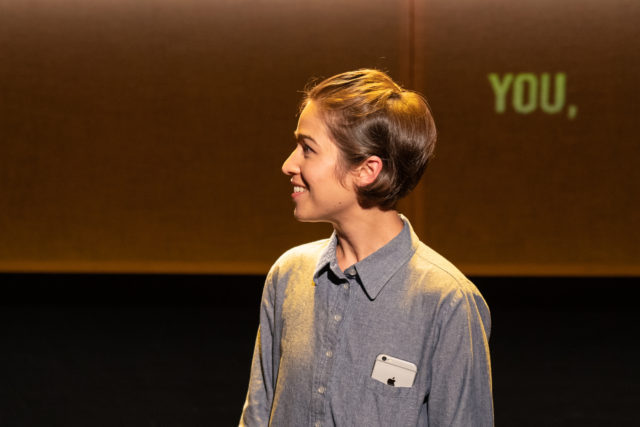
Writer and performer Xandra Nur Clark explores the reality of polyamory in the insightful one-person show, Polylogues. The seventy-five-minute piece of documentary theater has just finished its run at HERE Arts Center and is available on demand through October 13. Clark, a queer Indian American community builder who studied with Anna Deavere Smith, interviewed more than fifty people over three years about ethical nonmonogamy, ranging in age from five to seventy-five, from eleven different countries and numerous races, religions, socioeconomic backgrounds, and political perspectives. Clark wears earphones during the Colt Coeur production, listening to the actual words spoken by the subjects and enacting them for the audience, which sits on three sides of Clark, who doesn’t do a deep dive into each character but embodies them with small differences in tonality and gestures. The characters are either the one who initiated the idea of nonmonogamy in the relationship, the one who was asked to consider it, or had nonmonogamous parents. In some cases they are happy with their decision to participate, but in others it either goes awry or they appear to be trying too hard to defend and rationalize their choices.
Ryan points out, “I’m not behaving like a quote unquote normal person would behave in this situation.” Shamma offers, “When you spend your whole life as a cheater, right? You’re doing it to fulfill a certain insecurity that you have in the, you know, a gap that you have in the relationship?
So you go to the next person to fill that gap. . . . Why can’t this be a new form of family?!” Trudy refers to the additional person as a “love friend.”
Casius says, “Most people think polyamory is just like about having orgies! . . . It’s like being willing to do anything for another person no matter what!” Jackson declares, “You know, I’m not a fucking toy! You know, like, I’m a person. And it’s not that we couldn’t have made a very casual arrangement, but, like, I need to have some autonomy in that decision!”
K, a Muslim from Malaysia, where men can have multiple wives, asserts, “Nonmonogamy interacting with male privilege, or interacting with capitalism, can, like, produce some really, like, frightening dynamics. . . . And finding ways to self-limit that in my nonmonogamy practice is . . .
important to me. To ensure I’m not trying to . . . I don’t know, like, build a . . . mmm, I don’t know . . . build a harem or something.”
Xandra Nur Clark embodies multiple characters involved in polyamorous relationships (photo by Ashley Garrett)
The issue of jealousy comes up numerous times. Alex admits, “I’m not okay with him with another girl other than his wife, but I’m okay with him with his w-wife. I want it — this one, this one guy love me with his full heart, everything. But meanwhile, I still got freedom to choose someone else!” And CJ concedes, “I’m fine with being with one person. But I always want to make sure that the other person doesn’t feel an obligation to me. I don’t want you to feel like you’re stuck with me.” She later adds, “It’s just like,
well, I’ll just — if this is just a little piece of it, I can get through nonmonogamy, I’ll take this little piece. Or like, if we’re ‘n a . . . nonmonogamous relationship, you can’t break my heart. But, maybe I just equate breaking my heart with cheating on me.”
Directed by Molly Clifford (Karaoke,Soldier), who introduces the piece in a clever way that prepares everyone for what is to follow, Polylogues begins with a stream of questions and statements on the wall behind Clark, including the key one: “How do you experience love in your life?” Clark (Everything You’re Told,Separated) is charming as she embodies the diverse characters, displaying a relaxing demeanor that brings ease and comfort to an audience that most likely doesn’t understand the complexities of modern-day ethical nonmonogamy, a term I had not encountered until seeing this show. You’re likely to be enticed by the play, if not polyamory itself, although I’m not sure my friend is ready to hear more about it just yet.
Morgan Danielle Day delivers one of six monologues about motherhood in Matriarch
Who:The Roots and Wings Project What: Livestream of six monologues Where:Houston Coalition Against Hate online When: Friday, October 8, free (donations accepted), 7:00 (available on demand through October 30) Why: The Roots and Wings Project and the Houston Coalition Against Hate have teamed up to present Matriarch, a collection of six monologues and a song exploring the complex relationship between mothers and children in a patriarchal society. Filmed in front of a live, masked audience in the small backyard of the MKM Cultural Arts Center in Los Angeles, the show begins with Lioness, in which writer and Roots and Wings co-executive producer Jesse Bliss rails at an unseen man chastising her for breastfeeding in her parked car. “Fuck that,” she argues. “I’ll feed my baby wherever we need to handle it and it should elicit no kind of reaction and cause no kind of problem. . . . I birthed her, care for her, feed her. I could scream loud as fuck right now and it won’t bother her because we are a team. She wants me to chew your ass out. . . . . You’re trying to make shame out of something beautiful,” immediately establishing motherhood as a nurturing necessity and connection.
In The Truth about Perfecta, written by Obie winner Diane Rodriguez, who died of lung cancer in April 2020, Cristina Frias plays a mother defending herself against racist stereotypes. “I bet when you people look at me, you make assumptions about who I am, where I come from, who I belong to, who I love, how I love, where I live, how I live, who my friends are, how I manage my life, how much money I make, how I treat my kids. Well, don’t do that; you don’t know who I am, and you don’t know how I was raised.”
Some Things You Should Know about My Mom is a eulogy written by Gabriel Diamond and Tamar Halpern and performed by Diamond in front of a music stand. “You’ve been talking about Sandy the friend, the playwright, the sister, the calligrapher, the painter, the poet, all these things,” he says. ”I’m gonna talk about her as the mommy,” proceeding to tell stories about her decision to be a single mother and detailing her death.
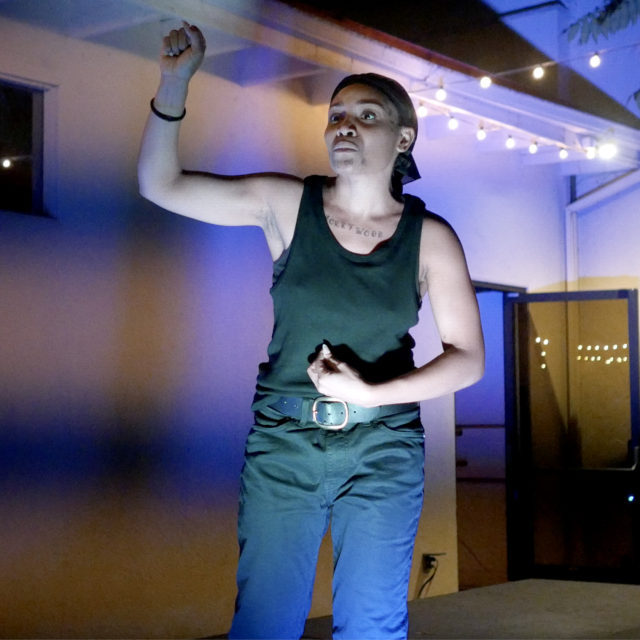
Morgan Danielle Day is explosive as a young woman fighting the system in Taylor Lytle’s The Formula. Wearing a durag and face tattoos, Day fiercely proclaims, “I was criminalized long before I was ever incarcerated. I remember it like it was yesterday.” She recounts how her drug-addicted, sexually abused mother sent her off to foster care. “Now, it may be to you all a surprise that I was actually happy to get a foster home. Now, don’t get the wrong idea. I had a beautiful mother. I admire this woman for her strength. She was loving and caring and did what she could with what she had, period. . . . But there wasn’t a lot of room in this world for a single mother of twelve on welfare.”
Bahni Turpin sits down for Sigrid Gilmer’s Remember This . . . in which she portrays Margaret, a mother who is preparing her daughter for her impending death. “Oh, Angela. Please, dear,” she pleads. “Please, don’t. No tears, my darling. Stop it. I’m not going to discuss it. It is just dying. . . . I will not suffer any more than I have to. I will not waste away. You know, you don’t have to be here when I go.” She also admits, “I should have never had children.”
The evening concludes with Roger Q. Mason’s Age Sex Location, in which a fab Ramy El-Etreby dances onstage in glittery drag and proclaims, “Fat bitch / Black queen / Mixed breed mishap / Round nosed fag hoe / That’s what you think of me / As I walk down the street / My wide hips waddling / My fleshy neck obscuring a too-soft jawline.” He goes on to tell how he was rejected by his mother, father, and doctor, none of whom even tried to understand who he was, who he needed to be. The show also features a song by Sheila Govindarajan in which she sings, “Let me go / set me free,” along with snippets from Lizzo, Talking Heads, Nina Simone, Bob Dylan, Ella Fitzgerald, and Roberta Flack.
Created and directed by Bliss and photographed by Ivan Cordeiro, Matriarch debuts online October 8 at 7:00, followed by a panel discussion with several of the performers and Houston-area domestic violence prevention advocates, including Dr. Nusrat Ameen of Daya and Barbie Brashear of the Harris County Domestic Violence Coordinating Council, moderated by HCAH executive director Marjorie Joseph, and will be available on demand on YouTube and Facebook through October 30.