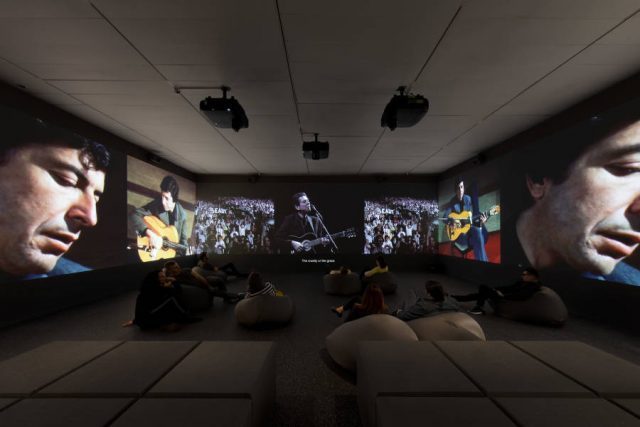
George Fok’s Passing Through is centerpiece of Leonard Cohen show at Jewish Museum (courtesy of the artist / photo by Frederick Charles)
The Jewish Museum
1109 Fifth Ave. at 92nd St.
Through September 8, $8-$18, pay-what-you-wish Thursday from 5:00 – 8:00, free Saturday
212-423-3200
thejewishmuseum.org
In an October 2016 Q&A at the Canadian Consulate in LA, Leonard Cohen explained, “Uh, I said I was ready to die recently. And I think I was exaggerating. I’ve always been into self-dramatization. I intend to live forever.” Leonard Norman Cohen died the next month at the age of eighty-two, leaving behind a legacy that might just live forever, as evidenced by the sensational exhibition “Leonard Cohen: A Crack in Everything” that continues at the Jewish Museum through September 8. Curated by John Zeppetelli and Victor Shiffman for the Musée d’art contemporain de Montréal in Cohen’s beloved hometown, the show is an ingenious exploration of the life and career of the singer-songwriter, poet, novelist, visual artist, Buddhist monk, father, grandfather, Sabbath-observant Jew, and elegant raconteur.
Named after a quote from his song “Anthem” from the 1992 album The Future — “Ring the bells that still can ring / Forget your perfect offering / There is a crack, a crack in everything / That’s how the light gets in” — the three-floor multimedia exhibit consists of thirteen installations by artists repurposing and recontextualizing Cohen’s words and images. The centerpiece is George Fok’s nearly hourlong Passing Through, a nine-channel video across three walls of a large room in which visitors can sit on benches or beanbag chairs; the piece features concert and backstage footage ranging from Cohen’s early days to his final tour in 2013, merging together performances of the same songs through the years, including “Hallelujah,” “Tower of Song,” “Suzanne,” “I’m Your Man,” “Chelsea Hotel #2,” and “First We Take Manhattan,” revealing how he adapted his unique trademark vocal phrasings as he got older. Kara Blake’s The Offerings is a five-channel video that compiles thirty-five minutes of interviews in which Cohen discusses his writing process and some of his life choices, from moving to Greece to becoming a monk. In Ari Folman’s Depression Chamber, the director of such films as Waltz with Bashir and The Congress invites people one at a time to spend five minutes in a dark room, lying on a bed as Cohen’s “Famous Blue Raincoat” plays, the lyrics coming alive in mesmerizing, meaningful ways. At the other end of the hall, more than two hundred of Cohen’s self-portrait drawings from 2003 to 2016 are projected on a loop, edited together by Alexandre Perreault.
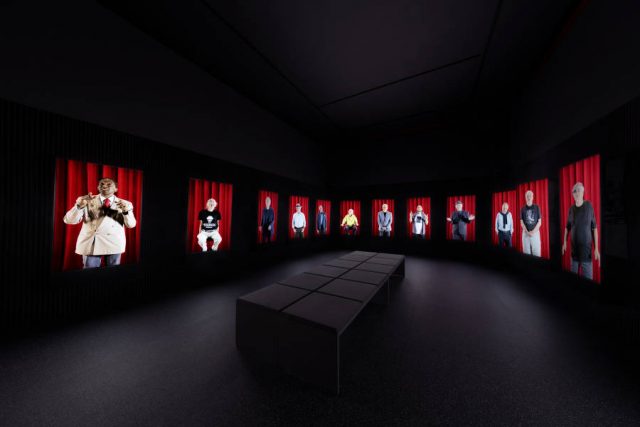
Candice Breitz’s I’m Your Man (A Portrait of Leonard Cohen) consists of eighteen fans singing all of 1988 Cohen comeback album (courtesy of the artist / photo by Frederick Charles)
Candice Breitz’s two-part I’m Your Man (A Portrait of Leonard Cohen) begins with a video of the all-male Shaar Hashomayim Synagogue Choir, from Cohen’s longtime shul, singing only the background vocals to every tune on Cohen’s extraordinary 1988 comeback album, I’m Your Man (“First We Take Manhattan,” “Ain’t No Cure for Love,” “Everybody Knows,” “Take This Waltz,” “Tower of Song,” the title track, et al.); down a narrow path blanketed by red curtains, eighteen Cohen fans sing the main lyrics to the songs, each on their own screen and speaker. For the best effect, walk around the room and then into the hall to find the exact spot where the lead vocals and harmonies merge. Audiences can participate in Janet Cardiff and George Bures Miller’s The Poetry Machine, a vintage Wurlitzer organ with an array of speakers and gramophone horns; guests can take a seat and press down the keys, each of which connects to Cohen’s voice reading poems from his 2006 Book of Longing. You can also sit or lie down on a bench and hum “Hallelujah” into any of several dangling microphones in Daily tous les jours’ Heard There Was a Secret Chord, joining a chorus of live hummers online.
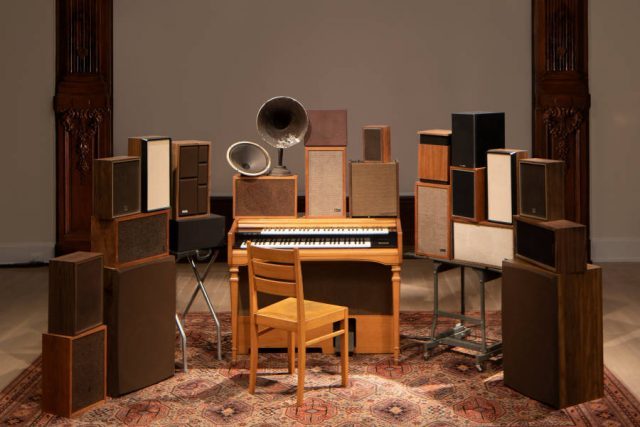
Janet Cardiff and George Bures Miller’s The Poetry Machine invites visitors to take a seat (courtesy of the artists; Luhring Augustine, New York; Fraenkel Gallery, San Francisco; and Gallery Koyanagi, Tokyo / photo by Frederick Charles)
On the third floor is a listening room where you can relax and hear specially commissioned Cohen cover songs while immersed in a James Turrell–like display of changing colors and shapes; the setlist includes Feist’s “Hey, That’s No Way to Say Goodbye,” Dear Criminals’ “Anthem,” Ariane Moffatt and the Orchestre Symphonique de Montréal’s “Famous Blue Raincoat,” Moby’s “Suzanne,” Chilly Gonzales, Jarvis Cocker, and Kaiser Quartett’s “Paper Thin Hotel,” and the National, Sufjan Stevens, Ragnar Kjartansson, and Richard Reed Parry’s “Memories.” There are also contributions from Christophe Chassol, Kota Ezawa, Jon Rafman, Taryn Simon (linking Cohen’s death with the election of Donald Trump), and Tacita Dean (a sweet tribute to “Bird on the Wire”) along with extensive biographical text in one area. It all comes together to paint a magnificent portrait of an exceptional artist who continually challenged himself and his audience, a highly intelligent storyteller and performer who seemed to exist on his own plane. “I never had the sense that there was an end. That there was a retirement or that there was a jackpot, Cohen told Paul Zollo in an 1990s interview. With “Leonard Cohen: A Crack in Everything,” fans hit the jackpot with a potpourri of phenomenal proportion. (On August 29, the Jewish Museum and Russ & Daughters are hosting the final “Cocktails with Cohen,” in which, from 5:30 to 7:30, visitors can partake of the Red Needle, a drink invented by Cohen in 1975 consisting of tequila, cranberry juice, lemon, and ice. Beer, wine, and other drinks will also be available for purchase.)
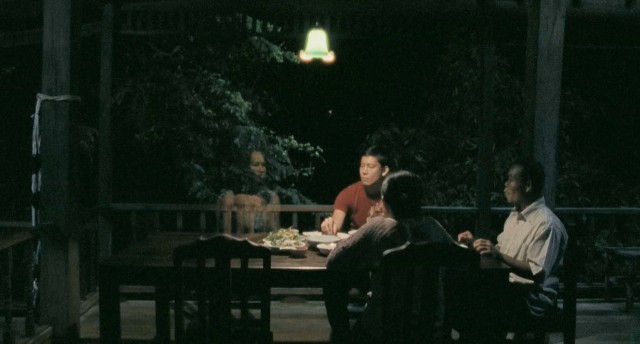
 The BAM series “Programmers’ Notebook: On Memory,” consisting of works involving creative, cinematic ways of the mind’s relationship with the past, continues August 31 with Apichatpong Weerasethakul’s exquisite 2010 Palme d’Or winner, Uncle Boonmee Who Can Recall His Past Lives, an elegiac, personal meditation on memory, transformation, death, and rebirth, a fascinating integration of the human, animal, and spirit worlds. Uncle Boonmee (Thanapat Saisaymar) is dying of kidney failure, being tended to by his Laotian helper, Jaai (Samud Kugasang). Boonmee is joined by his dead wife’s sister, Jen (Jenjira Pongpas), in his house in the middle of the jungle. Boonmee and Jen have nearly impossibly slow conversations that seem to go nowhere, just a couple of very simple people not expecting much excitement out of what’s left of their lives. Even when Boonmee’s long-dead wife, Huay (Natthakarn Aphaiwonk), and his long-missing son, Boonsong (Geerasak Kulhong), now a hairy ghost monkey covered in black fur and with two laserlike red eyes, suddenly show up, Boonmee and Jen pretty much just go with the flow. Weerasethakul maintains the beautifully evocative pace whether Jaai is draining Boonmee’s kidney, the characters discuss Communism, Tong (Sakda Kaewbuadee) questions his monkhood, a princess (Wallapa Mongkolprasert) has sex with a catfish, or they all journey to a cave in search of another of Boonmee’s past lives, framing each section in the context of a different cinematic genre, a lament for the ways movies used to be made and viewed.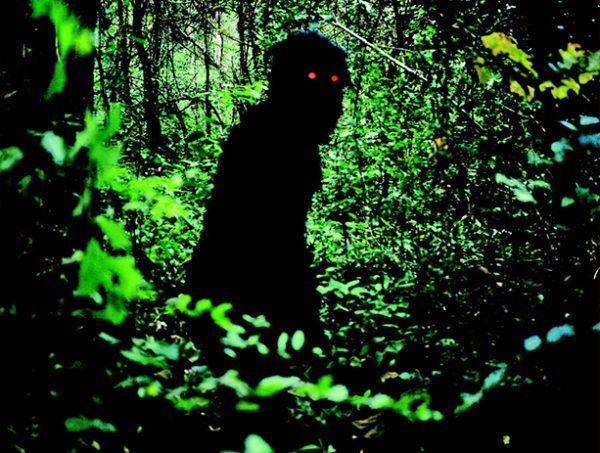
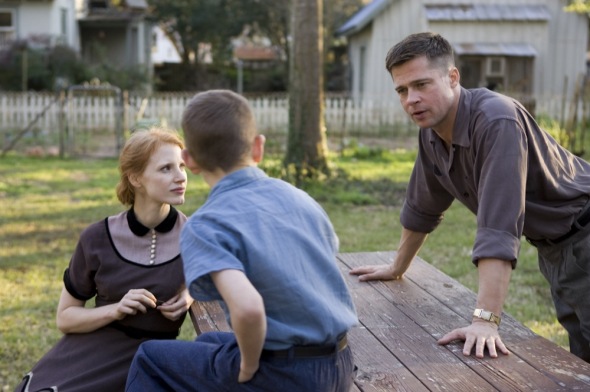
 The BAM series “Programmers’ Notebook: On Memory,” consisting of works involving creative, cinematic ways of the mind’s relationship with the past, continues August 28-30 with an unforgettable gem. As of 2005, iconoclastic writer-director Terrence Malick had made only five feature films in his forty-plus-year career, but his 2011 effort, The Tree of Life, is his very best. Following Badlands (1973), Days of Heaven (1978), The Thin Red Line (1998), and The New World (2005), The Tree of Life is an epic masterpiece of massive proportions, a stirring visual journey into the beginning of the universe, the end of the world, and beyond. The unconventional nonlinear narrative essentially tells the story of a middle-class Texas family having a difficult time coming to grips with the death of one of their sons in the military. Malick cuts between long flashbacks of Mr. and Mrs. O’Brien (Brad Pitt and Jessica Chastain) in the 1950s and 1960s, as they meet, marry, and raise their three boys, to the present, when Jack (Sean Penn), their eldest, now a successful architect, is still searching for answers. The sets by production designer Jack Fisk transport viewers from midcentury suburbia to the modern-day big city and a heavenly beach, all gorgeously shot by cinematographer Emmanuel Lubezki. Every frame is so beautiful, it’s as if they filmed the movie only at sunrise and sunset, the Golden Hour, when the light is at its most pure. The Tree of Life is about God and not God, about faith and belief, about evolution and creationism, about religion and the scientific world. The film opens with a quote from the Book of Job: “Where were you when I laid the earth’s foundation . . . while the morning stars sang together and all the sons of God shouted for joy?” Early on Mrs. O’Brien says in voice-over, “The nuns taught us there are two ways through life: The way of nature, and the way of grace. You have to choose which one to follow.” Malick doesn’t get caught up in those questions, instead focusing on the miracles of life and death and everything in between.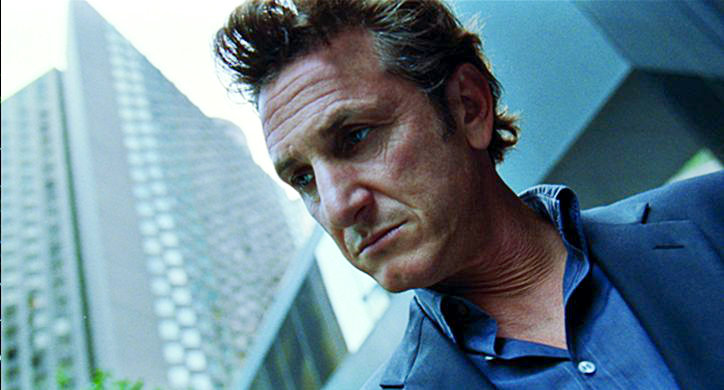
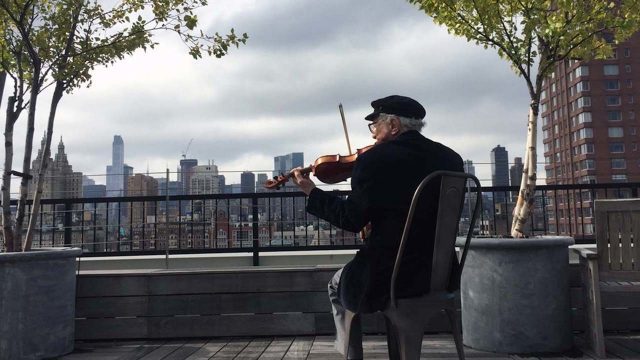
 I’ve always felt a deep connection to Fiddler on the Roof, one of the most popular and critically successful musicals in history. I was awed by the movie when I was a kid, listened over and over to the original Broadway cast recording (on cassette!), and have enjoyed several stage productions, including one at a Long Island synagogue when I was a teen, one