this week in film and television

FIDDLER: A MIRACLE OF MIRACLES

Fiddler

Fiddler on the Roof lyricist Sheldon Harnick plays the violin in new documentary about history of the show

FIDDLER: A MIRACLE OF MIRACLES (Max Lewkowicz, 2019)
Quad Cinema, 34 West 13th St. between Fifth & Sixth Aves., 212-255-2243
The Landmark at 57 West, 657 West 57th St. at Twelfth Ave.
Opens Friday, August 23
thefiddlerfilm.com

I’ve always felt a deep connection to Fiddler on the Roof, one of the most popular and critically successful musicals in history. I was awed by the movie when I was a kid, listened over and over to the original Broadway cast recording (on cassette!), and have enjoyed several stage productions, including one at a Long Island synagogue when I was a teen, one in Yiddish, and two on the Great White Way. I always assumed that it was because of my Eastern European Jewish roots; my grandparents on one side and great grandparents on the other escaped from pogroms in shtetls not unlike Anatevka, the small, tight-knit community in Ukraine where the show takes place. But as the new documentary Fiddler: A Miracle of Miracles reveals, the story is far more universal. “What is that that makes it speak in so many languages, and everybody thinks it’s about them,” Joel Grey, director of the smash Yiddish version running at Stage 42, says in the film. Theater critic Charles Isherwood points out, “Fiddler is really not just about violence that is visited on a single person but violence that is visited on an entire culture. Really it’s about what we now call ethnic cleansing, in the end, and these forces are still very much alive in the world. Bigotry, oppression, sometimes disguised as mere conservatism, it’s eerily and perhaps sadly relevant today.”

Fiddler

Producer Hal Prince explains the legacy of Fiddler in A Miracles of Miracles

In the documentary, director Max Lewkowicz (Underfire: The Untold Story of Pfc. Tony Vaccaro), whose mother is a Holocaust survivor, explores the creation of the Broadway musical, which was based on the Tevye the milkman stories by Sholem Aleichem and features a score by Jerry Bock, lyrics by Sheldon Harnick, book by Joseph Stein, and direction and choreography by Jerome Robbins, as well as examining its lasting international influence. He shifts between 1905, the time when the show is set; 1964, when it opened on Broadway; and today, where a production can be seen somewhere around the globe every day. He has amassed a treasure trove of archival footage, including old television appearances, a recording of Aleichem narrating one of his tales, a scene from the 1939 Yiddish drama Tevya, original Marc Chagall-inspired set designs by Boris Aronson, and the tape of music that Bock would send to Harnick so he could write the words (instead of working together at the piano).

He combines old interviews, photos, and clips of Bock, Stein, Robbins, and Tevye originator Zero Mostel with new interviews with Harnick (who plays a violin on a New York City roof), the late producer Harold Prince, violinist Itzhak Perlman, Fiddler fans Stephen Sondheim and Lin-Manuel Miranda, and numerous actors and directors affiliated with the show: Austin Pendleton and Joanna Merlin from the original 1964 cast, Topol and Norman Jewison (who is not Jewish) from the 1971 Oscar-winning film, Harvey Fierstein from the 2005-6 iteration, Danny Burstein, Jessica Hecht, Bartlett Sher, Adam Kantor, and Michael C. Bernardi — whose father, Herschel, portrayed Tevye on Broadway in 1964 and 1981 — from the 2016 version, and the current Yiddish Tevye, Steven Skybell. Authors Jan Lisa Huttner and Alisa Solomon put the story in sociopolitical context by relating it to the civil rights and women’s movements of the 1960s and ’70s.

Lewkowicz and editor Joseph Borruso also interweave footage from Fiddler productions in the Netherlands, Japan, Canada, Thailand, England, Brooklyn Middle School 447, and other locations, emphasizing again the universality of the story, particularly in light of today’s refugee crisis, the rise of anti-Semitism and racism, images of immigrant children being ripped out of their parents’ arms, and the cultural need to hold on to tradition and personal connection in the age of social media and the internet. “In moments of great upheaval, Fiddler is always going to seem relevant because the world is changing faster than we can understand,” Miranda, whose In the Heights was partially inspired by Fiddler, explains. “And that’s what the show’s about, and it’s intensely accessible because we are going through times of great change and great upheaval.” And, of course, there’s the music itself, as the film delves into such classic songs as “Matchmaker, Matchmaker,” “Sunrise, Sunset,” “Sabbath Prayer,” “Tradition,” “To Life,” “If I Were a Rich Man,” and “Do You Love Me?” Perhaps the best thing about Fiddler: A Miracle of Miracles, which opens today at the Quad and the Landmark at 57 West, is that it has given me an even greater appreciation of the musical’s endless wonders, which I didn’t think possible. I’ve also learned that it’s not just mine, but I guess I can share it with everyone else.

CHARLIE PARKER JAZZ FESTIVAL 2019

charlie parker

Multiple locations
August 21-25, free (some events require advance RSVP)
cityparksfoundation.org/charlieparker

City Parks Foundation’s twenty-seventh annual Charlie Parker Jazz Festival, a free five-day SummerStage salute to the Kansas City–born saxophonist known as Bird and Yardbird, celebrates the centennial of the Harlem Renaissance this year with two big concerts and satellite events. The highlights are the shows on August 24 in Marcus Garvey Park and August 25 at Tompkins Square Park, but there are also panel discussions, film screenings, tributes to Clark Terry, Fred Hersch, and Art Blakey, and solo performances in intimate garden settings, some of which require advance RSVP. The festivities take place in Harlem, where Parker established himself as one of the greatest jazz saxophonists, and on the Lower East Side, where Parker lived from 1950-54, in a now-landmarked row house on Ave. B.

Wednesday, August 21
Native Soul Tribute to Clark Terry & Screening: Keep on Keepin’ On (Alan Hicks, 2014), Hansborough Recreation Center Rooftop, advance RSVP required (charlierparker@cityparksfoundation.org), concert at 6:00, screening at 7:45

Jazz in the Garden: Michael Marcus, 6BC Botanical Garden, 5:30

Thursday, August 22
Unpacking Jazz and Gender Justice, with Terri Lynne Carrington and Aja Burrell Wood, the National Jazz Museum in Harlem, advance RSVP required (charlierparker@cityparksfoundation.org), 12:00

An Evening at Langston’s: Celebrating the Centennial Anniversary of the Harlem Renaissance, with Candice Hoyes, the Langston Hughes House, advance RSVP required (events@itooarts.com), 7:00

Screening: The Ballad of Fred Hersch (Charlotte Lagarde & Carrie Lozano, 2016), followed by a Q&A with the directors, Maysles Documentary Center, advance RSVP required (charlierparker@cityparksfoundation.org), 7:00

Friday, August 23
Jazz in the Garden: René Mclean, Harlem Rose Garden, 5:30

Harlem 100: Mwenso and the Shakes, Brianna Thomas, Vuyo Sotashe, Fred Wesley, and Jazzmobile Presents: Winard Harper & Jeli Posse, Marcus Garvey Park, 7:00

Saturday, August 24
Dee Dee Bridgewater, Ravi Coltrane, Quiana Lynell, and Reclamation: Camille Thurman, Nikara Warren and Brandee Younger, Marcus Garvey Park, 3:00

Sunday, August 25
Carl Allen’s Art Blakey Tribute, George Coleman Trio, Fred Hersch, and Lakecia Benjamin, Tompkins Square Park, 3:00

WHAT YOU GONNA DO WHEN THE WORLD’S ON FIRE?

What You Gonna Do When the World’s on Fire?

Titus Turner looks up to his older brother, Ronaldo King, in What You Gonna Do When the World’s on Fire?

WHAT YOU GONNA DO WHEN THE WORLD’S ON FIRE (Roberto Minervini, 2018)
Film Society of Lincoln Center
Elinor Bunin Munroe Film Center, Francesca Beale Theater, Howard Gilman Theater
144 West 65th St. between Broadway & Amsterdam Aves.
Opens Friday, August 16
212-875-5050
www.kimstim.com
www.filmlinc.org

Roberto Minervini follows up his Texas Trilogy – The Passage, Low Tide, and Stop the Pounding Heart – with the powerful sociopolitical call to action, What You Gonna Do When the World’s on Fire? The film is shot in sharp, distinctive black-and-white by cinematographer Diego Romero Suarez-Llanos so that it looks like a fictional work from the civil rights era, but it is an all-too-real documentary that shows what’s happening in the US today, even though far too many Americans would deny the inherent realities the movie depicts. Italian-born director Minervini, who is based in the American south, tells four poignant stories steeped in oppression: Judy Hill is struggling to get by, running a bar that has become an important meeting place for the Tremé community while also caring for her elderly mother, Dorothy; Ashlei King hopes that her young sons, fourteen-year-old Ronaldo King and nine-year-old Titus Turner, come back safe after going out to play in a junkyard; Mardi Gras Indian Chief Kevin Goodman melds black and Native American traditions in changing times; and Krystal Muhammad and the New Black Panther Party for Self Defense protest the killings of two African American men at the hands of police.

What You Gonna Do When the World’s on Fire?

The New Black Panther Party for Self Defense fights the power in What You Gonna Do When the World’s on Fire?

Beautifully edited by Marie-Hélène Dozo, the film, which was shot in Louisiana and Mississippi in the summer of 2017, captures the continuing results of institutionalized, systemic racism and income inequality in the United States. “We’ve been set free, but we’re still being slaves,” Judy Hill proclaims. “Nowadays, people don’t fight; they like to shoot,” Ronaldo teaches Titus. What You Gonna Do When the World’s on Fire? is the kind of film that should be widely seen, including in schools around the country, to highlight the everyday impact of racial injustice. There are no confessionals in the film, no so-called experts discussing socioeconomic issues; instead, it’s real people, struggling to survive and fighting the status quo and America’s failure to effectively face and deal with its original sin. The most controversial section involves the New Black Panther Party for Self Defense, the members of which march through town declaring, “Black power!” When they face off against the police, they make some arguable choices, but what’s most important is what has taken place to even put them in that situation. There’s a good reason why the title, What You Gonna Do When the World’s on Fire?, is framed as a question, one that every one of us should look in the mirror and answer for ourselves.

What You Gonna Do When the World’s on Fire?

Judy Hill struggles to get by in poignant, important film by Roberto Minervini What You Gonna Do When the World’s on Fire?

A selection of the New York Film Festival and numerous other festivals, What You Gonna Do When the World’s on Fire? opens August 16 at Lincoln Center, with Minervini participating in Q&As with Hill and Muhammad on August 16-17 at 3:30, and Minervini will introduce the 9:00 screening on August 16 with Hill and the 6:00 screening on August 17 with Hill and Muhammad. There will also be a reception after the 6:00 and 9:00 screenings on August 16.

VISION PORTRAITS

(photo by Kjerstin Rossi)

Filmmaker Rodney Evans explores his increasing blindness in Vision Portraits (photo by Kjerstin Rossi)

VISION PORTRAITS (Rodney Evans, 2019)
Metrograph
7 Ludlow St. between Canal & Hester Sts.
Opens Friday, August 9
212-660-0312
metrograph.com
www.thefilmcollaborative.org

“In a lot of ways, I feel like I’m just looking for guidance in how to be a blind artist,” filmmaker Rodney Evans says in Vision Portraits, his remarkable new documentary opening August 9 at Metrograph. Evans follows three artists as they deal with severe visual impairment but refuse to give up on their dreams as he seeks experimental treatment for his retinitis pigmentosa. Manhattan photographer John Dugdale lost most of his eyesight from CMV retinitis when he was thirty-two but is using his supposed disability to his advantage, taking stunning photos bathed in blue, inspired by the aurora borealis he sees when he closes his eyes. “Proving to myself that I could still function in a way that was not expected of a blind person was really gonna be the thing,” he says. “It’s fun to live in this bliss.” Bronx dancer Kayla Hamilton was born with no vision in one eye and developed iritis and glaucoma in the other, but she is shown working on a new piece called Nearly Sighted that incorporates the audience into her story. “How can I use my art form as a way of sharing what it is that I’m experiencing?” she asks.

(photo by Kjerstin Rossi)

Dancer Kayla Hamilton is not about to let visual impairment get in the way of her career (photo by Kjerstin Rossi)

Canadian writer Ryan Knighton lost his eyesight on his eighteenth birthday due to retinitis pigmentosa, but he teaches at a college and presents short stories about his condition at literary gatherings. “I had that moment where I had a point of view now, like, I realized blindness is a point of view on the world; it’s not something I should avoid, it’s something I should look from, and I should make it my writerly point of view,” Knighton explains. Meanwhile, Evans heads to the Restore Vision Clinic in Berlin to see if Dr. Anton Fedorov can stop or reverse his visual impairment, which is getting worse.

Vision Portraits is an intimate, honest look at eyesight and art and how people adapt to what could have been devastating situations. Evans, who wrote and directed the narrative features Brother to Brother and The Happy Sad, also includes animated segments that attempt to replicate what the subjects see, from slivers of light to star-laden alternate universes. Metrograph is hosting several postscreening Q&As opening weekend, with Evans, Hamilton and cinematographer Mark Tumas, moderated by Sabrina Schmidt-Gordon, on Friday at 7:00; with Evans, moderated by Yance Ford, on Friday at 9:00; with Evans, moderated by Imani Barbarin, on Saturday at 7:45; and with Evans, moderated by Debra Granik, on Sunday at 4:00.

ABBAS KIAROSTAMI — A RETROSPECTIVE: FIVE DEDICATED TO OZU

FIVE DEDICATED TO OZU

Five Dedicated to Ozu is screening as part of tribute to Abbas Kiarostami at IFC Center

FIVE DEDICATED TO OZU (Abbas Kiarostami, 2003)
IFC Center
323 Sixth Ave. at West Third St.
Saturday, August 10, 7:30, and Wednesday, August 14, 5:05
Series continues through August 14
212-924-7771
www.ifccenter.com

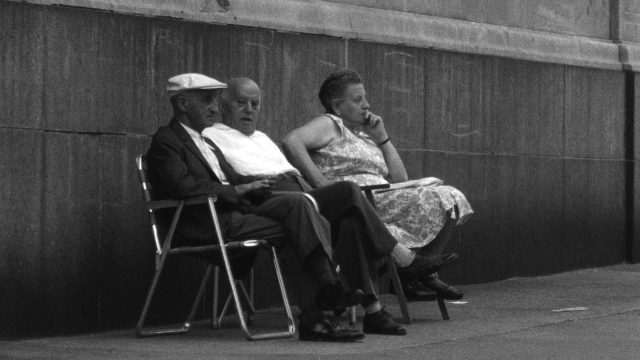
We first saw Abbas Kiarostami’s gorgeous five-part film Five Dedicated to Ozu at the Iranian director’s 2007 multidimensional MoMA exhibit, “Image Maker,” where all five segments ran continuously and simultaneously in five semiprivate partitioned spaces, each with its own comfy bench. The film as a whole, which is composed of static shots on a beach in Galicia, are dedicated to Japanese director Yasujirō Ozu, whose films attempted to catch the reality of human existence in all its simplicity. In the first episode, the coming waves threaten a piece of driftwood; we dare you not to create your own narrative in your head once the wood is split apart. (By the way, this is the only part of the film that includes any camera movement at all, as Kiarostami opts to follow the driftwood for one short moment.) For the second scene, the camera is moved to the boardwalk, with people passing to the right and left as the surf continues to crash onto the shore; this is the least compelling of the five pieces. Back on the beach for the third part, the camera finds a group of stray dogs in the distance, nestled together by the water; again, as one dog gets up and moves away, left to himself, you’ll create your own ideas about what is really happening. Next is the funniest section of the movie, as a long line of ducks don’t know whether they’re coming or going, but they do so determinedly. Finally, the last scene takes place at night, as the moon glistens in a dark sky as the sounds of frogs and nature envelop this small part of the earth. Relax and let your mind wander during this fascinating and fun cinematic experience that we found exhilarating as a single work — but we also loved how it was installed at MoMA, where you could sit down with any of the films at any time and just let them take you away. Five Dedicated to Ozu is screening the conventional way on August 10 and 14 in IFC’s comprehensive series “Abbas Kiarostami: A Retrospective,” which continues through August 15 with such other films by the Iranian director as The Traveler, Close-Up, Like Someone in Love, 24 Frames, and numerous shorts.

ABBAS KIAROSTAMI — A RETROSPECTIVE: CLOSE-UP

Close-Up

Hossain Sabzian has to explain why he impersonated Mohsen Makhmalbaf in Abbas Kiarostami’s Close-Up

CLOSE-UP (کلوزآپ ، نمای نزدیک‎) (Abbas Kiarostami, 1990)
IFC Center
323 Sixth Ave. at West Third St.
Wednesday, August 7, 7:50, Saturday, August 10, 1:10, Monday, August 12, 1:05, Tuesday, August 13, 7:30
Series continues through August 15
212-924-7771
www.ifccenter.com/films/close-up

In his 1996 short Opening Day for Close-Up, Italian actor-writer-director Nanni Moretti plays a theater manager preparing to show Abbas Kiarostami’s 1990 masterpiece, Close-Up. As the first screening approaches, he worries about the parking situation, the size of the ad in the local paper, the specific angle the projectionist is using, the precise minute when the film should start, how it’s going to compete with big Hollywood blockbusters, and how one of his employees is handling phone calls. “The film is about the power of cinema. Let’s be a little more enticing,” he tells her. It won’t take much enticing to get people to show up at IFC Center to see Close-Up, which is screening August 7, 10, 12, and 13 in the exhaustive, comprehensive series “Abbas Kiarostami: A Retrospective.”

In 1989, Kiarostami read about a strange case that was unfolding: A man named Hossain Sabzian had been arrested for impersonating Iranian auteur Mohsen Makhmalbaf, convincing the Ahankhah family that he was Makhmalbaf and that he was going to make a movie with them in their house. Kiarostami immediately turned his attention to the story, meeting with Sabzian in prison, persuading judge Haj Ali Reza Ahmadi to let his crew film the trial, and getting all the participants, including Sabzian, Ahmadi, journalist Hossain Farazmand, and the Ahankhahs — husband and father Abolfazl, his wife, Mahrokh, and their sons, Mehrdad and Monoochehr — to allow themselves not only to be filmed going forward but to re-create specific scenes together. Thus, for example, Kiarostami restages Mahrokh’s initial encounter with Sabzian on a bus, where they talk about Makhmalbaf’s The Cyclist, and Sabzian’s arrest is also performed, complete with soldier (Mohammad Ali Barrati) and sergeant (Davood Goodarzi).

Abbas Kiarostami

Abbas Kiarostami on the set of his 1990 masterpiece, Close-Up

It’s often difficult to tell what is happening in the present and what has been remade from the past, which is a significant part of the film’s charm. The trial scene is an eye-opener as we watch the Iranian justice system at work; Kiarostami shoots the scene with different equipment, resulting in a grainier texture. Part of the boom mic is often visible, further blurring the lines between fiction and nonfiction, reminding us that this is a film. Kiarostami also injects some pure poetry, most beautifully when the taxi driver (Hooshang Shamaei) picks a few flowers outside the Ahankhahs’ home, then kicks a green and pink aerosol can that cinematographer Ali Reza Zarrindast follows as it clinks noisily down the street. Close-Up is much more than a celebration of the power of cinema; it is a magisterial film about what makes us profoundly human. (You can find out more about Sabzian in Moslem Mansouri and Mahmoud Chokrollahi’s 1996 Close-Up Long Shot.) “Abbas Kiarostami: A Retrospective” continues through August 15 with such other films by the Iranian director as Through the Olive Trees, The Wind Will Carry Us, Taste of Cherry, Ten, and numerous shorts.

ABBAS KIAROSTAMI — A RETROSPECTIVE: LIKE SOMEONE IN LOVE

The lives of three very different individuals intertwine in Abbas Kiarostami’s remarkable Like Someone in Love

LIKE SOMEONE IN LOVE (Abbas Kiarostami, 2012)
IFC Center
323 Sixth Ave. at West Third St.
Tuesday, August 6, 12:55, Friday, August 9, 1:05, and Tuesday, August 13, 12:30
Series continues through August 15
212-924-7771
www.ifccenter.com

Following the Tuscany-set Certified Copy, his first film made outside of his home country, master Iranian auteur Abbas Kiarostami headed to Japan for the beautifully told Like Someone in Love. Rin Takanashi stars as Akiko, a sociology student supporting herself as an escort working for bar owner and pimp Hiroshi (Denden). An older, classy businessman, Hiroshi insists that Akiko is the only person to handle a certain client, so, despite her loud objections, she is put in a cab and taken to meet Takashi (Tadashi Okuno), an elderly professor who seems to just want some company. But soon Akiko unwittingly puts the gentle old man in the middle of her complicated life, which includes her extremely jealous and potentially violent boyfriend, Noriaki (Ryō Kase), and a surprise visit from her grandmother (Kaneko Kubota). Taking its title from the song made famous by, among others, Ella Fitzgerald, Like Someone in Love is an intelligent character-driven narrative that investigates different forms of love and romance in unique and engaging ways. Kiarostami (Taste of Cherry, Close-Up) and cinematographer Katsumi Yanagijima, who has worked on numerous films by Takeshi Kitano, establish their visual style from the very beginning, as an unseen woman, later revealed to be Akiko, is on the phone lying to her abusive boyfriend about where she is, the camera not moving for extended periods of time as people bustle around her in a crowded bar.

As is often the case with Kiarostami, much of the film takes place in close quarters, including many in cars, both moving and parked, forcing characters to have to deal with one another and face certain realities they might otherwise avoid. Takanashi is excellent as Akiko, a young woman trapped in several bad situations of her own making, but octogenarian Okuno steals the show in the first lead role of a long career that has primarily consisted of being an extra. The soft look in his eyes, the tender way he shuffles through his apartment, and his very careful diction are simply captivating. Despite his outstanding performance, Okuno said at the time that he was committed to returning to the background in future films, shunning the limelight, but he did star in one more film, Yûichi Onuma’s Kuujin in 2016. A music-filled tale that at times evokes the more serious work of Woody Allen, another director most associated with a home base but who made movies in other cities for a lengthy period, Like Someone in Love is like a great jazz song, especially one in which the notes that are not played are more important than those that are. The film is screening August 6, 9, and 13 in IFC’s comprehensive series “Abbas Kiarostami: A Retrospective,” which continues through August 15 with such other films by Kiarostami, who died in 2016 at the age of seventy-six, as Homework, 10 on Ten, ABC Africa, Shirin, and numerous shorts.