this week in film and television

CURATORS’ CHOICE: WHAT YOU GONNA DO WHEN THE WORLD’S ON FIRE?

What You Gonna Do When the World’s on Fire?

Titus Turner looks up to his older brother, Ronaldo King, in What You Gonna Do When the World’s on Fire?

WHAT YOU GONNA DO WHEN THE WORLD’S ON FIRE (Roberto Minervini, 2018)
Museum of the Moving Image
35th Ave. at 36th St., Astoria
Friday, December 20, 7:30
Series continues through January 12
718-777-6888
www.movingimage.us
www.kimstim.com

Roberto Minervini follows up his Texas Trilogy – The Passage, Low Tide, and Stop the Pounding Heart – with the powerful sociopolitical call to action What You Gonna Do When the World’s on Fire?, which is screening December 20 in the Museum of the Moving Image’s annual series “Curators’ Choice,” a collection of the best works of the past twelve months, which curator Eric Hynes and assistant curator Edo Choi call “among the best film years in memory.”

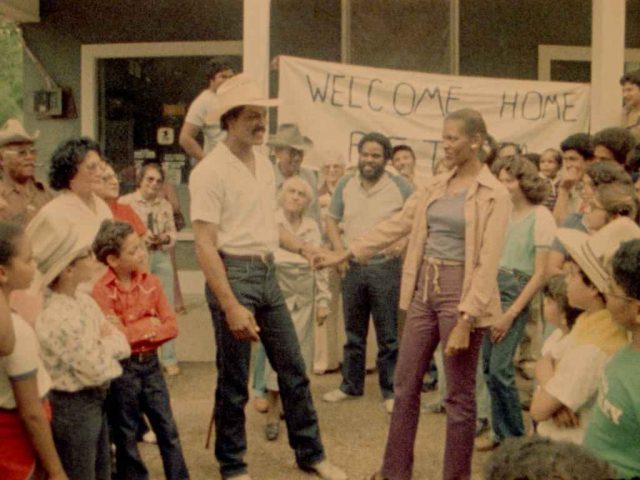
What You Gonna Do When the World’s on Fire? is shot in sharp, distinctive black-and-white by cinematographer Diego Romero Suarez-Llanos so that it looks like a fictional work from the civil rights era, but it is an all-too-real documentary that shows what’s happening in the US today, even though far too many Americans would deny the inherent realities the movie depicts. Italian-born director Minervini, who is based in the American south, tells four poignant stories steeped in oppression: Judy Hill is struggling to get by, running a bar that has become an important meeting place for the Tremé community while also caring for her elderly mother, Dorothy; Ashlei King hopes that her young sons, fourteen-year-old Ronaldo King and nine-year-old Titus Turner, come back safe after going out to play in a junkyard; Mardi Gras Indian Chief Kevin Goodman melds black and Native American traditions in changing times; and Krystal Muhammad and the New Black Panther Party for Self Defense protest the killings of two African American men at the hands of police.

What You Gonna Do When the World’s on Fire?

The New Black Panther Party for Self Defense fights the power in What You Gonna Do When the World’s on Fire?

Beautifully edited by Marie-Hélène Dozo, the film, which was shot in Louisiana and Mississippi in the summer of 2017, captures the continuing results of institutionalized, systemic racism and income inequality in the United States. “We’ve been set free, but we’re still being slaves,” Judy Hill proclaims. “Nowadays, people don’t fight; they like to shoot,” Ronaldo teaches Titus. What You Gonna Do When the World’s on Fire? is the kind of film that should be widely seen, including in schools around the country, to highlight the everyday impact of racial injustice. There are no confessionals in the film, no so-called experts discussing socioeconomic issues; instead, it’s real people, struggling to survive and fighting the status quo and America’s failure to effectively face and deal with its original sin. The most controversial section involves the New Black Panther Party for Self Defense, the members of which march through town declaring, “Black power!” When they face off against the police, they make some arguable choices, but what’s most important is what has taken place to even put them in that situation. There’s a good reason why the title, What You Gonna Do When the World’s on Fire?, is framed as a question, one that every one of us should look in the mirror and answer for ourselves.

What You Gonna Do When the World’s on Fire?

Judy Hill struggles to get by in poignant, important film by Roberto Minervini What You Gonna Do When the World’s on Fire?

“Curators’ Choice” continues through January 12 with such other 2019 popular and little-seen gems as Quentin Tarantino’s Once Upon a Time . . . in Hollywood, James Gray’s Ad Astra, Kent Jones’s Diane, and the director’s cut of Ari Aster’s Midsommar and features Q&As with Jones, Aster, Penny Lane (Hail Satan?), Alex Ross Perry (Her Smell), Brett Story (The Hottest August), Nathan Silver, Cindy Silver, and Jarred Alterman from Cutting My Mother, and Julia Reichert, Steve Bognar, and Jeff Reichert from American Factory.

MIDNIGHT FAMILY

Juan Ochoa in Midnight Family

EMT Juan Ochoa deals with corrupt police in Luke Lorentzen’s Midnight Family

MIDNIGHT FAMILY (Luke Lorentzen, 2019)
Metrograph
7 Ludlow St. between Canal & Hester Sts.
Opens Friday, December 6
212-660-0312
metrograph.com
midnightfamilyfilm.com

Following nearly 120 screenings at film festivals around the world and winning more than two dozen awards, Luke Lorentzen’s spellbinding documentary Midnight Family opens December 6 for a weeklong run at Metrograph. The San Francisco–based Stanford grad initially went south of the border to make a different movie, but after meeting the Ochoa family, he quickly changed direction, embedding himself for six months over three years with Fernando (Fer) Ochoa and his two sons, Juan, who is now seventeen, and Josué, now ten, riding along with them in their private ambulance as they roam around Mexico City searching for hurt people in desperate need of assistance. The film announces at the beginning that there are only about forty-five government ambulances for nine million people in the city, so a slew of independently operated vehicles use radio scanners and police tips to race toward scenes of accidents so they can take victims to nearby hospitals and get paid for their efforts. However, they are not necessarily properly trained EMTs, and their ambulances are often not registered — the Mexican health-care system is in such disarray that there is little if any oversight anywhere — and if the people they pick up are poor, they don’t collect on the bill.

But the Ochoas, who named their business Med Care, soldier on, going out night after night. They are truly concerned about helping men, women, and children who require medical care, even if they don’t always know the best methods to treat them while speeding toward either a public or private hospital — sometimes making the decision based on whether they have a deal with that hospital to get some cash in exchange for delivering patients. There’s a good reason why it says on their ambulance: “Urgencias Basicas,” which means “basic emergencies.”

Lorentzen expertly unfolds the narrative, as the emergencies start with a broken nose and build up to much more serious health situations. It plays out like a thriller, first with the Ochoas racing through crowded streets and on sidewalks, trying to get to the accident scene before another ambulance does, then roaring to the hospital while their new passenger is still alive. Serving as producer, director, cinematographer, and editor, Lorentzen uses two Sony FS-7s, one mounted on the windshield facing in, the other either handheld or on a tripod in the back, making viewers feel like they’re in the ambulance, experiencing the breathtaking, claustrophobic nature of the Ochoas’ everyday experiences, enhanced by Matías Barberis’s immersive sound design and natural light, which is often quite beautiful, as street lamps and glowing gas stations add a magical quality to the darkness.

There are no talking heads, no experts discussing the health-care crisis, no pontificating about how bad things are. It’s just the Ochoas and their ambulance. Even when they take a break, Fer relaxes right in front of the vehicle, ready to jump into action if a call comes in. “I’d love to take just one night off to show people how screwed they’d be without us. This city would be a mess without private ambulances,” Juan says. Even with them, it’s quite a mess, as Lorentzen does not shy away from the ethical questions raised by the Ochoas’ modus operandi. But in the end, Midnight Family is a gripping and powerful look at the struggles to get quality health care and make a living in Mexico while also evoking the countless medical issues that are prevalent around the world — and in America too.

LITTLE JOE

Little Joe

Alice Woodard (Emily Beecham) surveys her creation in Jessica Hausner’s Little Joe

LITTLE JOE (Jessica Hausner, 2019)
Quad Cinema
34 West 13th St. between Fifth & Sixth Aves.
Opens Friday, December 6
212-255-2243
www.littlejoefilm.com
quadcinema.com

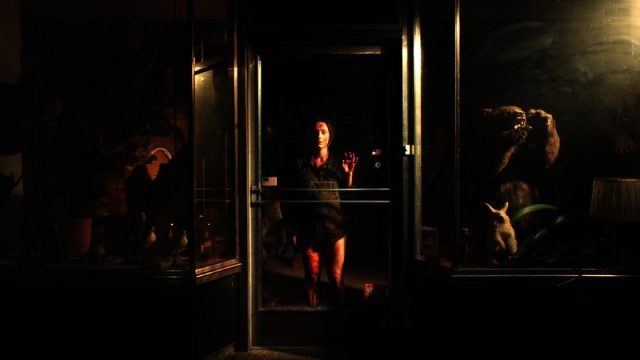
Emily Beecham was named Best Actress at Cannes for her role as a scientist and single mother who creates a different kind of monster in Jessica Hausner’s tense and gripping Little Joe, which opens Friday at the Quad. The Austrian director’s first English-language film was inspired directly by Frankenstein and Invasion of the Body Snatchers while evoking elements of Rosemary’s Baby and Little Shop of Horrors as it plays with horror, sci-fi, teen drama, and other genre conventions. Beecham is Alice Woodard, a plant breeder who is developing a flower she believes can make people happy through its “mood-lifting, antidepressant” scent. She names the new species Little Joe, after her son, Joe (Kit Connor), and even sneaks one plant home for him from the highly secured lab, which is blatantly against the rules.

She works at a science institute — a pristine environment with sterile-looking halls and researchers walking around in white lab coats — with Chris (Ben Whishaw), who has a crush on her, Bella (Kerry Fox), who goes everywhere with her dog, assistants Ric (Phénix Brossard) and Jasper (Andrew Rajan), and their boss, Karl (David Wilmot), who is hesitant to release the plant to the public until rigorous testing proves its safety, even though there’s an important plant show coming up where it would be perfect to introduce it. But after the lovely red blooms start emitting clouds of white spores, first Bella’s dog, then Alice’s coworkers and son, along with his friend Selma (Jessie-Mae Alonzo), begin changing.

Little Joe

Joe (Kit Connor) and his mother, Alice (Emily Beecham), sit down for takeout in stylized, atmospheric Little Joe

Written by Hausner (Lourdes, Amour Fou) with Géraldine Bajard, Little Joe is thick with foreboding, as scenes play out slowly to creepy electronic music by late Japanese composer Teiji Ito, who scored films by Maya Deren. The film is set in a timeless world of brightly lit, vividly contrasting pastel yellows, reds, greens, pinks, purples, and blues that conjure the 1970s but there are cell phones; cinematographer Martin Gschlacht, editor Karina Ressler, costume designer Tanja Hausner (the director’s sister), and production designer Katharina Wöppermann invoke the atmosphere of such cult faves as auteurs John Carpenter and David Cronenberg and novelist Ira Levin — who wrote The Stepford Wives, The Boys from Brazil, and Rosemary’s Baby — as Alice soon finds herself fighting against what appears to be a spreading conspiracy, all the while exploring her fears with her understanding psychotherapist (Lindsay Duncan). Alice’s bowl-cut red hair is reminiscent of Mia Farrow’s in Rosemary’s Baby (and her last name, Woodard, is similar to Rosemary’s, Woodhouse). Like that classic horror film, Little Joe focuses on the concept of birth and parenthood from a female point of view; even as Alice tries to protect her scientific creation, she is attempting to hold on to her pubescent son as he and his father, Ivan (Sebastian Hulk), become closer. “The ability to reproduce is what gives every living being meaning,” Bella says.

Perhaps the scariest part of the film is how realistic it feels despite its heavily stylized artifice. Hausner, for her first English-language movie, consulted with neuroscientist James Fallon, biologist Hanns Hatt, and other experts to research the validity of her plot, particularly in an age where there is global controversy over the efficacy of genetically modified food and animal and human cloning. Beecham (Sulphur and White, Into the Badlands) is superb as Alice, a stand-in for all of us, someone who just wants to bring happiness to the world but, in this case, may not fully understand the price it comes with.

FIRST SATURDAYS: BEST OF THE BOROUGH

Tuesday_Smillie_S.T.A.R._2000

Tuesday Smillie, S.T.A.R., watercolor, collage on board, 2012 (courtesy of the artist / © Tuesday Smillie)

Brooklyn Museum
200 Eastern Parkway at Washington St.
Saturday, December 7, free (some events require advance tickets), 5:00 – 11:00
212-864-5400
www.brooklynmuseum.org

The Brooklyn Museum shows off the best of the borough in the December edition of its free First Saturday program. There will be live performances by Los Hacheros, Gemma, DJ Laylo, Adrian Daniel, and drag collective Switch n’ Play (featuring Divina GranSparkle, K.James, Miss Malice, Nyx Nocturne, Pearl Harbor, and Vigor Mortis with special guest Heart Crimson); Visual AIDS screenings of short films commemorating the annual Day With(out) Art, followed by a conversation between filmmakers Iman Shervington and Derrick Woods-Morrow, moderated by writer Mathew Rodriguez; a book talk on Elia Alba’s The Supper Club with Sur Rodney (Sur) and Jack Waters, focusing on the conversation from the book that asks “What Would an HIV Doula Do?”; a curator tour of the Arts of Japan galleries with Joan Cummins; teen apprentice pop-up gallery talks in “Nobody Promised You Tomorrow: Art 50 Years After Stonewall”; a night market with handmade artisanal products; and a poetry reading and book signing by Brooklyn poet laureate Tina Chang from her latest book, Hybrida. In addition, the galleries will be open late so you can check out “Garry Winogrand: Color,” “Nobody Promised You Tomorrow: Art 50 Years After Stonewall,” “yasiin bey: Negus,” “One: Xu Bing,” “Pierre Cardin: Future Fashion,” “JR: Chronicles,” and more.

CHARLOTTE FOREVER — GAINSBOURG ON FILM: MELANCHOLIA

Justine (Kirsten Dunst) faces the end of the world in Lars von Trier’s dazzling Melancholia

CinéSalon: MELANCHOLIA (Lars von Trier, 2011)
French Institute Alliance Française, Florence Gould Hall
55 East 59th St. between Madison & Park Aves.
Tuesday, December 3, 7:30
Series continues Tuesday nights through December 17
212-355-6100
fiaf.org

Danish writer-director Lars von Trier has nothing less than the end of the world on his mind in his controversial 2011 drama, Melancholia, which is screening December 3 at 7:30 in the FIAF CinéSalon series “Charlotte Forever: Gainsbourg on Film.” Yet another of Von Trier’s love-it-or-hate-it cinematic forays opens with epic Kubrickian grandeur, introducing characters in marvelously composed slow-motion and still shots (courtesy of cinematographer Manuel Alberto Claro) as an apocalyptic collision threatens the earth and a Wagner overture dominates the soundtrack. Kirsten Dunst won the Best Actress award at Cannes for her portrayal of Justine, a seemingly carefree young woman celebrating her wedding day who soon turns out to be battling a debilitating mental illness. Her husband, Michael (Alexander Skarsgård), is madly in love with her and does not know quite what he has gotten himself into, especially as the partying continues and Justine’s motley crew of family and friends get caught up in various forms of intrigue, including Gaby, her marriage-hating mother (Charlotte Rampling), Dexter, her never serious father (John Hurt), Jack, her pompous boss (Stellan Skarsgård), Claire, her married sister (Charlotte Gainsbourg), and Claire’s filthy rich husband, John (Kiefer Sutherland), who is hosting the event at his massive waterfront estate.

While most of the film focuses on the wildly unpredictable Justine, the latter section turns its attention on Claire, who is terrified that a newly discovered planet named Melancholia is on its way to destroy the world. But Melancholia is not just about sadness, depression, family dysfunction, and the end of the world. It’s about the search for real love and truth, things that are disappearing from the earth by the minute. Justine works as an advertising copywriter, attaching tag lines to photographs to help sell product; at the wedding, Jack is determined to get one more great line of copy from her, even siccing his young, inexperienced nephew, Tim (Brady Corbet), on her to make sure she delivers. But what she ends up delivering is not what either man expected. Perhaps the only character who really sees what is going on is a wedding planner played by the great Udo Kier, who continually, and comically, shields his eyes from Justine, unable to watch the impending disaster. Just as in the film, as some characters get out their telescopes to watch the approaching planet and others refuse to look, there are sure to be many in the moviegoing public who will shield their eyes from Melancholia, choosing not to view yet another polemical film from a director who likes to antagonize his audience. They don’t know what they’re missing.

LE CONVERSAZIONI: FILMS OF MY LIFE

Laurie Anderson. Photography by Ebru Yildiz / Nicole Krauss. Photography by Goni Riskin.

Laurie Anderson and Nicole Krauss will be at the Morgan Library on December 5 for latest Le Conversazioni presentation (photos by Ebru Yildiz and Goni Riskin)

Morgan Library & Museum
225 Madison Ave. at 36th St.
Thursday, December 5, $20, 7:00
212-685-0008
www.themorgan.org

The ongoing series “Le Conversazioni: Films of My Life” continues December 5 at the Morgan Library with Laurie Anderson and Nicole Krauss sitting down for a discussion with moderator Antonio Monda, the artistic director and cofounder of Le Conversazioni, an Italian festival started in 2006 dedicated to literature but which has since spread to include other disciplines. Anderson is an Illinois-born, New York-based, Grammy-winning musician, filmmaker, composer, and multimedia performance and spoken-word artist who has released such records as Big Science and Mister Heartbreak, made such films as Home of the Brave and Heart of a Dog, and staged such cutting-edge shows as United States Live, Moby-Dick, and The End of the Moon. Krauss is the Manhattan-born award-winning author of Man Walks into a Room, The History of Love, Great House, and Forest Dark. They will be discussing films that influenced their work. The 7:00 event is being held in conjunction with the Morgan exhibition “Verdi: Creating Otello and Falstaff — Highlights from the Ricordi Archive,” which will be open at 6:00 for ticket holders.

SHOOTING THE MAFIA

Shooting the Mafia

Letizia Battaglia’s stunning photographs of the Cosa Nostra are shown in Shooting the Mafia

SHOOTING THE MAFIA (Kim Longinotto, 2019)
Quad Cinema
34 West 13th St. between Fifth & Sixth Aves.
Through December 5
212-255-2243
quadcinema.com

Palermo native Letizia Battaglia took a major turn at the midpoint of her life, becoming a photojournalist at the age of forty, concentrating on brutal crime scenes often involving the Mafia. Now, at the age of eighty-four, her engrossing story is being told in the documentary Shooting the Mafia. The first female photographer to work for a daily Italian newspaper, Battaglia is a bold presence, dominating the screen, displaying a series of distinctive hair colors as she talks about her life and career, discussing her love affair with photography. “The camera changed my life. I began to find myself. Before that, I wasn’t a real person,” she tells director Kim Longinotto. But she wasn’t taking pictures of death for the thrill of it, or for sensationalism. She was determined to show everyone what was happening in Sicily, how the mob operated, leaving a bloody trail behind it as the police, the courts, and the local community looked away. “Photographing trauma is embarrassing. You love these people, but you have to take photos. I couldn’t tell them I was doing it with love,” she says while also explaining that people should not be ruled by fear.

Shooting the Mafia

The fearless Letizia Battaglia takes on the Palermo mob in Shooting the Mafia

At one point, in the town of Corleone, she sets up an outdoor exhibit of her black-and-white photos of Mafia killings and suspected Cosa Nostra leaders; showing such images in public breaks the code of silence and puts her own safety at risk as she receives death threats. She also enters politics as a Green Party councilor. “I wanted to build a better society,” she says. The latter parts of the film focus on the 1986-87 efforts of judges and prosecutors Giovanni Falcone and Paolo Borsellino as they arrest and try a huge group of mafiosos led by Luciano Liggio and Totò Riina. Longinotto (Gaea Girls, Runaway, Dreamcatcher) and editor Ollie Huddleston interweave new interviews with Battaglia, her assistant, Maria Chiara Di Trapani, Battaglia’s former lovers and fellow photographers Santi Caleca, Eduardo Rebulla, and Franco Zecchin, and her current partner, Roberto Timperi, with archival news reports, home movies, family photographs, and clips from Alberto Lattuada’s 1951 film about sin and redemption, Anna. Through it all are Battaglia herself and her stunning photos, haunting pictures that you can’t look away from. “I want to take away the beauty that others see in them,” she says. “I want to destroy them.” Thank goodness she didn’t.