Kelly Reichardt’s First Cow is among the first films IFC Center will be screening inside for in-person audiences
IFC Center
323 Sixth Ave. at West Third St.
Friday, March 5 – Thursday, April 1, 2021 www.ifccenter.com
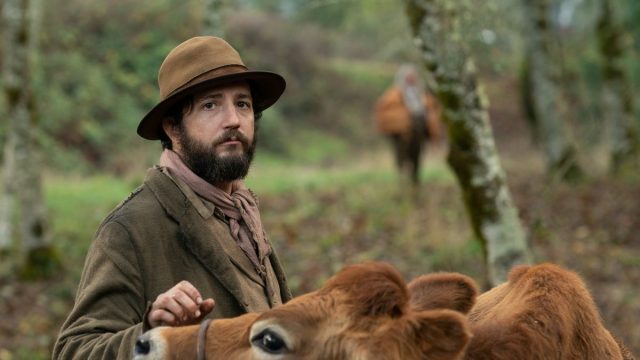
On March 5, IFC Center opened its doors to limited, masked, socially distanced audiences, allowing film lovers inside for the first time in nearly a year. They are kicking off this new chapter with four weeks of movies that have been available for streaming but could not previously be seen in a theater in New York City. “What’d We Miss?” consists of nearly two dozen films, each group being shown for one week. Through March 11, you can catch Thomas Vinterberg’s Another Round, Alexander Nanau’s Collective, Sam Pollard’s MLK/FBI (followed by a prerecorded Q&A with the director), Eliza Hittman’s Never Rarely Sometimes Always, and David France’s Welcome to Chechnya. The March 12-18 lineup comprises Francis Lee’s Ammonite, Kelly Reichardt’s gorgeously moving First Cow, Darius Marder’s hard-hitting Sound of Metal, Michael Almereyda’s Tesla, Garrett Bradley’s poignant Time, and Karen Maine’s Yes, God, Yes.
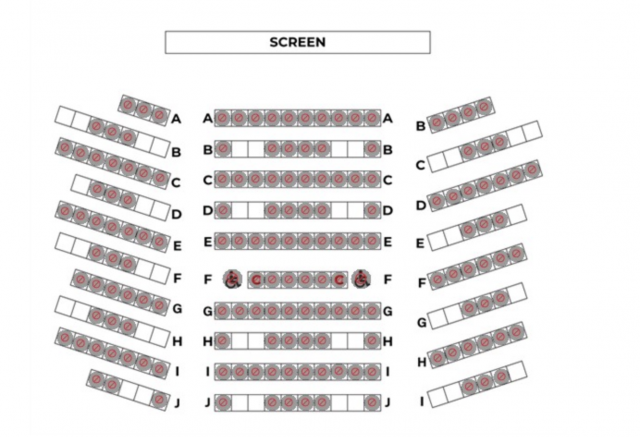
Seating choices are limited as theaters such as IFC Center reopen
From March 19 to 26, you can settle in for Bill and Turner Ross’s Bloody Nose, Empty Pockets, Kirsten Johnson’s bizarre, mesmerizing comedy-documentary Dick Johnson Is Dead, Pietro Marcello’s Martin Eden, Natalie Erika James’s Relic, Kiyoshi Kurosawa’s stunning To the Ends of the Earth, and Hirokazu Kore-Eda’s The Truth. And the roster for March 16 to April 1 is Kitty Green’s powerful The Assistant, Kleber Mendonca Filho and Juliano Dornelles’s beautifully strange and violent Bacurau, Miranda July’s eclectic and gripping Kajillionaire, Chad Hartigan’s Little Fish, Channing Godfrey’s Miss Juneteenth, and Sean Durkin’s The Nest.
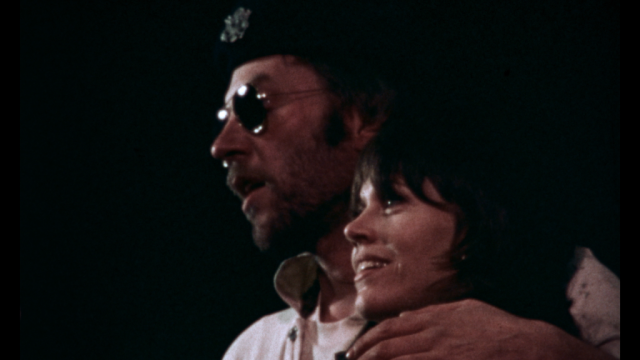
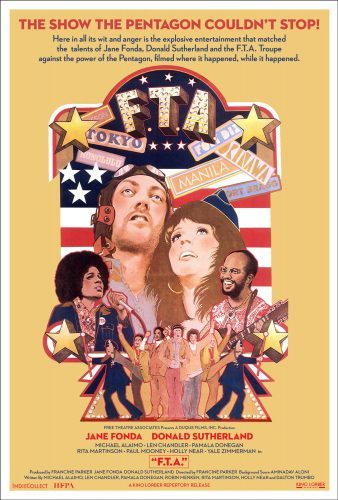
In 1972, actress Jane Fonda was excoriated for posing for a picture in North Vietnam sitting on an anti-aircraft gun with members of the Viet Cong, earning her the nickname “Hanoi Jane.” But the previous year, Fonda was being cheered wildly by US soldiers as she brought the antiwar F.T.A. tour to American military bases in Hawaii, Japan, Okinawa, and the Philippines. The tour, alternately known as “Fun, Travel, and Adventure,” “Free the Army,” “Free Theater Associates,” “Foxtrot Tango Alpha,” and “Fuck the Army,” featured comedy sketches and music with Fonda, fellow actors Donald Sutherland, Pamela Donegan, and Michael Alaimo, singer-songwriters Rita Martinson, Len Chandler, and Holly Near, and comedian Paul Mooney. Kino Marquee has just released a 4K restoration by IndieCollect of Francine Parker’s rarely screened, little-known 1972 film, F.T.A., documenting the Pacific section of the tour. The movie, about “the Show the Pentagon Couldn’t Stop!,” according to its ad campaign, ran for a week before being pulled from theaters by the distributor, who destroyed most copies.
“Histories of the Vietnam War all mention the widespread antiwar movement that was centered on college campuses. What most histories don’t tell you is that an equally widespread and powerful movement against the war existed inside the military itself,” Fonda says in a new video introduction, recorded in what has become a very familiar scene to viewers of Fire Drill Fridays, her weekly show about climate change and the Green New Deal, which the two-time Oscar and Emmy winner hosts in her home, sitting in front of a wall of photos.
The brainchild of court-martialed antiwar army doctor Howard Levy, F.T.A. was created specifically as “a counter show to the very pro-war, sexist” Bob Hope shows that were so popular, Fonda notes. She had just completed shooting Klute and so she invited her costar, Sutherland, who had previously appeared in such war films as The Dirty Dozen,M*A*S*H,Kelly’s Heroes, and Johnny Got His Gun, to join her. Working with material garnered from GI magazines in addition to skits written by the likes of Jules Feiffer and Herb Gardner, the revue ended up entertaining some 64,000 active-duty soldiers, sailors, marines, and air force men and women. But it wasn’t just fun and games; Fonda, Sutherland, and the rest of the team were there to make a point.
The film doesn’t open with comedy or music but with an unidentified GI saying, “I mean, how can you write your mother and tell her that her handsome young darling marine, her hero, is anti-military? But I sat down and I wrote her a letter and told her exactly how I felt, and my mother wrote back and she said she fully understood and she was happy I felt that way.” Parker follows that with several other servicemen and -women explaining that they were serving in the military either to avoid jail or because they didn’t have any other options, not because they wanted to fight Communism and defend democracy in Southeast Asia.
The narrative then shifts to the tour itself, an alternative modern vaudeville with political songs and short skits that skewer the government and military leaders, poking fun at the bureaucracy while focusing on the very real class, gender, and race differences that are inherent in war and society. “I went down to that base / They took one look at my face / And read out an order to bar me / I said, ‘Foxtrot Tango Alpha’ / ‘F-f-free the army,’” Fonda sings with Chandler and others.
Amid the laughs — and there are many of them, including one funny scene in which Sutherland and Alaimo play two sports announcers, both named Red, calling the war as if it were a football game — Parker, Fonda, and Sutherland speak with more antiwar soldiers, individually and at small gatherings, where they feel comfortable enough to express their views about chemical warfare and nuclear weapons. The crowd gets rocking singing along with such songs as Chandler’s “My Ass Is Mine” and “Set the Date!” and Robin Menken’s “Nothing Could Be Finer Than to Be in Indochina!” and “So Nice to Be a Member of the Military Class,” while Martinson’s “Soldier, We Love You,” about injustice and inequality, hits hard and Beverly Grant’s feminist rant, “I’m Tired of Bastards Fuckin’ Over Me,” brings down the house.
Produced by Parker, Fonda, and Sutherland, F.T.A. is a clarion call against the misuse of military power; it feels today much more than a mere time capsule celebrating opposition to one war fifty years ago but a shot across the bow for protestors everywhere fighting against the military-industrial complex, against corrupt government, in a country that’s more divided than ever and where identity politics have run rampant.
“You won’t see a change here [overseas] until you see a change back in the world [in the US],” one man says. “Gimme a cause that I can believe in and let me die for that,” another adds. After watching F.T.A., you’ll realize that 2021 is not as different from 1971 as you might have thought, or wanted it to be.
As a teenager, I first became aware of the government’s use of Agent Orange in Vietnam on a 1980 episode of Barney Miller, in which Sgt. Wojciehowicz (Max Gail) calls in representatives from the air force, the government, and a chemical company to explain the possibly dangerous side effects of the compound. (Their ultimate answer: They just don’t know.) In 1982, I was at Pier 84 for a benefit concert for victims of Agent Orange, featuring Ian Hunter, Todd Rundgren, Paul Butterfield, and John Cale. Nearly forty years later, it took another form of popular entertainment to make me aware that many of the problems associated with the herbicide have not gone away — and are still being denied by those using the vilified chemical compound.
“I was born in war, I grew up in war, and we are at war now,” French-Vietnamese activist, journalist, and author Tran To Nga says early on in Kate Taverna and Alan Adelson’s award-winning documentary, The People vs. Agent Orange, opening virtually March 5 at New Plaza Cinema here in New York City. The film details the long-lasting effects of the deployment of Agent Orange on four generations in Vietnam as well as the devastating impact it is having in the Pacific Northwest, specifically in Five Rivers in Oregon, where it is used for brush eradication. Yes, “is,” present tense.
Written and produced by Taverna, Adelson, and Véronique Bernard, directed by Taverna and Adelson (In Bed with Ulysses,Lodz Ghetto), and edited by Taverna, the revelatory film follows two converging story lines: Nga’s fight for justice in Paris and South Vietnam and environmentalist and author Carol Van Strum’s battle over the deployment of Agent Orange, made with the controversial chemical Dioxin (in 2,4,5-T and 2,4-D), in Oregon’s Five Rivers area between 1975 through today. Taverna and Adelson meet with human rights lawyers, including Bruce Anderson and Jonathan Moore working with Van Strum and Susan Swift, who formed the group Citizens Against Toxic Sprays (C.A.T.S.), and Bertrand Repolt, William Bourdon, and Amélie Lefebvre representing Nga, who know it won’t be easy, as the chemical companies (Dow, Monsanto) are not about to give in. “This case will be merciless,” Bourdon says.
The filmmakers incorporate archival footage of news reports and interviews from the 1960 and 1970s, whistleblower video taken by Oregon spray helicopter crew member Darryl Ivy in 2015, and home movies and photos of Van Strum, Nga, and their families, detailing the terrible personal tragedies they have suffered. Nga visits a children’s hospital where kids have severe birth defects, walks through the tiger cages in Poulo Condor Prison on Con Dao Island in Vietnam where her mother was tortured, and returns to the forest where she and her husband, Kieu Xuan Long, were married. Van Strum and Swift discuss how they have been followed, intimidated, and harassed by mysterious men in black cars. Retired Oregon physician Dr. Renee Stringham talks about how, after recording a serious increase in the number of birth defects among her patients, her family was threatened. And Heather Bower, founder of Children of Vietnam Veterans Health Alliance, shares her information about birth defects wile displaying her own.
Among the other experts adding their voices are David Zierler, author of The Invention of Ecocide, Peter Sills, lawyer and author of Toxic War, André Bouny, author of Agent Orange: Apocalypse Vietnam, former Senate majority leader Thomas Daschle, and retired air force scientist Dr. James Clary, who chokes up when he says, “I was getting so angry that my own government didn’t want to provide help to veterans who were suffering.” Nobody goes on the record to defend the chemical companies, although retired senior US district judge Jack Weinstein tiptoes around some pointed questions.
“Agent Orange spared no one,” Nga says. And the horrors are far from over. To find out more, you can watch two recent panel discussions featuring the filmmakers, Van Strum, and other activists, researchers, and journalists here.
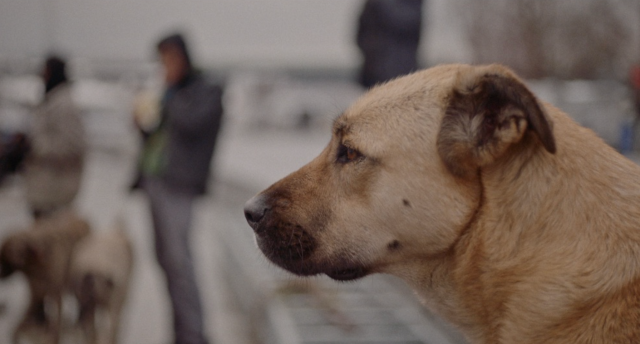
You can have Sounder, Old Yeller, and Lassie, cheer on Balto, Benji, and Beethoven. But the best movie dog ever is Keytin, the extraordinary golden mutt who is the star of Elizabeth Lo’s masterful feature-length debut, Stray. Lo follows the remarkable canine as she wanders through the streets of Istanbul and other parts of Turkey, living a dog’s life, in a place that until fairly recently would regularly round up strays and euthanize them mercilessly. Everywhere she goes, she meets up with people she knows and who love her, from a dock to a dangerous construction site; she also plays with such puppy pals as Nazar and Kartal. Keytin scavenges for food, cuddles up with homeless refugee children from Aleppo, relaxes amid traffic, and chases a cat, all with a look in her eyes that reveals great depth and understanding that humans can only dream of. The film was born out of loss; Lo notes in her director statement, “The impetus for Stray is personal. When my childhood dog died, I felt a quiet need to suppress my grief at his passing. I was shocked that something as personal as how my heart responds to the death of a loved one could be shaped by an external politics that defined him or ‘it’ as ‘valueless.’ As my grief evolved, I also saw how our moral conceptions of who or how much one matters can be in constant flux. This transformative moment is what propels Stray’s exploration into value, hierarchy, and sentience.”
The pandemic has only increased the meaning of pets in our lives, as if we needed more reasons to worship them. For many people, their dogs and cats have been their sole companions while sheltering in place, and it is devastating every time someone posts on social media that their dog or cat has passed — to say nothing of friends and relatives who have been stricken with the coronavirus and did not survive. Crouching down to get the dog’s perspective, Lo filmed the independent, purposeful Keytin for six months, with no choice but to let the confident canine guide the action as they encounter class, ethnic, and gender differences while making deep connections with everyone Keytin comes into contact with — a connection the audience will make as well, especially if they are watching the film at home, all alone. The soundtrack mixes a splendid score by Ali Helnwein with snippets of poignant conversation overheard on Keytin’s journeys, accompanied by occasional intertitles with wise, relevant quotes by Diogenes and Themistius, including “Human beings live artificially and hypocritically and would do well to study the dog.” As I said, Best. Movie. Dog. Ever. Stray begins streaming March 5 via Film Forum Virtual Cinema, complete with a conversation between Lo and filmmaker Rachel Grady and a Q&A with Lo and Joanne Yohannan from the North Shore Animal League, moderated by film critic Tomris Laffly.
Childhood friends David Shapiro and Leeds Atkinson search for the perfect slice — of pizza and life — in Untitled Pizza Movie (photo courtesy of Sundance Institute)
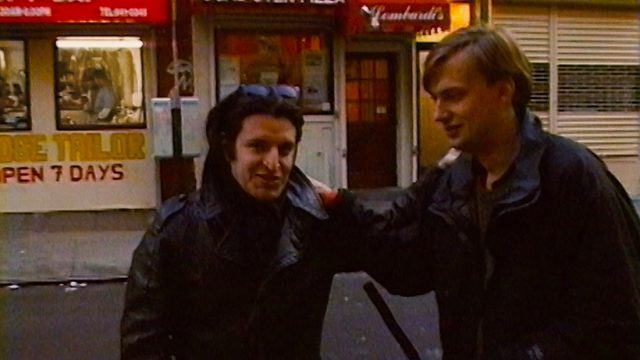
Who: David Shapiro, Jonathan Lethem, Matt Wolf, Scott Macaulay What: Q&As at live screenings in conjunction with online members-only release of seven-part Untitled Pizza Movie Where:Metrograph Digital When:Untitled Pizza Movie Part 1: Ice Cube Trays, Friday, February 26, 8:00; Untitled Pizza Movie Part 4: Zig Zag, Thursday, March 4, 8:00; Untitled Pizza Movie Part 5: The Natufian Culture of 9,000 BC, Saturday, March 6, 8:00 Why: “We had New York dreams, like the next Bohemian, but there was no hometown discount,” David Shapiro says in the first episode of the seven-part series Untitled Pizza Movie. This was the mid-1990s, and he and his childhood friend from Stuyvesant, Leeds Atkinson, went on a search for the best pizza in New York City, pretending to be with the Food Channel and showing up at restaurants with a caliper and cameraman Jonathan Kovel, stuffing themselves as they measured slices as if they knew what they were doing, speaking with the owners to get them to reveal some of their secrets. But what started as a quest for free food turned into a socially conscious adventure about their own lives as well as that of a New York City seeing so much of its past go by the wayside in the modern era, as Shapiro cuts back and forth in time. “I’m clouding this narrative with nostalgia, clinging to the rock by documenting fiction,” Shapiro explains. “We remember the stories we want to tell and misremember the ones that we don’t. Leeds and I were in denial; friends and cities are forever. We were making a movie, a movie to stop time. But then we met Bellucci.” New York City pizza aficionados will recognize that as being Andrew Bellucci, formerly of Lombardi’s before he was sent to prison; he is now out and just opened a slice joint in Astoria. Bellucci and Leeds become the centerpieces of the film.
Shapiro (Keep the River on Your Right,Missing People), who wrote, directed, edited, and produced the film, also meets with food and wine critic Eric Asimov, Drew Nieporent of Nobu, Anthony “Mummy” Barile of the much-lamented Three of Cups, lawyers, and members of Bellucci’s and Atkinson’s families, visiting some of the most famous pizza parlors in the city, driving through the streets and over bridges, playing in a band, and interspersing shots of various and sundry items spinning on a turntable. Along the way, it’s made clear that pizza is life. The series is being streamed February 27 through March 14 via Metrograph Digital, for members only. (Membership is only five bucks a month.) Each film — Part 1: Ice Cube Trays,Part 2: Eat to Win in the Elevator,Part 3: Pizza Purgatory,Part 4: Zig Zag,Part 5: The Natufian Culture of 9,000 BC,Part 6: Clams, and Part 7: Mars Bar — will have a live premiere, and three of them will include a Q&A with Shapiro, moderated by Jonathan Lethem (Part 1), Matt Wolf (Part 4), and Scott Macaulay (Part 5).
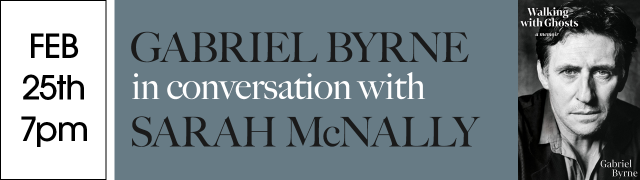
Who: Gabriel Byrne, Sarah McNally What: Livestreamed discussion Where:McNally Jackson Books Zoom When: Thursday, February 25, $5, 7:00 Why: “How many times have I returned in my dreams to this hill. It is always summer as I look out over the gold and green fields, ditches foaming with hawthorn and lilac, river glinting under the sun like a blade. When I was young, I found sanctuary here and the memory of it deep in my soul ever after has brought me comfort. Once I believed it would never change, but that was before I came to know that all things must. It’s a car park now, a sightseers panorama.” So begins award-winning actor Gabriel Byrne’s widely hailed, poetic, soul-searching memoir, Walking with Ghosts (Grove Press, January 2021, $26).
The seventy-year-old Dublin native has appeared in such films as The Usual Suspects and Miller’s Crossing, such television series as In Treatment and Vikings, and such Broadway productions as A Moon for the Misbegotten and Long Day’s Journey into Night. On the book, he recounts his childhood in a working-class family, his discovery of the theater, and his battle with addiction with grace, humor, and bracing honesty. On February 25 at 7:00, he will speak with McNally Jackson Books founder Sarah McNally about the memoir and his career, live over Zoom. Admission is $5, but you can get those five bucks back if you buy a copy of the book when registering for the event and using discount code BYRNE5OFF.
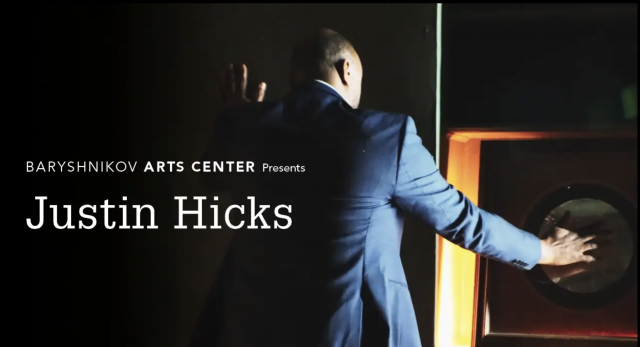
Who:Justin Hicks, Meshell Ndegeocello What: Live conversation about Hicks’s Use Your Head for More Where:Baryshnikov Arts Center Zoom When: Wednesday, February 24, free with RSVP, 8:00 (Use Your Head for More available on demand through March 1 at 5:00) Why: On February 24 at 8:00, multidisciplinary artist and performer Justin Hicks, who was born in Cincinnati and is based in the Bronx, will be joined by DC-born singer-songwriter, musician, and ten-time Grammy nominee Meshell Ndegeocello to talk about Hicks’s world premiere commission from the Baryshnikov Arts Center, Use Your Head for More, which is streaming for free through March 1 at 5:00. The half-hour piece is an experimental audiovisual poem with spoken text based on a 2004 conversation Hicks had with his mother, found sound and background vocal samples from members of his family, and rich, dreamlike imagery, from empty corners and doors to a wrinkled hand repeatedly rubbing a wall, all bathed in a golden glow and filmed in his home. “The saying ‘Use your head for more than a hatrack’ became a song my mom wrote as a reminder to her children that mining your imagination offers a way to create lushness with little at hand,” Hicks said in a statement. “She would also use it in moments to let us know that your brain is much more valuable than anything you could acquire. She used songs to remind us of things that kept us safe.”
Use Your Head for More, which features editing by Breck Omar Brunson, lighting by Tuce Yasak, cinematography and styling by Kenita Miller-Hicks, and vocals by Jade Hicks and Jasmine Hicks, is part of the BAC Artist Commissions initiative, which was started in September 2020 to support new online works made during the COVID-19 pandemic; Mariana Valencia’s brownout premieres March 1, followed by Holland Andrews’s Museum of Calm March 15-29, Stefanie Batten Band’s Kolonial May 3-17, Tei Blow’s The Sprezzaturameron May 17-31, and Kyle Marshall’s STELLAR June 7-21.