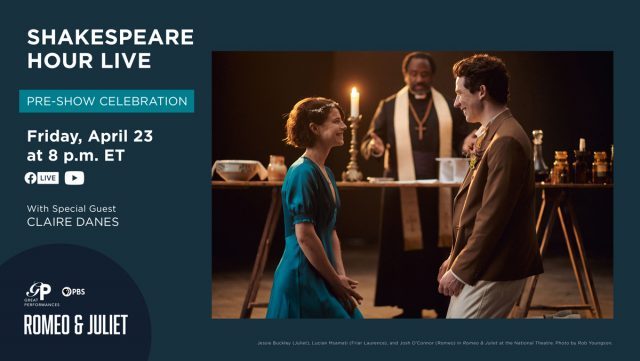
Who: Claire Danes What:Shakespeare Hour Live! discussion about Romeo + Juliet Where:Facebook Live and YouTube Live When: Friday, April 23, free, 8:00 Why: Twenty-five years ago, Leonardo DiCaprio and Claire Danes starred as the title lovers in Baz Luhrmann’s Romeo + Juliet, a modern-day adaptation of Shakespeare’s tragedy, pitting two business empires against each other, the Montagues and the Capulets, while using the the Bard’s original dialogue. On the night that PBS’s Great Performances presentation of the National Theatre’s Romeo & Juliet, which was filmed following Covid-19 protocols, is making its US premiere, Danes will talk about the movies and the play in the latest Shakespeare Hour Live!, the ongoing series hosted by DC’s Shakespeare Theatre Company, whose artistic director, Simon Godwin, directed the National Theatre production. Luhrmann’s 1999 movie features Brian Dennehy and Christina Pickles as Romeo’s parents, Paul Sorvino and Diane Venora as Juliet’s folks, John Leguizamo as Tybalt, Dash Mihok as Benvolio, and Miriam Margolyes as the nurse, while Godwin’s version, which makes full use of the National Theatre space, stars Jessie Buckley as Juliet and Josh O’Connor as Romeo, with Tamsin Greig as Lady Capulet, Lloyd Hutchinson as Lord Capulet, Colin Tierney as Lord Montague, David Judge as Tybalt, Alex Mugnaioni as Paris, Shubham Saraf as Benvolio, Adrian Lester as the prince, Fisayo Akinade as Mercutio, and Deborah Findlay as the nurse.
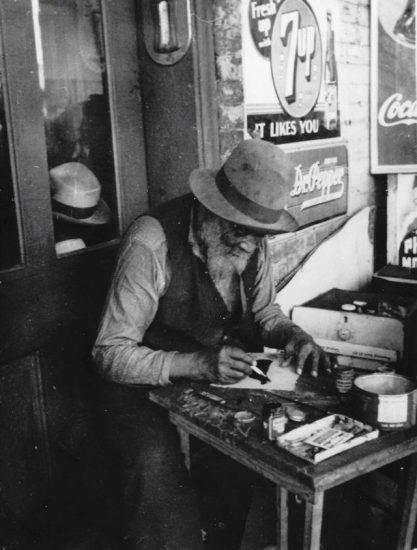
The life and art of Bill Traylor are the subject of illuminating documentary (photo courtesy Jean and George Lewis / Caroline Cargo Folk Art Collection)
“I think Traylor is probably the greatest artist you’ve never heard of, but he’s getting heard of more and more,” art critic Roberta Smith says at the beginning of Jeffrey Taylor’s Bill Traylor: Chasing Ghosts, an insightful documentary that runs April 16–22 at Film Forum — both virtually and in person at the West Houston St. theater.
I well remember the first time I truly encountered the scope of Bill Traylor’s art, at a pair of 2013 exhibits at the American Folk Art Museum. I had seen his work before, but these two shows opened my eyes to his immense self-taught skill and his poignant and personal view of the world he had experienced, becoming, in his later years, a unique chronicler of the American South, from slavery and the Civil War through the Great Migration and the Great Depression to Jim Crow and WWII. He passed away in 1949 at the age of ninety-six, leaving behind some 1,500 drawings, all made between 1939 and 1942; it would still be decades until he would be duly recognized him as one of the most important artists of the twentieth century.
Director, producer, and editor Taylor and writer-producer Fred Barron tell Traylor’s uniquely American tale through archival photos, commentary from art connoisseurs and historians, members of Traylor’s family, and, most important, images of hundreds of his works. Born into slavery in Benton, Alabama, in 1853, Traylor was a slave on a cotton plantation, a field hand, a tenant farmer, a shoe repairman, and an ill homeless man while fathering nine children with multiple women before spending three years sitting behind a small refrigerated soda case on Monroe St. in Montgomery, Alabama, drawing both from memory and observation of the bustling Black community in front of him. Using anything he could find — torn paper, stained cardboard with logos on one side — Traylor would draw flat, silhouetted objects, primarily in black but with flourishes of blue, red, and occasional yellows, imbued with a musicality that breathes life into them while also exploring race and class; today, his art evokes elements of both Jacob Lawrence and Kara Walker. Taylor often juxtaposes Traylor’s drawings with photographs of places that might have served as inspiration, which offer further understanding of the art and the man.
“There are certain elements in the work — the use of animal spirits and plant spirits, and there’s hybrid people, there’s were-people — that all of these speak to someone operating intentionally with the desire to render the fantastic. So he’s giving us a whole enchanted, magical realm,” writer, musician, and producer Greg Tate says, adding, “The mystery prevails throughout.” Artist Radcliffe Bailey notes, “When I look at Traylor’s work, I see this freedom of expressing, or seeing what’s going on around him but also being very lyrical about it.” Among the others celebrating Traylor with a deep reverence are archivist Dr. Howard O. Robinson II, professor Richard Powell, and curator Leslie Umberger. Taylor includes readings by actors Russell G. Jones and Sharon Washington, songs by Willie King, Lead Belly, Buddy Guy, and Chick Webb, and tap dances by Jason Samuels Smith, along with the words of Zora Neale Hurston and Langston Hughes as well as the white painter and teacher Charles Shannon, who championed and represented Traylor.
The film’s latter section focuses on Traylor’s descendants, including his great-grandson Frank L. Harrison, who tears up when talking about his ancestor. Some knew of Traylor, and some didn’t, which is all part of his legacy. Umberger, who curated the major 2018-19 Smithsonian retrospective “Between Worlds: The Art of Bill Traylor,” sums it up when she states, “He put down this entire oral history in the language that was available to him, which was the language of pictures.” What pictures they are, and we now know more about where they came from, thanks to Chasing Ghosts.
Song-Ming Ang will discuss his High Line Art video installation “Piano Magic” in live, online Q&A on April 6
Who:Song Ming Ang,Melanie Kress What: Live online artist talk Where:The High Line Zoom When: Tuesday, April 6, free with RSVP, 1:00 (exhibition continues through April 28) Why: In the 2019 interview “A New Understanding of Place” for the High Line blog, associate curator Melanie Kress explained why video was part of the elevated park’s continuing celebration of site-specific public art. “When we think of public art, most of us think of murals and sculptures. But to fully showcase the range of mediums that artists are working in today, video is indispensable,” she said. “Video also has the ability to cross back and forth between many different worlds and forms at the same time — between advertising, social media, film, documentary, documentation, television, music videos, and more. It provides a really interesting place for artists to play with viewers’ expectations. In a public space, visitors aren’t necessarily expecting to encounter art — especially video art — so those lines can be blurred in all the more challenging and creative ways.”
The latest video art installation to screen on the High Line Channel at Fourteenth St. is Singapore-born artist Song-Ming Ang’s “Piano Magic,” which consists of 2014’s Backwards Bach, in which Ang, who is based in Singapore and Berlin, plays Johann Sebastian Bach’s C Major Prelude from Book I of The Well-Tempered Clavier on the harpsichord both forward and backward, and 2011’s Parts and Labour, in which he fixes a disused piano. On April 6 at 2:00, Ang and Kress will discuss the project, which continues through April 28, in a live Zoom Q&A. Ang is also represented at the Asia Society Triennial with the multimedia site-specific installation True Stories, twelve music stands with text and images that explore the demise of societal norms, which he detailed in the Instagram Live program “Talking Dreams: A Conversation with Artist Song-Ming Ang.”
NINA WU (Midi Z, 2019)
Museum of the Moving Image Online Retrospective
March 26 – April 11, Nina Wu $10, others $5, series pass $30 www.movingimage.us
“I believe a film performance should be natural,” a woman casting director (Hsieh Ying-Xuan) tells actress Nina Wu (Wu Ke-Xi) at an audition in Midi Z’s harrowing psychosexual thriller Nina Wu, streaming through April 11 in the Museum of the Moving Image online retrospective “Six Films by Midi Z.” Nina then delivers the key lines from the script, the first of several times she recites them through the film: “I can’t bear it any longer. I really can’t take it anymore. They’re not only destroying my body . . . but my soul. Take me with you. Wherever you go . . . Only when I’m with you . . . can I be free.”
Her deep pain is palpable as she struggles every time she says those words, but each time we hear them it’s subtly different as we learn more about her situation. The film thoroughly blurs the boundaries between fantasy and reality: Wu Ke-Xi wrote the screenplay, inspired by actual events that happened to her as well as abuses by industry figures such as Harvey Weinstein and Bill Cosby that led to the #MeToo movement. Myanmar-born Taiwanese director Midi Z has gone back and forth between fiction films and documentaries in his career, and here he also includes dream sequences and faulty memories that are both frustrating and beguiling, melding with Nina’s conception of reality. In an elegantly designed scene in the film within a film, one that requires numerous takes, we see the track on which the camera pulls back, revealing the inner workings of cinema, reminding us we are watching a movie but also making us consider whether this camera belongs to Midi Z or the onscreen director (Shih Ming-Shuai) and whose view we are sharing.
Nina has spent the previous six years primarily acting in short films, fearful of being asked to do things she doesn’t want to do in feature films, primarily nudity. Her agent, Mark (Lee Lee-Zen), has landed her an audition for a major film that could be her breakthrough, but she is uncertain because of a three-way sex scene. She ultimately gets the role and heads off to Taipei, but she doesn’t want to leave her roots behind in the small rural community where she grew up; she tries to keep in touch with her closest friend, Kiki (Sung Yu-Hua), and helps out her parents (Cheng Ping-Chun and Wang Chuan), who are having business problems. Meanwhile, she is being stalked by a mysterious young woman (Hsia Yu-Chiao) for unknown reasons. The story zigzags between the past and the present, replaying scenes from multiple points of view, creating too much confusion in the second half until a shocking ending explains it all.
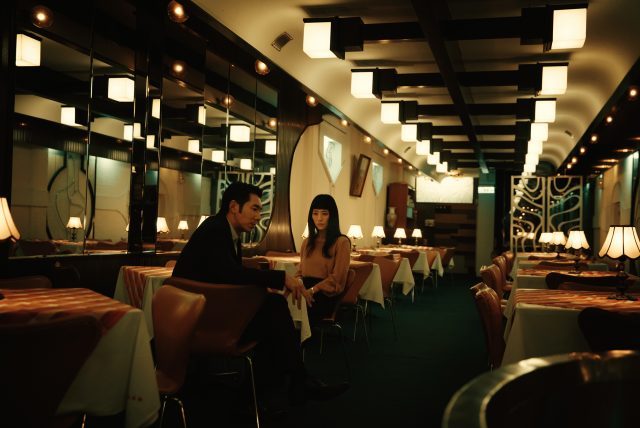
Nina Wu (Wu Ke-Xi) considers an offer with her agent (Lee Lee-Zen) in Midi Z’s psychosexual thriller
Nina Wu, which screened in the 2019 Cannes Un Certain Regard competition, looks fabulous, gorgeously photographed by Florian J. E. Zinke, with stellar production design by Kuo Chih-Da and costumes by Jelly Chung and Chan Cheuk-Ming, anchored by a stunning red dress in which Nina appears often. Wu, who also starred in Midi Z’s other fiction films, The Road to Mandalay and Ice Poison (Bing du), gives a heart-wrenching performance as Nina, who suffers and/or witnesses abuse at the hands of the director and producer (Tan Chih-Wei) as she tries to keep her life and career in balance. She’s walking a fine line that can be disturbing to watch, but that is part of the point. The harassment Nina experiences stings, making us want to look away, but we just can’t. Midi Z also prominently features the concept of doubling, not only in the repetition of scenes but in the characters themselves, who sometimes appear to be twisted doppelgängers; it’s no coincidence that writer-actress Wu named her protagonist Wu. The doubling makes the audience complicit as well, all of us part of a misogynistic system with a reprehensible legacy.
“Six Films by Midi Z” continues with 14 Apples,The Road to Mandalay,City of Jade (Fei cui zhi cheng), Ice Poison, and Return to Burma (Gui lái dí rén), along with two prerecorded interviews, one with Jessica Kiang in conversation with Midi Z and Wu Ke-Xi about Nina Wu, the other with Midi Z and Jeff Reichert focused on the director’s entire oeuvre.
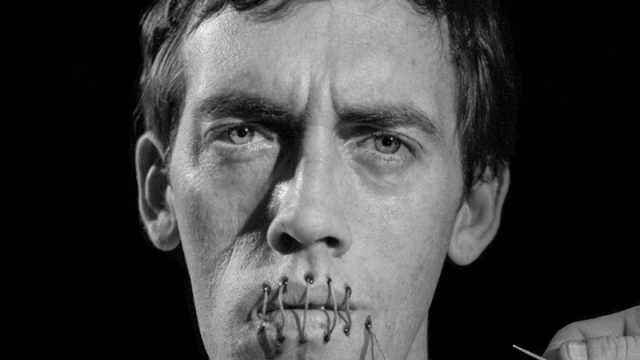
David Wojnarowicz tells his own story in Chris McKim documentary (Andreas Sterzing, David Wojnarowicz (Silence = Death), photograph, 1989 [courtesy of the artist, the estate of David Wojnarowicz, and P·P·O·W, New York])
WOJNAROWICZ: F**K YOU F*GGOT F**KER (Chris McKim, 2020)
Film Forum Virtual Cinema
Opens Friday, March 19; live Q&A on Tuesday, March 30, free with RSVP, 7:00 filmforum.org kinomarquee.com
David Wojnarowicz packed a whole lot of living into his too-brief thirty-seven years, and the frenetic pace of his life and death is copiously captured in Chris McKim’s dynamic documentary, Wojnarowicz: F**k You F*ggot F**ker. Born in New Jersey in September 1954, Wojnarowicz — pronounced VOY-nah-ROH-vich — experienced a difficult childhood riddled with physical abuse from his father, became a teen street hustler in Times Square, and later dabbled in heroin. He gained fame as an avant-garde artist and anti-AIDS activist in the 1980s, when several of his pieces earned notoriety, condemned by right-wing politicians who wanted to censor the works and defund the National Endowment for the Arts, which had supported the shows of art they found objectionable or morally corrupt. (The controversy continued decades past his death, into December 2010, when the National Portrait Gallery edited his short film Fire in My Belly in a group show.)
McKim lets Wojnarowicz, who died of AIDS-related complications in July 1992, tell his own story, using the multimedia artist’s extensive archive of journals, cassette tapes, phone messages, photographs, and super 8 films; Wojnarowicz lived his life as if it was an ongoing radical performance installation itself, obsessively recording himself. “All the paintings are diaries that I always thought as proof of my own existence,” he says. “Whatever work I’ve done, it’s always been informed by what I experience as an American in this country, as a homosexual in this country, as a person who’s legislated into silence in this country.”
Editor Dave Stanke does a masterful job of putting it all together, primarily chronologically, seamlessly melding Wojnarowicz’s paintings, photographs, and videos into a compelling narrative that is as experimental, and successful, as the artist’s oeuvre, placing the audience firmly within its milieu. He intercuts news reports and other archival footage as Wojnarowicz’s life unfolds; among those whose voices we hear, either in new interviews or old recordings, are cultural critics Fran Lebowitz and Carlo McCormick, gallerist Gracie Mansion, curator Wendy Olsoff, his longtime partner Tom Rauffenbart, photographer and close friend/onetime lover Peter Hujar, artists Kiki Smith and Nan Goldin, artist and activist Sur Rodney Sur, Fire in the Belly author Cynthia Carr, Wojnarowicz’s siblings, and photographer and filmmaker Marion Scemama, who collaborated with Wojnarowicz on the haunting Untitled (Face in Dirt), pictures of the artist partially buried in the southwest desert. In addition, McKim includes such conservative mouthpieces as Donald Wildmon of the American Family Association and Senator Jesse Helms, who both sought to shut down Wojnarowicz and the NEA.
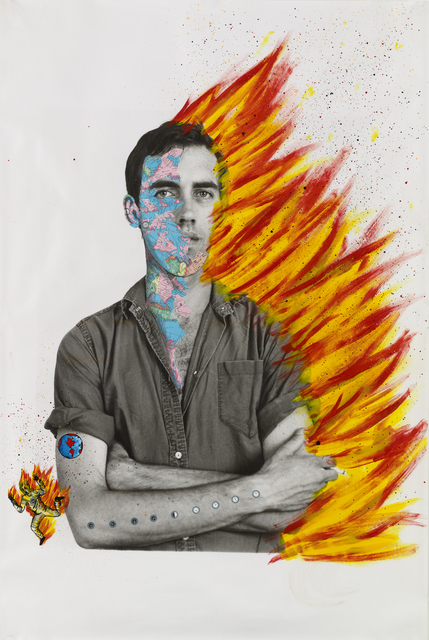
Influenced by such writers and artists as Jean Genet, William S. Burroughs, and Arthur Rimbaud, Wojnarowicz’s art is as bold and in your face as it can get, relentlessly depicting a hypocritical world inundated with lies, violence, and perpetual inequality. Among the works that are examined in the film are Untitled (Buffalo),Untitled (Peter Hujar),Gagging Cow at Pier,Arthur Rimbaud in New York (Times Square),Burning House,Untitled (One Day This Kid . . . ,David Wojnarowicz (Silence = Death, New York),Untitled (Genet After Brassai), and his Fire,Water,Earth, and Air four elements series. McKim also focuses on Wojnarowicz’s incendiary East Village punk band, 3 Teens Kill 4, with snippets of such songs as “Hold Up,” “Hunger,” and “Stay & Fight.” Wojnarowicz spoke in a relatively calm, straightforward tone, especially when compared with the constant whirlwind surrounding him, but his work, from art to music, revealed the fiery emotions bubbling inside, a roiling mix of rage, rebellion, and resistance.
Self-Portrait of David Wojnarowicz, acrylic and collaged paper on gelatin silver print, 1983–84 (photo by Ron Amstutz/Whitney Museum of American Art)
McKim (RuPaul’s Drag Race, Out of Iraq) adds a curious, overly sentimental modern-day ending that might elicit a tear or two but is completely out of place; otherwise, Wojnarowicz: F**k You F*ggot F**ker, named after one of the artist’s works from 1984, is an intense journey into the mind of a deeply troubled soul who shared his endless dilemmas in very public ways that made so many people uneasy. “Last night I was standing around here, looking at my photographs. They’re my life, and I don’t owe it to anybody to distort that just for their comfort,” he says.
Wojnarowicz: F**k You F*ggot F**ker opens virtually at Film Forum through Kino Marquee on March 19 and includes a prerecorded Q&A with McKim, Mansion, McCormick, and producer Fenton Bailey, moderated by journalist Jerry Portwood. There will also be a live Q&A on March 30 at 7:00 with McKim and Stanke, moderated by artist and activist Leo Herrera, that is free and open to all.
The magnificent Maggie Cheung takes center stage at Metrograph Digital in thirtieth anniversary restoration
CENTER STAGE (Stanley Kwan, 1991)
Metrograph Digital
March 12 – April 1, $12 metrograph.com
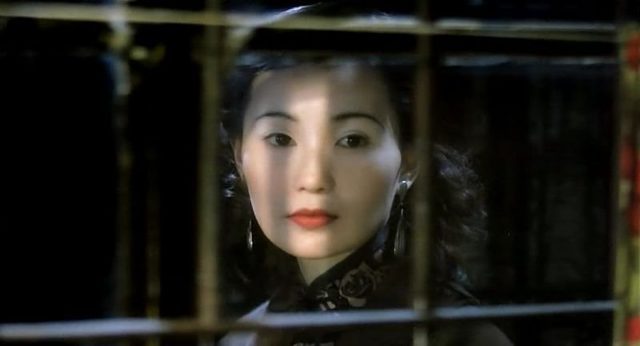
“Isn’t she a replica of myself?” Maggie Cheung says of Chinese actress Ruan Ling-yu in 1991’s Center Stage, in which Cheung plays Ruan as well as Maggie Cheung. “Maggie, may I ask if you wish to be remembered half a century later?” a man asks, to which Cheung responds, “That’s not so important to me. If future people do remember me, it won’t be the same as Ruan Ling-yu, as she halted her career at the age of twenty-five, when she was at her most glorious. Now she is a legend.” The Hong Kong–born Cheung is now a legend herself, having made more than ninety films since her career began in 1984, when she was nineteen; current and future people are sure to remember the glamorous superstar who continues to help spread Chinese cinema around the world.
Cheung, a former model and beauty queen, is radiant as both herself and Ruan as director Stanley Kwan goes back and forth between the present, as Cheung is making the film, and the past, as she portrays Ruan rising from an extra to a star in the late 1920s and early 1930s, at the same time Japan is mounting attacks against China. Cheung (As Tears Go By,In the Mood for Love), who was named Best Actress at prestigious film festivals in Berlin, Chicago, Taiwan, and Hong Kong for the role, is joined by a stellar cast, including Chen Yen-yen, Lily Li, Tony Leung Ka-fai, Carina Lau, and Chin Han; the real Ruan is seen in archival footage. Made thirty years ago, Center Stage, also known simply as Actress, is now available in a 4K digital restoration, created from the original negative and approved by Kwan (Women,Hold You Tight), streaming March 12 to April 1 on Metrograph’s online platform.
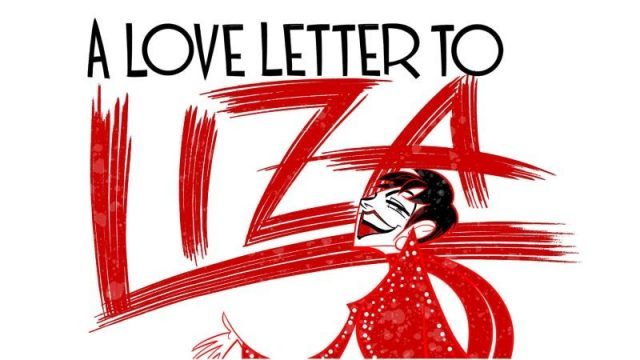
Who: Lorna Luft, Joel Grey, Lily Tomlin, Michael York, Joan Collins, Catherine Zeta-Jones, Ben Vereen, Ute Lemper, Michael Feinstein, Billy Stritch, Kathie Lee Gifford, Lea Delaria, Chita Rivera, Jonathan Groff, Charles Busch, Kathy Najimy, Sandra Bernhard, Andrew Rannells, Julie Halston, John Waters, John Kander, Nathan Lane, Mario Cantone, Tony Hale, Coco Peru, John Cameron Mitchell, Andrea Martin, Michele Lee, Nicolas King, Parker Posey, Craig Ferguson, Hoda Kotb, Jason Alexander, Jim Caruso, Kathy Griffin, Neil Meron, Haley Swindal, Seth Sikes, Verdon Fosse legacy dancers What: Seventy-fifth birthday tribute to Liza Minnelli Where:The Town Hall via Stellar When: Friday, March 12, $30, 8:00 (also available March 13 at 8:00 and March 14 at 7:00) Why: On March 12, 1946, Liza May Minnelli was born to beloved actress and singer Judy Garland and Hollywood director Vincente Minnelli in Los Angeles, ultimately a family of Academy Award winners. On March 12, 2021, several dozen of Liza’s friends and admirers will gather virtually to wish the Tony-, Oscar-, and Emmy-winning star of stage and screen — Cabaret, The Sterile Cuckoo, Arthur, Liza with a Z, The Act — a very happy seventy-fifth birthday. Presented by the Town Hall, “A Love Letter to Liza Minnelli: 75th Birthday All-Star Tribute” will feature performances and appearances by a wide-ranging group of celebrities, including Joel Grey, Lily Tomlin, Joan Collins, Catherine Zeta-Jones, Ben Vereen, Michael Feinstein, Kathie Lee Gifford, Chita Rivera, Jonathan Groff, Charles Busch, Sandra Bernhard, Andrew Rannells, John Waters, John Kander, Nathan Lane, Mario Cantone, Andrea Martin, Michele Lee, and Kathy Griffin, along with surprise guests and never-before-seen footage of Liza.
“Sometimes you’re happy, sometimes you’re sad / But the world goes ’round / Sometimes you lose every nickel you had / But the world goes ’round,” Minnelli sings in New York, New York, offering words to live by, especially during the current crises. “Somebody loses and somebody wins / And one day it’s kicks, then it’s kicks in the shins / But the planet spins, and the world goes ’round.” Of course, this is Liza’s world; we’re only living in it. Tickets to the birthday tribute are $30, with twenty percent of the proceeds benefiting the Actors Fund.