PJ Harvey traveled to Kosovo, Kabul, and Washington, DC, to inspire 2016 album The Hope Six Demolition Project
A DOG CALLED MONEY (Seamus Murphy, 2019)
Film Forum online
Opens virtually Wednesday, December 9, $12 for 48-hour rental filmforum.org
Irish photojournalist Seamus Murphy lays bare English musician PJ Harvey’s creative process in the irresistible documentary A Dog Called Money. Polly Jean Harvey initially hired Murphy to take photos for her 2011 album, Let England Shake, after having seen Murphy’s 2008 exhibit and book, A Darkness Visible: Afghanistan. Murphy ended up making twelve short films with her, one for each song on the record, and in 2012 he asked Harvey if she wanted to accompany him on his trips to Kabul, Kosovo, and Washington, DC, where they would work separately, he on a book, she on a record. But the journeys led to a creative cornucopia that also resulted in their collaborating on the book The Hollow of the Hand, featuring his photographs and her poetry, as well as the 2016 album The Hope Six Demolition Project and the documentary, which opens virtually December 9 at Film Forum.
Murphy follows Harvey, dressed all in black, as she goes through old photos and other detritus in a looted, destroyed home, sits on the rocky shore of a lake writing in her journal (with voice-over narration of her thoughts), hangs out with Corny’s crew in Anacostia, wanders into a theater in ruins (“I’ve heard twenty years ago, you could pay to get into the cinema with bullets,” she says), has tea with a group of children, and visits with local musicians in Kabul’s “Tin Pan Alley.” Murphy cuts between these scenes and Harvey and her band recording new songs in a specially constructed studio in the basement of the historic arts center Somerset House in London. Harvey, who burst onto the alternative music scene in the 1990s with such seminal records as Dry,Rid of Me, and To Bring You My Love, turns the sessions into an art installation by allowing people to watch from behind a one-way mirror; they can see her, but she can’t see them. It’s a genuine treat to observe Harvey’s process as she works with such musicians as John Parish, Terry Edwards, Kenrick Rowe, Enrico Gabrielli, Mike Smith, Alessandro Stefana, James Johnston, Alaine Johannes, Adam “Cecil” Bartlett, Jean-Marc Butty, and Mick Harvey (no relation) on melody, vocalization, and instrumentation, the songs taking shape right before our eyes and ears.
Murphy draws direct parallels between what Harvey witnesses and the songs she is writing. She meets a woman walking with her hands behind her back, holding a chain with two keys, who says, “I would kill them with my own hands if I knew who was responsible”); in “Chain of Keys,” Harvey sings, “The woman’s old / The woman’s old and dressed in black / She keeps her hands / She keeps her hands behind her back / Imagine what / Imagine what her eyes have seen / We ask if she / We ask but she won’t let us in.” After playing with the Kabul musicians, she transforms their sounds into the powerful “Homo Sappy Blues.” She uses some of Corny’s crew’s exact words and actions in her lyrics for “A Dog Called Money.” She also captures the overall feeling of her experience in such tunes as “The Ministry of Defence” (“Those are the children’s cries from the dark / These are the words written under the arch / Scratched in the wall in biro pen / This is how the world will end”) and the stunning “I’ll Be Waiting” (“They swept across the land / They did not leave a thing / They did not leave a person / A stone or a tree / They did not leave anything / They did not leave anything / All that’s left is sand / All that’s left is sand”).
At first what seems like it could be cultural appropriation develops into something else, a genuine attempt to understand what is happening in these countries and around the world — as well as in America with the inclusion of DC — and sharing that through music. “Everyone driving in one direction / Everyone driving in every direction / Where to go? / Why? / What to say when I get there?” Harvey narrates near the start of the film, which opens with an extended close-up of a smiling boy with a dirty face, his nose pressed against the window of a car, the sound of traffic all around him. For ninety minutes, we are all that boy, and he is us. And we have a book, an album, and now a documentary to remember that.
Who: Paul Pfeiffer, Eiko Otake, Amina Henry, Morgan Bassichis, Mona Chalabi, Ivy Mix, Mariana Valencia, Jessica Lappin, Maggie Boepple What:LMCC benefit fundraiser Where:Lower Manhattan Cultural Council online When: Wednesday, December 9, free with RSVP (donations accepted), 7:00 Why: Since 1973, the Lower Manhattan Cultural Council has “served, connected, and made space for artists and communities in NYC through programs that deepen artists’ creative practice and afford them opportunities to share their process and work with local communities.” Rarely has that been more important than during the pandemic lockdown. On December 9 at 7:00, LMCC’s annual fundraiser goes virtual with “A Toast to Downtown,” celebrating the great work the organization does not only in Lower Manhattan but on Governors Island and other locations. This year’s civic leadership honorees are Downtown Alliance president Jessica Lappin and former LMCC president Maggie Boepple; in addition, Amina Henry (The Animals, Bully) will receive the Sarah Verdone Writing Award, Eiko Otake will be presented with the Sam Miller Award for Performing Arts, and Paul Pfeiffer will receive the Michael Richards Award for Visual Arts.
The evening will include video from Pfeiffer, who will show excerpts from a new work as well as from 2001’s Orpheus Descending, which was installed at the World Trade Center and follows the life cycle of a flock of chickens; a new video from Eiko, made for this gala and recently shot on location at LMCC’s Arts Center at Governors Island; and appearances by LMCC artists and alumni Morgan Bassichis, Mona Chalabi, Ivy Mix, and Mariana Valencia. It’s free to RSVP, but $20 gives you a chance to win a limited edition “100 New Yorkers” print by Chalabi based on her 2020 River to River project, $50 helps fund artist residencies, $100 supports grants to neighborhood arts communities, and $250 gives artists the opportunity to share their work and their creative process.
Two essential healthcare workers take a much-deserved brief break in a Wuhan hospital in 76 Days
76 DAYS (Hao Wu, Weixi Chen, and Anonymous, 2020)
Opens virtually at Film Forum at Home on Friday, December 4 Live Q&A Tuesday, December 8, 7:00 filmforumhome.org www.76daysfilm.com
The prospect of sitting through a ninety-minute documentary about essential healthcare workers in four hospitals in Wuhan fighting in the early days of Covid-19, during the city’s seventy-six-day lockdown, might seem daunting. But what could have been a difficult, emotional, and political roller coaster about fear and anger, government lies and finger pointing turns out to be a deeply affecting film that celebrates our most basic hopes and humanity.
Chinese director Hao Wu was researching a film about pandemics when, in mid-February, he came upon footage being shot by a pair of reporters in Wuhan, Weixi Chen and a man who has decided to remain anonymous. They had been given full access to four hospitals, where they followed doctors, nurses, patients, and family members for several months. There are no talking heads, and no one speaks directly to the camera; instead, 76 Days offers a fly-on-the-wall perspective that manages to be as uplifting as it is frightening.
The film opens like a sci-fi thriller, as an unidentified group of people in head-to-toe protective gear that includes light-blue masks, long face shields, white Hazmat suits, and blue footies comforts a distraught colleague who is prevented from saying goodbye to her father, who has just died from the novel coronavirus. Near the end of the scene, one of her coworkers tries to calm her down, saying, “We don’t want to see you in distress or pain. What will we do if you fall sick? We all have to work in the afternoon.” Moments later, sick people are banging on a door of the hospital to be let in, like a crowd trying to escape a coming zombie apocalypse, while two workers decide who to admit first. Those exchanges set the stage for the rest of the film, in which doctors and nurses go about their business with a relatively relaxed demeanor, displaying endless empathy and compassion as they care for scared patients with uncertain futures.
Wu focuses on a few specific cases that serve to represent the crisis as a whole, following an elderly couple who both have the virus and are not permitted to see each other even though they are on the same floor, and a young couple who are forced to quarantine in their apartment after the woman gives birth to a baby girl, unable to see their newborn for two weeks. While the nurses fall in love with the infant, who must stay in an incubator and whom they name Little Penguin, the workers have their hands full with the old man, who constantly tries to leave the hospital and doesn’t seem capable of wearing his mask correctly, if at all.
Doctors and nurses in Wuhan care for Covid patients, displaying empathy and compassion during seventy-six-day lockdown
The genuine kindness and concern displayed by the hospital employees is, well, infectious. They are risking their lives at every moment; each encounter is fraught with the possibility that they could contract the virus even with all the PPE. It’s hard not to cringe when they feed the old man, wipe the face of the infant, or use a patient’s phone to call a relative with news, because the reality is that people die from this disease, and Wu is not afraid to show that. It’s a riveting film that immerses you in this global emergency that started right there, at that time; if this doesn’t make you wear a mask, wash your hands, observe social distance protocols, and avoid gathering with others indoors, I don’t know what will.
We also see the empty streets and highways of Wuhan, a city of eleven million people, deserted, with signs advising, “Staying home makes a happy family.” All the action is happening in the hospitals, where the doctors and nurses bond with themselves and the patients, decorate their white Hazmat suits with drawings and sayings (“Clay Pot Chicken: I miss you”), and caution everyone to “be extra vigilant.” As the crisis continues to surge around the world and here in America, where politics trumps safety, those are indeed words to live by. Winner of the Best Cinematography award at DOC NYC 2020 and nominated for a Best Documentary Gotham Award, 76 Days launches virtually at Film Forum on December 4; Wu will share more about the documentary and his process in a free, live Q&A on December 8 at 7:00.
Film fans can watch obsessive film fanatics in Cinemania, streaming at BAM festival
BAM online
December 4 – January 3, free – $12 www.bam.org
Among the endless negative aspects of the pandemic lockdown is our inability to see and interact with our fellow New Yorkers in locations that are special to this great city. We are trapped inside, most of us making only virtual contact with friends, families, work colleagues, and strangers on the street. BAM takes us on a trip down memory lane in the first online edition of its continuing Programmers’ Notebook series, this one titled “New York Lives”; of course, we can’t even go to BAM to watch them in an audience filled with other film fans. In addition to the below recommendations, BAM will be showing Angela Christlieb and Stephen Kijak’s 2002 Cinemania, which follows, well, five obsessed film fans who do whatever they can to see as many movies as possible, each with unusual quirks (and all of whom I used to see at various screenings); Diego Echeverria’s 1984 Los Sures, about Puerto Rican street culture; Loira Limbal’s 2020 Through the Night, a portrait of three caregivers of children; Brett Story’s 2020 The Hottest August, a poetic and poignant look at what New Yorkers think about the future in August 2017; Megan Rossman’s 2019 The Archivettes, which goes inside the Lesbian Herstory Archives; and a double feature of Marci Reaven and Beni Matías’s 1979 The Heart of Loisaida and William Sarokin and Matías’s 1985 Housing Court, both of which explore the housing crisis.
Marc Singer’s Dark Days looks at people living in underground tunnels below Penn Station
DARK DAYS (Marc Singer, 2000)
Opens December 4, $4.99 www.bam.org
The award-winning documentary Dark Days takes a frightening look at a community of homeless men and women — many of them former or current crack users — who live in the Amtrak tunnels beneath Penn Station. They sleep in tents, cardboard shacks, and small plywood shanties, some of which have been painted and decorated. As the belowground residents shave, cook, play with their pets, and take showers under leaking pipes, trains speed by, and rats scavenge through the countless mounds of garbage. At times some of the men venture aboveground (“up top”) to go through trash cans, mostly looking for recyclable bottles and junk items they can resell. First-time filmmaker Marc Singer became a part of this colony for two years (he initially went down to help the people, not to film them), getting the residents to open up and tell their fascinating stories, which turn out to be filled with a surprising zest for living. In fact, all of the underground shooting was completed with the help of the subjects themselves acting as the crew when they were not on camera. DJ Shadow composed the haunting music for this strangely enriching look at a mysterious, truly terrifying part of New York City.
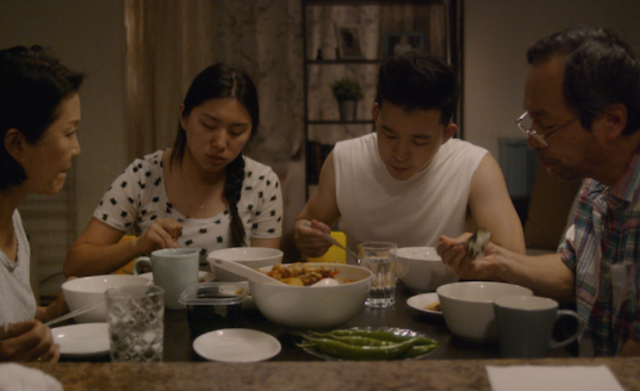
Crystal Kayiza’s See You Next Time is set in a nail salon that does extraordinary work (photo courtesy of Sundance Institute | photo by Leroy Farrell)
“See You Next Time: Neighborhood Stories” takes viewers on six slice-of-life journeys into unique parts of New York City, local tales about people making a difference or just struggling to get by — while also reminding us of things we cannot do or that have been severely limited during the Covid-19 crisis. In Aisha Amin’s Friday, a Brooklyn community is excited about the potential of acquiring a building to house their mosque. Crystal Kayiza’s See You Next Time introduces us to the relationship between a woman who gets extravagant nails and her salon artist. In Emily Packer and Lesley Steele’s By Way of Canarsie, a coastal community fights for ferry access. In Heather María Ács’s fictional Flourish, drag queen Crystal Visions (Justin Sams) prepares for an important show while battling with her drunk partner, Beau (Becca Blackwell), and young nonbinary couple Lazer (Poppy Liu) and T-Bone (Delfina Cano) consider making an addition to their love life. In Anna Pollack’s fictional Briarpatch, teenage siblings Marcus (Juan Lara) and Ashley (Oumou Traoré) face multiple hardships after the death of their mother. And in Tayler Montague’s semiautobiographical In Sudden Darkness, thirteen-year-old Tati (Sienna Rivers) navigates her way around a blackout. The free screening on December 9 at 7:30 will be followed by a live Q&A with the filmmakers, moderated by programmer Natalie Erazo (RSVP required here).
Manfred Kirchheimer’s Free Time is a symphonic film about a very different time in the city
In 2019, eighty-eight-year-old Manfred Kirchheimer was at Lincoln Center’s Francesca Beale Theater to screen and discuss his latest work, the subtly dazzling Free Time, which had its world premiere in the Spotlight on Documentary section of the fifty-seventh annual New York Film Festival. The German-born, New York-raised Kirchheimer has taken 16mm black-and-white footage he and Walter Hess shot between 1958 and 1960 in such neighborhoods as Hell’s Kitchen, Washington Heights, Inwood, Queens, and the Upper East Side and turned it into an exquisite city symphony reminiscent of Helen Levitt, Janice Loeb, and James Agee’s classic 1948 short In the Street, which sought to “capture . . . an image of human existence.” Kirchheimer does just that, following a day in the life of New York as kids play stickball, a group of older people set up folding chairs on the sidewalk and read newspapers and gossip, a worker disposes of piles of flattened boxes, laundry hangs from clotheslines between buildings, a woman cleans the outside of her windows while sitting on the ledge, a fire rages at a construction site, and a homeless man pushes his overstuffed cart.
Kirchheimer and Hess focus on shadows under the el train tracks, gargoyles on building facades, smoke emerging from sewer grates, old cars stacked at a junkyard, and grave markers at a cemetery as jazz and classical music is played by Count Basie (“On the Sunny Side of the Street,” “Sandman”), John Lewis (“The Festivals,” “Sammy”), Bach (“The Well Tempered Klavier, Book 1 — Fugue in B flat minor”), Ravel (Sonata for Violin & Cello), and others, with occasional snatches of street sounds. The title of the film is an acknowledgment of a different era, when people actually had free time, now a historical concept with constant electronic contact through social media and the internet and the desperate need for instant gratification. Kirchheimer, whose Dream of a City was shown at the 2018 NYFF and whose poetic Stations of the Elevated was part of the 1981 fest (but not released theatrically until 2014), directed and edited Free Time and did the sound, and it’s a leisurely paced audiovisual marvel. The only unfortunate thing is that it is only an hour long; I could have watched it for days.
Okwui Okpokwasili takes viewers behind the scenes of her one-woman show in Bronx Gothic (photo courtesy of Grasshopper Film)
“Okwui’s job is to scare people, just to scare them to get them to kind of wake up,” dancer, choreographer, and conceptualist Ralph Lemon says of his frequent collaborator and protégée Okwui Okpokwasili in the powerful documentary Bronx Gothic. Directed by Okpokwasili’s longtime friend Andrew Rossi, the film follows Okpokwasili during the last three months of her tour for her semiautobiographical one-woman show, Bronx Gothic, a fierce, confrontational, yet heart-wrenching production that hits audiences right in the gut. Rossi cuts between scenes from the show — he attached an extra microphone to Okpokwasili’s body to create a stronger, more immediate effect on film — to Parkchester native Okpokwasili giving backstage insight, visiting her Nigerian-born, Bronx-based parents, and spending time with her husband, Peter Born, who directed and designed the show, and their young daughter, Umechi. The performance itself begins with Okpokwasili already moving at the rear of the stage, shaking and vibrating relentlessly, facing away from people as they filter in and take their seats.
She continues those unnerving movements for nearly a half hour (onstage but not in the film) before finally turning around and approaching a mic stand, where she portrays a pair of eleven-year-old girls exchanging deeply personal notes, talking about dreams, sexuality, violence, and abuse as they seek their own identity. “Bronx Gothic is about two girls sharing secrets. . . . It is about the adolescent body going into a new body, inhabiting the body of a brown girl in a world that privileges whiteness,” Okpokwasili, whose other works include Poor People’s TV Room and the Bessie-winning Pent-Up: A Revenge Dance, explains in the film. National Medal of Arts recipient Lemon adds, “It’s about racism, gender politics — it’s not just about these two little black girls in the Bronx.” Rossi includes clips of Okpokwasili performing at MoMA in Lemon’s “On Line” in 2011, developing Bronx Gothic at residencies at Baryshnikov Arts Center and New York Live Arts, and participating in talkbacks at Alverno College in Milwaukee and the Bronx Academy of Arts and Dance, where the tour concluded, right next to her childhood church, which brings memories surging back to her.
Okwui Okpokwasili nuzzles her daughter, Umechi, in poignant and timely documentary (photo courtesy of Grasshopper Film)
Rossi is keenly aware of the potentially controversial territory he has entered. “As a white man, I was conscious of the complexity and implications of embarking on a project that revolves around the experience of African American females,” he points out in his director’s statement. “But fundamentally, I believe in an artist’s creative ability to explore topics that are foreign to the artist’s own background. I think this takes on even more resonance when the work itself has an explicit objective to ‘grow our empathic capacity,’ as Okwui says of Bronx Gothic, [seeking] an audience that is composed of ‘black women, black men, Asian women, Asian men, white women, white men, Latina women, Latina men. . . .’” Cinematographers Bryan Sarkinen and Rossi (Page One: Inside the New York Times, The First Monday in May) can’t get enough of Okpokwasili’s mesmerizing face, which commands attention, whether she’s smiling, singing, or crying, as well as her body, which is drenched with sweat in the show. “We have been acculturated to watching brown bodies in pain. I’m asking you to see the brown body. I’m going to be falling, hitting a hardwood floor, and hopefully there is a flood of feeling for a brown body in pain,” Okpokwasili says. Meanwhile, shots of the audience reveal some individuals aghast, some hypnotized, and others looking away.
Editor Andrew Coffman and coeditors Thomas Rivera Montes and Rossi shift from Okpokwasili performing to just being herself, but the film has occasional bumpy transitions; also, Okpokwasili, who wrote the show when she was pregnant, does the vast majority of the talking, echoing her one-woman show but also at times bordering on becoming self-indulgent. (Okpokwasili produced the film with Rossi, while Born serves as one of the executive producers.) But the documentary is a fine introduction to this unique and fearless creative force and a fascinating examination of the development of a timely, brave work.
Frank Langella will discuss his role in The Trial of the Chicago 7 and more in 92Y talk
Who: Frank Langella, Roger Rosenblatt What: Livestreamed discussion Where:92nd St. Y online When: Thursday, December 3, free with RSVP, 7:00 Why: One afternoon at my first job out of college at an independent publishing house in New York City, I discovered a small flood in the boiler room. I instantly began trying to save a few boxes that were being overwhelmed by water. One of the boxes I found was filled with items, I quickly learned, from what was supposed to be a book to support the appeal of the Chicago Eight, the publication of the official court transcripts to try to overturn their convictions and sentences. An acetate of Galley One announced, “More than 22,000 pages and more than 4 1/2 million words of testimony — the outstanding theatrical event in American legal history.” Galley Two explained that the book would be “a crucial reference work in five volumes, a history-making trial, with wide-ranging political and cultural implications.” The political and cultural implications included what was believed to be government interference in preventing the book from being published, so all that remains is this ephemera — and now Aaron Sorkin’s compelling and revealing if uneven and one-sided Netflix adaptation, The Trial of the Chicago 7.
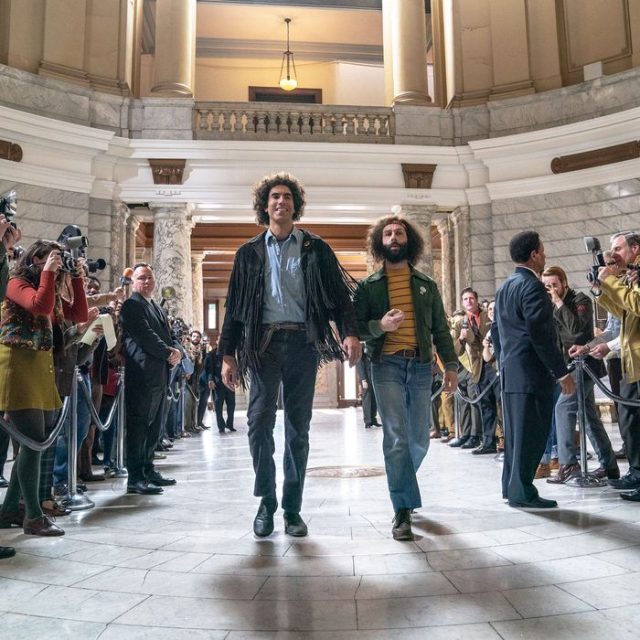
In the film, two-time Obie winner, four-time Tony winner, and Oscar and Emmy nominee Frank Langella (Frost/Nixon,Dracula,The Americans) stars as Judge Julius Hoffman, who ruled over the trial of Abbie Hoffman (Sacha Baron Cohen), Jerry Rubin (Jeremy Strong), David Dellinger (John Carroll Lynch), Tom Hayden (Eddie Redmayne), Rennie Davis (Alex Sharp), John Froines (Daniel Flaherty), Lee Weiner (Noah Robbins), and Bobby Seale (Yahya Abdul-Mateen II) in a rather unique way, letting his biases show as he cited defendants and lawyers over and over again for contempt and had Seale bound and gagged. On December 3 at 7:00, Langella will discuss the film, as well as his career onstage and onscreen as a whole, in a 92nd St. Y livestreamed conversation with writer and critic Roger Rosenblatt. Admission is free with RSVP.
Who: Zachary Levi, Alison Pill, Dean Norris, Clancy Brown, Macon Blair, Ross Partridge, Sarah Clarke, Jeff “the Dude” Dowd, Jordana Brewster, Leila Almas Rose, Jaime Zavallos What: Benefit reading for Covenant House Where: Pandemic Players YouTube channel When: Wednesday, November 25, pay-what-you-can, 2:00 Why: “This here’s the TV. Two hours a day, maximum, either . . . either educational or football, so’s, y’know, you don’t ruin your appreciation of the finer things,” H.I. “Hi” McDunnough says in the Coen brothers classic Raising Arizona. Since the middle of March, we have all had to get our entertainment from screens — televisions, desktop computers, laptops, phones, etc., and for a lot longer than two hours a day as we shelter in place from the deadly coronavirus. On November 25, that finer entertainment includes a charity reading, by the newly formed Pandemic Players, of the 1987 film about a childless couple (from a now-battleground state) who decide that another family has enough kids and won’t mind if they take one. “Edwina’s insides were a rocky place where my seed could find no purchase,” H.I. explains in defending the crime. Wildly unpredictable, gut-bustingly funny, and beautifully insane, the film helped spread the genius of writer-director Joel Coen and producer-director Ethan Coen, who had previously made the modern noir Blood Simple and would follow Arizona with Miller’s Crossing and Barton Fink, quite a start to their storied career. The reading is a benefit for Covenant House, which helps protect homeless youth in thirty-one cities across six countries. The original film featured Nicolas Cage as H.I., Holly Hunter as Ed, Trey Wilson as Nathan Arizona Sr., John Goodman as Gale, William Forsythe as Evelle, Sam McMurray as Glen, Frances McDormand as Dot, and Randall “Tex” Cobb as Leonard Smalls; the benefit cast consists of Zachary Levi as H.I., Alison Pill as Ed, Dean Norris as Nathan Arizona Sr., Clancy Brown as Gale Snoats, Macon Blair as Evelle Snoats, Ross Partridge as Glen, Sarah Clarke as Dot, Jeff “the Dude” Dowd as Leonard Smalls, Leila Almas Rose and Jaime Zavallos as multiple minor characters, and Jordana Brewster as the narrator.
Pandemic Players will present a benefit reading of Raising Arizona on YouTube on November 25
Pandemic Players self-identify as “a ragtag fugitive fleet on a lonely quest . . . for a shining planet known as Earth . . No, wait . . . that’s Battlestar Galactica. Pandemic Players told HAL to open the pod bay doors . . . Crap! Pandemic Players is a group of nobodies who dream of being somebodies. No, that’s Taxi Driver. . . . Pandemic Players is an epic of epic epicness . . . Damn you, Scott Pilgrim! OK, got it: Pandemic Players is diverse and growing group of like-minded artists who have come together for a common cause to do what they can to help in these deeply troubling times.” Headed by director-producer Matthew Barber, filmmakers Chris Brown and Darren Dean, writer-producers Frederik Ehrhardt and Myrta Vida, and producer Mark Rabinowitz, Pandemic Players will next present benefit readings of The Breakfast Club and Heathers along with other classic TV shows, radio plays, and films, partnering with different charity organizations on a monthly basis.
Rosanne Cash and A. M. Homes appear in new Met film Eye of the Collector (photo by Nicholas Hunt/Getty Images North America)
Who:Rosanne Cash,A. M. Homes What: Prerecorded film with songs and poems Where:Met MuseumFacebook and YouTube When: Tuesday, November 17, free, 7:00 Why: In conjunction with the exhibition “Photography’s Last Century: The Ann Tenenbaum and Thomas H. Lee Collection,” which continues through November 30, the Met is hosting the free virtual presentation Eye of the Collector. In the half-hour film, directed and edited by Phyllis Housen, singer-songwriter extraordinaire Cash, whose albums include Seven Year Ache, The List, and She Remembers Everything, and Homes, who has written such books as Days of Awe, This Book Will Save Your Life, and The Mistress’s Daughter, share songs and poems, accompanied by images from the exhibit, which features works by Paul Strand, Man Ray, László Moholy-Nagy, Alfred Stieglitz, Edward Weston, Walker Evans, Joseph Cornell, Diane Arbus, Andy Warhol, Sigmar Polke, Cindy Sherman, Richard Avedon, and many others, promised as a 150th anniversary gift to the Met from Tenenbaum and Lee. The film will be streamed over the Met’s Facebook and YouTube pages on November 17 at 7:00.
“The pandemic and the protests were the perfect storm of isolation, longing, inspiration, longing, fear, and hope,” Cash writes about her new single, the sociopolitical “Crawl into the Promised Land,” adding, “Living in New York City was a pressure cooker, particularly in April and May, when the deaths were spiking and the city sealed itself off, and utterly changed. But strangely, there was also a sense of unity and community, and the potential for transcendence. I kept thinking of the model in physics, where things have to fall apart in order to re-assemble themselves in a more refined, evolved state. . . . I need more space and time to understand what happened, what we are still going through. Why we elected such an unfit person to guide us, why we kill Black people with impunity, why our leaders dismantle and mock every institution we have painstakingly created to hold us safe, why some deaths matter and others don’t. I won’t be here ‘fifty years away from here,’ but someone I gave birth to, or someone they gave birth to, will live in those times and understand, and maybe pass the knowledge on to me, even in another world or another life. The magnitude of the moment requires time and an ocean of reflection.” That is precisely what Cash and Homes will be offering on Tuesday night.