this week in film and television

M. C. ESCHER: JOURNEY TO INFINITY

Documentary gazes into the complex world of M. C. Escher

M. C. ESCHER: JOURNEY TO INFINITY (Robin Lutz, 2019)
New Plaza Cinema
Opens virtually February 5
kinomarquee.com
newplazacinema.org

Maurits Cornelis Escher, better known as M. C. Escher, is one of the most popular graphic artists of the twentieth century, even though he considered himself a mathematician, not an artist. His fantastical works, often of impossible architectural configurations, are imbedded with a scientific surrealism that has made them favorites on T-shirts, posters, placemats, puzzles, album covers, ads, and tattooed body parts. In 2019, the traveling show “Escher: The Exhibition & Experience” came to Industry City in Brooklyn; the Italian-sponsored presentation included lots of Instagram-friendly installations that invited visitors to put themselves inside some of Escher’s most famous pieces. But who was the Dutch artist?

At the beginning of Robin Lutz’s documentary, M. C. Escher: Journey to Infinity, there’s a shot of fingers typing out the following: “I’m afraid there is only one person in the world who could make a good film about my prints; me.” And so it is; the movie is structured around Escher’s own words, compiled from his notes, journals, lectures, calendars, and letters, elegantly narrated by British actor Stephen Fry. The only talking heads who share their thoughts are two of Escher’s children, George and Jan Escher, and one of Escher’s daughters-in-law, along with, curiously enough, superfan Graham Nash. “I cannot understand why the out-of-control youths of today appreciate my works so much,” Escher says of late-1960s psychedelic re-creations of his butterflies and geometric space objects. Of course, it’s easy to tell what drew, and continues to draw, so many to his artistry.

Supplemented by archival photographs and film footage, Lutz traces Escher’s life and career from his love of drawing as a child and his studies at the Haarlem School of Architecture and Decorative Artists to his falling in love with Jetta Umiker, a romance he explains in rather unique language. His description of a picture of a seemingly endless winding road of trees is particularly revealing, accompanied by the sounds of an echoing church organ, played at St. Bartholomew’s in Haarlem, where Escher honed his craft. The camera focuses on a pair of feet treading the same paths that Escher took, as if he himself is leading us on this journey, focusing on rocks, flowers, birds, leaves, chameleons, and other elements that became his subject matter.

At the age of forty, he writes about his evolving process, involving systematism, recognizability, and the importance of background: “I have things of my own that had to come out, that I could express something others don’t have. . . For me, this is the richest of times.” The film grows richer as well as Escher shares insight behind the creation of some of his most famous works while also discussing isolation, human contact, and the horrors of Fascism and WWII. In addition, Lutz, who also served as producer and cinematographer, has plenty of fun with animation, bringing works to life, from a skull floating through the clouds to moving chess pieces to figures going up and down impossible staircases.

Breathlessly edited by Moek de Groot, M. C. Escher: Journey to Infinity is a pure joy because Lutz lets Escher, who passed away in 1972 at the age of seventy-three, run the show, his words poetic and passionate, the images captivating and mind-bending, infused with an infectious, futuristic energy that transcends the now. It’s an exciting trip deep into one man’s relationship with a complex world that he captured in extraordinary artworks that are likely to dazzle and confound viewers for a long time to come.

TWO OF US (DEUX)

Martine Chevallier and Barbara Sukowa star as secret lovers in Filippo Meneghetti’s Two of Us

TWO OF US (DEUX) (Filippo Meneghetti, 2019)
Film Forum Virtual Cinema
Opens virtually Friday, February 5
www.twoofusfilm.com
filmforum.org

“You and I have memories / longer than the road that stretches out ahead,” the Beatles sing on the 1970 Let It Be song “Two of Us,” continuing, “Two of us wearing raincoats, standing solo / in the sun / You and me chasing paper, getting nowhere / on our way back home / We’re on our way home / We’re on our way home / We’re going home.” The concept of home is at the center of Filippo Meneghetti’s heartbreakingly beautiful Two of Us, France’s official submission for the Best International Feature Film Oscar. Two of Us begins in a park around Montpelier, where two little girls are playing hide-and-seek until one mysteriously disappears. It’s a park where Nina (Barbara Sukowa) and Madeline (Martine Chevallier), affectionately known as Mado, get to enjoy being together in a way they cannot in front of Madeline’s family — the two senior citizens, who live down the hall from each other on the top floor of an apartment building, have been lovers and traveling companions for decades, secrets they have kept from Madeline’s daughter, Anne (Léa Drucker), and son, Frédéric (Jérôme Varanfrain). Madeline promises to finally tell her children about their relationship and that she and Nina are planning to move to Rome, but tragedy strikes, forcing the two women apart, both physically and metaphorically like the girls in the park, but their deeply intense and honest connection isn’t about to relent under the circumstances, which include a villainous caregiver portrayed by Muriel Bénazéraf.

Reminiscent of Michael Haneke’s gorgeously told Amour, in which an elderly couple played by Jean-Louis Trintignant and Emmanuelle Riva deal with dementia, Two of Us, which does not involve Alzheimer’s, is a magnificent love story and a gripping psychological thriller. Sukowa (Berlin Alexanderplatz, Lola) gives a sexy, harrowing performance as Nina, a determined woman who refuses to give up despite mounting obstacles, while longtime Comédie-Française star Chevallier is a revelation as Madeline, her every movement exquisitely choreographed; Aurélien Marra’s camera seems to be magnetically drawn to her eyes as they search her changed world in silence.

In his debut feature film, the Italian-born, France-based Meneghetti has crafted a love story for the ages, written specifically for Sukowa and Chevallier by Meneghetti and Malysone Bovorasmy with Florence Vignon. Nina spends much of the first part of the film darting across the hall into Mado’s unlocked apartment, no one aware they are a lesbian couple; it is like the hallway is their own red carpet ushering them into their own private fantasy. At certain angles, it appears that they are younger versions of themselves, their passion for each other helping them stay youthful. But after the event, forces conspire to keep them apart, a separation that Nina fights against, resolved to make a home for the two of them. Two of Us is an unforgettable film about place, about belonging, about a love that knows no bounds. As the Beatles also sang on the Let It Be album, “The long and winding road / That leads to your door / Will never disappear / I’ve seen that road before / It always leads me here / Lead me to your door.”

The film opens virtually at Film Forum on February 5; each forty-eight-hour link comes with a conversation with Meneghetti and Sukowa, moderated by Julianne Moore. In conjunction with Two of Us, the French title of which is simply Deux, Film Forum is streaming three other Sukowa films, Rainer Werner Fassbinder’s Lola beginning February 12 and Margarethe Von Trotta’s Hannah Arendt February 19 and Rosa Luxemburg March 5.

21st CENTURY JAPAN: FILMS FROM 2001-2020

21st CENTURY JAPAN: FILMS FROM 2001-2020
Japan Society
February 5-25, $8-$12 for three-day rental per film, $99 for all-access pass through February 4
film.japansociety.org

Japan Society and Japan’s Agency for Cultural Affairs have teamed up for “21st Century Japan: Films from 2001-2020,” an impressive collection of Japanese works from the last twenty years, streaming February 5-25. This inaugural ACA Cinema Project consists of thirty films, from recent classics to online US premieres as well as a focus on Kiyoshi Kurosawa, including a one-hour talk with the director, moderated by Abi Sakamoto. Among the primo filmmakers being represented are Sion Sono, Yukiko Mishima, Shinya Tsukamoto, Naomi Kawase, Hirokazu Kore-eda, Yoji Yamada, and Takashi Miike, many of whom are well known to regular attendees of Japan Society’s annual summer Japan Cuts festival.

“While it’s impossible to really capture the last two decades of Japanese narrative fiction filmmaking in its full breadth, we are excited to share at least the tip of the iceberg for these three weeks in February,” Japan Society deputy director of film K. F. Watanabe said in a statement. “Online or otherwise, a large majority of these titles remain unavailable to watch with English subtitles in the U.S., so I hope this series provides an opportunity to create new fans of filmmakers such as Naoko Ogigami or Shuichi Okita and expand any preconceptions of what modern Japanese cinema can offer.” Below are select reviews; keep watching this space for more recommendations.

dreams of another life in AIR DOLL

Nozomi (Bae Doona) dreams that there’s more to life in Hirokazu Kore-eda’s Air Doll

AIR DOLL (Hirokazu Kore-eda, 2009)
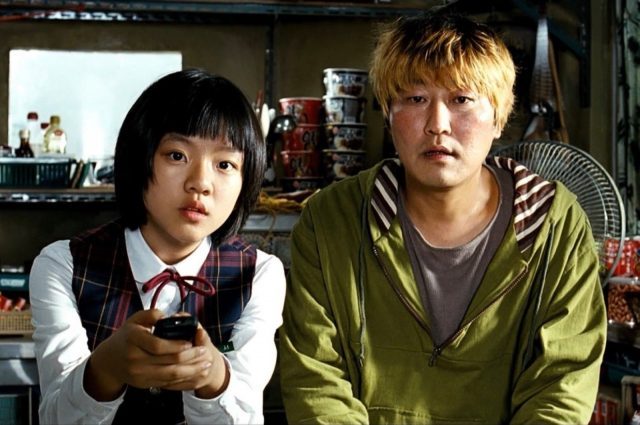
Over the last twenty-five years, Japanese filmmaker Hirokazu Kore-eda has compiled a remarkable resume, directing fourteen narrative features and five documentaries that investigate such themes as memory and loss. His 2009 film, Air Doll, examines loneliness through the eyes of a blow-up doll come to life. Bae Doona stars as Nozomi, a plastic sex toy owned by Hideo (Itsuji Itao), a restaurant worker who treats her like his wife, telling her about his day, sitting with her at the dinner table, and making love to her at night. But suddenly, one morning, Nozomi achieves consciousness, discovering that she has a heart, and she puts on her French maid costume and goes out into the world, learning about life by wandering through the streets and working in a video store, always returning home before Hideo and pretending to still be the doll. Adapted from a manga by Yoshiie Goda, Air Doll is another beautiful, meditative study from Kore-eda. Nozomi’s wide-eyed innocence at the joys of life comes sweet and slowly, played with a subtle wonderment by South Korean model and actress Bae (Sympathy for Mr. Vengeance, The Host). The film does, however, take one nasty turn and is a bit too long, at more than two hours. But it’s still another contemplative gem from the masterful director of Maborosi, Nobody Knows, Shoplifters, and Still Walking.

Hiroyuki Sanada gets ready to fight in Yoji Yamada’s The Twilight Samurai

THE TWILIGHT SAMURAI (Yoji Yamada, 2002)
Hiroyuki Sanada is outstanding as the title character in Yoji Yamada’s period drama, The Twilight Samurai, playing a lowly ronin who chooses to take care of his family after his wife dies, instead of wielding his sword. During the day, he works as a bean counter, then goes straight home to his aging mother and two young daughters. When he learns that a childhood friend, Tomoe (Rie Miyazawa), is divorcing her abusive husband, he ends up fighting for her honor. But instead of battling his opponent with a sharp sword, he pulls out a piece of wood. Word of his skill reaches the highest level of his clan, who wants him to kill for them, setting up an emotional and psychological inner struggle for the quiet and shy family man. The Twilight Samurai, which was nominated for a Best Foreign Language Film Oscar, is a different kind of samurai movie, focusing more on love and loss than blood and vengeance.

The great Takashi Miike adapts manga in family-friendly genre fantasy The Great Yokai War

THE GREAT YOKAI WAR (YÔKAI DAISENSÔ) (Takashi Miike, 2005)
Mixing in a liberal amount of Time Bandits with The Wizard of Oz, throwing in a little Hayao Miyazaki, and adding dashes of Raiders of the Lost Ark, The Lord of the Rings, Gremlins, Return of the Jedi, Labyrinth, and even Kill Bill, Takashi Miike has wound up with an entertaining fantasy film for both kids and adults. Known more for such ultraviolent, hard-to-watch frightfests as Audition and Ichi the Killer, Miike reveals his softer side in this genre film based on a yokai manga by Shigeru Mizuki (who also plays the Demon King). Ryunosuke Kamiki is splendid as Tadashi, a young city boy taking care of his grandfather (Hiroyuki Miyasako) in a country village, where he is chosen at a local festival as the mythical Kirin Rider, the guardian of peace and friend of justice. Soon he finds himself in a real battle between good and evil, taking him from the heights of the Great Goblin’s mountain cave to the depths of a seedy underworld run by the very white Agi (Chiaki Kuriyama) and powerful mastermind Katou Yasunori (Etsushi Toyokawa). Joined by yokai spirits Kawahime (Mai Takahashi), Kawatarou (Sadao Abe), and the oh-so-cute Sunekosuri, Tadashi fights to save the human world, wielding his special sword against a phalanx of mechanical robots and other villainous creatures. At more than two hours, The Great Yokai War is at least twenty minutes too long and would have greatly benefited by the excision of one very silly subplot. But it is still a charming tale from one of the true masters of horror.

100 DAYS TO LIVE

100 DAYS TO LIVE (Ravin Gandhi, 2019)
Available Tuesday, February 2
100daystolive.co

“Every ten minutes, someone in America kills themselves,” suicide prevention counselor Rebecca Church (Heidi Johanningmeier) says near the beginning of Ravin Gandhi’s cinematic debut, the insightful if methodical psychological thriller, 100 Days to Live, which releases online February 2. Gandhi is an unlikely filmmaker, a successful Illinois businessman who made his money in nonstick coatings and private equity. He felt compelled to make this film, which he wrote over several years on nights and weekends and ultimately shot in three weeks on an indie budget, much of it filmed in his house; he even cast his mother in it. But it’s not an “issue” movie: It’s a serial killer flick with a unique and powerful twist, involving suicide. “What do you see when you fantasize about death?” the killer (Gideon Emery) asks.

Suicide prevention counselor Rebecca Church (Heidi Johanningmeier) faces off against a serial killer in 100 Days to Live (photo by Nicholas Puetz)

Rebecca is putting her life back together, falling in love with Gabriel Weeks (Colin Egglesfield). But when Gabriel is kidnapped by the killer, who stalks his prey for days in an ominous white van, Rebecca works with Detective Jack Byers (Yancey Arias) to try to save him. The city of Chicago is a character unto itself as the hunt continues and characters’ secrets emerge.

Winner of the Best World Premiere and Best First Time Director awards at the 2021 San Diego International Film Festival, 100 Days to Live features several cool turns that appear just in time, whenever the narrative threatens to get bogged down in cliché or get stuck in a big plot hole. Gandhi, who serves as writer and director as well as one of the producers and executive producers, tends to forge ahead with a fairly straightforward procedural style, both visually and with the narrative, but the main twist is so good, it’s worth sticking around for and seeing through to the end.

YOUR HONOR: THE EVENT WITH BRYAN CRANSTON

Who: Bryan Cranston, Hunter Doohan, Isiah Whitlock Jr., Liz Glotzer, Alon Aranya
What: Live discussion about Showtime series Your Honor
Where: The Temple Emanu-El Streicker Center
When: Monday, January 25, free with RSVP, 6:30
Why: For those of you watching the eight-part Showtime series Your Honor, you might be feeling a little lonely on January 24 as the Sunday-night show takes a week off before presenting two new episodes on January 31. But you can get your fix on Monday night when stars Bryan Cranston (Michael Desiato), Hunter Doohan (Adam Desiato), and Isiah Whitlock Jr. (Charlie Figaro) and executive producers Liz Glotzer and Alon Aranya appear in a live, virtual discussion for the Temple Emanu-El Streicker Center. In the series, which is based on the Israeli show Kvodo, Cranston portrays a widowed judge in New Orleans whose teenage son accidentally kills the son of a mob boss in a hit-and-run, and the judge goes to extreme lengths to protect his child. The panel will talk about the show as well as adapting Israeli television programs; such popular Israeli shows as Homeland, In Treatment, The Spy, and Euphoria have also been remade for American audiences.

ACASĂ, MY HOME

Acasă, My Home follows the trials and tribulations of a Roma family living off the grid in the wilderness

ACASĂ, MY HOME (Radu Ciorniciuc, 2020)
Opened virtually and in theaters January 15
kinomarquee.com

“Anywhere you are is home,” Elvis Presley sang in the 1962 movie Kid Galahad. Where one puts down roots is at the heart of Acasă, My Home, debut filmmaker Radu Ciorniciuc’s gripping documentary about the Enaches, a Roma family living in squalor away from society in the wilderness of Văcărești Nature Park in the Bucharest Delta. For nearly twenty years, the patriarch, Gică Enache, and his wife, Niculina Nedelcu, existed off the grid, raising nine children whom they hid from social services and did not send to school; the family subsisted on fish from a lake, hunted birds and small animals, and used books for kindling. Ciorniciuc, an investigative journalist who cofounded the independent media organization Casa Jurnalistului, was doing a story on the park when he came upon the Enache clan, led by Gică, who in 2012 had temporarily emerged when he became a local hero for saving some children from a burning house. When the government decides to turn the swampland into a public park, Gică, Niculina, Vali, Rică, Corina, Duca, Georgiana, Gigel, Luci, Marcel, Nicușor, and Zâna might have to rejoin civilization, a prospect the parents are ready to fight against. “I’ll set myself on fire. I’m not afraid to die,” Gică says.

Acasă, My Home is an intimate film told in cinéma verité style; written by journalist Lina Vdovîi and shot by director of photography Mircea Topoleanu, the film follows the Enaches as they go about their daily life. They are well aware they are being filmed, but they never speak directly to the camera, and Ciorniciuc does not interview anyone about their situation. The narrative develops in such a way that if you didn’t know better, you might think it is a fiction film. Ciorniciuc, who served as cowriter, co-cinematographer, and producer (with Monica Lãzurean-Gorgan), also gave cameras to the children for them to photograph themselves as they go fishing, play with pigeons, chickens, dogs, cats, and pigs, and head into the big town, which is just across a road, an ever-present threat to their not-quite-Walden-like existence. He merely keeps the camera rolling as Gică rages on, the media arrive to cover an inspection by Prince Charles and Prime Minister Dacian Cioloș, one of the sons gets himself into a personal dilemma, and Niculina tries to avoid the spotlight. There’s an implicit discrimination inherent in the treatment of the family; no one cared about them when they lived in filthy, abject poverty, but now that the government wants the parkland, they are on everyone’s mind.

About ten minutes into the film, a spectacular drone shot begins with a few of the boys kicking around a ball by one of their two shacks and rises dramatically hundreds of feet into the air, wind blowing ominously, until the Enaches’ tiny patch of dirt amid the vast green landscape is barely visible, then turns to reveal the large white and gray city next door, where a very different life awaits. But Ciorniciuc, who in addition to the film has created a book and a continuing social project about the Enaches, refuses to celebrate this marginalized group of people as heroic figures; he depicts them as they are, warts and all, perhaps victims of circumstance but also complicit in the decisions that set them apart from the rest of the world.

VIRTUAL VIEWS: GARRETT BRADLEY’S AMERICA, A LIVE Q&A

MoMA talk will focus on Garrett Bradley’s multichannel video installation America

Who: Garrett Bradley, Thelma Golden
What: Live Q&A about Projects: Garrett Bradley
Where: MoMA YouTube
When: Thursday, January 21, free, 8:00
Why: In November, MoMA posted “Re-Imaging America,” a conversation between artist Garrett Bradley, Studio Museum in Harlem associate curator Legacy Russell, and Studio Museum in Harlem director and chief curator Thelma Golden, discussing Bradley’s multichannel video installation America, continuing at MoMA through March 21 as part of the Elaine Dannheisser Projects Series. The work combines twelve new black-and-white short films (about Harry T. Burleigh, James Reese Europe, the Negro National League, and other historical subjects) and a score by Trevor Mathison and Udit Duseja with archival footage of the unreleased 1914 film Lime Kiln Club Field Day, which is thought to be the oldest-surviving feature-length work with an all-Black cast, a love story starring Bert Williams and Odessa Warren Grey. “I knew that Bert was required to wear blackface, and I did not, even in my initial introduction to the material, feel that it took away from his brilliance. But it became critical to prove that, and to prove it using what already existed within the original footage,” Bradley says in the talk.

“That is one of the exciting challenges in working with archives — the prospect of revealing a new dimension of something that appears fixed. How could I make it clear that Bert’s power and creative genius were not confined to his performance alone? His vision extended far beyond our immediate gaze as audience members, and could be seen in-between the scenes themselves. It could be seen in a simple portrait, unmasked and still. I wanted to open America with these moments that made clear who he was, separate from the character in the film and outside of the narrative. It was important we saw him giving direction and in negotiation with the surrounding power structures. It became all the more critical that we had a moment to sit with certain frames — certain truths — that are less discernible at seventeen frames per second.” On January 21 at 8:00, Golden, who curated the exhibition with Russell, will host a live “Virtual Views” Q&A with Bradley on MoMA’s YouTube channel; museum members can send in questions beforehand here. The discussion will also be archived for later on-demand viewing, and you can check out three audio clips of Bradley delving into her work here.