this week in film and television

USE YOUR HEAD FOR MORE: DIGITAL PREMIERE AND LIVE CONVERSATION

Who: Justin Hicks, Meshell Ndegeocello
What: Live conversation about Hicks’s Use Your Head for More
Where: Baryshnikov Arts Center Zoom
When: Wednesday, February 24, free with RSVP, 8:00 (Use Your Head for More available on demand through March 1 at 5:00)
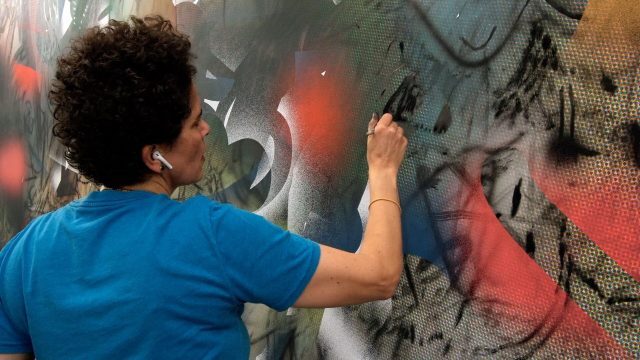
Why: On February 24 at 8:00, multidisciplinary artist and performer Justin Hicks, who was born in Cincinnati and is based in the Bronx, will be joined by DC-born singer-songwriter, musician, and ten-time Grammy nominee Meshell Ndegeocello to talk about Hicks’s world premiere commission from the Baryshnikov Arts Center, Use Your Head for More, which is streaming for free through March 1 at 5:00. The half-hour piece is an experimental audiovisual poem with spoken text based on a 2004 conversation Hicks had with his mother, found sound and background vocal samples from members of his family, and rich, dreamlike imagery, from empty corners and doors to a wrinkled hand repeatedly rubbing a wall, all bathed in a golden glow and filmed in his home. “The saying ‘Use your head for more than a hatrack’ became a song my mom wrote as a reminder to her children that mining your imagination offers a way to create lushness with little at hand,” Hicks said in a statement. “She would also use it in moments to let us know that your brain is much more valuable than anything you could acquire. She used songs to remind us of things that kept us safe.”

Use Your Head for More, which features editing by Breck Omar Brunson, lighting by Tuce Yasak, cinematography and styling by Kenita Miller-Hicks, and vocals by Jade Hicks and Jasmine Hicks, is part of the BAC Artist Commissions initiative, which was started in September 2020 to support new online works made during the COVID-19 pandemic; Mariana Valencia’s brownout premieres March 1, followed by Holland Andrews’s Museum of Calm March 15-29, Stefanie Batten Band’s Kolonial May 3-17, Tei Blow’s The Sprezzaturameron May 17-31, and Kyle Marshall’s STELLAR June 7-21.

AARON SORKIN IN RESIDENCE

Aaron Sorkin will have something to say as host of Metrograph film series

Metrograph Digital
February 16-19, members only
metrograph.com

Back in the before times, you had to trudge to independent movie theaters all over the city to catch special screenings and live events, from BAM and the Museum of the Moving Image to the Quad, Lincoln Center, Film Forum, the Angelika, IFC, Metrograph, and others. But now you can watch everything from the friendly confines of your home, on your comfy couch, streamed from all over the world. One of the best deals is Metrograph Digital, the online platform of the Lower East Side cinema. For $5 a month or $50 a year, you gain access to great programming, including live screenings, previews, and talks. Up next is “Aaron Sorkin in Residence,” in which the fifty-nine-year-old Manhattan native and award-winning screenwriter, director, and playwright introduces five films that he wrote and/or directed, along with four films that influenced him. The four-day series begins February 16 at 6:30 with David Fincher’s Facebook flick, The Social Network, which Sorkin scripted and makes a cameo in. That will be followed by a trio of livestreamed double features: Moneyball and The Hot Rock, Molly’s Game and Downhill Racer, and The Trial of the Chicago 7 and Inherit the Wind. Sorkin, the mastermind behind such television series as The West Wing, The Newsroom, and Sports Night and author of such plays as A Few Good Men and adaptations of To Kill a Mockingbird and The Farnsworth Invention, will take part in a conversation with fellow activist Bradley Whitford, who won an Emmy for his role as Josh Lyman in The West Wing and starred as Danny Tripp in Sorkin’s Studio 60 on the Sunset Strip, following the Chicago 7 screening.

Justin Timberlake and Jesse Eisenberg are a couple of high-profile whiz kids in David Fincher’s The Social Network

THE SOCIAL NETWORK (David Fincher, 2010)
Tuesday, February 16, 6:30
metrograph.com

Nominated for eight Oscars and winner of three, The Social Network stars Jesse Eisenberg (The Squid and the Whale, Adventureland) as computer whiz kid Mark Zuckerberg, the boy genius who developed what became Facebook while attending Harvard. The film is told primarily in flashback as Zuckerberg is being sued for having allegedly stolen the idea from the Winklevoss twins (both played by Armie Hammer). Zuckerberg is depicted as a spiteful, mean-spirited, self-indulgent person trying to prove to his ex-girlfriend (Erica Albright) that he will amount to something. Justin Timberlake is outstanding as the fast-moving, smooth-talking Sean Parker, the founder of Napster who loves living the high life. For a young man who created a social media platform where people collect friends, Zuckerberg made a lot of enemies on his way to the top. The film was written by Aaron Sorkin (A Few Good Men, The West Wing), who makes an appearance as an ad executive meeting with Zuckerberg, and directed by David Fincher, who has made such other terrific films as Fight Club, Zodiac, and The Curious Case of Benjamin Button. “To compare your own work to Citizen Kane takes a lot of confidence . . . or something. But David Fincher kept drawing comparisons, and when Fincher talks about movies, I find it best to agree,” Sorkin says of the film.

Oscar nominees Brad Pitt and Jonah Hill take a different approach with the Oakland A’s in Moneyball

MONEYBALL (Bennett Miller, 2011) & THE HOT ROCK (Peter Yates, 1972)
Wednesday, February 17, 6:30 & 9:30
metrograph.com

After winning 102 games during the 2001 season but then falling to the New York Yankees in the American League Division Series in five tough games, the cash-poor Oakland A’s also lost three of their most prominent players, Jason Giambi, Johnny Damon, and Jason Isringhausen, to free agency. To rebuild the team with limited funds, general manager Billy Beane (Brad Pitt) turns to an unexpected source: Peter Brand (Jonah Hill), a young stat geek who believes that on-base percentage is the key to the game. The A’s scouts find it hard to believe that Beane is looking at has-been catcher Scott Hatteberg (Chris Pratt), aging outfielder David Justice (Stephen Bishop), and underperforming submariner Chad Bradford (Casey Bond) to get the A’s to the World Series, as does manager Art Howe (Philip Seymour Hoffman), who refuses to use the new players the way Beane insists. But when the A’s indeed start winning after a few more questionable deals pulled off by Beane and Brand, the entire sport world starts taking a much closer look at what is soon known as “moneyball.”

Based on the 2003 bestseller Moneyball: The Art of Winning an Unfair Game by Michael Lewis, Moneyball is an exciting film even though the vast majority of it occurs off the field. Pitt is wonderfully understated as Beane, a former five-tool prospect for the Mets and divorced father of a twelve-year-old girl (Kerris Dorsey). Pitt earned an Oscar nod for Best Actor for his portrayal of the real-life Beane, a confident but nervous man who may or may not have a big chip on his shoulder. Hill was nominated for Best Supporting Actor for his role as wiz-kid Brand, a fictional character inspired by Paul DePodesta, who refused to let his name and likeness be used in the film; Brand instead is an amalgamation of several of the people who work for Beane. Director Bennett Miller (The Cruise, Capote) takes the viewer into a number of fascinating back-room dealings, including a revealing scene in which Beane tries to acquire Ricardo Rincon from the Cleveland Indians, furiously working the phones to pull off the deal. Also nominated for Best Picture, Best Editing, Best Sound Mixing, and Best Adapted Screenplay by Steven Zaillian and Aaron Sorkin, Moneyball firmly belongs in the playoff pantheon of great baseball movies, with the added bonus that you don’t have to be a fan or know a lot about the game to get sucked into its intoxicating tale.

Sorkin is pairing the film with Peter Yates’s fab 1972 caper comedy, The Hot Rock, in which Robert Redford, George Segal, Ron Leibman, and Paul Sand attempt to steal a gem from the Brooklyn Museum for Moses Gunn; the film is highlighted by a memorable turn from Zero Mostel. Sorkin says about the double feature, “These two films have almost nothing in common except that I saw The Hot Rock when I was very young and I’ve liked posses ever since. A gang of lovable misfits trying to do something impossible. Steal a diamond, win the World Series with the lowest payroll in baseball . . . same thing.”

Jessica Chastain in fully in charge in gambling thriller Molly’s Game

MOLLY’S GAME (Aaron Sorkin, 2017) & DOWNHILL RACER (Michael Ritchie, 1969)
Thursday, February 18, 6:30 & 9:30
metrograph.com

Jessica Chastain is sexy and sensational as Molly Bloom in Aaron Sorkin’s directorial debut, Molly’s Game. Sorkin earned his third screenplay Oscar nomination for his adaptation of Bloom’s 2014 memoir, Molly’s Game: From Hollywood’s Elite to Wall Street’s Billionaire Boys Club, My High-Stakes Adventure in the World of Underground Poker. Bloom, not to be confused with the character in James Joyce’s Ulysses, is a freestyle skier preparing for the Olympics when a terrible accident suddenly ends her career. She soon finds herself working for an asshole real estate developer (Jeremy Strong), both in the office and running a big-time poker game featuring major celebrities and businessmen. Despite her attempts to keep it all legal, she is busted by the feds and is hesitantly represented by lawyer Charles Jaffey (Idris Elba), who wants her to name names to stay out of jail. The film is nearly two and a half hours but flies by; two-time Oscar nominee Chastain (Zero Dark Thirty, The Tree of Life) is mesmerizing as she manages a ragtag bunch of wealthy men playing hands worth tens and hundreds of thousands of dollars, portrayed by a cast that includes Bill Camp, Chris O’Dowd, Brian d’Arcy James, and Michael Cera as Player X, who is in it not to win it but to destroy lives. Kevin Costner is Molly’s hard-driving father.

Sorkin has paired the film with Michael Ritchie’s 1969 sports drama Downhill Racer, in which Robert Redford stars as a selfish and sexy skier determined to become a champion while at odds with his father (Walter Stroud) and coach (Gene Hackman). One of four screenplays written by novelist James Salter, Downhill Racer is an underrated gem, with lots of superb skiing. Sorkin notes in a spoiler alert, “The only thing these two films have in common is competitive skiing. But the moment at the end of Downhill Racer, when everyone’s celebrating Redford’s record-breaking run while Hackman has his eye on a skier who’s about to beat Redford’s run but ends up wiping out just before the finish line, helped give me the idea for the opening of Molly’s Game.

Abbie Hoffman (Sacha Baron Cohen) and Jerry Rubin (Jeremy Strong) are on the case in The Trial of the Chicago 7

THE TRIAL OF THE CHICAGO 7 (Aaron Sorkin, 2020) & INHERIT THE WIND (Stanley Kramer, 1960)
Friday, February 19, 6:30 & 9:30
metrograph.com

In an eerily timely drama based on real events, Aaron Sorkin’s The Trial of the Chicago 7 goes behind the scenes of the protests, arrest, and trial of eight men accused of inciting a riot at the tumultuous 1968 Democratic National Convention in the Windy City: Tom Hayden (Eddie Redmayne), Abbie Hoffman (Sacha Baron Cohen), Rennie Davis (Alex Sharp), Jerry Rubin (Jeremy Strong), David Dellinger (John Carroll Lynch), Lee Weiner (Noah Robbins), John Froines (Daniel Flaherty), and Bobby Seale (Yahya Abdul-Mateen II). The trial is overseen by seriously biased judge Julius Hoffman (Frank Langella), with Mark Rylance as defense counsel William Kunstler, Ben Shenkman as defense counsel Leonard Weinglass, Joseph Gordon-Levitt as assistant federal prosecutor Richard Schultz, J. C. MacKenzie as chief federal prosecutor Tom Foran, Kelvin Harrison Jr. as Black Panther leader Fred Hampton (whose story is now being told in Judas and the Black Messiah), Michael Keaton as US attorney general Ramsey Clark, and John Doman as Clark’s successor, John N. Mitchell. The film can be a bit scattershot, but it humanizes these legendary figures and reveals a corrupt justice system that wanted to shut these men up so much that Judge Hoffman even had Seale bound and gagged at one point.

To accompany his latest film, Sorkin has chosen one of the greatest courtroom movies ever made, Stanley Kramer’s 1960 classic, Inherit the Wind. Nominated for four Oscars (but not Best Picture?!?), the film fictionalizes the 1925 Scopes Monkey Trial, a battle in a Tennessee town over the right to teach evolution in school. Kramer takes on creationism and McCarthyism in the film, which pits Henry Drummond (Spencer Tracy) against Matthew Harrison Brady (Fredric March), channeling Clarence Darrow and William Jennings Bryan, in an acting tour de force that also includes Gene Kelly, Dick York, Harry Morgan, Claude Akins, Noah Beery Jr., Norman Fell, and Richard Deacon. “The Bible is a book. It’s a good book, but it is not the only book,” Drummond says. And reporter E. K. Hornbeck (Kelly) explains, “I do hateful things for which people love me, and I do lovable things for which they hate me. I’m admired for my detestability. Now don’t worry, little Eva. I may be rancid butter, but I’m on your side of the bread.” The double feature comes at a time when the former president has just been acquitted of inciting a riot at the Capitol, evolution is still a heavily debated topic in schools, and much of America believes the media is fake news; you can expect those issues and more to be discussed in the conversation between Sorkin and West Wing star Bradley Whitford that follows the live screening of The Trial of the Chicago 7.

HAPPY CLEANERS

The Choi family finds itself at a critical crossroads in Flushing in Happy Cleaners

HAPPY CLEANERS (Julian Kim & Peter S. Lee, 2018)
Opens virtually Friday, February 12
koreanamericanstory.org
K-Town Stories

Following appearances at seventeen festivals around the globe, including the Asian American International Film Festival, KAFFNY Infinite Cinema, and Queens World Film Festival based here in New York City, Happy Cleaners is getting its virtual streaming release starting February 12. Set in Flushing, Queens, the insightful, small-scale film is produced by KoreanAmericanStory.org, founded in 2010 to document the Korean-American experience. Written and directed by Julian Kim and Peter S. Lee and cowritten by producer Kat Kim, Happy Cleaners is about a multigenerational immigrant family trying to make it in Flushing despite familiar hardships. “As Korean-Americans, we have called this country our home for over one hundred years. However, we have never really felt like true members of the family but mere guests in someone else’s house,” the filmmakers explain in their note about the film.

Gentle Mr. Choi (Charles Ryu) and stern Mrs. Choi (Hyanghwa Lim) operate a large dry cleaners on a busy corner. Their son, Kevin (Yun Jeong), works at Big D’s Grub Truck, a mobile food purveyor of Asian fusion cuisine — grinders, tacos, bulgogi, dumplings, and yuca fries. (Note: Big D’s is a real operation in NYC, and I highly recommend their grub.) Kevin wants to move to LA and start his own food truck business, but he doesn’t exactly have a plan. His mother is furious with him, insisting he stay in school and become a doctor, which he has no interest in. Kevin’s sister, Hyunny (Yeena Sung), works as a nurse in a hospital, contributing money to her parents and refereeing the battles between mother and son. But Mrs. Choi is also angry at Hyunny for refusing to break up with her boyfriend, Danny (Donald Chang), who she thinks will hold her back; Danny has recently quit school to work in a liquor store. When the new landlord of the dry cleaners (John Del Vecchio) starts poking around shortly before the lease is up for renewal — the store has been a part of the community for seventeen years — the Chois face an uncertain future in a country the parents still do not feel at home in.

Happy Cleaners might not be a wholly original tale, but it has an intimate, authentic feel as it deals with cultural identity, assimilation, and tradition. “It’s not my fault you live like this,” Kevin shouts at his father, who responds, “What do you know about our lives?” When Kevin and his mother argue about how to prepare a favorite family dish, she tells him, “It’s better bland than salty,” a metaphor for their different approaches to life. Overseeing it all is Kevin’s wise, feisty grandmother (Jaehee K. Wilder), who always knows just what to say. It’s all summed up by Hyunny, who explains, “This is the fate of being children of immigrants. It’s even embedded in our ethnicity in the form of a hyphen.” That multifaceted identity is expressed further in the song that plays over the closing credits, rap duo Year of the Ox’s “Word to the Hyphen.” Winner of the Narrative Audience Award at San Francisco’s CAAMFest Happy Cleaners might not break new ground, but it’s a realistic, heartfelt drama about the American dream and its impact on a Queens family that finds itself at a crossroads, in more ways than one.

SHOW ME WHAT YOU GOT

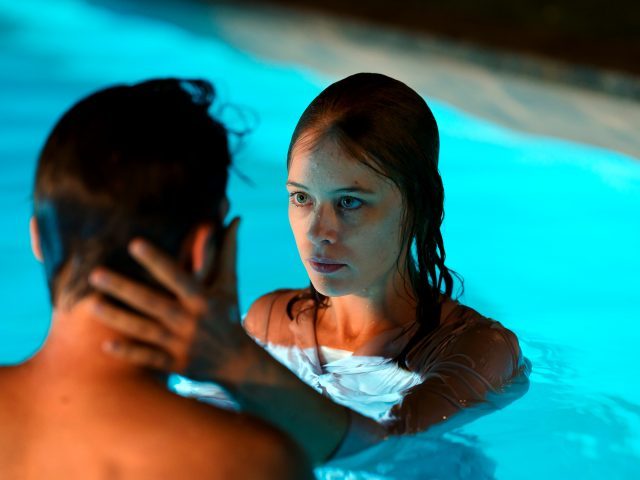
Neyssan Falahi, Cristina Rambaldi, and Mattia Minasi play a trio of pretty lovers in Svetlana Cvetko’s Show Me What You Got

SHOW ME WHAT YOU GOT (Svetlana Cvetko, 2020)
Opens Friday, February 12
www.showmewhatyougot.film
www.levelforward.live

Cinematographer Svetlana Cvetko pays homage to the French New Wave in her second feature-length film, Show Me What You Got. Her follow-up to the Netflix thriller Deadly Switch is a riff on François Truffaut’s menage-a-trois classic, Jules and Jim, spiced up with elements of Jean-Luc Godard (Bande à part) and Agnes Varda (Cléo from 5 to 7), photographed in black-and-white so it often resembles a TV ad for perfume. It looks great, but there’s only so much compassion the audience will be able to dredge up for the three protagonists, a trio of lost, pulchritudinous twentysomethings searching for home as they get it on in modern-day LA.

Looking like a young, red-haired, freckle-faced Bon Jovi, Mattia Minasi is Marcello, the gorgeous son of an Italian soap opera star (Pietro Genuardi), who has been sent to LA to have a series of meetings about future projects for his father. Scraggly bearded Adrien Brody doppelgänger Neyssan Falahi is Nassim, a wannabe actor whose father wants him to return to the family in Tehran and whose mother (Anne Brochet) wants him to visit her in Paris. And former dancer Cristina Rambaldi, a compelling mix of Maria Schneider and Giulietta Masina and the granddaughter of Oscar-winning special effects wizard Carlo Rambaldi (Alien, E.T.), is Christine, a visual artist working at the Back on the Beach Café who had been living in her grandfather’s room at a nursing facility until he passed away, devastating her. All three millennials are searching for purpose in their lives as well as for a sense of home, and they find that in one another, particularly in bed, where they interact with a furious freedom and a wild abandon, with no thought about how long that can last as the real world hovers ever closer.

At one point, Christine leads them to an art campground in the middle of nowhere in the Joshua Tree desert, where they sit on the edge of a large boat on a hill. The omniscient narrator says, “Each of them empathize with this boat differently. Marcello relates to it as adrift but adventurous. Nassim sees it as out of place. Lost on its journey. Christine believes the boat could be Noah’s Ark, where all the people she’s truly loved, living or dead, could be together, forever.” The narration is intimately delivered in French by Anne-Laure Jardry, a friend of Cvetko’s, over lovely shots of the boat, the three lovers, and the vast landscape as Eric Avery’s score plays. The scene is an example of what doesn’t quite work in the film: Each part on its own is lovely, but when put together it reveals the central flaw, that Cvetko tells instead of shows, continually explaining in detail what we should be learning or already know from the narrative itself, rather than from the narration, which can be lovely and poetic at times as it spells it all out for us. It’s also difficult to empathize with the three characters, who are living quite the youthful life in the now as they abandon thinking about what comes next. They also each are dealing with the patriarchal part of their families, either a father or grandfather; Cvetko suffered the loss of her own father while filming, and cowriter, producer, and editor David Scott Smith’s father passed away during the editing stage.

Cvetko (Red Army, Inside Job), who has photographed numerous documentaries, shoots the film in a cinéma verité style that makes us flies on the wall of this polyamorous relationship. The director encouraged the actors to improvise, which brings an immediacy to the film as well as a forced naturalism. One of the best scenes is when Christine is in a bathtub, fully clothed, experiencing either a flashback or an imagined fear, with haunting music by Avery. Cvetko cuts to Nassim shadowboxing in front of a mirror, then over to Marcello, deep in thought on a couch, and back to Christine, rolling around on the floor, overcome with emotion. There’s no dialogue, no narration, just the three of them, seen individually, and we begin to understand them in new ways. When they appear together onscreen again, that moment becomes a memory for us, and I wished for more scenes like that during the film, hoping Cvetko would trust the viewer to figure things out on their own. Alas, she shows us too much of what she’s got.

Show Me What You Got releases virtually on February 12. On February 14 at 8:00, Level Forward will host the screening and live event “The Sensuality of Show Me What You Got,” with clinical sexologist Dr. Laurie Bennett-Cook, followed February 15 at 8:00 by “Filmmaker’s Workshop: The Vision & Visual of Svetlana Cvetko,” with Cvetko.

SUMMERSTAGE ANYWHERE: RODNEY KING FILM CONVERSATION WITH ROGER GUENVEUR SMITH AND DR. STEPHANIE LEIGH BATISTE

Roger Guenveur Smith will discuss his role as Rodney King in Spike Lee film as part of SummerStage Anywhere series

Who: Roger Guenveur Smith, Dr. Stephanie Leigh Batiste
What: Live discussion and Q&A
Where: SummerStage Anywhere
When: Thursday, February 11, free, 7:00
Why: “So whatcha wanna do, Rodney King? Reminisce?” Roger Guenveur Smith asks in Rodney King. “It goes a little bit something like this. . . .” Directed by Spike Lee, the 2017 film is a document of Smith’s one-man multimedia stage show exploring who Rodney King is as a human being and not just a controversial figure who became the symbol of the 1992 LA riots. On February 11 at 7:00, Smith, who has appeared in numerous Lee movies and has also portrayed Booker T. Washington, Huey P. Newton, and basebrawlers Juan Marichal and John Roseboro, will discuss the film with Dr. Stephanie Leigh Batiste, associate professor of Black studies and English at the University of California, Santa Barbara, offering new perspectives given the BLM protests that began last May following the murder of George Floyd at the hands of police. The film is available on Netflix or can be watched for free here in advance. The event is part of SummerStage Anywhere, an online initiative of the City Parks Foundation that also includes last week’s “Lift Every Voice: Celebrating 150 Years of James Weldon Johnson’s Legacy,” with Desmond Richardson, Khalia Campbell, Angie Swan, Laila Jeter, Donovan Canales, Elizabeth Alexander, and Phylicia Rashad, and continues February 18 with “The Rewind: A Celebration of Black Culture,” introduced by Greg Tate, and February 25 with “Michael Mwenso: Hope, Resist, and Heal,” a performance and conversation with Michael Mwenso and Shannon Effinger.

REEL PIECES WITH ANNETTE INSDORF: SPECIAL ONLINE CONVERSATION WITH RAMIN BAHRANI

Ramin Bahrani and Annette Insdorf will discuss The White Tiger and more in 92Y talk and Q&A

Who: Annette Insdorf, Ramin Bahrani
What: Special online conversation about The White Tiger
Where: 92Y
When: Monday, February 8, free with RSVP. 8:00
Why: Iranian-American writer, director, and producer Ramin Bahrani burst onto the indie scene in 2005 with his brilliant Man Push Cart, followed by the charming Chop Shop and Goodbye Solo. He was nominated for the Golden Lion for 2013’s At Any Price and 2015’s 99 Homes but slipped a bit with his 2018 HBO adaptation of Ray Bradbury’s Fahrenheit 451. Bahrani is now back with the Netflix original The White Tiger, based on the Booker Prize–winning novel by his friend Aravind Adiga. The film stars Adarsh Gourav as a young boy who sees his future out of poverty by working for wealthy masters (Rajkummar Rao and Priyanka Chopra Jonas) who will help him climb the ladder of success, at an ever-increasing price. On February 8 at 8:00, Bahrani, a Columbia graduate and film professor, will join film historian, Columbia professor, and author Annette Insdorf for her 92nd St. Y series “Reel Pieces,” a livestreamed conversation and audience Q&A; admission is free with RSVP. You can also check out previous episodes of the show, online during the pandemic (Aaron Sorkin, Sofia Coppola) and from the before time in person (Greta Gerwig, Glenda Jackson, Nick Nolte), here.

KIRSTEN JOHNSON CARTE BLANCHE: HAROLD AND MAUDE (AND MORE)

Harold (Bud Cort) has a little bit of an obsession with death in very different kind of romantic comedy that is part of Metrograph series

HAROLD AND MAUDE (Hal Ashby, 1971)
Metrograph Digital
Sunday, February 7, 8:00
Series continues through February 18
metrograph.com/screenings

New York City–based cinematographer and documentarian Kirsten Johnson has jumped into the spotlight with her latest nonfiction film, Dick Johnson Is Dead, which is garnering Oscar buzz; the film imagines multiple deaths for her father, who is suffering from dementia. The film was a follow-up to her 2016 autobiographical cinematic memoir, Cameraperson, which put her on the map after years of serving as director of photography for Laura Poitras (The Oath, Citizenfour), Michael Moore (Fahrenheit 9/11), and others. She is currently hosting “Kirsten Johnson Carte Blanche,” five specially selected films for Metrograph Digital, each uniquely dealing with life and death, including Elia Suleiman’s Divine Intervention, Yuval Hameiri’s I Think This Is the Closest to How the Footage Looked, Souleymane Cissé’s Yeelen, and Keisha Rae Witherspoon’s T.

On February 7 at 8:00, she will introduce a one-time-only live fiftieth anniversary screening of the existential cult fave Harold and Maude. Bud Cort (Harold) and Ruth Gordon (Maude) are magnificent in this glorious black comedy from director Hal Ashby (The Last Detail, Shampoo, Being There) and writer Colin Higgins (Foul Play, 9 to 5). Harold is an eighteen-year-old rich kid obsessed with death, regularly flirting with suicide. Maude is a fun-loving, free-spirited senior citizen approaching her eightieth birthday. Ashby throws in just the right amount of post-1960s social commentary, including a very funny antiwar scene, without becoming overbearing, as this could have been a maudlin piece of sentimental claptrap, but instead it’s far from it. Even the Cat Stevens soundtrack (“If You Want to Sing Out, Sing Out,” “Tea for the Tillerman,” “Where Do the Children Play?”) works beautifully. Harold and Maude is a tender, uproarious, bittersweet tale that is one of the best of its kind, completely unforgettable, enlightening, and, ultimately, life-affirming in its own odd way. While H&M will screen only on Sunday night, offering a respite from the Super Bowl frenzy, all the other films in “Kirsten Johnson Carte Blanche” will be available for several days after their initial livestream.