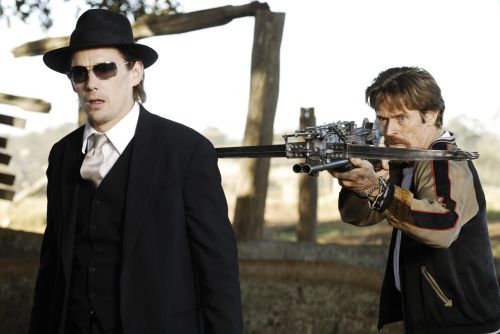
Ethan Hawke and Willem Dafoe fight for humanity in DAYBREAKERS
DAYBREAKERS (the Spierig Brothers, 2010)
Opens Friday, January 8
www.daybreakersmovie.com
 Australian brothers Michael and Peter Spierig, who played with the zombie genre in their feature-length debut, 2003’s UNDEAD, dig their teeth into vampires in their follow-up, DAYBREAKERS. It’s 2019, and the world has been turned upside down — one infected bat has led to ninety-five percent of the population being vampires, living in a nocturnal society that shuts down during the day. At night, the vamps put on their suits, board the subways, and go to work, getting their blood at coffee shops and acting fairly normal. But with the dwindling supply of human blood — as humanity itself is on the brink of extinction — some vampires are turning into evil, bloodthirsty winged creatures ready to tear apart anything, including themselves, for a shot of the red stuff.
At Bromley Marks Pharmaceuticals, hematologist Edward Dalton (Ethan Hawke) is desperately researching a blood substitute that can save civilization even as he disagrees with many of the policies of his smarmy boss, powerful CEO Charles Bromley (Sam Neill), who is harvesting humans for their blood, sucking them dry. But when Dalton meets human Audrey Bennett (Claudia Karvan) and Elvis Cormac (Willem Dafoe), a former auto mechanic who claims that he was a vampire but is now human again, having accidentally discovered what might be a cure, the lines are drawn and a new battle is on, one that might not be quite what it was originally about. Filled with sly twists on the vampire genre, including exploding bodies and specially equipped daytime cars, DAYBREAKERS is a bloody good thriller that also manages to comment on politics, business, and immigration without becoming didactic and melodramatic. The Spierig brothers set just the right look and mood from the very beginning to the gory conclusion.
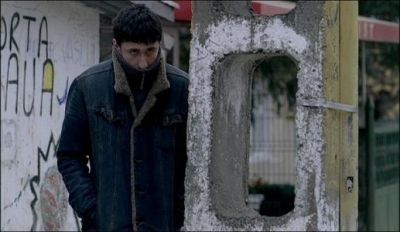
 The first half of Corneliu Porumboiu’s POLICE, ADJECTIVE is as dreadfully boring as detective Cristi’s (Dragos Bucur) assignment, tailing a student, Victor (Radu Costin), who enjoys a joint with two of his friends every day after school. While Cristi wants to nail the kid’s supplier, the cop’s boss has him on a tight deadline, insisting he arrest Victor if the investigation continues to go nowhere, but Cristi strongly disagrees with putting the teenager away for up to seven years for a crime he believes will soon be abolished by the government. However, the film picks up considerably as Cristi seeks help from various contacts, getting caught up in red tape and public servants who would really rather not be bothered. And when he gets called in by the chief (Vlad Ivanov from 4 MONTHS, 3 WEEKS, and 2 DAYS) and gets a long lecture in linguistics, well, you won’t be able to control yourself from laughing out loud. Porumboiu (12:08 EAST OF BUCHAREST) keeps the pace very slow and very steady, but hang in there, because the end is a riot. POLICE, ADJECTIVE won the Un Certain Regard Jury Prize at this year’s Cannes Film Festival, screened at the New York Film Festival and at MoMA as part of the “Contenders, 2009,” series, and is Romania’s official entry for the Foreign Language Film Academy Award.