
Lars von Trier’s ANTICHRIST will, unsurprisingly, prove rather controversial
ANTICHRIST (Lars von Trier, 2009)
IFC Center
323 Sixth Ave. at Third St.
212-924-7771
http://www.ifcfilms.com
 Generally, Danish Dogme practitioner Lars von Trier makes films that critics and audiences alike are either repulsed by or deeply love. Controversial works such as BREAKING THE WAVES, THE IDIOTS, DANCER IN THE DARK, and DOGVILLE win international awards while also driving people out of theaters. In fact, at his recent New York Film Festival press conference for ANTICHRIST, he was asked how he feels when no one walks out on his work: “Then I have failed,” he replied with a sly grin. Well, there are sure to be many walkouts during ANTICHRIST, a harrowing tale of grief, pain, and despair that begins with a gorgeously shot, visually graphic sex scene followed by a tragic accident. The rest of the film details how the unnamed couple (Willem Dafoe and Charlotte Gainsbourg) deal with the loss of their young child; a therapist, he opts to treat her more as a patient than as his wife, a highly questionable decision that threatens to tear them apart — both psychologically and physically, as the film turns into an extremely violent horror flick in the final scenes. Somehow, we found ourselves pretty much right in the middle of this one, neither loving it nor hating it while admiring it greatly despite its odd meanderings, loose holes, sappy dialogue, and occasionally awkward scenarios. In certain ways, it’s a bizarre amalgamation of Alfred Hitchcock’s SPELLBOUND, Ingmar Bergman’s SCENES FROM A MARRIAGE, Stanley Kubrick’s THE SHINING (and various other Stephen King stories), Roman Polanski’s ROSEMARY’S BABY, Richard Donner’s THE OMEN, Robert Wise’s AUDREY ROSE, and Tobe Hooper’s THE TEXAS CHAIN SAW MASSACRE. Or something like that. Add half a star if you think von Trier is a creative genius; delete two stars if you consider him a certifiable lunatic.
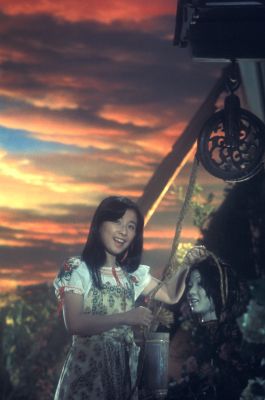



 Writer-director Andrea Arnold follows up her brilliant, harrowing feature debut, 2006’s RED ROAD, with the brilliant, highly perceptive, and emotionally gripping FISH TANK. Katie Jarvis, a seventeen-year-old discovered by Arnold while the girl was arguing with her boyfriend on a train station platform, had never acted before and was not a dancer, but Arnold cast her in the lead role of Mia, a fifteen-year-old troubled kid who dreams of becoming a professional hip-hop dancer as her only way out of her drab life. A loner quick to curse and fight, Mia lives with her mother, Joanne (Kierston Wareing), who loves to drink and party, and her little sister, Tyler (Rebecca Griffiths making her acting debut as well). When her mother starts dating Connor (Michael Fassbender), Mia soon turns to him for help and advice, but their relationship threatens to grow much too close and far too dangerous. Arnold shot the film in chronological order, giving each actor only parts of the script at a time, so virtually every scene of FISH TANK feels fresh and genuine, with natural, believable actions and reactions. While Wareing and Fassbender (HUNGER and 300) are excellent, the film belongs to the remarkable Jarvis, who will break your heart over and over again.
 French auteur André Téchiné (RENDEZ-VOUS, WILD REEDS), who specializes in deeply emotional dramas, follows up the wholly unnecessary AIDS film WITNESSES with the equally unnecessary THE GIRL ON THE TRAIN. Adapted from a play by Jean-Marie Besset based on a real-life scandal, the films stars the charming Emilie Dequenne as Jeanne, a young woman trying to find her place in the world. Flighty and flakey, Jeanne agrees to go on a job interview with a high-powered lawyer, Samuel Bleistein (Michel Blanc), whom her mother, Louise (Catherine Deneuve), used to work for and nearly had an extramarital fling with. But when Jeanne’s burgeoning relationship with a suspicious wrestler named Franck (Nicolas Devauchelle) ends in extreme violence, she acts out in a way that results in a national scandal built on lies. As with WITNESSES, THE GIRL ON THE TRAIN has little to say about its subject matter. The characters seem lost, wandering around aimlessly in Téchiné’s misguided story, and Jeanne feels particularly outdated and irrelevant even though she’s the title character. Téchiné, who divides the film into two parts, “Circumstances” and “Consequences,” admits to having significantly changed both the actual events and the play; perhaps he should have left well enough alone.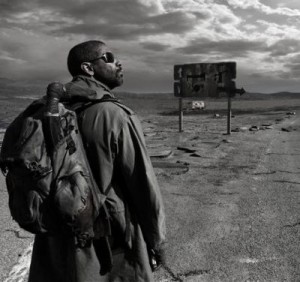
 The Hughes brothers’ postapocalyptic thriller, THE BOOK OF ELI, looks great, and star and producer Denzel Washington is great, but as the story continually teases the audience with a series of more and more ridiculous “revelations,” the film devolves into a jaw-droppingly awful mess. Washington plays the walker, a man who has been journeying west across a desolate land laid low by a war that ended three decades before, leaving death and destruction in its wake. He’s on a mission, carrying with him a treasured book, the last of its kind, and he’s well equipped to protect it with his life — and with an arsenal of supercool weapons that he uses on deranged men roaming around looking for people to rob and women to rape. But soon he finds himself in a no-horse town run by the villainous Carnegie (Gary Oldman), who thinks he can expand his domain if only he could get his grubby hands on a book that he’s been searching for — and that the walker just happens to have and is not about to give up. Things really start falling apart once Solara (Mila Kunis), the daughter of Carnegie’s blind girlfriend (Jennifer Beals), decides to join the walker on the run. THE BOOK OF ELI is a mad mix of THE ROAD WARRIOR, THE PASSION OF THE CHRIST, YOJIMBO, HIGH PLAINS DRIFTER, FAHRENHEIT 451, and not at all in a good way. You’re much better off sitting down for a few hours and reading a good book.