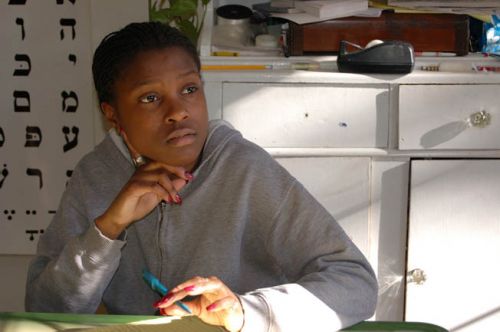
Avery tries to hold together her complicated life in OFF AND RUNNING
OFF AND RUNNING (Nicole Opper, 2009)
IFC Center
323 Sixth Ave. at West Third St.
January 29 – February 4
212-924-7771
www.ifccenter.com
www.firstrunfeatures.com

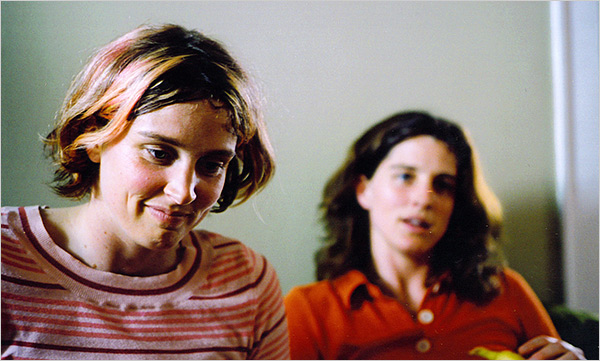
Nicole Opper’s OFF AND RUNNING starts off as a heartwarming tale of a Brooklyn family that refers to itself as the United Nations — lesbian mothers Tova (from Israel) and Travis (from Illinois) and their adopted children: multiracial Rafi, African American Avery, and Korean Zay-Zay. Opper focuses on Avery, a teenage track star who has suddenly decided to contact her birth mother, beginning her descent into a troubled world that jeopardizes her relationship with her family as well as her once-promising future. Her struggles appear to stem from her insistence on developing a black identity; she takes great offense at being called an “Oreo” by some of her African American friends and soon is turning her back on her dismayed parents, who give their children remarkable freedom along with their deep love. Although OFF AND RUNNING is a moving portrait of a very modern American family, it at times feels like a carefully manipulated reality TV show, with Avery calling the shots. In fact, director Opper has been a mentor and teacher to Avery since she first encountered the youngster at a Hebrew school she was visiting for an earlier film. Opper helped Avery craft her voice-over narration and even worked with her in the editing room, calling into question her objectivity. There are times when viewers will wonder why the filmmaker and Avery’s parents don’t just scare her straight, instead sitting idly by as the confused girl makes wrong choice after wrong choice. Still, OFF AND RUNNING, featuring stirring music is by experimental violinist Daniel Bernard Romain, is a fascinating study that raises many important social and cultural issues.
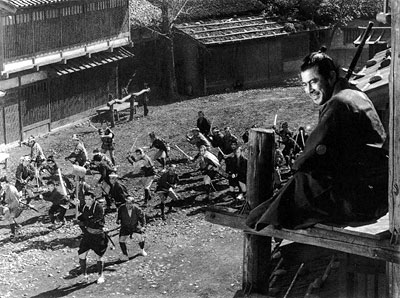
 Toshiro Mifune is a lone samurai on the road following the end of the Tokugawa dynasty in Akira Kurosawa’s unforgettable masterpiece. Mifune comes to a town with two warring factions and plays each one off the other as a hired hand. Neo’s battles with myriad Agent Smiths are nothing compared to Yojimbo’s magnificent swordfights against growing bands of warriors that include one man with a gun. Try watching this film and not think of several Clint Eastwood Westerns as well as HIGH NOON.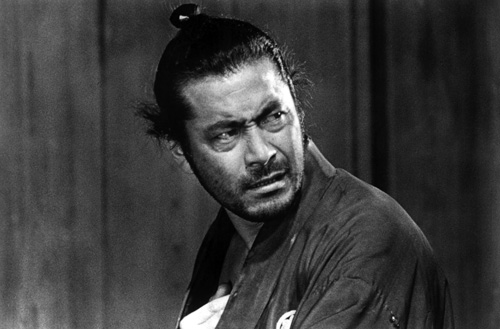
 In this YOJIMBO-like tale, Toshiro Mifune shows up in a small town looking for food and fast money and takes up with a rag-tag group of wimps who don’t trust him when he says he will help them against the powerful ruling gang. Funnier than most Kurosawa samurai epics, the film is unfortunately brought down a notch by a bizarre soundtrack that ranges from melodramatic claptrap to a jazzy big-city score.
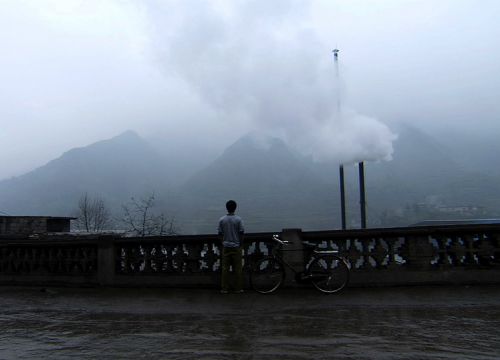
 Not to be confused with Li Yang’s 2003 film, BLIND SHAFT (MANG JING), which was also set in a rural Chinese coal-mining town, THE SHAFT (DIXIA DE TIANKONG) is a beautifully shot, mesmerizingly slow-paced debut feature from writer-director Zhang Chi. The story is told in three sections: In the first, Song Daming (Li Chen) overhears that his girlfriend, Ding Jingshui (Zheng Luoqian), might have slept with the boss to get a promotion, forcing him to reconsider their relationship. In the second, Ding Jingsheng (Huang Xuan), Jingshui’s brother, is a lazy slacker who is not smart enough to go to university, refuses to work in the mine, and instead thinks he could become a pop singer. And in the third, Ding Baogen (Luo Deyuan), Jingsheng and Jingshui’s father, has reached retirement age and is not sure what to do with the rest of his life, as the only thing he knows is the mine. THE SHAFT moves at a snail’s pace, reminiscent of Jim Jarmusch’s STRANGER THAN PARADISE but without any humor, a meditative examination of the decaying social and economic structure in rural China. Cinematographer Liu Shumi’s camera lingers on scenes long after they appear to be over, as characters just stand and stare out at the dim gray and black countryside, occasionally saturated in lush blues and reds; out there somewhere is Beijing, more than a dream away, but the big city doesn’t necessarily hold any answers either. Dialogue is kept to a bare minimum, with no musical soundtrack, just natural sound that often borders on complete silence. THE SHAFT, which is screening at MoMA January 21-27 as part of the Global Lens festival, is an intense, rewarding, uneasy experience from an extremely talented young filmmaker.