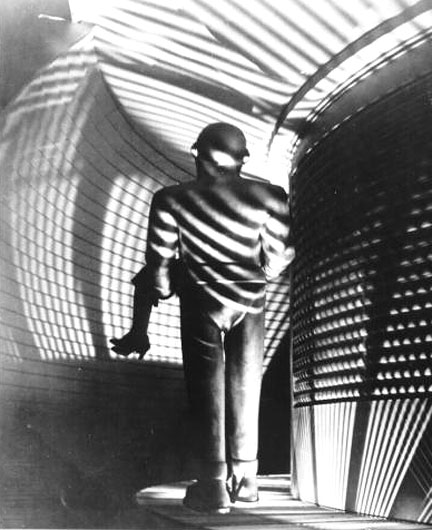
Gort makes his way through the shadows in Robert Wise’s sci-fi gem
THE DAY THE EARTH STOOD STILL (Robert Wise, 1951)
Rubin Museum of Art
150 West 17th St. at Seventh Ave.
Friday, May 7, free with $7 bar minimum, 9:30
212-620-5000
www.rmanyc.org/cabaretcinema
 This cold-war-era classic stars Michael Rennie as an alien who lands on earth with a very important message: No peace, no planet. He brings along with him one of the great robots in cinema history, Gort (Lock Martin), and later utters to Patricia Neal one of the ten best lines ever: “Klaatu borada nikto.” This science-fiction fave works on a number of different and fascinating levels; during a 1998 UC Berkeley interview, director Robert Wise even noted, “Some people read a religious connotation into the thing, the resurrection and all. If you want to put a beard on Rennie and all, he could be a Christ figure.” The film will be screening May 7 at the Rubin Museum as part of its Cosmic Cabaretcinema series, featuring “films that explore a new frontier in humankind’s understanding of the universe,” and will be introduced by writer Larry Doyle, a veteran of THE SIMPSONS and BEAVIS AND BUTT-HEAD.

 Jean-Pierre Léaud gives a bravura performance in Jean Eustache’s New Wave classic about love and sex in Paris following the May 1968 cultural revolution. Léaud stars as Alexandre, a jobless, dour flaneur who rambles on endlessly about politics, cinema, music, literature, sex, women’s lib, and lemonade while living with current lover Marie (Bernadette Lafont), obsessing over former lover Gilberte (Isabelle Weingarten), and starting an affair with new lover Veronika (Françoise Lebrun), a quiet nurse with a rather open sexual nature. The film’s three-and-a-half-hour length will actually fly by as you become immersed in the complex characters, the fascinating dialogue, and the excellent acting. Much of the movie consists of long takes in which Alexandre shares his warped view of life and art in small, enclosed spaces, the static camera focusing either on him or his companion. The film is screening on May 3 as part of the Neue Galerie’s Battlefields film series, featuring works involving soldiers in WWI, in conjunction with the current exhibit focusing on World War I veteran Otto Dix. The series concludes May 10 with Albert and Allen Hughes’s FROM HELL, starring Johnny Depp.
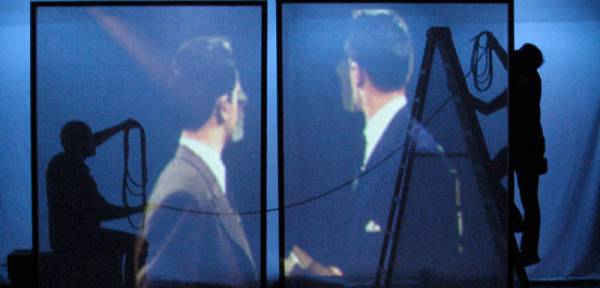
 In 1948, Alfred Hitchcock released his first Technicolor film, a psychological thriller loosely based on the Leopold & Loeb murders, starring Farley Granger and John Dall as a pair of Nietzschean “superior intellects” who throw a dinner party in their New York City apartment immediately after killing a former classmate and stuffing him into a chest they leave in the middle of the living room as guests start arriving. Reid Farrington, who previously reimagined Carl Th. Dreyer’s THE PASSION OF JOAN OF ARC in THE PASSION PROJECT, deconstructs and reconstructs Hitchcock’s film in GIN & “IT,” a multimedia whirlwind in which Farrington digitally removes ROPE’s characters and projects them individually onto screens that four actors move around the set, creating a three-dimensional effect that mixes live theater with film. (“It” was Hitchcock and screenwriter Arthur Laurents’s code word for the underlying homosexuality between Granger and Dall’s characters, which they subtly hid from the censors.)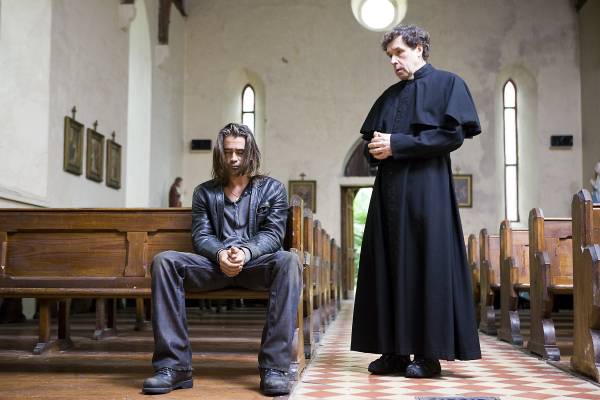
 After hard-luck fisherman Syracuse (a decidedly unglamorous Colin Farrell) raises his net to find out he has caught a woman (Alicja Bachleda) from the bottom of the sea, his life takes a dramatic shift in Neil Jordan’s wonderful fairy tale, ONDINE. Syracuse, also known disaffectionately as Circus for his checkered past, resuscitates the beautiful woman, who appears to have lost her memory and later chooses the name Ondine, which means “little wave.” Syracuse brings Ondine fishing with him, and when she sings her strange, haunting song, he catches more lobster and salmon than he ever has before. But his wheelchair-bound daughter, Annie (Alison Barry), who needs a new kidney, thinks than Ondine might be more than just good luck; she believes that Ondine is a selkie, a supposedly mythological sea creature who can live on land for seven years before having to return to her watery home. But when a mysterious stranger suddenly shows up in town, everyone is forced to reevaluate their changing lives. Gorgeously shot by master cinematographer Christopher Doyle (IN THE MOOD FOR LOVE) in the coastal village of Castletownbere and along Poulin Harbor, ONDINE is a compelling story that easily could have turned into treacly melodrama but manages to keep surprising up to the very end. Farrell is excellent as the uneducated, simple, but lovable Syracuse who, when not fishing or taking his daughter to her weekly dialysis treatment, shares his tale with the town priest (Stephen Rea) in some very funny scenes. Jordan (MONA LISA, THE CRYING GAME), who has a house in Castletownbere, has made a fairy tale audiences can really believe in with ONDINE, which features a lush soundtrack by Sigur Rós’s Kjartan Sveinsson that accompanies the lush locations.