Jessica Oreck reveals Tokyo’s love of bugs in unusual documentary
BEETLE QUEEN CONQUERS TOKYO (Jessica Oreck, 2009)
Film Forum
209 West Houston St.
May 12-18
212-727-8110
www.filmforum.com
www.beetlequeen.com
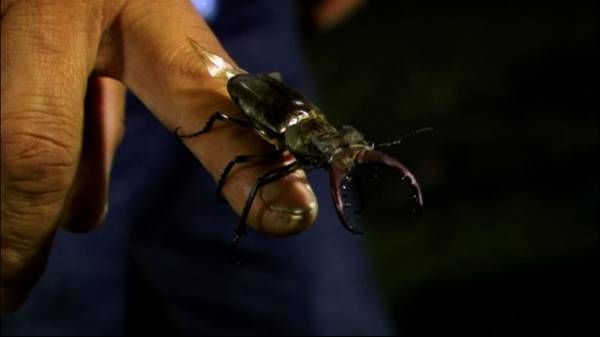
 Collecting insects as pets is a way of life in Japan, and first-time director Jessica Oreck captures this obsession with bugs in the surprisingly effective and highly unusual documentary BEETLE QUEEN CONQUERS TOKYO, playing at Film Forum May 12-18. Oreck, a docent and animal keeper at the American Museum of Natural History, traces the history of the relationship between Japan and bugs in a nonlinear narrative that often plays like a fiction film, especially when showing a young boy shopping for a particular insect – his favorite costs fifty-seven dollars – much the way children in the West look for dogs or cats, or following an insect hunter as he searches the forest for specimens to sell. Oreck cuts between dazzling, colorful shots of fast-paced, modern-day Tokyo backed by a thumping, bass-heavy soundtrack and calmer, more subtle scenes of nature as people discuss their love of beetles, crickets, and other creepy crawlers. But Oreck doesn’t present the Japanese treatment of insects as a strange fad or craze, instead seeing it as yet another relationship with nature and beauty that Westerners are unable to understand. Oreck will be at Film Forum for the 6:30 and 8:20 screenings on May 12 and 14, bringing with her some live exotic insects, and will also be at the 4:40 show on May 16 with INSECTOPEDIA author Hugh Raffles.

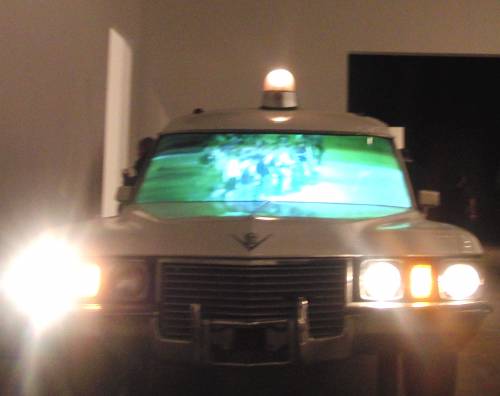


 Inspired by his own childhood raised on a commune, Adam Sherman’s debut film, HAPPINESS RUNS, is filled with angst and ennui, overwhelmed by a dank darkness that very nearly strangles it. Mark L. Young stars as Victor, a high school senior living in a utopian — dystopian? — community where sex and drugs run rampant, among the kids as well as the adults, which include Victor’s incompetent mother (Andie MacDowell) and Insley (Rutger Hauer), the local guru who heals his flock by sleeping with all the women he can. When the prodigal daughter, the beloved and beautiful Becky (Hanna Hall), returns to care for her ailing father, followed by ultracool drug dealer Shiloh (Shiloh Fernandez, looking frighteningly like Joaquin Phoenix), life in this supposedly idyllic setting threatens to explode as greed, jealousy, and violence turn the not-so-free-spirited commune into LORD OF THE FLIES. HAPPINESS RUNS, which has its moments, suffers from the lack of an attractive protagonist; everyone appears to be so miserable that it is difficult to identify with any of them. In his song “Happiness Runs,” ’60s icon Donovan sings, “You can have everything if you let yourself be”; in his first movie, HAPPINESS RUNS, Adam Sherman shows that that is not necessarily always the case.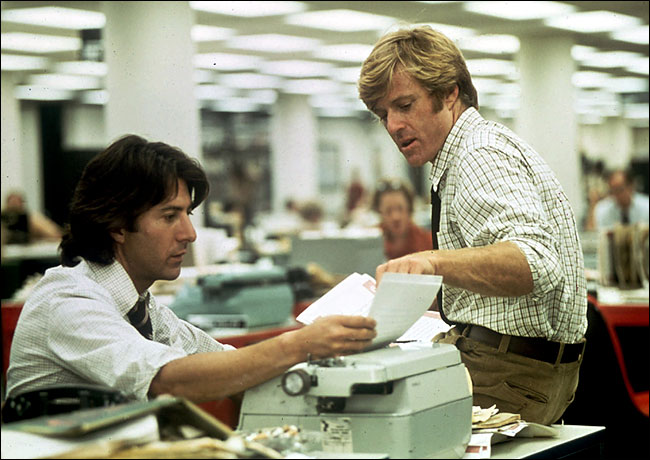
 Film Forum concludes its four-week series “The Newspaper Picture” with one of the grandest of them all, Alan J. Pakula’s ALL THE PRESIDENT’S MEN. Even though the audience knows the outcome, following two young reporters, Bob Woodward (Robert Redford) and Carl Bernstein (Dustin Hoffman), as they try to get to the bottom of the Watergate scandal is an absolute joy, an edge-of-your-seat thriller written by master scribe William Goldman. Pakula goes inside the machinations of the Nixon administration and the Washington Post, setting up an epic battle with an all-star cast that also includes Jack Warden, Martin Balsam, Jason Robards, Jane Alexander, Ned Beatty, and Hal Holbrook as Deep Throat. Nominated for eight Oscars and winner of two (for sound and art direction), ALL THE PRESIDENT’S MEN is not just one of the great newspaper pictures of all time but one of the best films of an outstanding decade for movies.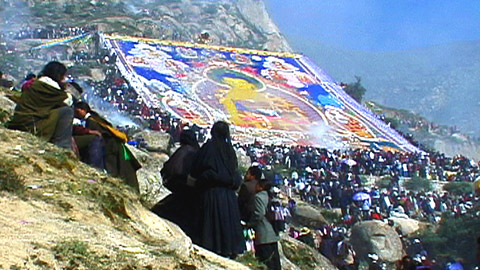
 The Asia Society’s presentation of John Bush’s Yatra Trilogy concludes on May 7 with VAJRA SKY OVER TIBET: JOURNEY INTO AN ENDANGERED WORLD, a reverential documentary that examines the history of the Tibetan people, focusing on the long-standing battle with China. In 1959, the fourteenth Dalai Lama was forced into exile, finding safe haven in India. Although many Tibetans escaped with him, many stayed behind, where they practice their faith under the sharp watch of the Chinese government, which would like to name their own Dalai Lama in time. VAJRA SKY OVER TIBET is the third part of the Yatra Trilogy by producer/director John Bush, following DHARMA RIVER and PRAJNA EARTH, as Bush completes his Buddhist pilgrimage that previously took him to Southeast Asia. Bush, a Western Buddhist himself, gained remarkable access to some of Vajrayana Buddhism’s holiest palaces and sites of worship, including Jokhang Temple in Llasa, the Potala, and the Norbulinka. Bush winds his way through the Drepung Festival, traveling with a Tibetan guide whose name he can’t share because of possible reprisals. Bush narrates much of the film, along with Tenzin L Choegyal, the nephew of the current Dalai Lama, and Dadon, a popular Tibetan singer. The meditative score is by David Hykes and the Harmonic Choir, supplemented with devotional music by Dadon and other Himalayan musicians. Although it often plays too much like a travel show on PBS or the Travel Channel, VAJRA SKY, which has been personally endorsed by the Dalai Lama, is an illuminating look into a fascinating culture that is in serious danger of disappearing. “Tibetan civilization,” writes the Dalai Lama as the film begins, “forms a distinct part of the world’s precious common heritage. Humanity would be the poorer if it were to be lost.” For nearly ninety minutes, with beautiful cinematography, captivating music, and gorgeous settings, Bush, who will introduce the Asia Society screening in conjunction with the exhibit “Pilgrimage and Buddhist Art,” takes you deep inside a mysterious, peaceful, and threatened world that you will not soon forget.