Film Forum
209 West Houston St.
August 27 – September 6
212-727-8110
www.filmforum.org
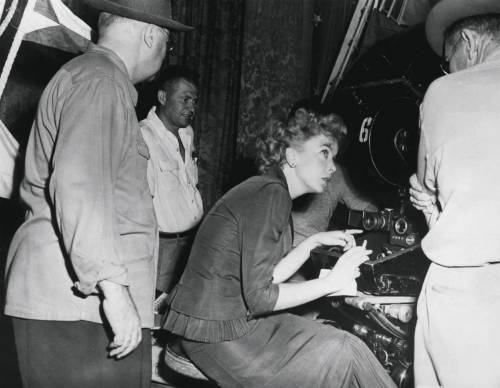
Maverick film director and producer William Castle titled his 1976 memoir STEP RIGHT UP! . . . I’M GONNA SCARE THE PANTS OFF AMERICA. And for some thirty-plus years, that’s exactly what he did. The guru of film gimmicks, who died in 1977 just as Sensurround was taking hold, was the mastermind behind such tantalizing tales as THE TINGLER, filmed in Percepto; HOUSE ON HAUNTED HILL, made in Emergo; HOMICIDAL, which came complete with a Fright Break; MR. SARDONICUS, which had a climactic Punishment Poll; MACABRE, which offered Fright Insurance; STRAIT-JACKET, in which the audience was given toy axes; and THIRTEEN GHOSTS, shown in “bloodcurdling” Illusion-O. All of those films and more are part of Film Forum’s ten-day retrospective, totaling fifteen works in all, starring the likes of Joan Crawford, J. Carrol Naish, Kim Hunter, Martin Milner, Barbara Stanwyck, and, of course, the great Vincent Price. Castle was quite the character himself, introducing many of his films and warning the audience about the frightening experiences they were about to encounter; as he says in the above trailer for THE TINGLER, “Remember this: A scream at the right time may save your life.” Castle’s daughter Terry will be at Film Forum to introduce the 8:10 screening of HOMICIDAL on Friday and the 10:00 showings for STRAIT-JACKET Saturday and Sunday.

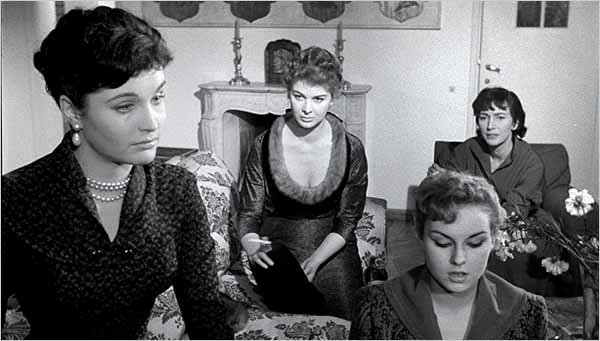
 After its much-hailed one-week run in June at Film Forum, the 35mm restoration of Michelangelo Antonioni’s LE AMICHE returns by popular demand, playing August 25-31, and there’s just no reasonable excuse for missing it again. Winner of the Silver Lion at the 1955 Venice Film Festival, the sublimely marvelous LE AMICHE follows the life and loves of a group of oh-so-fabulous catty, chatty, and ultra-fashionable Italian women and the men they keep around for adornment. Returning to her native Turin after having lived in Rome for many years, Clelia (Eleonora Rossi Drago) discovers that the young woman in the hotel room next to hers, Rosetta (Madeleine Fischer), has attempted suicide, thrusting Clelia into the middle of a collection of self-centered girlfriends who make the shenanigans of George Cukor’s THE WOMEN look like child’s play. The leader of the vain, vapid vamps is Momina (Yvonne Furneaux), who carefully orchestrates situations to her liking, particularly when it comes to her husband and her various, ever-changing companions, primarily architect Cesare (Franco Fabrizi). As Rosetta falls for painter Lorenzo (Gabriele Ferzetti), who is married to ceramicist Nene (Valentina Cortese), Clelia considers a relationship with Cesare’s assistant, Carlo (Ettore Manni), and the flighty Mariella (Anna Maria Pancani) considers just about anyone. Based on a novella by Cesare Pavese, LE AMICHE is one of Antonioni’s best, and least well known, films, an intoxicating and thoroughly entertaining precursor to his early 1960s trilogy, L’AVVENTURA, LA NOTTE, and L’ECLISSE. Skewering the not-very-discreet “charm” of the Italian bourgeoisie, Antonioni mixes razor-sharp dialogue with scenes of wonderful ennui, all shot in glorious black and white by Gianni Di Venanzo. LE AMICHE is a newly rediscovered treasure from one of cinema’s most iconoclastic auteurs.
 In THE END OF POVERTY? director Philippe Diaz speaks with Nobel Prize winners, economists, writers, politicians, researchers, and other experts, attempting to get at the heart of international poverty — particularly by tugging at the audience’s heartstrings. He intercuts shots of talking heads discussing slavery and colonialism, the World Bank, the free market, the International Monetary Fund, and government bailouts with portraits of men, women, and children living in squalor in Africa, Latin America, the United States, and elsewhere. He supplements the film with a barrage of statistics that, individually, are infuriating but, taken as a whole, get lost in a whirlwind of numbers. Adding to the overkill is Martin Sheen’s over-the-top narration, which piles on yet more information and outrage. But even as the film sometimes feels like a Sally Struthers save-the-children infomercial, its crucial message does manage to pull through and take root — the money is out there, but its incredibly lopsided distribution in a warped system is basically set up to keep the imbalance that has led to such a tragic situation. THE END OF POVERTY? is being screened August 25 at the Action Center to End World Hunger as part of the monthly Films for Change series, followed by a free wine and beer reception and a Q&A with Monisha Bajaj, assistant professor of international and translational studies at Columbia University Teachers College.