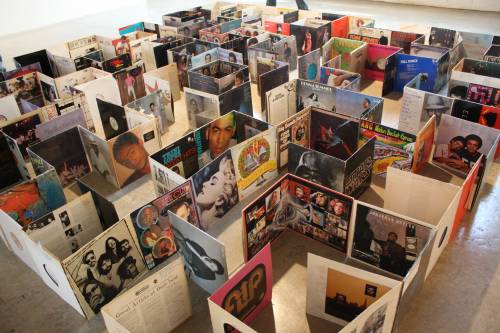
William Cordova’s “Laberintos (after octavio paz)” is set up like dominoes ready to come tumbling down at any moment (photo by twi-ny/mdr)
MoMAPS1
22-25 Jackson Ave. at 46th Ave.
Warm Up: Saturdays from 2:00 to 9:00 through September 4, $15 (free for Long Island City residents)
Greater New York: Thursday through Monday from 12 noon – 6:00 pm through October 18
Suggested donation: $10 (free with MoMA ticket within thirty days of MoMA visit)
718-784-2084
www.ps1.org
“pole dance” slideshow
MoMA PS1’s third quinquennial, their five-year survey of contemporary art in the metropolitan area, is an engaging and involving collection of multimedia work from approximately seventy artists. Taking on everything from environmentalism and racism to marketing and celebrity, the show moves along at a breezy pace. Various artists get their own relatively large galleries, including David Benjamin Sherry (yes, you can walk through the doors), Leidy Churchman, Vlatka Horvat, and Zipora Fried, while others get their own small rooms, like Conrad Ventur, who presents the history of Shirley Bassey singing “This Is My Life” as seen through rotating crystal prisms. David Brooks’s “Preserved Forest” installation comments on the deforestation along a new superhighway in Brazil, while Gilad Ratman’s two-channel video, “The 588 Project,” features a bubbling, muddy ooze seemingly coming alive. Visitors are encouraged to add colorful strips of tape to Franklin Evans’s “timecompressionmachine” and to play the strings of Naama Tsabar’s pair of speaker walls. One of the most powerful pieces is Hank Willis Thomas’s “Unbranded,” consisting of advertising photographs tailored to the African American community, organized chronologically from the 1960s to the present, in which all text and brand names have been removed, leaving just the central image to be judged on its own. In the same room, William Cordova’s “Laberintos (after octavio paz)” collects record sleeves from an Ivy League institution that borrowed 200 Inca artifacts from Peru in 1914 and refuses to return them; the albums are arranged in a perilous maze that appears likely to collapse at any moment. As usual, there’s art just about everywhere you look or listen at PS1; Nico Muhly’s specially commissioned sound piece loops in the elevator, and Aki Sasamoto collaborated with Saul Melman on “Skewed Lies / Central Governor” in the boiler room, where live performances are scheduled September 17-19 and October 15-17. Also downstairs, in the cinema, Ronald Bronstein’s FROWNLAND (2007) continues through August 30, with Bronstein discussing the film with Amy Taubin on August 28; future screenings include works by Dani Leventhal and Fern Silva as well as Tomonari Nishikawa and Redmond Entwistle, with upcoming performances by Andrew Lampert and Trisha Baga. In addition, Dutch artist Guido van der Werve will be presenting an orchestra performance October 2 & 9.
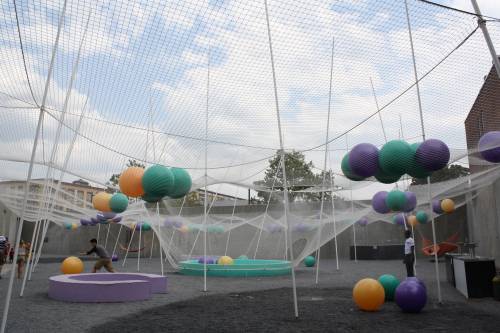
Solid Objectives — Idenburg Liu have installed the playful, interactive “Pole Dance” in the PS1 courtyard (photo by twi-ny/mdr)
The summer-long hot and sweaty Warm Up series has two Saturdays remaining, with Big Freedia, DJ Rusty Lazer, DJ Rashad, GHE20 GOTHIK DJs Venus X and Brenmar, and Traxx getting booties shaking on August 28, and House of House, DJ Mehdi, and a live set by Holy Ghost! ready to close out the season on September 4. The winner of this year’s Young Architects Program, Solid Objectives — Idenburg Liu (SO – IL), has filled the courtyard with large beach balls, overhead netting, hammocks, wading pools, and sand, where people can relax or toss around the balls while also getting sprayed with mist. Some of the poles in the section immediately to the right are linked to sound, so you can orchestrate your own concert or watch a show choreographed by Kyra Johannesen on August 28 at 2:30. You can also grab burgers, beer, and dogs at the regular Warm Up barbecue, but be prepared for some massive crowds. Summer Saturdays at PS1 have become a right of passage for New Yorkers, who are able to experience art, music, film, dance, food, sport, literature, and more, all in one fabulous setting.
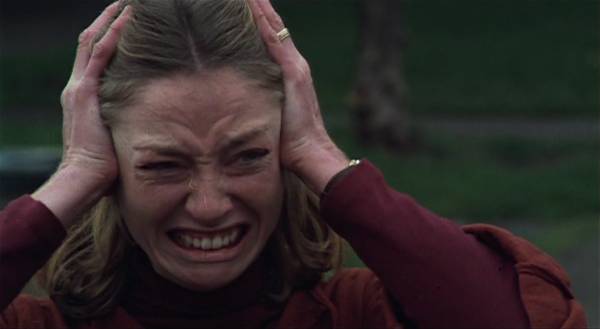
 Based on a magazine serial by Jack Finney, Don Siegel’s 1956 classic, INVASION OF THE BODY SNATCHERS, was the ultimate thriller about cold war paranoia. Twenty-two years later, in a nation just beginning to come to grips with the failure of the Vietnam War, Philip Kaufman (THE RIGHT STUFF, QUILLS) remade the film, moving the location north to San Francisco from the original’s Los Angeles. When health inspector Matthew Bennell (Donald Sutherland) and lab scientist Elizabeth Driscoll (Brooke Adams) suspect that people, while they sleep, are being replaced by pod replicas, they have a hard time making anyone believe them, especially Dr. David Kibner (Leonary Nimoy), who takes the Freudian route instead. But when Jack and Nancy Bellicec (Jeff Goldblum and Veronica Cartwright) seem to come up with some physical proof, things begin to get far mores serious — and much more dangerous. Kaufman’s film is one of the best remakes ever made, paying proper homage to the original while standing up on its own, with an unforgettable ending (as well as an unforgettable dog). It cleverly captures the building selfishness of the late 1970s, which would lead directly into the Reagan era. As an added treat, the film includes a whole bunch of cameos, including Siegel as a taxi driver, Robert Duvall as a priest, and Kevin McCarthy, who starred as Dr. Miles Bennell in the original, still on the run, trying desperately to make someone believe him. The sc-fi thriller is screening at the Rubin as part of the museum’s Memento Mori series, being held in conjunction with the exhibition “Remember That You Will Die,” and will be introduced by Georgia Clark.
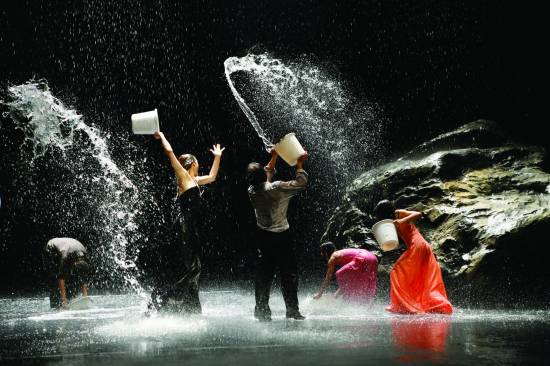
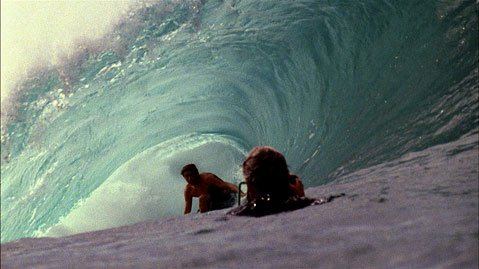
 Surfing is in Dana Brown’s blood. His father, Bruce, was a champion surfer who made such documentaries as SLIPPERY WHEN WET, SURF CRAZY, and the 1966 classic THE ENDLESS SUMMER. The elder Brown revisited that last film in 1994 in THE ENDLESS SUMMER 2, which he cowrote with Dana, who went on to make the exciting STEP INTO LIQUID in 2003. Dana has headed back to the beach for HIGHWATER, bringing along his son, Wes, to continue the family tradition. (Wes serves as associate producer and cowriter and coeditor with his dad.) The film ostensibly follows surfing’s Triple Crown on the North Shore of Hawaii in 2005, but it’s not really about winners and losers; it’s about the life — and, sometimes, the loss of life or limb — of the men and women who hop on surfboards and take on some of the most fearsome and beautiful waves ever seen. Brown, who proves as narrator that he’s never met a cliché he didn’t like, speaks with such champion surfers and up-and-coming stars as Kelly Slater, Sunny Garcia, Pat O’Connell, Rochelle Ballard, Carrissa Moore, and Pancho Sullivan, who talk about their personal relationship with the Seven Mile Miracle (along the North Shore) and their love of the water. The film is somewhat scattershot, giving relatively short shrift to the women and not explaining nearly enough to audiences, most of whom will probably need many more details about how the contests are scored and what the rules are. That said, cinematographer Steve Matzinger and his team of cameramen do a good job of capturing some great rides, risking their own safety to go after the perfect shot, just as the surfers are after the perfect wave. And the subplot involving Brown’s pursuit of the elusive, enigmatic Eric Haas is wonderfully wacky. HIGHWATER primarily preaches to the converted, but it does so with heart, especially when tragedy hits.