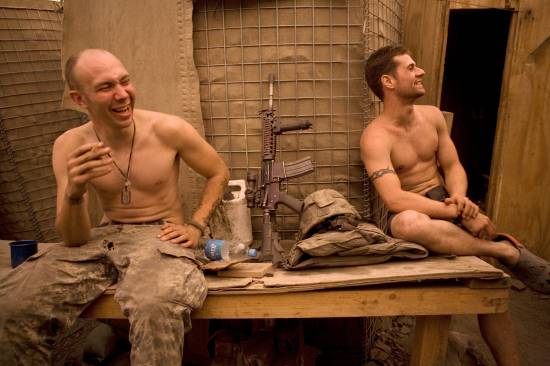
Life in the Korengal Valley was not all fun and games for Specialist Misha Pemble-Belkin, Ross Murphy, and the rest of Battle Company, 173rd US Airborne at Outpost Restrepo in Afghanistan (photo © Tim Hetherington)
RESTREPO: ONE PLATOON, ONE YEAR, ONE VALLEY (Sebastian Junger & Tim Hetherington, 2010)
Symphony Space, Leonard Nimoy Thalia
2537 Broadway at 95th St.
Sunday, October 17, 4:00 & 8:00
212-864-5400
www.restrepothemovie.com
www.symphonyspace.org
 From June 2007 to July 2008, journalists Sebastian Junger (THE PERFECT STORM) and Tim Hetherington (LIBERIA: AN UNCIVIL WAR) made a total of ten trips to the dangerous Korengal Valley in Afghanistan, documenting the full deployment of Battle Company of the 173rd Airborne Brigade. With snipers hidden all around them, the fifteen soldiers of Second Platoon built a remote, strategic outpost they named Restrepo after PFC Juan Restrepo, the well-liked company medic who was killed early on. Junger and Hetherington film such men as Captain Dan Kearney, Staff Sergeant Kevin Rice, and Sergeant Brendan C. O’Byrne as they go about their daily duties, joking around, playing the guitar, meeting with Afghan locals to get information about the Taliban, and digging trenches while prepared to be shot at at any moment. The journalists took more than 150 hours of footage, supplemented with interviews with several of the soldiers after they were safely back at home base in Italy, talking about what they went through. There is nothing political about RESTREPO, nor does it pull at the heartstrings with melodramatic, overemotional scenes; instead, it depicts the harsh realities of battle, including the long stretches of boredom punctuated by sudden life-or-death situations. There is no narration, no one discusses the possible merits of the war, and no generals or politicians are on hand to defend America’s involvement in the region. There’s no ethnocentric yahooism, nor is there racist treatment of the mostly unseen enemy. It’s just war, pure and simple, seen from the perspective of men who chose to join the army and risk their lives for their country. The film won the documentary Grand Jury Prize at this year’s Sundance Festival and recently screened at the Human Rights Watch Film Festival at Lincoln Center.
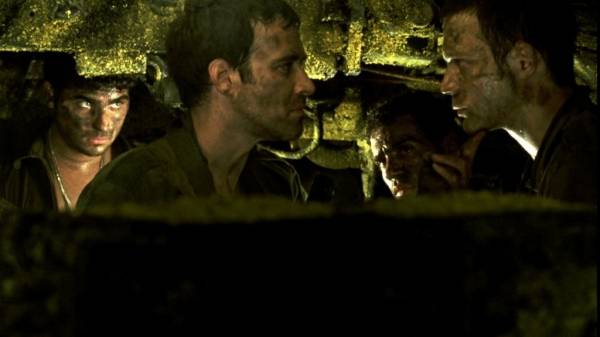
 Claustrophobics, beware. Nearly all of Samuel Moaz’s microcosmic examination of the first day of the 1982 Israel-Lebanon war — the same struggle recently tackled by Ari Folman in the animated WALTZ WITH BASHIR — takes place within a dark, grungy tank. In this tiny space, audiences get to experience the fear building inside company leader Yigal (Michael Moshonov), driver Hertzel (Oshri Cohen), weapons loader Assi (Itay Tiran), and gunner Shmulik (Yoav Donat) as they are suddenly put in the middle of a secret, dangerous mission by commander Jamil (Zohar Strauss) and meet action head-on almost immediately, having to deal with the prospects of killing for the first time. The world outside the tank is seen only through the cross-hairs of Shmulik’s telescopic lens, making everyone outside a potential victim. At times the tension mounts at a breathtaking pace, although the film gets bogged down in too much melodrama as the characters get further developed. As a teenager, writer-director Moaz actually fought in the war, and it was his memories of having killed a man on that very day — June 6, 1982 — that led him to make the movie, which won the Silver Bear at the Venice Film Festival. LEBANON is quite a ride.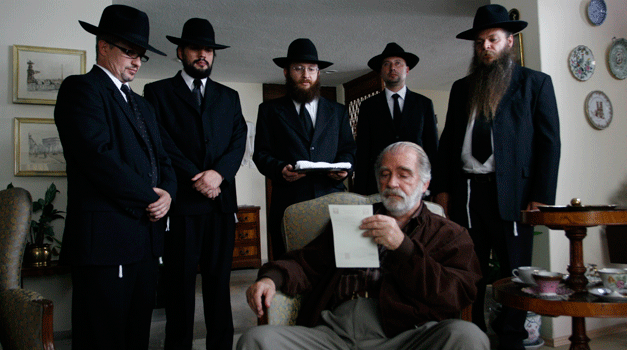
 Mariana Chenillo’s debut feature, NORA’S WILL, is an endearingly bittersweet black comedy about family and forgiveness. As the film opens, Nora (Silvia Mariscal) is carefully organizing her home, putting cards and letters away and setting an ornate table for the first night of Passover. Then, after more than a dozen prior attempts, she successfully commits suicide. Her ex-husband, José (Fernando Luján), who lives across the street, discovers her, but with their son, Rubén (Ari Brickman), and his family in Texas, José suddenly finds himself responsible for the body. Before José can make any decisions, Rabbi Jackowitz (Max Kerlow) arrives, telling him that because of the holiday and the Sabbath, the body will have to remain in Nora’s apartment for five days before burial and that Moisés (Enrique Arreola) will continually pray over Nora until they can proceed with the funeral, which is further complicated because of how she died. None of this sits well with José, a cynical atheist who quickly orders a Christian wake and offers the rabbi a piece of ham, bacon, and sausage pizza. But when José comes upon a postcard Nora had accidentally dropped during her obsessive preparations, he thinks he might have uncovered a mystery that shakes him from his apathy. Luján is absolutely marvelous as the well-bearded José, making subtle gestures and hysterically offensive comments as if they were nothing, insulting just about everyone with a bored look in his eye, as if he’d rather be anywhere than where he is. Angelina Peláez is a hoot as Nora’s very Catholic housekeeper, Fabiana, who insists on making up Nora’s face and praying over her with rosary beads. Winner of seven Mexican Ariel Awards including Best Picture, NORA’S WILL is a splendidly told tale with tongue firmly implanted in cheek. Just like Nora does, writer-director Chenillo keeps everything in its proper place — after all, “seder” does mean “order” — never going over the top even when slapstick beckons. The film’s Mexican title, CINCO DIAS SIN NORA, translates as FIVE DAYS WITHOUT NORA, but Nora is ever-present in all the hijinks, not only through her corporeal body in the bedroom but via the will she continues to impose on everyone even after death.

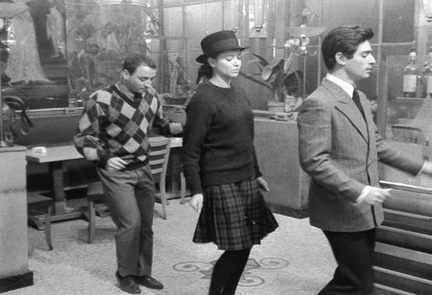
 When a pair of disaffected Parisians, Arthur (Claude Brasseur) and Franz (Sami Frey), meet an adorable young woman, Odile (Anna Karina), in English class, they decide to team up and steal a ton of money from a man living in Odile’s aunt’s house. As they meander through the streets of cinematographer Raoul Coutard’s black-and-white Paris, they talk about English and wealth, dance in a cafe while director Jean-Luc Godard breaks in with voice-over narration about their character, run through the Louvre in record time, and pause for a near-moment of pure silence. Godard throws in plenty of commentary on politics, the cinema, and the bourgeoisie in the midst of some genuinely funny scenes. BAND OF OUTSIDERS is no ordinary heist movie; based on Dolores Hitchens’s novel FOOL’S GOLD, it is the story of three offbeat individuals who just happen to decide to attempt a robbery while living their strange existence, as if they were outside from the rest of the world. The trio of ne’er-do-wells might remind Jim Jarmusch fans of the main threesome from STRANGER THAN PARADISE (1984), except Godard’s characters are more aggressively persistent. BAND OF OUTSIDERS is screening as part of Film Forum excellent series “The Heist,” in a double feature with Jean-Pierre Melville’s BOB LE FLAMBEUR.
 Masaki Kobayashi paints four marvelous ghost stories in this eerie collection that won a Special Jury Prize at Cannes. In “The Black Hair,” a samurai (Rentaro Mikuni) regrets his choice of leaving his true love for advancement. Yuki (Keiko Kishi) is a harbinger of doom in “The Woman of the Snow.” Hoichi (Katsuo Nakamura) must have his entire body covered in prayer in “Hoichi, the Earless.” And Kannai (Kanemon Nakamura) finds a creepy face staring back at him in “In a Cup of Tea.” Winner of the Special Jury Prize at Cannes, KWAIDAN is one of the greatest ghost story films ever made, four creepy, atmospheric existential tales that will get under your skin and into your brain. KWAIDAN kicks off the Japan Society’s “Zen & Its Opposite: Essential (& Turbulent) Japanese Art House,” comprising six films that illustrate the Six Planes of Existence, or the Six Paths of Samsara. The series continues on November 12 with ONIBABA (Kaneto Shindo, 1964), December 10 with FIRES ON THE PLAIN (Kon Ichikawa, 1959), January 12 with HELL (Nobuo Nakagawa, 1960), and February 18 with SWORD OF DOOM (Kihachi Okamoto, 1966).