Friday, October 22, NYU Skirball Center, 566 La Guardia Pl., $20-$30, 8:00
Friday, October 22, Bowery Ballroom, 6 Delancey St., $15, 11:30
www.myspace.com/deanandbritta
www.cmj2010.com
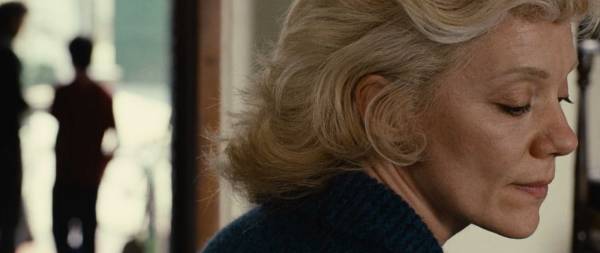
Dean Wareham and Britta Phillips will be doing double duty on Friday night at CMJ, first holding the final New York City performance ever of “13 Most Beautiful: Songs for Andy Warhol’s Screen Tests” at 8:00 at NYU’s Skirball Center before heading over to the Bowery Ballroom for “Dean Wareham Plays Galaxie 500.” Two years ago, the Andy Warhol Museum in Pittsburgh commissioned Dean & Britta to compose scores for screen tests that the silver-haired artist shot at the Factory from 1964 to 1966; they searched through hundreds of the black-and-white films (each four minutes and sixteen seconds in length) until they decided on Lou Reed, Nico, Edie Sedgwick, Dennis Hopper, Paul America, Susan Bottomly, Ann Buchanan, Freddy Herko, Jane Holzer, Billy Name, Richard Rheem, Ingrid Superstar, and Mary Woronov. The result is a stunning collection of gorgeous instrumentals (“Silver Factory Theme,” “Incandescent Innocence”), covers (Bob Dylan’s “I’ll Keep It with Mine” and the Velvet Underground’s “I’m Not a Young Man Anymore”), “Knives from Bavaria” from the Dean & Britta record L’AVVENTURA, and other trippy tracks, including the phenomenal “Teenage Lightning (and Lonely Highways),” that the duo, accompanied by Anthony Lamarca and Matt Sumrow, will perform live at the Skirball while the screen tests are projected behind them. Then it’s off to the Bowery Ballroom, where Dean and Britta, who have been partners on- and offstage ever since Phillips joined Luna in 2005, will play songs from the brief tenure of the much-missed Galaxie 500, which released the Rough Trade albums TODAY (1988), ON FIRE (1989), and THIS IS OUR MUSIC (1990) once upon a time. Also on the bill are Crocodiles, Wakey! Wakey!, Brian Bonz & the Major Crimes, James Vincent McMorrow, and Young Buffalo.
Also
UME, Mercury Lounge, 7:00
Bad Rabbits, Pure Volume House, 8:00
Four Tet, Webster Hall, 8:30
Fishbone, (le) poisson rouge, 9:00
MiniBoone, Crash Mansion, 9:30
La Strada, Bruar Falls, 10:00
Shinobi Ninja, Sullivan Hall, 10:30
Takka Takka, Bruar Falls, 11:00
Hypernova, Cameo Gallery, 11:30
We Are Country Mice, Cake Shop, 11:50
Lower Dens, Rockwood Music Hall, 12 midnight
Nada Surf, Mercury Lounge, 1:00 am

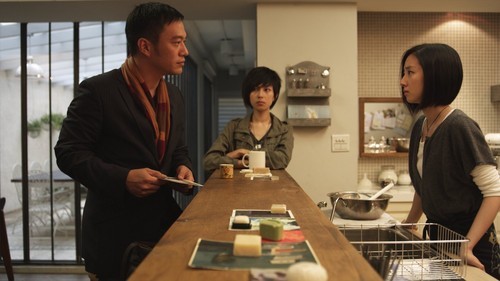
 Commissioned by Taipei’s tourism bureau and made by longtime television commercial director Hsiao Ya-Chuan, TAIPEI EXCHANGES borders on being too sickly sweet, lacking any type of real edge. Yet the tender tale about the value of things, from random objects to memories, still manages to hold its own, avoiding being an eighty-two-minute ad for Taiwan travel. When Doris (Gwei Lun-mei) opens up a coffee shop, her friends bring her lots of odd gifts that she doesn’t know what to do with. Her sister, Josie (Zaizai Lin), comes up with the novel idea that people can exchange their own objects for those in the store — of course, while they’re also buying coffee and pastries so she and her sister can pay the rent. Doris and Josie refuse to put a price on anything, instead creating a barter system that could involve storytelling, plumbing emergencies, or a song. Doris becomes particularly intrigued by one customer, Han Chang (Chou Chun-Ching), who has brought thirty-five bars of soap, each one with its own tale. Like Doris herself, TAIPEI EXCHANGES is charmingly innocent but not nearly as quirky as its most obvious predecessor, Jean-Pierre Jeunet’s endlessly entertaining 2001 hit, AMÉLIE. Hsiao likes his characters too much to give them the necessary depth, but he does manage to make some commentary on materialism and ethics. On three occasions he adds people-on-the-street interviews, getting strangers’ general reactions to questions that come up in the course of the film — which is set in a space that was transformed into a café and is now a real place where visitors can stop and get coffee and pastries (but can’t exchange anything).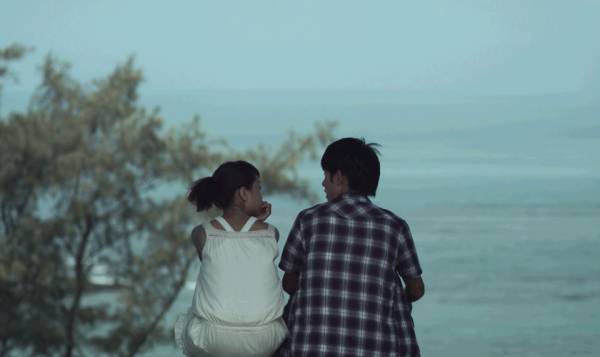
 After being chosen for the Berlin and Hong Kong International Film Festivals, Hou Chi-Jan’s debut feature, ONE DAY, makes its U.S. premiere Thursday night as the centerpiece selection of the CMJ Music Marathon and Film Festival. On a military boat heading out to Kinmen, an island off Taipei, a young woman who works on the ship, Singing (Nikki Hsin-Ying Hsieh), sees a young soldier, Tsung (Bryan Shu-Hao Chang), looking at a compass, an item that has special meaning for her. Soon the two are huddled in a tiny space together, hiding from a hatchet-wielding crazy man on an otherwise suddenly empty ship. “We’re not in the real world,” Tsung tells Singing. ONE DAY is a fantastical love story that jumps between dreams and reality, often in confusing ways, but its innate charm overcomes its sci-fi problems. Beautifully shot by cinematographer Mahua Hsin-Hua Feng, the film’s dreamlike pace works well with the story as Singing and Tsung go from the past to the present to the future in constantly shifting states of mind, even if you might need your own compass to figure out just where the story is at any given moment. ONE DAY, from executive producer Hou Hsiao Hsien, is screening at CMJ on Thursday night at 7:50 and will be followed by a Q&A with the director.
 After the breakout success of BORN TO RUN in 1975, Bruce Springsteen became embroiled in a lawsuit over control of his music that prevented him from going into the studio to make the highly anticipated follow-up. Springsteen found himself at a crossroads; “You didn’t know if this would be the last record you’d ever make,” he says in the revealing behind-the-scenes documentary THE PROMISE: THE MAKING OF DARKNESS ON THE EDGE OF TOWN. Combining archival footage of the DARKNESS sessions shot by Barry Rebo with new interviews with all the members of the E Street Band in addition to producers Jimmy Iovine, Jon Landau, and others, editor and director Thom Zimny melds Bruce’s past with the present, delving deep into Springsteen’s complex, infuriating, and fiercely dedicated creative process. “I had to disregard my own mutation,” Springsteen says at one point, regarding his battle to avoid getting caught up in the hype that came with BORN TO RUN, so he decided that his next album would be “a meditation on where are you going to stand.” Rebo captures Springsteen and the E Street Band — from a bare-chested Bruce to a bandanna-less Steve Van Zandt — rehearsing and recording alternate takes of familiar songs as well as tunes that would later wind up on such albums as THE RIVER and TRACKS, opening up Bruce’s famous notebooks and examining his intense creative process, which included throwing away dozens and dozens of songs that he believed just didn’t fit within his vision of what DARKNESS should be. Two of the most fascinating parts of the THE PROMISE, a recent hit at the Toronto Film Festival, involve Patti Smith discussing “Because the Night,” which is about her waiting for her boyfriend at the time, Fred “Sonic” Smith, to call her, and Toby Scott talking about mixing the DARKNESS record to get the sound pictures in Bruce’s head onto vinyl. THE PROMISE: THE MAKING OF DARKNESS ON THE EDGE OF TOWN is screening Wednesday night at the CMJ Film Festival (and will be followed by a Q&A with Zimny moderated by Q04.3 deejay Jonathan Clarke), which opens Tuesday with CIRCUS MAXIMUS (Thomas J. La Sorsa, 2010) and also includes such films as GAINSBOURG AND HIS GIRLS (Pascal Forneri, 2010), PASSENGER SIDE (Matt Bissonnette, 2010), FIREWALL OF SOUND (Devin DiMattia, 2010), and THE CHILD PRODIGY (Luc Dionne, 2010); select showings will feature introductions or postscreening Q&As with the filmmakers, performers, and others.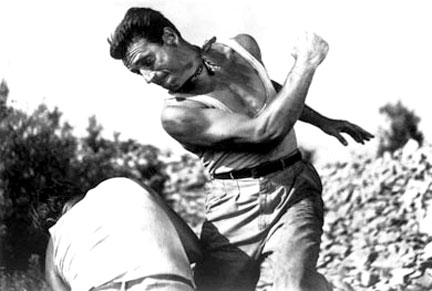
 In a very poor South American village, four men are needed to transport two truckloads of nitroglycerin to the scene of an industrial accident. The men jump at the chance to risk their lives for a small amount of cash because they have nothing else in their pitiful lives. Yves Montand stars in this endlessly tense, harrowing film that won the Golden Bear in Berlin, the BAFTA in England, and the Grand Prize at Cannes. The cast also includes Charles Vanet, Peter van Eyck, Folco Lulli, and Véra Clouzot, the wife of director Henri-Georges Clouzot (LES DIABOLIQUES, LES ESPIONS). THE WAGES OF FEAR will be screening as part of the French Institute Alliance Française series Hollywood Loves French Cinema, along with William Friedkin’s surprisingly gripping 1977 remake, SORCERER, in which Roy Scheider does an outstanding job playing the torturous Montand role as a driver who must go through hell to try to get a shipment of nitroglycerine to its intended destination.