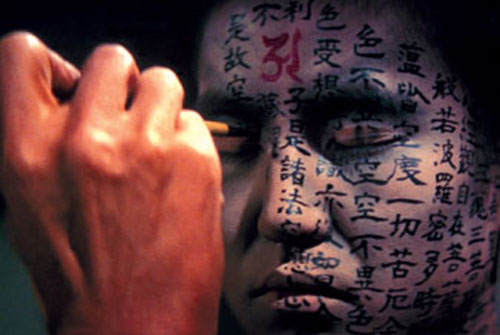
Tōru Takemitsu “wanted to create an atmosphere of terror” in Masaki Kobayashi’s quartet of ghost stories
KWAIDAN (Masaki Kobayashi, 1964)
Film Forum
209 West Houston St.
Friday, December 10, 1:00, 6:30
Series continues through December 16
212-727-8110
www.filmforum.org
 Masaki Kobayashi paints four marvelous ghost stories in this eerie collection that won a Special Jury Prize at Cannes. In “The Black Hair,” a samurai (Rentaro Mikuni) regrets his choice of leaving his true love for advancement. Yuki (Keiko Kishi) is a harbinger of doom in “The Woman of the Snow.” Hoichi (Katsuo Nakamura) must have his entire body covered in prayer in “Hoichi, the Earless.” And Kannai (Kanemon Nakamura) finds a creepy face staring back at him in “In a Cup of Tea.” Winner of the Special Jury Prize at Cannes, KWAIDAN is one of the greatest ghost story films ever made, four creepy, atmospheric existential tales that will get under your skin and into your brain. The score was composed by Tōru Takemitsu, who said of the film, “I wanted to create an atmosphere of terror.” He succeeded.
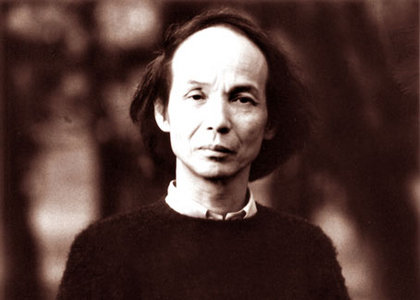
Japanese composer Tōru Takemitsu will be celebrated in film and music in New York City this month
KWAIDAN is screening as part of Film Forum’s two-week salute to composer Tōru Takemitsu (1930-96), who scored KWAIDAN and more than one hundred other films, including such diverse works as Teshigahara’s ANTONIO GAUDI, PITFALL, THE FACE OF ANOTHER, and WOMAN IN THE DUNES, Nagisa Oshima’s THE CEREMONY, Masahiro Shinoda’s CHINMOKU and PALE FLOWER, Mitsuo Yanagimachi’s HIMATSURI, Kon Ichikawa’s ALONE ON THE PACIFIC, Masaki Kobayashi’s YOUTH OF JAPAN, HARAKIRI, and SAMURAI REBELLION, and Akira Kurosawa’s RAN and DODES’KA-DEN, all of which are part of the series. The music of Takemitsu will also be celebrated this month at the JapanNYC Festival, with Seiji Ozawa conducting the Saito Kinen Orchestra in a presentation of Takemitsu’s “November Steps,” with Yukio Tanaka on biwa and Kifu Mitsuhashi on shakuhachi, at Carnegie Hall on December 15 (in addition to Berlioz’s Symphonie fantastique), a concert featuring traditional hōgaku instruments at the Institute for Medieval Japanese Studies at Columbia University on December 16, and a tribute concert at Zankel Hall on December 17 curated by his daughter, Maki Takemitsu, with jazz performances of his film scores performed by guitarists Kazumi Watanabe and Daisuke Suzuki, accordionist coba, and percussionist Tomohiro Yahiro.

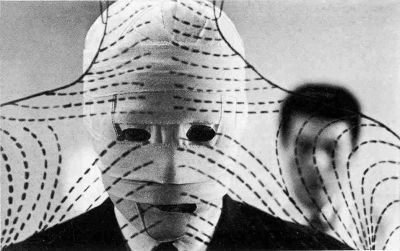
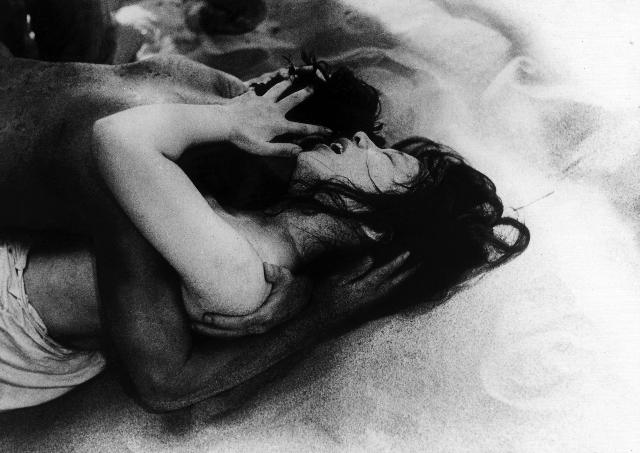
 Japanese novelist Kôbô Abe and director Hiroshi Teshigahara collaborated on five films together, including the marvelously existential WOMAN OF THE DUNES in 1964 and THE FACE OF ANOTHER two years later. In THE FACE OF ANOTHER, Tatsuya Nakadai (THE HUMAN CONDITION, KILL!) stars as Okuyama, a man whose face has virtually disintegrated in a laboratory accident. He spends the first part of the film with his head wrapped in bandages, a la the Invisible Man, as he talks about identity, self-worth, and monsters with his wife (Machiko Kyo), who seems to be growing more and more disinterested in him. Then Okuyama visits a psychiatrist (Mikijirô Hira) who is able to create a new face for him, one that would allow him to go out in public and just become part of the madding crowd again. But his doctor begins to wonder, as does Okuyama, whether the mask has actually taken control of his life, making him as helpless as he was before. Abe’s remarkable novel is one long letter from Okuyama to his wife, filled with utterly brilliant, spectacularly detailed examinations of what defines a person and his or her value in society. Abe wrote the film’s screenplay, which tinkers with the time line and creates more situations in which Okuyama interacts with people; although that makes sense cinematically, much of Okuyama’s interior narrative, the building turmoil inside him, gets lost. Teshigahara once again uses black and white, incorporating odd cuts, zooms, and freeze frames, amid some truly groovy sets, particularly the doctor’s trippy office, and Tōru Takemitsu’s score is ominously groovy as well. As a counterpart to Okuyama, the film also follows a young woman (Miki Irie) with one side of her face severely scarred; she covers it with her hair and is not afraid to be seen in public, while Okuyama must hide behind a mask. But as Abe points out in both the book and the film, everyone hides behind a mask of one kind or another.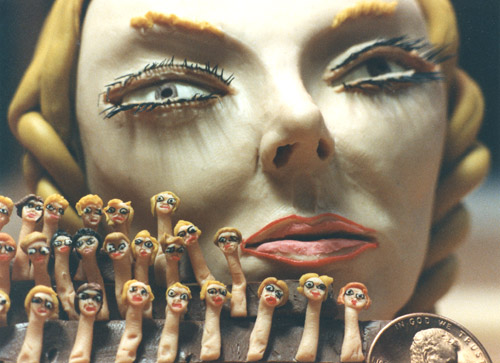
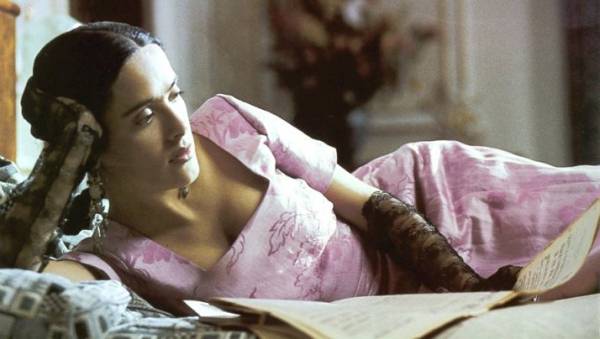
 Salma Hayek is terrific as Mexican artist Frida Kahlo in this uniquely creative biopic from Julie Taymor. Kahlo’s tumultuous twenty-five-year relationship with muralist and communist Diego Rivera (Alfred Molina) is the centerpiece of the film, which comes alive with bright colors, Elliot Goldenthal’s Oscar-winning score, splendidly bizarre animation from the Brothers Quay, and a fun group of supporting actors that includes Antonio Banderas, Ashley Judd, Valeria Golino, Edward Norton, and Geoffrey Rush as Leon Trotsky. Kahlo documented her difficult life on canvas, and Taymor uses those paintings in engaging and dramatic ways.