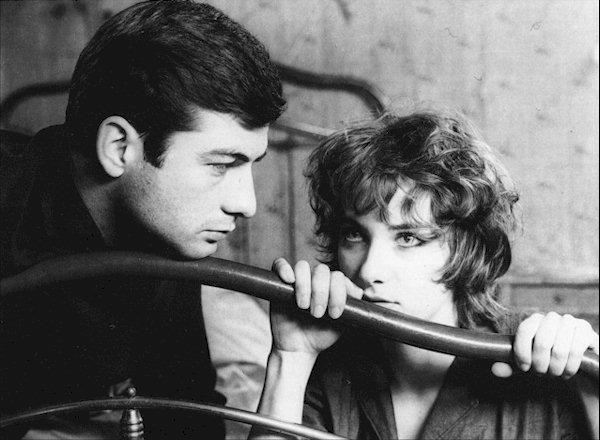
LE BEAU SERGE kicks off Lincoln Center tribute to Claude Chabrol and Arthur Penn
Film Society of Lincoln Center, Walter Reade Theater
165 West 65th St. at Amsterdam Ave.
December 3-9, $12 ($9 weekday matinees, three-film pass $27)
212-875-5601
www.filmlinc.com
On the surface, it might seem like the Film Society of Lincoln Center’s dual tribute to Claude Chabrol and Arthur Penn is merely one of coincidence and timing: French auteur Chabrol died on September 12 at the age of eighty, while American director Penn passed away on September 28 at the age of eighty-eight. Both made their first film in 1958, Penn with THE LEFT-HANDED GUN, starring Paul Newman as Billy the Kid, Chabrol winning the Prix Jean Vigo for LE BEAU SERGE. But while Chabrol went on to direct more than fifty films, through 2009’s INSPECTOR BELLAMY, Penn made a mere fourteen, the last being the 1989 cable TV movie INSIDE. In fact, the careers of both men were inextricably linked through the French New Wave, Chabrol being one of its earliest proponents, Penn among the first non-Europeans to adapt its highly stylized, antiestablishment aesthetic. Lincoln Center will be screening eight works by Chabrol and seven by Penn December 3-9, including the former’s STORY OF WOMEN, LA FEMME INFIDÈLE, and LES BONNES FEMMES and the latter’s LITTLE BIG MAN, NIGHT MOVES, and THE MIRACLE WORKER.
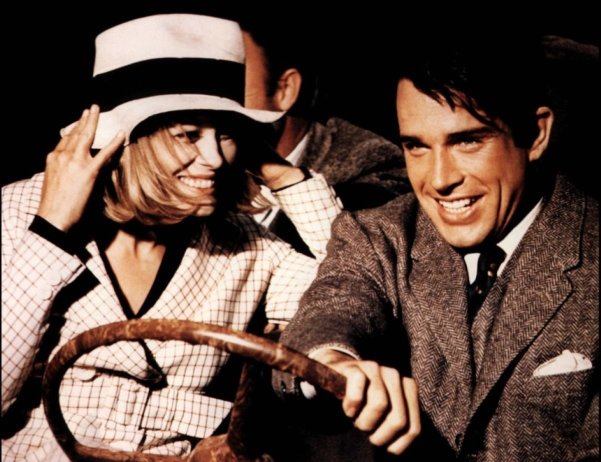
Faye Dunaway and Clyde Barrow go on a violent bank-robbing rampage in American classic BONNIE AND CLYDE
BONNIE AND CLYDE (Arthur Penn, 1967)
Friday, December 3, 6:30, & Thursday, December 7, 3:10
 Arthur Penn changed the course of Hollywood — and world cinema — in 1967 with BONNIE AND CLYDE, a film previously offered to such Nouvelle Vague luminaries as François Truffaut and Jean-Luc Godard. Cowritten by David Newman (SUPERMAN I-III) and Robert Benton (KRAMER VS. KRAMER), the film mythologizes the true story of depression-era bank robbers Clyde Barrow and Bonnie Parker, played magnificently by Warren Beatty and Faye Dunaway. At its heart, BONNIE AND CLYDE is a passionate yet unusual love story, filled with close-ups of the gorgeous Dunaway, who is first seen naked, running to her bedroom window confident and carefree, more a modern 1960s woman than a poor 1930s small-town waitress. Meanwhile, Barrow might know how to shoot a gun, but he’s a dud in bed; “I ain’t much of a lover boy,” he tells Bonnie early on, so their passion plays out in fast-moving car chases and shootouts rather than under the covers (while also playing off of Beatty’s already well-deserved reputation as a ladies’ man). They pick up an accomplice in gas-station attendant C. W. Moss (Michael J. Pollard) and are soon joined by Clyde’s brother, Buck (Gene Hackman), and his wife, Blanche (Estelle Parsons), and continue their rampage as heroic, happy-go-lucky hold-up artists, leading up to one of the most influential and controversial endings ever put on celluloid, an unforgettable finale of violent and poetic beauty. Penn, editor Dede Allen, and cinematographer Burnett Guffey redefined the gangster picture with their creative use of slow motion, long takes, and crowded shots, defying Hollywood conventions in favor of unique and innovative storytelling devices, allowing the film to work on multiple levels. Coscreenwriter Benton will participate in a Q&A following the December 3 screening.

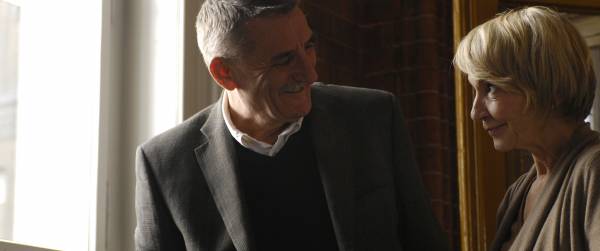
 Inspired by the success of THE LIVES OF OTHERS, Florian Henckel von Donnersmarck’s Oscar-winning 2006 drama about the German secret police, the Czech team of writer Petr Jarchovsky and director Jan Hrebejk (DIVIDED WE FALL, BEAUTY IN TROUBLE) tackle a similar subject from a different point of view in the powerful KAWASAKI’S ROSE. After discovering that her mystery illness is not terminal cancer, Lucie (Lenka Vlasáková) returns home to her husband, Ludek (Milan Mikulcik), and daughter, Bara (Anna Simonová), only to find out that Ludek is once again seeing his former lover, Radka (Petra Hrebícková). Ludek and Radka are working on a documentary about Lucie’s father, Pavel (Martin Huba), who is about to receive the coveted Czech memory prize in honor of his work with disabled children since the Velvet Revolution. But when Lucie understandably refuses to accept Radka’s gesture of friendship, Ludek decides to get even after being given Pavel’s complete dossier, which reveals that the beloved doctor and his wife, Jana (Daniela Kolárová), have been keeping some very damaging secrets that could tear apart their family. Like THE LIVES OF OTHERS, KAWASAKI’S ROSE is a nearly flawless film, with well-drawn characters, a compelling, emotional story, and a gripping narrative structure, always offering something unexpected. The performances are uniformly excellent, the script subtle and intelligent. Curiously, the only misstep, and thankfully it’s just a minor tangent, involves the title figure, Mr. Kawasaki (Isao Onoda), a painter who was taken in by Jana’s onetime lover, anarchist sculptor Borek (Antonin Kratochvil). Kawasaki seems completely unnecessary, existing merely as a metaphor both within the film and outside it, referring to master mathematician and paper folder Toshikazu Kawasaki and his famed origami rose that flows out from the center. Hrebejk will be at Film Forum for the 7:50 show on November 27.
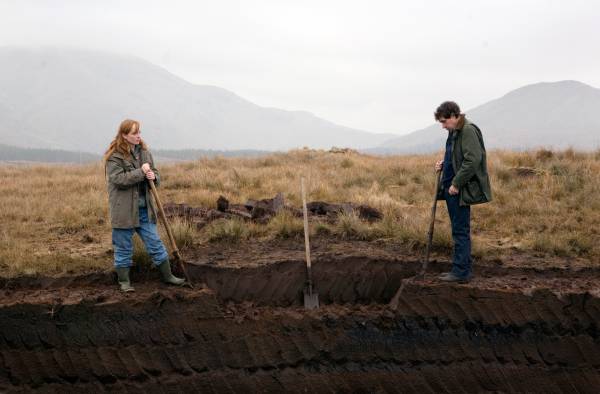
 Polish writer-director Urszula Antoniak’s debut feature film, NOTHING PERSONAL, is a muddled meditation on loneliness and the price of personal freedom. After walking out on her life for unstated reasons, a young Dutch woman (Lotte Verbeek) wanders the Irish countryside of Connemara, coming upon a cottage owned by a grumpy older man (Stephen Rea) who lives there alone, in the middle of nowhere. He offers her food in exchange for her tending to his garden, but at first she refuses, not wanting to have any real contact with other people, but she eventually relents, with one caveat: that he asks no personal questions of her, keeping their “relationship” at a distance. It soon becomes an intellectual boxing match as they spend more time together, deciding on what they each really want. Shot in Holland, Spain, and Ireland, NOTHING PERSONAL, winner of four Golden Calf awards at the 2009 Netherlands Film Festival, is a dreary and uncomfortable movie, with Antoniak’s heavy hand evident in nearly every scene, manipulating just how much information the characters will reveal, which ends up alienating audiences, who just won’t care about the two protagonists. There’s nothing personal about NOTHING PERSONAL, just a shivering coldness and chasm-like emptiness echoed by one of the jobs the man gives the woman; by the time it does start warming up, it’s too little, too late.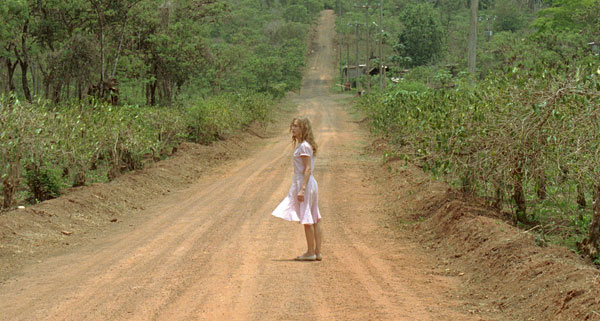
 In an unnamed West African nation besieged by a bloody civll war between rebels and the military government, Maria Vial (Isabelle Huppert) steadfastly refuses to leave her coffee plantation, determined to see the last crop through to fruition. Despite pleas from the French army, which is vacating the country; her ex-husband, André (Christophe Lambert), who is attempting to sell the plantation out from under her; and her workers, whose lives are in danger, Maria is unwilling to give up her home and way of life, apparently blind to what is going on all around her. She seems to be living in her own world, as if all the outside forces exploding around her do not affect her and her family. Without thinking twice, she even allows the Boxer (Isaach De Bankolé) to stay there, the seriously wounded leader of the rebel militia, not considering what kind of dire jeopardy that could result in. But when her slacker son, Manuel (Nicolas Duvauchelle), freaks out, she is forced to take a harder look at reality, but even then she continues to see only what she wants to see. A selection of both the New York and Venice Film Festivals, WHITE MATERIAL is an often obvious yet compelling look at the last remnants of postcolonial European domination as a new Africa is being born in disorder and violence. Directed and cowritten (with French playwright Marie Ndiaye) by Claire Denis (CHOCOLAT, BEAU TRAVAIL), who was born in Paris and raised in Africa, the film has a central flaw in its premise that viewers will either buy or reject: whether they accept Maria’s blindness to the evolving situation that has everyone else on the run. Watching Maria’s actions can be infuriating, and in the hands of another actress they might not have worked, but Huppert is mesmerizing in the decidedly unglamorous role.