Carolee Schneeman will introduce MEAT JOY and other short works at Anthology Film Archives on December 16 in celebration of the publication of her letters
Anthology Film Archives
32 Second Ave. at Second St.
Thursday, December 16, 7:30
212-505-5181
www.anthologyfilmarchives.org
www.dukeupress.edu
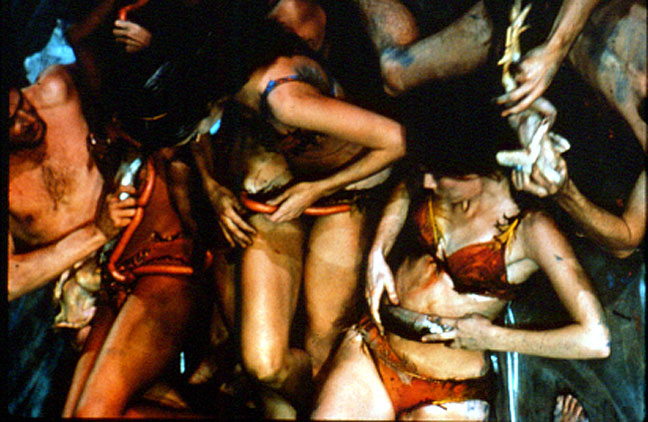
American performance artist Carolee Schneeman has been shaking up the art world since the late 1950s, staging happenings and making short films in which she bares it all in shocking, controversial ways, holding nothing back. Among her many works are FUSES, MEAT JOY, MORTAL COILS, and VULVA’S MORPHIA, which investigate such themes as erotics, kinetics, dreams, war, and cats. Born in Pennsylvania in 1939, Schneeman has opened up a fascinating aspect of her life in the new book CORRESPONDENCE COURSE: AN EPISTOLARY HISTORY OF CAROLEE SCHNEEMAN AND HER CIRCLE (Duke University Press, November 2010, $99.95 hardcover, $29.95 paperback), allowing Duke University professor Kristine Stiles to publish letters that Schneeman has kept throughout her career. “The letters were edited and selected for how they document charged personal and artistic struggles, arguments, and displays of ego; how they illuminate internecine aesthetic politics, conflicting ethics, and values; and how countless mundane activities constitute the exasperating vicissitudes of making art, building an artistic reputation, and negotiating an industry as unpredictable and demanding as the art world in the mid-to-late twentieth century,” Stiles writes in the preface. “For her part, Schneeman discusses financial dilemmas; grapples with her career; shares her success, joy, and love; and contends with loneliness, aging, and disappointment.” Schneeman will celebrate the publication of the book on Thursday, December 16, at Anthology Film Archives, where she will introduce and screen FUSES, MEAT JOY, KITCH’S LAST MEAL, ASK THE GODDESS, and MYSTERIES OF THE PUSSIES and discuss her work and career in what should be quite an unusual evening.

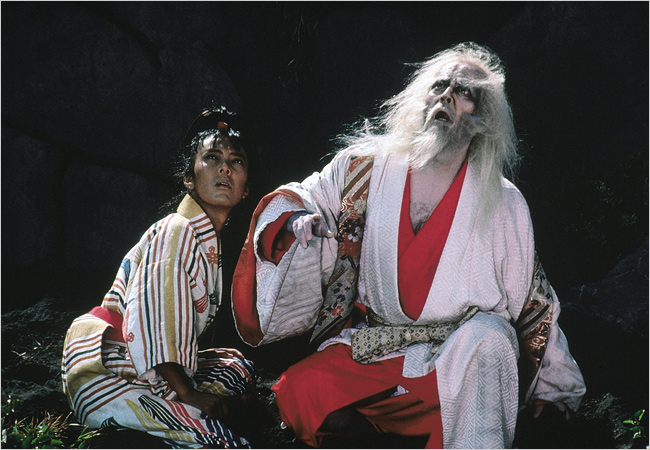
 Inspired by the story of feudal lord Mori Motonari and Shakespeare’s KING LEAR, Akira Kurosawa’s RAN is an epic masterpiece about the decline and fall of the Ichimonji clan. Aging Lord Hidetora (Tatsuya Nakadai) is ready to hand over his land and leadership to his three sons, Taro (Akira Terao), Jiro (Jinpachi Nezu), and Saburo (Daisuke Ryû). But jealousy, misunderstandings, and outright deceit and treachery result in Saburo’s banishment and a violent power struggle between the weak eldest, Taro, and the warrior Jiro. Hidetaro soon finds himself rejected by his children and wandering the vast, empty landscape with his wise, sarcastic fool, Kyoami (Peter), as the once-proud king descends into madness. Dressed in white robes and with wild white hair, Nakadai (THE HUMAN CONDITION), in his early fifties at the time, portrays Hidetaro, one of the great characters of cinema history, with an unforgettable, Noh-like precision. Kurosawa, cinematographers Asakazu Nakai, Takao Saitô, and Masaharu Ueda, and Oscar-winning costume designer Emi Wada bathe the film in lush greens, brash blues, and bold reds and yellows that marvelously offset the white Hidetaro. Kurosawa shoots the first dazzling battle scene in an elongated period of near silence, with only Tôru Takemitsu’s classically based score playing on the soundtrack, turning the film into a thrilling, blood-drenched opera. RAN is a spectacular achievement, the last great major work by one of the twentieth century’s most important and influential filmmakers. Film Forum is screening RAN as part of its two-week tribute to Takemitsu, which concludes this week with DODES’KA-DEN (Akira Kurosawa, 1970), EMPIRE OF PASSION (Nagisa Oshima, 1978), BALLAD OF ORIN (MELODY IN GREY) (Masahiro Shinoda, 1977), BAD BOYS (Susumu Hani, 1961), and SHE AND HE (Susumu Hani, 1963).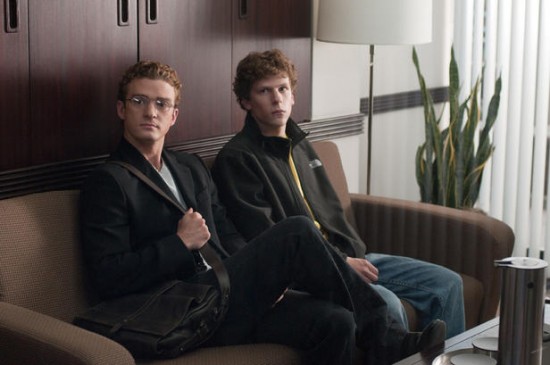
 One of the most widely praised films of 2010, THE SOCIAL NETWORK is being screened at the Museum of Modern Art on Tuesday night as part of the series “The Contenders 2010,” a collection of influential and innovative international movies the institution believes will stand the test of time. MoMA has already shown such works as Luca Guadagnino’s I AM LOVE, Christopher Nolan’s INCEPTION, Roman Polanski’s THE GHOST WRITER, and Mads Brügger’s THE RED CHAPEL, and upcoming films include Yael Hersonski’s A FILM UNFINISHED, Mark Romanek’s NEVER LET ME GO, and Banksy’s EXIT THROUGH THE GIFT SHOP. In THE SOCIAL NETWORK, Jesse Eisenberg stars as computer whiz kid Mark Zuckerberg as he develops what became Facebook while attending Harvard. The film is told primarily in flashback as Zuckerberg is being sued for having allegedly stolen the idea from the Winklevoss twins (both played by Arnie Hammer). Zuckerberg is depicted as a spiteful, mean-spirited, self-indulgent person trying to prove to his ex-girlfriend (Erica Albright) that he will amount to something. Justin Timberlake is outstanding as the fast-moving, smooth-talking Sean Parker, the founder of Napster who loves living the high life. For a young man who created a social media platform where people collect friends, Zuckerberg made a lot of enemies on his way to the top. The film was written by Aaron Sorkin (A FEW GOOD MEN, THE WEST WING), who makes an appearance as an ad executive meeting with Zuckerberg, and directed by David Fincher, who has made such other terrific films as FIGHT CLUB, ZODIAC, and THE CURIOUS CASE OF BENJAMIN BUTTON. Eisenberg (THE SQUID AND THE WHALE, ADVENTURELAND) will participate in a Q&A following the MoMA screening.