Executive producer James Cameron’s SANCTUM is all wet
SANCTUM (Alister Grierson, 2011)
Opens Friday, February 4
www.sanctummovie.com
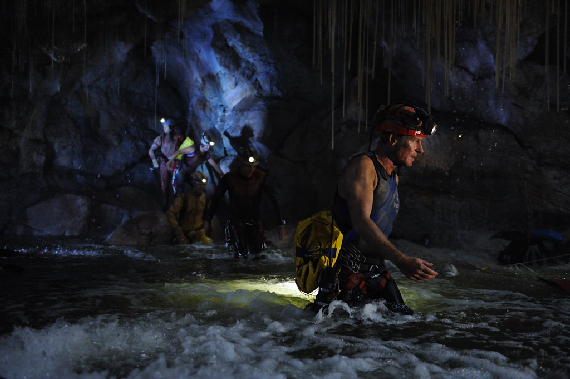
 Executive producer James Cameron’s mosh-up of TITANIC, AVATAR, ALIENS, and THE ABYSS is, well, abysmal. Inspired by a real-life 1988 expedition documented by SANCTUM writer and producer Andrew Wight in NULLARBOR DREAMING, this underwater spelunking adventure is classic Cameron: a combination of stunning imagery with absurd dialogue and overmanipulated melodrama. Richard Roxburgh stars as Frank McGuire, a tough-as-nails cave diver who has sacrificed his personal life for the opportunity to boldly go where no one has gone before. His latest challenge is a monster cave in Papua, New Guinea, in a dive sponsored by millionaire adventurer Carl Hurley, ridiculously played by Ioan Gruffudd, who awfully delivers the awful dialogue he is given. Carl has brought along his girlfriend, Victoria (Alice Parkinson), while Frank is joined by the seventeen-year-old son he doesn’t know very well, Josh (Rhys Wakefield). After a massive tornado hits them harder and faster than expected, the team is trapped in the seemingly limitless cave system, desperately trying to find a way out before they all drown. The 3-D effects are extremely cool in the beginning, if over the top, but they soon fade into the background as clichéd scene after clichéd scene chokes the story. It quickly devolves into a POSEIDON ADVENTURE wannabe, but with stale characters and little emotional involvement as well as more than its share of unintentional laughs. Still, there are some breathtakingly gorgeous shots, but SANCTUM is, ultimately, all wet.
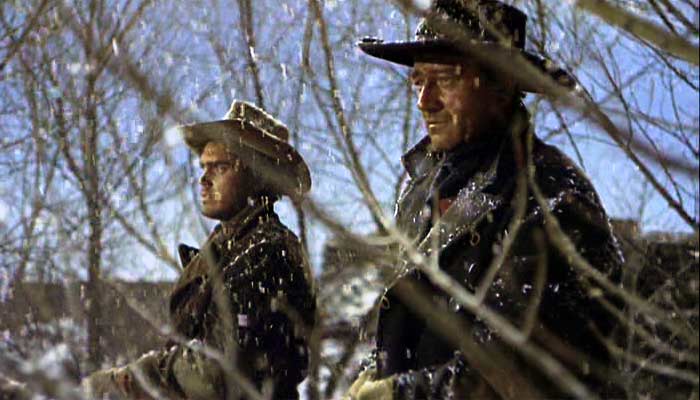
 That’ll be the day when someone tries to claim there’s a better Western than John Ford’s ethnocentric look at the dying of the Old West and the birth of the modern era. Essentially about a gunfighter’s attempt to find and kill his young niece, who has been kidnapped and, ostensibly, ruined by Indians, THE SEARCHERS is laden with iconic imagery, inside messages, and not-so-subtle metaphors. Hence, it is no accident that John Wayne’s son, Patrick, plays an ambitious yet inept officer named Greenhill. The elder Wayne stars as Ethan Edwards, a tough-as-nails Confederate veteran seeking revenge for the murder of his brother’s family; he’s also out to save Debbie from the Comanches, led by a chief known as Scar (Henry Brandon), by ending her life, because in his world view, it’s better to be dead than red. Joining him on his trek is Debbie’s adopted brother, Martin Pawley (Jeffrey Hunter), who wants to save her from Edwards. The magnificent film balances its serious center with a large dose of humor, particularly in the relationships between Ethan and Martin and Ethan with his Indian companion, Look (Beulah Archuletta). And keep your eye on that blanket in front of the house. THE SEARCHERS is screening on February 4 as part of the Rubin Museum’s Films About Nothing series, being held in conjunction with the exhibition “Grains of Emptiness: Buddhism-Inspired Contemporary Art,” and will be introduced by Italian writer, director, professor, and journalist Antonio Monda.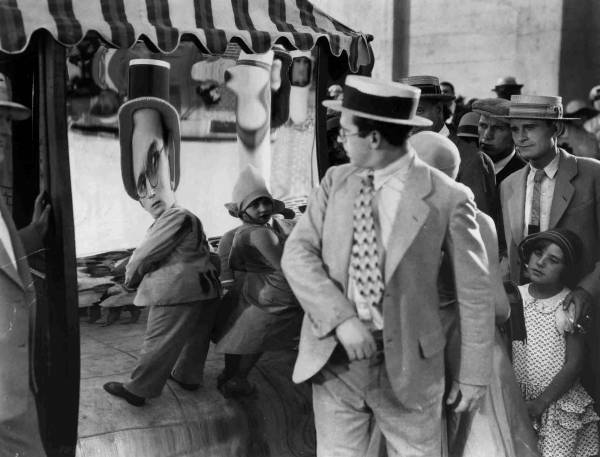
 Much like the end of the silent film era itself, the last horse-drawn trolley is doomed in Harold Lloyd’s final silent film. Big business is playing dirty trying to get rid of the trolley and classic old-timer Pop Dillon. Meanwhile, Harold “Speedy” Swift, a dreamer who wanders from menial job to menial job (he makes a great soda-jerk with a unique way of announcing the Yankees score), cares only about the joy and wonder life brings. But he’s in love with Pop’s granddaughter, Jane, so he vows to save the day. Along the way, he gets to meet Babe Ruth. Ted Wilde was nominated for an Oscar for Best Director, Comedy, for this thrilling nonstop ride through beautiful Coney Island and the pre-depression streets of New York City. SPEEDY is being screened for free February 2 at 7:00 as part of the New Sounds Live Silent Film Series at the World Financial Center, with a live score played by the Alloy Orchestra. For more on the series, read our twi-ny talk with festival curator John Schaefer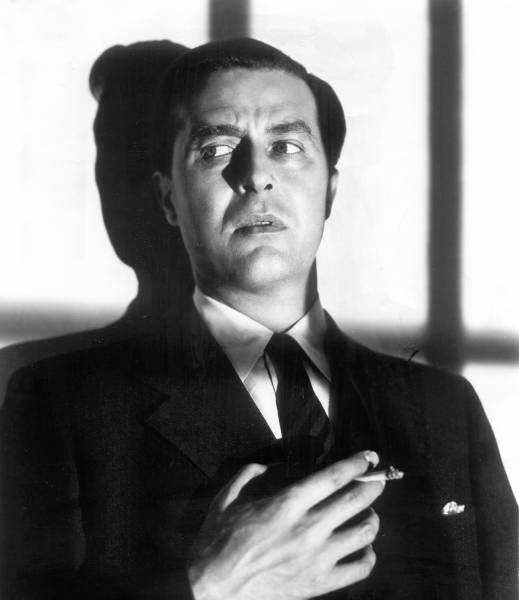
 Based on the 1943 novel by Graham Greene, Fritz Lang’s MINISTRY OF FEAR is a classic Hitchcockian noir about an innocent man caught up in a dangerous web of mystery and intrigue. Ray Milland stars as Stephen Neale, a man who, as the film opens, is being released from an asylum after serving time related to the death of his wife. His freedom doesn’t last long, as he stops at a local fair and visits the fortune-teller, who accidentally helps him win a guess-the-weight cake that some very bad people want to get their hands in. Out on the run, his only friends are Willi (Carl Esmond) and Carla (Marjorie Reynolds), foreign siblings who run the charity organization the Mothers of Free Nations, the sponsor of the fair. Throw in a séance, the Blitz, an old blind man, an alcoholic private investigator, a book called THE PSYCHOLOGY OF NAZISM, a disbelieving Scotland Yard detective, and wonderfully shadowy camerawork and the result is a tense, exciting spy tale filled with plenty of twists and surprises. MINISTRY OF FEAR is screening with Lang’s 1941 thriller MAN HUNT, starring Joan Bennett and Walter Pidgeon, as part of Film Forum’s Fritz Lang in Hollywood series, which continues through February 10 with such other great twin bills as CLASH BY NIGHT (1952) and RANCHO NOTORIOUS (1952) on February 6-7 and YOU ONLY LIVE ONCE (1937) and YOU AND ME (1938) on February 9-10.